Our bi-weekly Opinion provides you with latest updates and analysis on major capital market and financial investment industry issues.
Summary
Recently, the change in demand structure has become a topic of discussion in the global asset management market and is expected to have a significant impact on South Korea's asset management market in 2024. The asset management market and industry will be affected in various ways by the acceleration of recent trends such as the popularization of asset management services backed by AI development, the expansion of online fund sales channels, and the evolution of ETFs. Also significant is the growth and structural changes in the market for retirement plans. As defined contribution (DC) and individual retirement pension (IRP) plans are increasing their proportion and replacing defined benefit (DB) plans whose growth is stagnated, the central part of retirement plan assets is likely to shift gradually away from safe assets. For example, asset allocation funds centered on target-date funds (TDF) are likely to come to the fore as a means of long-term investment. Although the default option scheme was expected to be a catalyst for shifting pension funds' asset allocation towards seeking appropriate returns, it has failed to meet the expectation. In 2024, the asset management market and the industry will likely face several risks: polarization among asset managers, distress in overseas real estate funds, the health of the private fund management industry, and others. Despite the various positive and negative factors, the asset management market is expected to experience favorable growth in 2024. Promising areas include TDFs and other asset allocation products, active ETFs, and fixed income funds. On the other hand, negative factors are expected to arise around real estate, infrastructure, and other special asset funds.
In 2023, the asset management market seems to have recovered its growth path. As of the end of 2023, the assets under management (AUM) held by asset management companies (AMCs) exceeded KRW 1,600 trillion, which includes the net asset value (NAV) of publicly offered and privately placed funds and discretionary mandates. The market for private funds had achieved years of high growth before slowing down somewhat last year, while publicly offered funds and discretionary mandates expanded vigorously. ETFs continued to increase their share in public funds in 2023. Although the public equity fund market, which had been struggling, saw a significant NAV increase, most of the increase was from not cash flows, but the increased market value. As of the end of 2023, the combined size of private funds NAV and discretionary mandates totaled KRW 1,255 trillion, driven by high-net-worth individuals and institutional clients. There were no significant changes in the composition of assets in private funds and discretionary mandates. Real estate and special assets accounted for 50.1% of private funds, while fixed income took up 70.3% of discretionary mandates. AMCs’ fee income remained stagnant despite the recovery in market volumes. It may be the case that AMCs’ revenue structure is adversely affected by trend changes such as declining management fees and rising shares of low-revenue assets. In this article, we explore three themes that are worth considering in 2024: the change in demand structure, the structural change in the market for retirement plans, and risk factors. Also, their impacts on the asset management market and industry are discussed.
Changes in demand structure in the asset management market
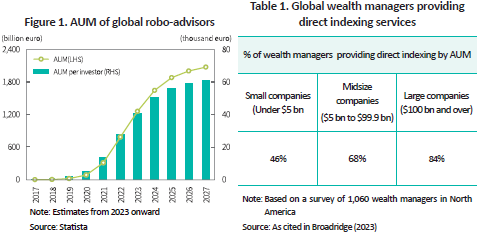
In 2024, the demand-side changes that have come to the fore for several years will accelerate further in the asset management market. The first is the rise of AI-based bespoke wealth management and the resultant intensification of competition among financial sectors. Compared to asset management, wealth management is a broader range of financial services and specifically refers to manufacturing, selling, and managing funds. It refers to personalized financial services that enable customers to integrate and manage assets in line with their life cycle through asset allocation, brokerage, advisory, risk management, rebalancing, and others. Wealth management services were too costly to be provided to small-sum retail investors but are now widely available thanks to AI-based technologies. As global financial services companies have expanded their investment in this area in seeking to provide robo-advisor and direct indexing services, the market size has ballooned. Overseas, not only banks and securities firms, but also AMCs are ardently seeking to offer these services. This means that the wealth and asset management markets, which have been viewed as separate, are likely to be transformed into a homogeneous market. In this case, competition between financial sectors over the two markets will intensify further. In the future, Korea will likely see similar movements in its asset and wealth management markets, and these movements could begin to take shape in 2024.
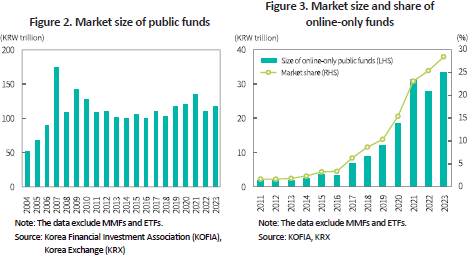
Online fund sales have been on the rise in full swing since the pandemic. The share of online-only funds in publicly offered funds, excluding MMFs and ETFs, increased from 10% at the end of 2019 to 28% at the end of 2023. This is because users increasingly recognize online channel's competitive advantages such as convenient trading and low costs compared to offline channels. Also, online platforms have become more user-friendly. In 2024, the preference for online-only funds is expected to continue, especially among younger generations who are familiar with digital devices. On top of the inherent advantages of convenient transactions and low costs, we expect to see an influx of funds into online savings such as retirement plans, annuity savings, individual savings accounts (ISA), etc.
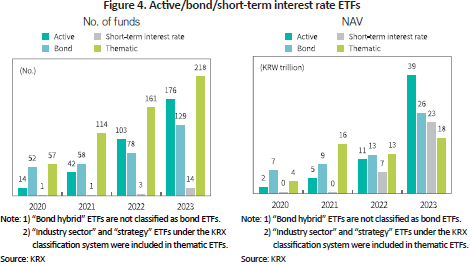
Another important issue on the demand side could be the evolution of ETFs, for example, wider usage of products. Behind the explosive growth of ETFs in recent years, there has been a broadening of its product range from representative indexes to active, fixed income, short-term interest rate, and thematic types. In 2024, the market is expected to see a more diversified types of ETFs to serve various purposes including hybrid accounts, trend following, excess return, and others. The demand for active ETFs is highly likely to surge, especially as the government is expected to abolish the requirement under which ETFs maintain a certain correlation coefficient. The continued expansion of the ETF market on the other hand could possibly gave rise to some side effects such as excessive short-term trading, declining AMC profitability, and differentiation among AMCs.
Structural changes in the retirement plans market
Since its introduction in 2006, the market for retirement plans has grown significantly. The growth of this market increases the demand for participating products, thereby affecting the asset management market. In particular, the structural changes recently observed are expected to be a key factor affecting the asset management market in 2024. Among others, DC and IRP plans are forecast to grow faster than DB plans for the foreseeable future. The growth momentum of DB plans seems to have weakened as most large employers have already adopted the scheme and an increasing number of companies among them have achieved the full-funded status. However, DB plans are a likely choice of a quite a few small- and medium-sized companies that have not adopted the retirement pension scheme yet. IRPs are also gaining importance as savings accounts for accumulating retirement assets as the participation rate rose thanks to the broadened eligibility criteria. As the market's center of gravity gradually shifts from DB to DC and IRP plans, the proportion of participating plans in the market is estimated to increase gradually.
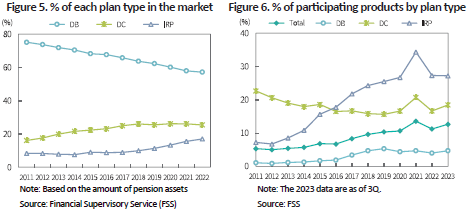
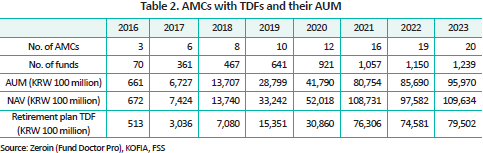
As the retirement plan market grows, so does the importance of asset allocation. Unlike regular savings accounts, retirement plans and tax-advantaged savings accounts are invested over a longer time horizon, and TDFs are believed to have the most suitable structure for this nature. Since their launch in 2016, Korean TDFs have grown rapidly, with their NAV exceeding KRW 10 trillion. Most of the TDF net assets are held in retirement plan accounts. Thanks to the default option scheme adopted in 2023, TDFs will presumably grow exponentially going forward. Although TDF growth underscores the importance of age-appropriate asset allocation, it may also widen the gap between AMCs. The market for TDFs is expected to grow in full throttle, but only 20 AMCs have launched and managed TDFs as of the end of 2023. Due to the high initial investment required to design and manage a TDF, it is difficult for small- and medium-sized AMCs to enter the market. Furthermore, AMCs without sophisticated design capabilities and low management fees can hardly pass the screening process to make their product eligible for default options. Therefore, the current competition structure among medium and large AMCs will remain intact in the TDF market for the foreseeable future.
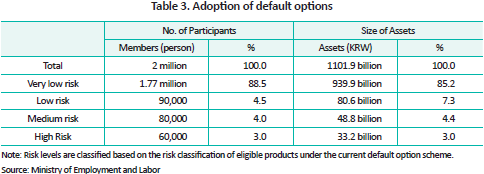
Korea has introduced its default option scheme for retirement plans since 2023 amid expectations that the scheme could be a catalyst for shifting the plan asset structure away from safe assets towards a return-seeking ones. However, that has had little impact on the asset allocation structure of plan accounts thus far, contrary to expectations. The default option scheme allows DC and IRP members to designate investment products (eligible products) in advance that will be automatically managed if they fail to provide specific investment instructions within a certain period of time. Unlike the default option in the US 401k, Korea's default option scheme places no rule regarding the inclusion of conservative funds. Also, principal guarantee products are regarded eligible. Therefore, the prevailing opinion is that the actual decision-making environment for asset allocation has not changed from the past. This is clearly reflected in the scheme's participation rate in 2023. Ultra-low and low-risk eligible products together account for 93% of the portfolios held by plan members, a trend which is almost identical to the past pattern tilting heavily towards principal protection. This suggests that, even in a favorable environment with the growing share of DC and IRP plans, the share of participating products will hardly likely increase in the short term under the current default option scheme.
Risk factors
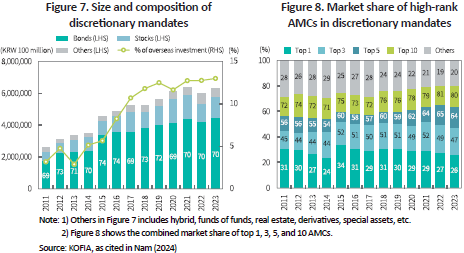
One of the risk factors predicted in the asset management market this year is the growing proportion of discretionary mandates. The growth of this market is obviously an opportunity for AMCs as they can secure more AUMs. However, this also has negative implications in two ways. Bonds and low-revenue assets take up a large portion in the asset mix of the market, and this will likely have a negative impact on AMCs' operating profitability. Fixed income accounts for around 70% of the discretionary investment market with little change in trend. In addition to the low-fee, bond-centered asset mix, institutional investors (pension funds and insurance companies), who are clients of the discretionary market, have much stronger bargaining power in prices (management fees) than retail investors. This means that the management fee on the same size of assets could be set lower than in the retail market. Another issue is that the growth of the discretionary investment market could possibly deepen the polarization between AMCs. Pension funds and insurance companies are the main investor base in this market. As a result, a small number of giant AMCs with strong brands or affiliation with insurers are dominating the market. Those AMCs have already achieved economies of scale to some extent enough to overcome the low-fee issue mentioned above. Consequently, there will likely be a large gap in the size of AUMs between large AMCs and small- to medium-sized, less-competitive players in the market.
In 2024, we believe the market will see the emergence of distress in overseas real estate funds largely held by Korean investors. Although a key rate cut will start in many economies, the market rate is hardly likely to fall to the previous levels in a short run. It will take more time for lower interest rates to revitalize the global real estate market. On top of that, the global real estate market currently faces many negative factors such as possible economic downturns in many countries, changes in work patterns, and others. As of the end of 2023, the NAV of public/private overseas real estate funds that are registered in Korea amounts to KRW 80 trillion. The exact size of distress will be confirmed later, especially from those established during the real estate market upturn. At the end of 2023, the commercial real estate price indices in the US and Europe fell 21.6% and 25.1% from their peaks, respectively. Real estate funds purchase assets with equity investments and senior loans. Because loans' legal claim comes before other assets, equity investors in those funds will suffer losses that are greater than the price decline in the fund's underlying assets. The decline in the fund NAV as a result of the declining value in the fund's underlying assets will be identified shortly after the periodic valuation of those assets. Some funds will likely be liquidated after their losses are finalized. Such a process will begin in full swing in 2024, given the time lag between the process and the asset price decline.

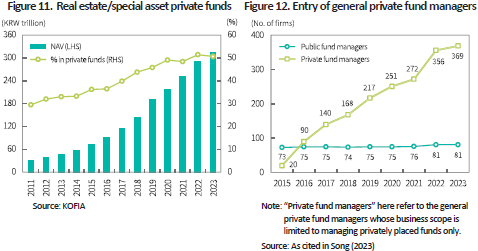
The problem of distress in real estate funds, mainly overseas ones, is also linked to the soundness of the industry specialized in managing private funds (“general private fund managers”). The number of general private fund managers has increased sharply since the entry system was changed to a registration system in the mid-2010s. As of March 2023, the number reached 369 firms. As of the end of September 2023, the number of AMCs posting deficits stood at 205 out of 474,1) a vast majority of which are believed to be general private fund managers. In 2024, the soundness of those players could possibly come to the forefront. The number of new entrants to this business shot up in a short period of time, sparking fierce competition. Furthermore, their AUM structure focused on real estate and special asset funds may meet the current conditions in the asset market and impose a further impact on prudence. By the end of 2023, the combined NAV of real estate special asset funds accounts for more than 50% of the total NAV of private funds. What's notable is the continued rise in the number since the entry of general private fund managers to the market began in full swing in 2015. If real estate funds have losses finalized and their liquidation is fully underway, the NAV of the overall market will likely plummet. Although the fallout may vary across asset types, the situation in special assets could be similar, too. If this is the case, it could be inevitable for general private fund managers to see their AUM declining, and business performance deteriorating.
Overall outlook for asset management industry in 2024
We have chosen three themes to discuss the key factors that will impact the asset management market and industry in 2024. Despite numerous factors that could be positive to the market, there seem to be clear limitations. Simply put, the asset management market is expected to achieve sound growth in 2024, with deeper differentiation across AMCs. Promising areas include TDFs and other asset allocation products, active ETFs, and fixed income funds. On the other hand, numerous negative factors are foreseeable in the real estate and special asset sectors.
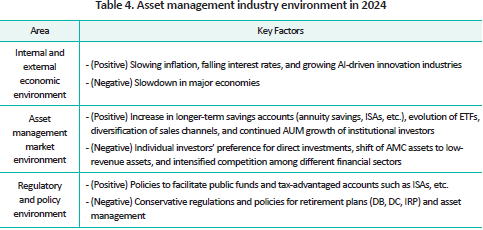
In conclusion, we briefly sum up the positive and negative factors that are likely to affect the asset management industry. Looking at the internal and external economic environment, we expect slow inflation, downward interest rates, and the growth in AI-based innovative industries, while there is a possibility of a slowdown in major economies. In the asset management market, there are many positive factors that could drive demand, including the expansion of longer-term savings accounts such as annuity savings and ISAs, the evolution of ETFs, and diversified sales channels. If these are well aligned with the wealth management services of financial firms including AMCs, the potential for growth could be significant. On the other hand, AMCs may face challenges such as retail investors' preference for direct investments, lower operating profitability, and intensified competition among different financial sectors in the wealth management market. Also, the regulatory and policy environment is also expected to have both positive and negative aspects. First of all, the policy drive to revitalize public funds, which started in 2023, is expected to continue in 2024. In addition to the bold policies that have already been proposed, such as the listing of public funds and the competition for sales loads among fund distributors, there is still much room for improvement in several areas: an overhaul in online fund sales platforms by promoting competition via open sales channels, improvement in sales loads, relaxation in fund-related asset management regulation. The government seems firmly committed to facilitating tax-advantaged accounts by increasing ISA tax benefits. This is expected to have a significantly positive impact on the asset management market. On another front, conservative asset management regulations related to DB, DC, and IRP plans could possibly limit the growth of the market in 2024.
1) Based on cumulative data between Q1 and Q3 2023 (KOFIA)
References
Nam, J.W., 2024, Development in discretionary investment and AMCs' response, KCMI Issue Paper (forthcoming).
Song, H.S., 2023, Private fund management after deregulation: Diagnosis and challenge, KCMI Issue Paper 23-27.
Broadridge, 2023, Preparing for the Next Evolution in Passive Investing: Direct Indexing.
Financial Supervisory Service www.fss.or.kr
Korea Financial Investment Association www.kofia.or.kr
Ministry of Employment and Labor www.moel.go.kr
Korea Exchange www.krx.co.kr
Green Street www.greenstreet.com
Statista www.statista.com
Changes in demand structure in the asset management market
In 2024, the demand-side changes that have come to the fore for several years will accelerate further in the asset management market. The first is the rise of AI-based bespoke wealth management and the resultant intensification of competition among financial sectors. Compared to asset management, wealth management is a broader range of financial services and specifically refers to manufacturing, selling, and managing funds. It refers to personalized financial services that enable customers to integrate and manage assets in line with their life cycle through asset allocation, brokerage, advisory, risk management, rebalancing, and others. Wealth management services were too costly to be provided to small-sum retail investors but are now widely available thanks to AI-based technologies. As global financial services companies have expanded their investment in this area in seeking to provide robo-advisor and direct indexing services, the market size has ballooned. Overseas, not only banks and securities firms, but also AMCs are ardently seeking to offer these services. This means that the wealth and asset management markets, which have been viewed as separate, are likely to be transformed into a homogeneous market. In this case, competition between financial sectors over the two markets will intensify further. In the future, Korea will likely see similar movements in its asset and wealth management markets, and these movements could begin to take shape in 2024.
Online fund sales have been on the rise in full swing since the pandemic. The share of online-only funds in publicly offered funds, excluding MMFs and ETFs, increased from 10% at the end of 2019 to 28% at the end of 2023. This is because users increasingly recognize online channel's competitive advantages such as convenient trading and low costs compared to offline channels. Also, online platforms have become more user-friendly. In 2024, the preference for online-only funds is expected to continue, especially among younger generations who are familiar with digital devices. On top of the inherent advantages of convenient transactions and low costs, we expect to see an influx of funds into online savings such as retirement plans, annuity savings, individual savings accounts (ISA), etc.
Another important issue on the demand side could be the evolution of ETFs, for example, wider usage of products. Behind the explosive growth of ETFs in recent years, there has been a broadening of its product range from representative indexes to active, fixed income, short-term interest rate, and thematic types. In 2024, the market is expected to see a more diversified types of ETFs to serve various purposes including hybrid accounts, trend following, excess return, and others. The demand for active ETFs is highly likely to surge, especially as the government is expected to abolish the requirement under which ETFs maintain a certain correlation coefficient. The continued expansion of the ETF market on the other hand could possibly gave rise to some side effects such as excessive short-term trading, declining AMC profitability, and differentiation among AMCs.
Structural changes in the retirement plans market
Since its introduction in 2006, the market for retirement plans has grown significantly. The growth of this market increases the demand for participating products, thereby affecting the asset management market. In particular, the structural changes recently observed are expected to be a key factor affecting the asset management market in 2024. Among others, DC and IRP plans are forecast to grow faster than DB plans for the foreseeable future. The growth momentum of DB plans seems to have weakened as most large employers have already adopted the scheme and an increasing number of companies among them have achieved the full-funded status. However, DB plans are a likely choice of a quite a few small- and medium-sized companies that have not adopted the retirement pension scheme yet. IRPs are also gaining importance as savings accounts for accumulating retirement assets as the participation rate rose thanks to the broadened eligibility criteria. As the market's center of gravity gradually shifts from DB to DC and IRP plans, the proportion of participating plans in the market is estimated to increase gradually.
As the retirement plan market grows, so does the importance of asset allocation. Unlike regular savings accounts, retirement plans and tax-advantaged savings accounts are invested over a longer time horizon, and TDFs are believed to have the most suitable structure for this nature. Since their launch in 2016, Korean TDFs have grown rapidly, with their NAV exceeding KRW 10 trillion. Most of the TDF net assets are held in retirement plan accounts. Thanks to the default option scheme adopted in 2023, TDFs will presumably grow exponentially going forward. Although TDF growth underscores the importance of age-appropriate asset allocation, it may also widen the gap between AMCs. The market for TDFs is expected to grow in full throttle, but only 20 AMCs have launched and managed TDFs as of the end of 2023. Due to the high initial investment required to design and manage a TDF, it is difficult for small- and medium-sized AMCs to enter the market. Furthermore, AMCs without sophisticated design capabilities and low management fees can hardly pass the screening process to make their product eligible for default options. Therefore, the current competition structure among medium and large AMCs will remain intact in the TDF market for the foreseeable future.
Korea has introduced its default option scheme for retirement plans since 2023 amid expectations that the scheme could be a catalyst for shifting the plan asset structure away from safe assets towards a return-seeking ones. However, that has had little impact on the asset allocation structure of plan accounts thus far, contrary to expectations. The default option scheme allows DC and IRP members to designate investment products (eligible products) in advance that will be automatically managed if they fail to provide specific investment instructions within a certain period of time. Unlike the default option in the US 401k, Korea's default option scheme places no rule regarding the inclusion of conservative funds. Also, principal guarantee products are regarded eligible. Therefore, the prevailing opinion is that the actual decision-making environment for asset allocation has not changed from the past. This is clearly reflected in the scheme's participation rate in 2023. Ultra-low and low-risk eligible products together account for 93% of the portfolios held by plan members, a trend which is almost identical to the past pattern tilting heavily towards principal protection. This suggests that, even in a favorable environment with the growing share of DC and IRP plans, the share of participating products will hardly likely increase in the short term under the current default option scheme.
Risk factors
One of the risk factors predicted in the asset management market this year is the growing proportion of discretionary mandates. The growth of this market is obviously an opportunity for AMCs as they can secure more AUMs. However, this also has negative implications in two ways. Bonds and low-revenue assets take up a large portion in the asset mix of the market, and this will likely have a negative impact on AMCs' operating profitability. Fixed income accounts for around 70% of the discretionary investment market with little change in trend. In addition to the low-fee, bond-centered asset mix, institutional investors (pension funds and insurance companies), who are clients of the discretionary market, have much stronger bargaining power in prices (management fees) than retail investors. This means that the management fee on the same size of assets could be set lower than in the retail market. Another issue is that the growth of the discretionary investment market could possibly deepen the polarization between AMCs. Pension funds and insurance companies are the main investor base in this market. As a result, a small number of giant AMCs with strong brands or affiliation with insurers are dominating the market. Those AMCs have already achieved economies of scale to some extent enough to overcome the low-fee issue mentioned above. Consequently, there will likely be a large gap in the size of AUMs between large AMCs and small- to medium-sized, less-competitive players in the market.
In 2024, we believe the market will see the emergence of distress in overseas real estate funds largely held by Korean investors. Although a key rate cut will start in many economies, the market rate is hardly likely to fall to the previous levels in a short run. It will take more time for lower interest rates to revitalize the global real estate market. On top of that, the global real estate market currently faces many negative factors such as possible economic downturns in many countries, changes in work patterns, and others. As of the end of 2023, the NAV of public/private overseas real estate funds that are registered in Korea amounts to KRW 80 trillion. The exact size of distress will be confirmed later, especially from those established during the real estate market upturn. At the end of 2023, the commercial real estate price indices in the US and Europe fell 21.6% and 25.1% from their peaks, respectively. Real estate funds purchase assets with equity investments and senior loans. Because loans' legal claim comes before other assets, equity investors in those funds will suffer losses that are greater than the price decline in the fund's underlying assets. The decline in the fund NAV as a result of the declining value in the fund's underlying assets will be identified shortly after the periodic valuation of those assets. Some funds will likely be liquidated after their losses are finalized. Such a process will begin in full swing in 2024, given the time lag between the process and the asset price decline.
The problem of distress in real estate funds, mainly overseas ones, is also linked to the soundness of the industry specialized in managing private funds (“general private fund managers”). The number of general private fund managers has increased sharply since the entry system was changed to a registration system in the mid-2010s. As of March 2023, the number reached 369 firms. As of the end of September 2023, the number of AMCs posting deficits stood at 205 out of 474,1) a vast majority of which are believed to be general private fund managers. In 2024, the soundness of those players could possibly come to the forefront. The number of new entrants to this business shot up in a short period of time, sparking fierce competition. Furthermore, their AUM structure focused on real estate and special asset funds may meet the current conditions in the asset market and impose a further impact on prudence. By the end of 2023, the combined NAV of real estate special asset funds accounts for more than 50% of the total NAV of private funds. What's notable is the continued rise in the number since the entry of general private fund managers to the market began in full swing in 2015. If real estate funds have losses finalized and their liquidation is fully underway, the NAV of the overall market will likely plummet. Although the fallout may vary across asset types, the situation in special assets could be similar, too. If this is the case, it could be inevitable for general private fund managers to see their AUM declining, and business performance deteriorating.
Overall outlook for asset management industry in 2024
We have chosen three themes to discuss the key factors that will impact the asset management market and industry in 2024. Despite numerous factors that could be positive to the market, there seem to be clear limitations. Simply put, the asset management market is expected to achieve sound growth in 2024, with deeper differentiation across AMCs. Promising areas include TDFs and other asset allocation products, active ETFs, and fixed income funds. On the other hand, numerous negative factors are foreseeable in the real estate and special asset sectors.
In conclusion, we briefly sum up the positive and negative factors that are likely to affect the asset management industry. Looking at the internal and external economic environment, we expect slow inflation, downward interest rates, and the growth in AI-based innovative industries, while there is a possibility of a slowdown in major economies. In the asset management market, there are many positive factors that could drive demand, including the expansion of longer-term savings accounts such as annuity savings and ISAs, the evolution of ETFs, and diversified sales channels. If these are well aligned with the wealth management services of financial firms including AMCs, the potential for growth could be significant. On the other hand, AMCs may face challenges such as retail investors' preference for direct investments, lower operating profitability, and intensified competition among different financial sectors in the wealth management market. Also, the regulatory and policy environment is also expected to have both positive and negative aspects. First of all, the policy drive to revitalize public funds, which started in 2023, is expected to continue in 2024. In addition to the bold policies that have already been proposed, such as the listing of public funds and the competition for sales loads among fund distributors, there is still much room for improvement in several areas: an overhaul in online fund sales platforms by promoting competition via open sales channels, improvement in sales loads, relaxation in fund-related asset management regulation. The government seems firmly committed to facilitating tax-advantaged accounts by increasing ISA tax benefits. This is expected to have a significantly positive impact on the asset management market. On another front, conservative asset management regulations related to DB, DC, and IRP plans could possibly limit the growth of the market in 2024.
1) Based on cumulative data between Q1 and Q3 2023 (KOFIA)
References
Nam, J.W., 2024, Development in discretionary investment and AMCs' response, KCMI Issue Paper (forthcoming).
Song, H.S., 2023, Private fund management after deregulation: Diagnosis and challenge, KCMI Issue Paper 23-27.
Broadridge, 2023, Preparing for the Next Evolution in Passive Investing: Direct Indexing.
Financial Supervisory Service www.fss.or.kr
Korea Financial Investment Association www.kofia.or.kr
Ministry of Employment and Labor www.moel.go.kr
Korea Exchange www.krx.co.kr
Green Street www.greenstreet.com
Statista www.statista.com