Our bi-weekly Opinion provides you with latest updates and analysis on major capital market and financial investment industry issues.

The Evolving Landscape of US Overnight Stock Trading Markets and its Implications
Publication date Apr. 29, 2025

Summary
Over the eight months since Korean broker-dealers suspended daytime trading services for US stocks, the US overnight stock trading landscape has undergone significant developments. The number of alternative trading systems (ATSs) offering overnight trading sessions has doubled from two to four, and major exchanges are preparing to enter the overnight trading segment. NYSE Arca—the electronic trading platform of the New York Stock Exchange—and the newly established 24X National Exchange are both expected to commence overnight trading no later than the second half of 2026. Nasdaq is also reportedly exploring the extension of trading hours to cover overnight sessions. These developments call for renewed consideration by Korean broker-dealers regarding the resumption of daytime trading services for US stocks. In parallel, it is worth considering a mid- to long-term strategy to extend trading hours on Korean exchanges, KRX and Nextrade, which could enhance the global competitiveness of the Korean stock market and improve market accessibility for foreign investors.
Since Korean broker-dealers fully suspended daytime trading services for US stocks on August 16, 2024, the US overnight stock trading environment has undergone notable changes. The number of alternative trading systems (ATSs) offering overnight sessions has increased, and even major US exchanges are now preparing to launch their own overnight trading platforms. Moreover, heightened market volatility has contributed to a renewed surge in investor participation during overnight sessions. Against this backdrop, this article examines recent developments in the US overnight stock trading since August 2024 and discusses their implications for Korean broker-dealers and the broader Korean capital market.
Recent developments in US overnight trading
As of the first half of 2024, overnight stock trading in the US was primarily driven by demand from investors in Asia and attracted relatively limited attention from domestic market participants. Among the 31 ATSs trading National Market System stocks (NMS Stock ATSs), Blue Ocean ATS (BOATS) and IBKR Eos ATS (IEOS) launched overnight trading services on June 1, 2021, and October 11, 2022, respectively. Approximately, 75% to 80% of total overnight trades originated from Asia, with Korea accounting for more than 75% of that Asian volume at the peak of activity.
However, interest in overnight trading among US domestic investors grew significantly following two key events in August 2024: the temporary suspension of BOATS overnight trading services on August 5 due to system stability issues, and the decision by Korean broker-dealers to halt daytime trading of US stocks on August 16. Notably, strong demand for overnight trading among Millennial and Gen Z investors already emerged during the meme stock rallies of the early 2020s, and expectations have been rising that demand from Asian investors for US stocks would continue to grow.1)
As illustrated in Figure 1, the U.S. overnight trading landscape has diversified in the eight months following the suspension of Korean broker-dealers’ daytime trading services. In particular, NYSE Arca, the electronic trading platform operated by the New York Stock Exchange, announced on October 25, 2024, its plan to extend trading hours to 22 hours per weekday. On the same day, it filed a rule change proposal to the US Securities and Exchange Commission (SEC) to introduce the extended trading schedule. The SEC approved the filing on an accelerated basis on February 18, 2025, subject to certain modifications.2)
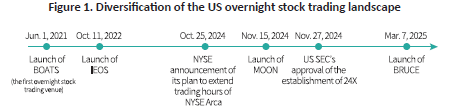
In addition, two new ATSs offering overnight trading sessions—MOON ATS and BRUCE ATS—were launched on November 15, 2024, and March 7, 2025, respectively. MOON ATS, established by OTC Markets Group—which had operated an overnight trading platform for OTC stocks since 2023—began offering overnight trading services in December 2024. BRUCE ATS, launched by PEAK6 Investments, commenced overnight trading operations in March 2025.
In addition, on November 27, 2024, the SEC approved the registration of a new national securities exchange, 24X National Exchange (24X), which is not classified as an ATS.3) 24X is set to begin operations in the second half of 2025 with trading hours from 4:00 a.m. to 7:00 p.m. Eastern Standard Time. It also plans to introduce a 23-hour trading schedule, subject to further SEC approval.
The diversification of the US overnight trading landscape is closely tied to the strategic motivations behind the establishment of new overnight trading venues. For instance, OTC Markets Group, the operator of MOON ATS, has emphasized that the platform aims to expand access to US-listed stocks for Asian investors while also providing extended trading opportunities for US investors.4) PEAK6 Investments, which launched BRUCE ATS, has noted that the emergence of 24-hour stock trading is inevitable and has expressed its commitment to proactively meeting rising investor expectations and demand.5) Similarly, 24X has articulated its aim to improve access to US stocks for Asia-Pacific investors and to serve the needs of global market participants more broadly.6)
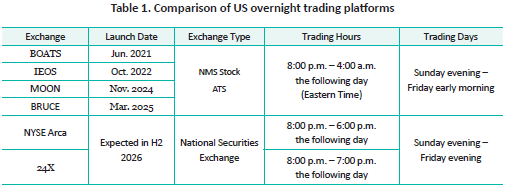
As shown in Table 1, the entry of traditional exchanges—previously limited to regular trading hours—into the overnight trading segment marks a distinct departure from the previous market structure and signals three key shifts. First, ATSs focused solely on overnight trading could face declining competitiveness, as investors and broker-dealers may favor platforms that offer continuous trading across both daytime and overnight sessions. Second, ATSs that have previously limited their operations to daytime trading may seek to expand into overnight trading in response to growing competition from national securities exchanges. Third, Nasdaq may follow NYSE Arca’s lead and introduce its own overnight trading sessions by extending trading hours.7)
Trends in US overnight stock trading
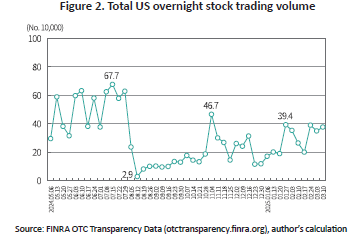
As illustrated in Figure 2, prior to the temporary suspension of overnight trading by BOATS on August 5, 2024, US overnight trading volumes had been on an upward trajectory, albeit with weekly fluctuations. Following the full suspension of daytime US stock trading services by Korean broker-dealers, weekly trading volumes fell sharply to a low of 29,000 trades. However, as interest in overnight trading grew within the US, trading volumes began to recover, rising modestly to just below 200,000 trades per week by the end of October.
Since then, overnight stock trading activity in the US has continued to grow, despite intermittent volatility. Between November 4 and 8, 2024, weekly trading volume surged by 149.1% from the previous week, reaching 467,000 trades, driven primarily by the US presidential election. Notably, between 8:00 p.m. on November 6 and 4:00 a.m. on November 7 (Eastern Time)—a period overlapping with vote counting—both BOATS and IEOS recorded their highest single-day trading volumes to date.8) Weekly overnight trades have continued to increase amid heightened volatility in the US stock market, particularly within the technology sector, following the inauguration of the Trump administration. For example, after Nvidia’s share price dropped by 16.97% on January 27, 2025 in response to the “DeepSeek shock” from China, weekly overnight trading volume climbed to 394,000 trades.
Despite the continued suspension of daytime US stock trading services by Korean broker-dealers, the overnight trading volume has rebounded in the US, largely fueled by a growing domestic investor base. This trend is also evident in the increasing number of US-based broker-dealers launching overnight trading services. For example, Webull, a leading US digital investment platform, began offering overnight trading through a partnership with BOATS on November 12, 2024. Similarly, Firstrade partnered with BOATS and launched commission-free overnight trading on April 3, 2025.9)10)
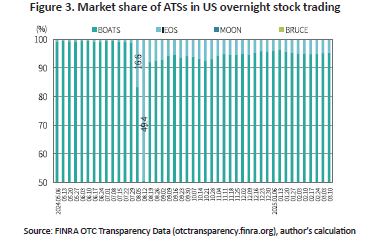
As shown in Figure 3, BOATS currently holds a dominant market share. Although its share temporarily declined to 50.6% during its service suspension, it has since rebounded and stabilized around 95.0%. In contrast, the share of IEOS rose to 49.4% at its peak but has recently plunged to around 5.0%. This reversal appears largely attributed to the MEMX-developed matching system adopted by BOATS, reportedly 1,000 times more advanced, which has substantially enhanced its order-matching capacity. Meanwhile, MOON and BRUCE, both still in the early stages of operation, account for less than 0.01% of the market share.
Support and response from the SEC, FINRA and DTCC
The SEC’s approval of overnight trading by a national securities exchange, rather than by an ATS, may be viewed as a landmark decision that signals potential regulatory and institutional shifts in the structure of overnight trading. This represents a significant departure from the SEC’s longstanding practice of requiring ATSs to register daytime and overnight operations separately.11)
Consistent with its mandate to ensure market stability and investor protection, the SEC has adopted a cautious stance in allowing national securities exchanges to operate overnight trading sessions in the absence of relevant market infrastructure. Its conditional approval of NYSE Arca’s proposed extension of trading hours, along with its guidance to 24X for a phased extension of trading hours, reflects this careful regulatory stance.
To enable full 24-hour trading operations by national securities exchanges, three key infrastructure requirements must be met. First, operating hours for the Securities Information Processors (SIPs) should be extended. SIPs consolidate stock price and trade data across multiple national exchanges and then calculate, and send to exchanges, the National Best Bid and Offer (NBBO), serving as a core element in the National Market System (NMS). Currently, however, SIPs do not operate during overnight trading hours. In March 2025, the Consolidated Tape Association (CTA) and the Unlisted Trading Privileges (UTP) operating committee, which jointly oversee SIP operations, reviewed proposals submitted by NYSE, Nasdaq, and 24X to extend trading hours. All these proposals were ultimately rejected due to opposition from certain committee members, and no progress has been made toward expanding SIP coverage into overnight hours.12)
If SIP operating hours are not extended to cover overnight trading, national securities exchanges, as is the case with ATSs, will be forced to provide proprietary stock price data directly to participants. This arrangement raises concerns over unequal access to market data, while introducing a discrepancy in trade reporting time between ATSs and conventional exchanges.13) In short, the absence of SIP operations during overnight trading sessions could present a material challenge to fairness and transparency in overnight trading.
The second requirement is the extension of operating hours for Trade Reporting Facilities (TRFs). Under Financial Industry Regulatory Authority (FINRA) regulations, TRFs are responsible for processing the reporting of stock trades executed off-exchange, including those conducted on ATSs. Currently, all off-exchange trades must be reported to a TRF during its operating hours from 8:00 a.m. to 8:00 p.m. Trades executed outside of this time frame can only be reported the following day beginning at 8:00 a.m., resulting in delayed trade reporting.14) The extension of TRF operating hours would necessitate both institutional and technical revisions to FINRA regulations and the associated system development. This includes standardizing the time frame of overnight trading sessions and enabling real-time trade reporting comparable to that of regular trading hours.
Although a formal extension of TRF operating hours has not yet been finalized, the outlook is highly favorable. Following the SEC’s approval of overnight trading by national securities exchanges, FINRA is expected to actively pursue the necessary regulatory amendments. Moreover, given that TRFs are operated by subsidiaries of NYSE and Nasdaq, both of which are national securities exchanges, associated system upgrades to support real-time overnight trade reporting are expected to follow.
The third requirement is the extension of operating hours for the National Securities Clearing Corporation (NSCC). A subsidiary of the Depository Trust & Clearing Corporation (DTCC), the NSCC functions as the central clearing party (CCP) for stock trades executed on national securities exchanges. It not only clears and settles trades but also provides CCP guarantees that eliminate counterparty risk during the settlement and clearing process. Without NSCC operations during overnight trading hours, counterparties could face settlement and clearing failures, potentially resulting in investor losses. Furthermore, as illustrated by the temporary suspension of BOATS, if trades are unilaterally canceled, investor confidence in the market could be severely undermined.
Among major market infrastructure providers, the DTCC has responded most promptly to developments in overnight trading. In Phase 1, effective as of September 2024, the NSCC advanced its clearing time by 2 hours and 30 minutes, enabling real-time clearing of trades beginning at 1:30 a.m. In Phase 2, the NSCC plans to implement a 24x5 real-time clearing framework starting from the second half of 2026, which covers trades executed from Sunday at 8:00 p.m. through Friday at 8:00 p.m.15) To support this transition, the DTCC is in the process of amending applicable rules and upgrading its systems to enable continuous clearing during the full trading week.
Implications for the Korean market
It has now been eight months since Korean broker-dealers suspended daytime trading services for US stocks. While these broker-dealers and the Korea Financial Investment Association have been in ongoing discussions with Blue Ocean Technologies, the operator of BOATS, there has been little progress to date. A key concern is that Korean broker-dealers have been unable to independently assess the system stability of BOATS, which is an essential consideration for ensuring investor protection.
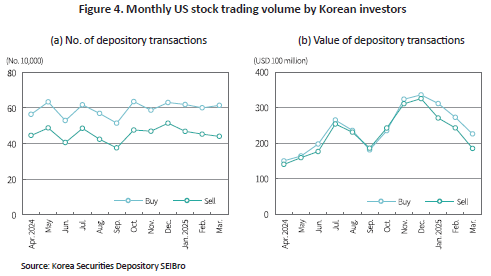
Nevertheless, recent developments in the US overnight trading environment highlight the growing need to reconsider the resumption of daytime trading services for US stocks in Korea. It is also notable that the heightened volatility of the US stock market has driven renewed demand among Korean investors for daytime access to US stocks. As shown in Figure 4, Korean investors have executed an average of more than one million US stock trades per month since August 2024. This trend suggests that trading convenience should be restored by enabling investors to trade US stocks during regular daytime trading hours in Korea.
In this context, it is also worth considering a mid- to long-term strategy to extend trading hours on Korean exchanges. Such a move would enhance the global competitiveness of the Korean stock market and improve accessibility for foreign investors. With the launch of Nextrade—Korea’s first ATS—on March 4, 2025, trading sessions were extended from 9 hours and 30 minutes (8:30 a.m. to 6:00 p.m. KST) to 12 hours (8:00 a.m. to 8:00 p.m.).16) This extension has been positively received by market participants.17) Building on this progress, Korean exchanges should actively explore further extensions to market operating hours in close consultation with financial regulators and relevant institutions.
1) Unlike Korean broker-dealers, Robinhood in the US resumed its overnight trading service immediately after BOATS reopened overnight trading sessions on Aug. 19, 2024, in response to demand from Millennial and Gen Z investors.
2) SEC, Feb. 18, 2025, Self-Regulatory Organizations; NYSE Arca, Inc.; Notice of Filing of Amendment No. 2 and Order Granting Accelerated Approval of a Proposed Rule Change, as Modified by Amendment Nos. 1 and 2, To Lengthen Current Extended Trading Sessions, Release No. 34-102400.
3) SEC, Nov. 27, 2024, In the Matter of the Application of 24X National Exchange LLC for Registration as a National Securities Exchange, Release No. 34-101777.
4) GlobeNewswire, Nov. 20, 2024, OTC Markets Group announces launch of MOON ATS, A new overnight trading platform for National Market System (NMS) Securities.
5) Businesswire, Mar. 12, 2025, Bruce ATS™ announces regulatory approval, now open for business.
6) PR Newswire, Nov. 27, 2024, 24 Exchange receives SEC approval of its new national securities exchange, “24X National Exchange”.
7) The Trade, Mar. 10, 2025, Nasdaq to launch 24-hour trading for US equities.
8) MarketWatch, Nov. 7, 2024, Overnight stock trading hit a record high on the night of the U.S. election.
9) PR Newswire, Nov. 12, 2024, Webull launches overnight trading in the United States.
10) PR Newswire, Apr. 3, 2025, Firstrade launches overnight trading.
11) For the same reason, Interactive Brokers (IBKR) chose not to extend the trading hours of its existing ATS for daytime trading (IBKR ATS), but instead established a separate platform—IEOS—dedicated solely to overnight trading in Oct. 2019.
12) Waters Technology, Mar. 12, 2025, No, no, no, and no: Overnight trading fails in SIP votes.
13) Currently, ATSs offering overnight trading sessions report trades to their partner TRFs at 8:15 a.m. the following day. The TRFs currently in operation are NYSE TRF, Nasdaq TRF Carteret, and Nasdaq TRF Chicago.
14) According to FINRA regulations, trades executed between 8:00 p.m. and midnight must be reported by 8:15 a.m. the following day, while trades executed between midnight and 8:00 a.m. must be reported before the opening of regular exchanges.
15) DTCC, Mar. 18, 2025, DTCC’s NSCC to increase clearing hours to support extended trading.
16) Financial Services Commission & Financial Supervisory Service, Feb. 6, 2025, Final License Approval for Nextrade, a multilateral ATS to engage in an investment brokerage business, press release.
17) News2day, Apr. 11, 2025, “drives market stability… daily turnover exceeds KRW 4 trillion.”
Recent developments in US overnight trading
As of the first half of 2024, overnight stock trading in the US was primarily driven by demand from investors in Asia and attracted relatively limited attention from domestic market participants. Among the 31 ATSs trading National Market System stocks (NMS Stock ATSs), Blue Ocean ATS (BOATS) and IBKR Eos ATS (IEOS) launched overnight trading services on June 1, 2021, and October 11, 2022, respectively. Approximately, 75% to 80% of total overnight trades originated from Asia, with Korea accounting for more than 75% of that Asian volume at the peak of activity.
However, interest in overnight trading among US domestic investors grew significantly following two key events in August 2024: the temporary suspension of BOATS overnight trading services on August 5 due to system stability issues, and the decision by Korean broker-dealers to halt daytime trading of US stocks on August 16. Notably, strong demand for overnight trading among Millennial and Gen Z investors already emerged during the meme stock rallies of the early 2020s, and expectations have been rising that demand from Asian investors for US stocks would continue to grow.1)
As illustrated in Figure 1, the U.S. overnight trading landscape has diversified in the eight months following the suspension of Korean broker-dealers’ daytime trading services. In particular, NYSE Arca, the electronic trading platform operated by the New York Stock Exchange, announced on October 25, 2024, its plan to extend trading hours to 22 hours per weekday. On the same day, it filed a rule change proposal to the US Securities and Exchange Commission (SEC) to introduce the extended trading schedule. The SEC approved the filing on an accelerated basis on February 18, 2025, subject to certain modifications.2)
In addition, on November 27, 2024, the SEC approved the registration of a new national securities exchange, 24X National Exchange (24X), which is not classified as an ATS.3) 24X is set to begin operations in the second half of 2025 with trading hours from 4:00 a.m. to 7:00 p.m. Eastern Standard Time. It also plans to introduce a 23-hour trading schedule, subject to further SEC approval.
The diversification of the US overnight trading landscape is closely tied to the strategic motivations behind the establishment of new overnight trading venues. For instance, OTC Markets Group, the operator of MOON ATS, has emphasized that the platform aims to expand access to US-listed stocks for Asian investors while also providing extended trading opportunities for US investors.4) PEAK6 Investments, which launched BRUCE ATS, has noted that the emergence of 24-hour stock trading is inevitable and has expressed its commitment to proactively meeting rising investor expectations and demand.5) Similarly, 24X has articulated its aim to improve access to US stocks for Asia-Pacific investors and to serve the needs of global market participants more broadly.6)
As shown in Table 1, the entry of traditional exchanges—previously limited to regular trading hours—into the overnight trading segment marks a distinct departure from the previous market structure and signals three key shifts. First, ATSs focused solely on overnight trading could face declining competitiveness, as investors and broker-dealers may favor platforms that offer continuous trading across both daytime and overnight sessions. Second, ATSs that have previously limited their operations to daytime trading may seek to expand into overnight trading in response to growing competition from national securities exchanges. Third, Nasdaq may follow NYSE Arca’s lead and introduce its own overnight trading sessions by extending trading hours.7)
As illustrated in Figure 2, prior to the temporary suspension of overnight trading by BOATS on August 5, 2024, US overnight trading volumes had been on an upward trajectory, albeit with weekly fluctuations. Following the full suspension of daytime US stock trading services by Korean broker-dealers, weekly trading volumes fell sharply to a low of 29,000 trades. However, as interest in overnight trading grew within the US, trading volumes began to recover, rising modestly to just below 200,000 trades per week by the end of October.
Since then, overnight stock trading activity in the US has continued to grow, despite intermittent volatility. Between November 4 and 8, 2024, weekly trading volume surged by 149.1% from the previous week, reaching 467,000 trades, driven primarily by the US presidential election. Notably, between 8:00 p.m. on November 6 and 4:00 a.m. on November 7 (Eastern Time)—a period overlapping with vote counting—both BOATS and IEOS recorded their highest single-day trading volumes to date.8) Weekly overnight trades have continued to increase amid heightened volatility in the US stock market, particularly within the technology sector, following the inauguration of the Trump administration. For example, after Nvidia’s share price dropped by 16.97% on January 27, 2025 in response to the “DeepSeek shock” from China, weekly overnight trading volume climbed to 394,000 trades.
As shown in Figure 3, BOATS currently holds a dominant market share. Although its share temporarily declined to 50.6% during its service suspension, it has since rebounded and stabilized around 95.0%. In contrast, the share of IEOS rose to 49.4% at its peak but has recently plunged to around 5.0%. This reversal appears largely attributed to the MEMX-developed matching system adopted by BOATS, reportedly 1,000 times more advanced, which has substantially enhanced its order-matching capacity. Meanwhile, MOON and BRUCE, both still in the early stages of operation, account for less than 0.01% of the market share.
The SEC’s approval of overnight trading by a national securities exchange, rather than by an ATS, may be viewed as a landmark decision that signals potential regulatory and institutional shifts in the structure of overnight trading. This represents a significant departure from the SEC’s longstanding practice of requiring ATSs to register daytime and overnight operations separately.11)
Consistent with its mandate to ensure market stability and investor protection, the SEC has adopted a cautious stance in allowing national securities exchanges to operate overnight trading sessions in the absence of relevant market infrastructure. Its conditional approval of NYSE Arca’s proposed extension of trading hours, along with its guidance to 24X for a phased extension of trading hours, reflects this careful regulatory stance.
To enable full 24-hour trading operations by national securities exchanges, three key infrastructure requirements must be met. First, operating hours for the Securities Information Processors (SIPs) should be extended. SIPs consolidate stock price and trade data across multiple national exchanges and then calculate, and send to exchanges, the National Best Bid and Offer (NBBO), serving as a core element in the National Market System (NMS). Currently, however, SIPs do not operate during overnight trading hours. In March 2025, the Consolidated Tape Association (CTA) and the Unlisted Trading Privileges (UTP) operating committee, which jointly oversee SIP operations, reviewed proposals submitted by NYSE, Nasdaq, and 24X to extend trading hours. All these proposals were ultimately rejected due to opposition from certain committee members, and no progress has been made toward expanding SIP coverage into overnight hours.12)
If SIP operating hours are not extended to cover overnight trading, national securities exchanges, as is the case with ATSs, will be forced to provide proprietary stock price data directly to participants. This arrangement raises concerns over unequal access to market data, while introducing a discrepancy in trade reporting time between ATSs and conventional exchanges.13) In short, the absence of SIP operations during overnight trading sessions could present a material challenge to fairness and transparency in overnight trading.
The second requirement is the extension of operating hours for Trade Reporting Facilities (TRFs). Under Financial Industry Regulatory Authority (FINRA) regulations, TRFs are responsible for processing the reporting of stock trades executed off-exchange, including those conducted on ATSs. Currently, all off-exchange trades must be reported to a TRF during its operating hours from 8:00 a.m. to 8:00 p.m. Trades executed outside of this time frame can only be reported the following day beginning at 8:00 a.m., resulting in delayed trade reporting.14) The extension of TRF operating hours would necessitate both institutional and technical revisions to FINRA regulations and the associated system development. This includes standardizing the time frame of overnight trading sessions and enabling real-time trade reporting comparable to that of regular trading hours.
Although a formal extension of TRF operating hours has not yet been finalized, the outlook is highly favorable. Following the SEC’s approval of overnight trading by national securities exchanges, FINRA is expected to actively pursue the necessary regulatory amendments. Moreover, given that TRFs are operated by subsidiaries of NYSE and Nasdaq, both of which are national securities exchanges, associated system upgrades to support real-time overnight trade reporting are expected to follow.
The third requirement is the extension of operating hours for the National Securities Clearing Corporation (NSCC). A subsidiary of the Depository Trust & Clearing Corporation (DTCC), the NSCC functions as the central clearing party (CCP) for stock trades executed on national securities exchanges. It not only clears and settles trades but also provides CCP guarantees that eliminate counterparty risk during the settlement and clearing process. Without NSCC operations during overnight trading hours, counterparties could face settlement and clearing failures, potentially resulting in investor losses. Furthermore, as illustrated by the temporary suspension of BOATS, if trades are unilaterally canceled, investor confidence in the market could be severely undermined.
Among major market infrastructure providers, the DTCC has responded most promptly to developments in overnight trading. In Phase 1, effective as of September 2024, the NSCC advanced its clearing time by 2 hours and 30 minutes, enabling real-time clearing of trades beginning at 1:30 a.m. In Phase 2, the NSCC plans to implement a 24x5 real-time clearing framework starting from the second half of 2026, which covers trades executed from Sunday at 8:00 p.m. through Friday at 8:00 p.m.15) To support this transition, the DTCC is in the process of amending applicable rules and upgrading its systems to enable continuous clearing during the full trading week.
Implications for the Korean market
It has now been eight months since Korean broker-dealers suspended daytime trading services for US stocks. While these broker-dealers and the Korea Financial Investment Association have been in ongoing discussions with Blue Ocean Technologies, the operator of BOATS, there has been little progress to date. A key concern is that Korean broker-dealers have been unable to independently assess the system stability of BOATS, which is an essential consideration for ensuring investor protection.
Nevertheless, recent developments in the US overnight trading environment highlight the growing need to reconsider the resumption of daytime trading services for US stocks in Korea. It is also notable that the heightened volatility of the US stock market has driven renewed demand among Korean investors for daytime access to US stocks. As shown in Figure 4, Korean investors have executed an average of more than one million US stock trades per month since August 2024. This trend suggests that trading convenience should be restored by enabling investors to trade US stocks during regular daytime trading hours in Korea.
1) Unlike Korean broker-dealers, Robinhood in the US resumed its overnight trading service immediately after BOATS reopened overnight trading sessions on Aug. 19, 2024, in response to demand from Millennial and Gen Z investors.
2) SEC, Feb. 18, 2025, Self-Regulatory Organizations; NYSE Arca, Inc.; Notice of Filing of Amendment No. 2 and Order Granting Accelerated Approval of a Proposed Rule Change, as Modified by Amendment Nos. 1 and 2, To Lengthen Current Extended Trading Sessions, Release No. 34-102400.
3) SEC, Nov. 27, 2024, In the Matter of the Application of 24X National Exchange LLC for Registration as a National Securities Exchange, Release No. 34-101777.
4) GlobeNewswire, Nov. 20, 2024, OTC Markets Group announces launch of MOON ATS, A new overnight trading platform for National Market System (NMS) Securities.
5) Businesswire, Mar. 12, 2025, Bruce ATS™ announces regulatory approval, now open for business.
6) PR Newswire, Nov. 27, 2024, 24 Exchange receives SEC approval of its new national securities exchange, “24X National Exchange”.
7) The Trade, Mar. 10, 2025, Nasdaq to launch 24-hour trading for US equities.
8) MarketWatch, Nov. 7, 2024, Overnight stock trading hit a record high on the night of the U.S. election.
9) PR Newswire, Nov. 12, 2024, Webull launches overnight trading in the United States.
10) PR Newswire, Apr. 3, 2025, Firstrade launches overnight trading.
11) For the same reason, Interactive Brokers (IBKR) chose not to extend the trading hours of its existing ATS for daytime trading (IBKR ATS), but instead established a separate platform—IEOS—dedicated solely to overnight trading in Oct. 2019.
12) Waters Technology, Mar. 12, 2025, No, no, no, and no: Overnight trading fails in SIP votes.
13) Currently, ATSs offering overnight trading sessions report trades to their partner TRFs at 8:15 a.m. the following day. The TRFs currently in operation are NYSE TRF, Nasdaq TRF Carteret, and Nasdaq TRF Chicago.
14) According to FINRA regulations, trades executed between 8:00 p.m. and midnight must be reported by 8:15 a.m. the following day, while trades executed between midnight and 8:00 a.m. must be reported before the opening of regular exchanges.
15) DTCC, Mar. 18, 2025, DTCC’s NSCC to increase clearing hours to support extended trading.
16) Financial Services Commission & Financial Supervisory Service, Feb. 6, 2025, Final License Approval for Nextrade, a multilateral ATS to engage in an investment brokerage business, press release.
17) News2day, Apr. 11, 2025, “drives market stability… daily turnover exceeds KRW 4 trillion.”