Our bi-weekly Opinion provides you with latest updates and analysis on major capital market and financial investment industry issues.
The Limitation of Fair Funds and the Proposal to Establish an Investor Protection Center
Publication date Aug. 19, 2025

Summary
To sustain the upward momentum of the securities market of South Korea (‘Korea’), it is essential to implement strong sanctions against unfair trading practices and strengthen investor protection mechanisms so that investors can trust and trade in the market. However, the current securities-related class action system lacks effectiveness in providing relief to victims due to strict litigation requirements and lengthy litigation periods, and the Unfair Trading Victim Litigation Support Center, established in 2013, has played only a limited role because of constraints in the scope of support and the information it provides.
To address these issues, discussions are underway to introduce a Korean-style Fair Fund, which would directly distribute compensation to victims using resources such as fines imposed for securities frauds. However, in reality, the available funds are not enough, and concerns about fairness and effectiveness are raised in the process of selecting eligible victims and establishing compensation standards for each case. While the Fair Fund system of the United States enables large-scale fund formation and distribution by virtue of the SEC’s strong authority and its ability to timely detect securities frauds, the ROK faces limitations in adopting a direct fund distribution model because it has not established such conditions unlike US does.
Therefore, reflecting the current circumstances of Korea, it is proposed to establish a dedicated institution—similar to Taiwan’s Securities and Futures Investors Protection Center—to provide substantive compensation to securities fraud victims, rather than adopting a direct fund distribution approach. This could be achieved by expanding the functions of the Korea Exchange’s Litigation Support Center into an Investor Protection Center, securing funds including those from fines for securities fraud, and establishing a legal framework for the center to directly support victims in litigation and dispute resolution. Through such substantive improvements to the victim protection system, it is expected that market participants’ trust will be restored and a transparent, sustainable growth foundation for the capital market will be established.
This year, as the KOSPI index has risen 29% , marking the highest growth rate in 26 years, and the KOSDAQ index has also gained 18% compared to the start of the year, the upward momentum in Korea’s securities market continues. To sustain this growth trend, it is essential to establish robust investor protection mechanisms alongside strong sanctions against fraudulent securities transactions, so that investors can trust and actively participate in South Korea’s capital market. In this regard, the presidential campaign pledges and the National Policy Planning Committee’s policy guide for the new administration’s growth strategy announced plans to introduce a Korean-style “Fair Fund” (Fair Compensation Fund), which would compensate investors for damages caused by securities frauds through the imposition of administrative fines and other penalties. The idea is to allocate a portion of the fines and penalties levied for fraudulent or illegal activities in the capital market to compensate affected investors.
This article points out the shortcomings of the current system for protecting victims of securities fraud, examines the key features and limitations of the proposed Korean-style Fair Fund currently under discussion, and proposes, as an alternative, a benchmarking approach based on Taiwan’s Securities and Futures Investors Protection Center.
Problems with the Current System for Protecting Victims of Securities Fraud
Fraudulent practices in securities market are not only crimes that undermine trust in the market as a whole, but also crimes that cause actual financial losses to victims. While it is important for the authority to recover the illicit gains obtained by perpetrators of the fraudulent transactions, it is equally important to provide remedies for investors who have suffered losses due to such illegal acts. However, in cases of securities frauds, a small number of perpetrators often reap enormous profits, whereas the victims are an unspecified large group whose losses are dispersed into small amounts. As a result, small-scale investors can only claim compensation for their actual losses through civil litigation, but the litigation costs are relatively high, making it rare for them to actually file lawsuits.1)
In consideration of the characteristics of unfair trading, the Securities-Related Class Action Act was enacted to protect victims, but in practice, compensation through this system is extremely rare. The Act, which provides special provisions to the Civil Procedure Act to efficiently remedy collective damages arising in the course of securities transactions, was enacted on January 20, 2004, and came into effect on January 1, 2005. At the time of the enactment, strict filing requirements, a lawsuit permission system, and regulations on plaintiffs and their representatives were introduced in concern of excessive lawsuits. Contrary to initial concerns, however, the first class action was not filed until April 2009. Moreover, even after 20 years since its introduction, as of July 2025, only about 12 securities-related class actions have been filed. Of these, only two cases — the Deutsche Bank case and the C-Motech case — have resulted in judgments on the merits, while four cases, including the RBC case, have been concluded through court settlements. This implication resulted from the fact that strict filing requirements make it difficult to initiate lawsuits, and that it takes a long time to obtain court approval to proceed, with even more time required to reach a judgment. Notably, the fact that the 11th filing occurred only in 2023, after the 10th in 2017, demonstrates how little securities-related class actions have contributed to victim relief.
Even when a class action is filed, securities-related disputes face the challenge that most of the information and evidence needed to prove violation of securities regulations is not in the possession of the victims, making litigation difficult. In class actions, the burden of proof still lies with the plaintiff, and if the plaintiff fails to provide adequate evidence, the case will be lost. Although measures such as the order to produce documents under Article 344 of the Civil Procedure Act have been introduced, there are no effective sanctions if the defendant fails to comply with such court orders. In class actions, non-compliance with an order to produce documents can be sanctioned under Article 63, but the fine is only 30 million KRW.
Recognizing the difficulty victims face in pursuing litigation, the government announced a comprehensive plan in 2013, under which the Korea Exchange established the Unfair Trading Victim Litigation Support Center to provide materials necessary for lawsuits. However, the scope of the materials is limited.2) The materials provided are trading information on specific stock on the issue trading and minute-by-minute stock price indices, which are materials that investors can also find through internet searches, and legal consultations necessary for litigation are merely advisory services that do not provide significant assistance in actual litigation conduct. Victims still have to obtain unfair trading-related evidence at their own expense.
Although many institutional changes related to securities fraud have been made since the detection of a large-scale stock price manipulation case in April 2023, unfortunately, no improvements have been made to the system for victim relief. Furthermore, while the introduction of administrative monetary penalties (2024) and account payment suspensions (2025) through amendments to the Capital Markets Act has enabled the swift transfer of unfair trading perpetrators' assets to the national treasury, investors who have suffered damages still face difficulties in securing resources for compensation.
Key Contents and Limitations of the Proposed Korean-Style Fair Fund
As criticism continues that protection for investors harmed by fraudulent practices in capital markets is insufficient, discussions are underway to introduce a Korean-style fair fund that would raise funds using penalties imposed on those who engaged in the frauds as financial resources for direct distribution to investors. Currently, four bills have been proposed in the National Assembly, with the following key contents.
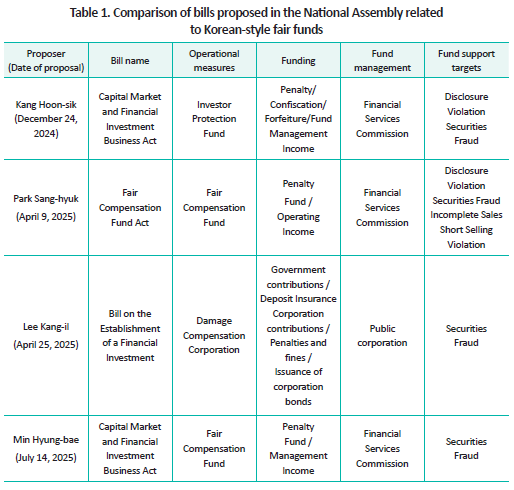
While specific details differ among the bills, they commonly contain the intent to establish a fund using ill-gotten gains recovered from fraudulent actors as financial resources for distribution to victims. This is modeled after the Fair Fund (Federal Account for Investor Restitution Fund) operated by the United States Securities and Exchange Commission (SEC).
In the United States, a fair fund system is operated to compensate investors for damages using financial resources collected through monetary sanctions imposed on violators of federal securities laws. The U.S. fair fund uses disgorgement and civil penalties as financial resources. When the SEC directly imposes administrative sanctions, the SEC decides on fair fund establishment (SEC-established type), and when the SEC takes a civil sanctions approach by filing a lawsuit in court, fair fund establishment is also decided by the court upon the SEC's request (court-established type). Once fair fund establishment is decided, the liable party must submit a distribution plan in accordance with the SEC’s order. The SEC then decides whether to approve the plan, and upon approval, appoints a fund administrator to commence the operation and distribution process.3)
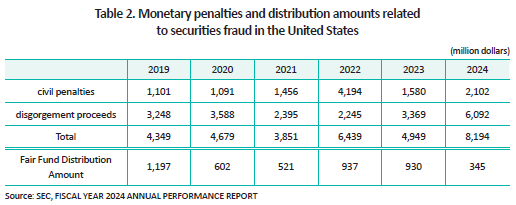
In the case of the United States, the amounts collected from penalties for the violations of securities fraud regulation are substantial, and accordingly, the amounts distributed to victims through fair fund formation are considerable. During 2024, USD 8.194 billion (KRW 11.4 trillion) in civil penalties and disgorgement was collected. The amount distributed to victims was USD 345 million (KRW 480 billion) in 2024, which was somewhat less compared to other years, but in 2022 and 2023, substantial amounts of USD 937 million (KRW 1.304 trillion) and USD 930 million (KRW 1.294 trillion) were paid, respectively.
A Fair Fund is not established for every case. If the amount of damages exceeds the collected funds, making distribution practically impossible, the collected funds are returned to the Treasury. For this reason, even in the United States, cases involving accounting fraud or disclosure violations by listed companies and incidents related to major financial institutions have a high rate of fair fund establishment, while cases such as market manipulation or insider trading have fewer instances of fair fund formation. From 2010 to 2018, fair funds were established in approximately 11% of cases where the SEC imposed measures including monetary sanctions.4) Monetary compensation is not immediately available when the fraudulent behaviors occur. While more than 80% is distributed within 24 months after approval of the distribution plan,5) the entire process—from SEC investigation of deceptive practices and imposition of monetary sanctions, through fair fund establishment and submission of distribution plans for approval, to hearings and final approval of distribution plans—takes an average of 6-7 years, with some cases taking more than 10 years.6)
The Fair Fund system in the United States is a unique mechanism that is difficult to find comparable legislative examples for, and it appears to be possible because the U.S. SEC, through its strong enforcement powers, is able to promptly detect fraudulent practices and impose swift monetary sanctions, resulting in substantial amounts collected. In contrast, in Korea, not only is the detection rate of securities fraud lower than in the U.S., but the amount of administrative fines or penalties available as funding sources is also limited. Furthermore, in the U.S., Fair Funds are established on a case-by-case basis, meaning that the ill-gotten gains from Case A are distributed to the victims of Case A, leaving little room for controversy. However, the bills currently under discussion in Korea proposes to recover administrative fines and manage them in the form of a fund, raising the question of whether it is appropriate to use the ill-gotten gains from Case A to compensate the victims of Case B. In addition, given the limited resources of the fund, the process of selecting which victims of which cases will get remedies and in what amounts carries the risk of discrimination. Furthermore, in the process of accurately identifying victims of fraudulent practices and precisely determining the amount of damages to be distributed specialized personnel and resources are needed. If limited human and material resources are allocated to fund operations, there are concerns that investigations and enforcement of deceptive behaviors may be delayed. Even if Korea could achieve high detection rates of securities frauds and high collection rates of monetary sanctions from it like the U.S., enabling accurate distribution, providing remedies in a “short time” is difficult in practice given the U.S. compensation periods that average 6-7 years and can extend up to 10 years in long-term cases.
A Way of Benchmarking Taiwan's Securities Investor and Futures Trader Protection Center
Through Taiwan’s case where, although it does not directly compensate victims of fraudulent practices, it operates a system that can provide substantial assistance, some lessons for improving Korea’s investor protection framework can be found. Similar to Korea, Taiwan has a high proportion of retail investors.7) To address the structural vulnerabilities that make it difficult for individual investors to recover losses—such as lack of information and the burden of litigation costs—Taiwan established the Securities and Futures Investors Protection Center (the “Center”) in 2003. Based on the Securities Investor and Futures Trader Protection Act (the “Act”), the Center initially raised TWD 1.031 billion (approximately KRW 47.6 billion) through contributions from 11 institutions, including the stock exchange, and now secures funding through contributions and other sources.8)
The Center provides legal advisory services and complaint handling services related to securities and futures for investors, and also takes charge of mediating civil disputes arising from securities, including futures transactions. In addition, the center may file class action lawsuits and arbitration claims on behalf of investors to seek damages, and if a investment company is unable to fulfill its compensation obligations to investors due to financial difficulties, the center provides remedies through a protection fund. The Center’s staff directly participate in shareholders’ meetings and, representing shareholders, file derivative suits and lawsuits for the dismissal of directors, thereby striving to improve corporate governance. Among the Center’s roles, one noteworthy aspect in protecting victims of fraudulent practices is the class action lawsuit. The background of allowing the Center to file class actions on behalf of investors is on the recognition that, due to a lack of information, limited personal capacity, high litigation costs, or other difficulties, individual investors rarely initiate legal proceedings to protect themselves when their interests or rights are infringed.
Also, the Center may file a class action lawsuit or arbitration claim in its own name if a single incident causes damage to multiple investors. In order to initiate such litigation, the Center must obtain litigation mandates from at least 20 investors or futures traders (Article 28 of the Act). If the Center files a class action on behalf of the investors, it will initially bear the related litigation costs. In the event the Center prevails in the lawsuit, it is permitted to deduct the necessary litigation expenses from the damages awarded before distributing the compensation to investors. Nevertheless, investors will not be liable for any costs when the Center loses the case (Article 33 of the Act). In addition, the Act provides that, to support the Center’s litigation, the court may establish a special tribunal or exempt the Center from obligations to provide litigation costs or collaterals for it (Articles 28-2, 34, and 35 of the Act). The Center is also granted the legal authority to obtain information in need from listed companies, investment companies, exchanges, and other entities, thereby enabling the collection of evidentiary materials (Article 17 of the Act).
As of the end of 2023, in class action lawsuits filed by the Center, the court rendered full or partial judgments in favor of the plaintiffs in 77 cases, resulting in compensation payments totaling TWD 29.8 billion (approximately KRW 1.4 trillion).9) As of 2024, the Center has filed a total of 300 class action lawsuits, with 186,000 victims having entrusted their cases to the Center.10) In addition, the Center also takes charge of securities-related dispute mediation to facilitate early resolution of conflicts, and as of the end of 2023, damages amounting to TWD 6.3 billion (approximately KRW 295 billion) were distributed through the Center.
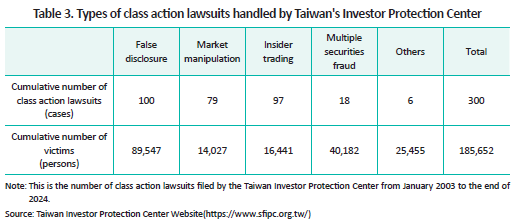
In the case of class actions introduced in Korea in 2005, only 12 cases have been filed, and merely 6 cases have resulted in a plaintiff’s win or a court-mediated settlement leading to distribution. In contrast, the Center in Taiwan, established in 2003, has seen 300 class action filings, with 77 wins in the litigations.11) The difference lies not only in the number of cases but also in the effort required from investors to obtain compensation for damages. In Korea, investors have faced difficulties in securing litigation costs themselves and in obtaining evidence to prove their losses. In Taiwan, however, investors need not make such efforts for direct litigation; they can simply delegate the lawsuit to the Center. This is because the Center, empowered by law, can directly request relevant data from related institutions to prove the occurrence of damages, conduct the litigation using its own funds, and then distribute the compensation to the investors.
Because using administrative fines from fraudulent practices as a direct source for compensating damages has several issues as previously noted, it is proposed to benchmark Taiwan’s Investor Protection Center to establish measures for protecting victims of unfair trading. This involves establishing a separate new investor protection center that expands the dispute mediation and litigation support center functions of Korea Exchange, where funds would be raised through various contributions including surcharges from fraudulent securities transactions to support dispute mediation and class action lawsuits for victims of unfair trading. Litigation costs or mediation costs would be initially covered by the fund, but in case of winning the lawsuit, necessary litigation costs would be deducted from the compensation before distributing the damages to investors.
Currently, while the Litigation Support Center of the Korea Exchange only provides limited litigation materials and consultation services, the newly established Investor Protection Center should be empowered to file lawsuits directly on behalf of investors. To this end, it is necessary to consider amending the Financial Consumer Protection Act to allow class actions,12) or enacting a special Act, as in Taiwan, to enable the Center newly established to initiate collective lawsuits. In addition, amendments to the Securities-Related Class Action Act—which in practice operates as a six-tier trial system and imposes strict requirements for filing lawsuits—should be pursued, along with the introduction of provisions, similar to those in Taiwan, to support the Center in securing evidence to substantiate investor damages.
Strengthening investor protection mechanisms is essential, as investor damages from frauds not only result in individual losses but can also undermine confidence in the entire capital market. While the intent behind a Korean-style Fair Fund is understandable, considering the realities of Korea’s capital market and the current regulatory framework, it would be more effective—rather than adopting a direct distribution model through the establishment of a U.S.-style Fair Fund or similar fund—to follow Taiwan’s approach of creating a dedicated center to facilitate substantive compensation for damages. By implementing such a compensation system, I hope to restore market participants’ trust and lay the foundation for the sound development and sustainable growth of the capital market.
1) Lee, Jung Soo, 2013, A Research on Public Actions for Unfair Securities Trading, The Korean Journal of Securities Law, 14(3), 121-152.
2) Choi Ja Yoo, 2022, A Few Considerations on Remedies for Harmed Investors of Unfair Securities Trading - Focusing on the Revitalization of a Lawsuit for Damages against Unfair Securities Trading, Korean Journal of Banking and Financial Law, 15(1), 77-100.
3) JunSun Park, 2024, Fair Fund Distribution in the U.S. and Its Implications in South Korea, Korean Commercial Law Association, 43(2), 103-140.
4) Velikonja, U., 2023, How Fair Funds Changed Public Compensation and Strengthened SEC Enforcement, The Business Lawyer, 78(3).
5) SEC, 2025, Fiscal Year 2024 Annual Performance Report.
6) Friedman, A., 2018, Managing Uncertainty in the SEC Fair Fund Process: Part 1, Law360.
7) According to the Taiwan Stock Exchange, as of the end of June 2024, the cumulative number of accounts stood at approximately 23.23 million, the cumulative number of investors holding trading accounts was 12.9 million, and the cumulative number of investors actively engaged in trading was 5.64 million. From January to June 2024, individual investors accounted for 55% of total trading volume, domestic institutional investors for 12%, and foreign institutional investors for 33% (2024 Guide to Investing in Taiwan). Considering that Taiwan’s population was approximately 23.36 million as of April 2025, it can be inferred that about half of the population holds a securities account and roughly one-quarter engage in continuous investment activities.
8) The initial funding was contributed by institutions designated by the Securities and Futures Commission pursuant to Article 7 of the Act, and subsequent funding has been provided in the form of contributions from securities firms, futures companies, and the stock exchange under Article 18 of the Act. The rationale for imposing such statutory obligations in Taiwan appears to be the belief that maintaining the soundness and fairness of the capital market and protecting investors ultimately lead to the revitalization of the capital market, thereby benefiting related institutions.
9) https://www.sfipc.org.tw/en/News_Content.aspx?n=7613&s=12062
10) https://www.sfipc.org.tw/en/cp.aspx?n=8818
11) The number of successful cases is based on figures as of the end of 2023, and it is speculated that the number has further increased as of 2025.
12) Lee, Jung-Soo, 2013, A Study on Public Interest Litigation in the Regulatory Sphere of Unfair Securities Trading, Journal of Securities Law Studies, 14(3), 121-152.
This article points out the shortcomings of the current system for protecting victims of securities fraud, examines the key features and limitations of the proposed Korean-style Fair Fund currently under discussion, and proposes, as an alternative, a benchmarking approach based on Taiwan’s Securities and Futures Investors Protection Center.
Problems with the Current System for Protecting Victims of Securities Fraud
Fraudulent practices in securities market are not only crimes that undermine trust in the market as a whole, but also crimes that cause actual financial losses to victims. While it is important for the authority to recover the illicit gains obtained by perpetrators of the fraudulent transactions, it is equally important to provide remedies for investors who have suffered losses due to such illegal acts. However, in cases of securities frauds, a small number of perpetrators often reap enormous profits, whereas the victims are an unspecified large group whose losses are dispersed into small amounts. As a result, small-scale investors can only claim compensation for their actual losses through civil litigation, but the litigation costs are relatively high, making it rare for them to actually file lawsuits.1)
In consideration of the characteristics of unfair trading, the Securities-Related Class Action Act was enacted to protect victims, but in practice, compensation through this system is extremely rare. The Act, which provides special provisions to the Civil Procedure Act to efficiently remedy collective damages arising in the course of securities transactions, was enacted on January 20, 2004, and came into effect on January 1, 2005. At the time of the enactment, strict filing requirements, a lawsuit permission system, and regulations on plaintiffs and their representatives were introduced in concern of excessive lawsuits. Contrary to initial concerns, however, the first class action was not filed until April 2009. Moreover, even after 20 years since its introduction, as of July 2025, only about 12 securities-related class actions have been filed. Of these, only two cases — the Deutsche Bank case and the C-Motech case — have resulted in judgments on the merits, while four cases, including the RBC case, have been concluded through court settlements. This implication resulted from the fact that strict filing requirements make it difficult to initiate lawsuits, and that it takes a long time to obtain court approval to proceed, with even more time required to reach a judgment. Notably, the fact that the 11th filing occurred only in 2023, after the 10th in 2017, demonstrates how little securities-related class actions have contributed to victim relief.
Even when a class action is filed, securities-related disputes face the challenge that most of the information and evidence needed to prove violation of securities regulations is not in the possession of the victims, making litigation difficult. In class actions, the burden of proof still lies with the plaintiff, and if the plaintiff fails to provide adequate evidence, the case will be lost. Although measures such as the order to produce documents under Article 344 of the Civil Procedure Act have been introduced, there are no effective sanctions if the defendant fails to comply with such court orders. In class actions, non-compliance with an order to produce documents can be sanctioned under Article 63, but the fine is only 30 million KRW.
Recognizing the difficulty victims face in pursuing litigation, the government announced a comprehensive plan in 2013, under which the Korea Exchange established the Unfair Trading Victim Litigation Support Center to provide materials necessary for lawsuits. However, the scope of the materials is limited.2) The materials provided are trading information on specific stock on the issue trading and minute-by-minute stock price indices, which are materials that investors can also find through internet searches, and legal consultations necessary for litigation are merely advisory services that do not provide significant assistance in actual litigation conduct. Victims still have to obtain unfair trading-related evidence at their own expense.
Although many institutional changes related to securities fraud have been made since the detection of a large-scale stock price manipulation case in April 2023, unfortunately, no improvements have been made to the system for victim relief. Furthermore, while the introduction of administrative monetary penalties (2024) and account payment suspensions (2025) through amendments to the Capital Markets Act has enabled the swift transfer of unfair trading perpetrators' assets to the national treasury, investors who have suffered damages still face difficulties in securing resources for compensation.
Key Contents and Limitations of the Proposed Korean-Style Fair Fund
As criticism continues that protection for investors harmed by fraudulent practices in capital markets is insufficient, discussions are underway to introduce a Korean-style fair fund that would raise funds using penalties imposed on those who engaged in the frauds as financial resources for direct distribution to investors. Currently, four bills have been proposed in the National Assembly, with the following key contents.
While specific details differ among the bills, they commonly contain the intent to establish a fund using ill-gotten gains recovered from fraudulent actors as financial resources for distribution to victims. This is modeled after the Fair Fund (Federal Account for Investor Restitution Fund) operated by the United States Securities and Exchange Commission (SEC).
In the United States, a fair fund system is operated to compensate investors for damages using financial resources collected through monetary sanctions imposed on violators of federal securities laws. The U.S. fair fund uses disgorgement and civil penalties as financial resources. When the SEC directly imposes administrative sanctions, the SEC decides on fair fund establishment (SEC-established type), and when the SEC takes a civil sanctions approach by filing a lawsuit in court, fair fund establishment is also decided by the court upon the SEC's request (court-established type). Once fair fund establishment is decided, the liable party must submit a distribution plan in accordance with the SEC’s order. The SEC then decides whether to approve the plan, and upon approval, appoints a fund administrator to commence the operation and distribution process.3)
In the case of the United States, the amounts collected from penalties for the violations of securities fraud regulation are substantial, and accordingly, the amounts distributed to victims through fair fund formation are considerable. During 2024, USD 8.194 billion (KRW 11.4 trillion) in civil penalties and disgorgement was collected. The amount distributed to victims was USD 345 million (KRW 480 billion) in 2024, which was somewhat less compared to other years, but in 2022 and 2023, substantial amounts of USD 937 million (KRW 1.304 trillion) and USD 930 million (KRW 1.294 trillion) were paid, respectively.
A Fair Fund is not established for every case. If the amount of damages exceeds the collected funds, making distribution practically impossible, the collected funds are returned to the Treasury. For this reason, even in the United States, cases involving accounting fraud or disclosure violations by listed companies and incidents related to major financial institutions have a high rate of fair fund establishment, while cases such as market manipulation or insider trading have fewer instances of fair fund formation. From 2010 to 2018, fair funds were established in approximately 11% of cases where the SEC imposed measures including monetary sanctions.4) Monetary compensation is not immediately available when the fraudulent behaviors occur. While more than 80% is distributed within 24 months after approval of the distribution plan,5) the entire process—from SEC investigation of deceptive practices and imposition of monetary sanctions, through fair fund establishment and submission of distribution plans for approval, to hearings and final approval of distribution plans—takes an average of 6-7 years, with some cases taking more than 10 years.6)
The Fair Fund system in the United States is a unique mechanism that is difficult to find comparable legislative examples for, and it appears to be possible because the U.S. SEC, through its strong enforcement powers, is able to promptly detect fraudulent practices and impose swift monetary sanctions, resulting in substantial amounts collected. In contrast, in Korea, not only is the detection rate of securities fraud lower than in the U.S., but the amount of administrative fines or penalties available as funding sources is also limited. Furthermore, in the U.S., Fair Funds are established on a case-by-case basis, meaning that the ill-gotten gains from Case A are distributed to the victims of Case A, leaving little room for controversy. However, the bills currently under discussion in Korea proposes to recover administrative fines and manage them in the form of a fund, raising the question of whether it is appropriate to use the ill-gotten gains from Case A to compensate the victims of Case B. In addition, given the limited resources of the fund, the process of selecting which victims of which cases will get remedies and in what amounts carries the risk of discrimination. Furthermore, in the process of accurately identifying victims of fraudulent practices and precisely determining the amount of damages to be distributed specialized personnel and resources are needed. If limited human and material resources are allocated to fund operations, there are concerns that investigations and enforcement of deceptive behaviors may be delayed. Even if Korea could achieve high detection rates of securities frauds and high collection rates of monetary sanctions from it like the U.S., enabling accurate distribution, providing remedies in a “short time” is difficult in practice given the U.S. compensation periods that average 6-7 years and can extend up to 10 years in long-term cases.
A Way of Benchmarking Taiwan's Securities Investor and Futures Trader Protection Center
Through Taiwan’s case where, although it does not directly compensate victims of fraudulent practices, it operates a system that can provide substantial assistance, some lessons for improving Korea’s investor protection framework can be found. Similar to Korea, Taiwan has a high proportion of retail investors.7) To address the structural vulnerabilities that make it difficult for individual investors to recover losses—such as lack of information and the burden of litigation costs—Taiwan established the Securities and Futures Investors Protection Center (the “Center”) in 2003. Based on the Securities Investor and Futures Trader Protection Act (the “Act”), the Center initially raised TWD 1.031 billion (approximately KRW 47.6 billion) through contributions from 11 institutions, including the stock exchange, and now secures funding through contributions and other sources.8)
The Center provides legal advisory services and complaint handling services related to securities and futures for investors, and also takes charge of mediating civil disputes arising from securities, including futures transactions. In addition, the center may file class action lawsuits and arbitration claims on behalf of investors to seek damages, and if a investment company is unable to fulfill its compensation obligations to investors due to financial difficulties, the center provides remedies through a protection fund. The Center’s staff directly participate in shareholders’ meetings and, representing shareholders, file derivative suits and lawsuits for the dismissal of directors, thereby striving to improve corporate governance. Among the Center’s roles, one noteworthy aspect in protecting victims of fraudulent practices is the class action lawsuit. The background of allowing the Center to file class actions on behalf of investors is on the recognition that, due to a lack of information, limited personal capacity, high litigation costs, or other difficulties, individual investors rarely initiate legal proceedings to protect themselves when their interests or rights are infringed.
Also, the Center may file a class action lawsuit or arbitration claim in its own name if a single incident causes damage to multiple investors. In order to initiate such litigation, the Center must obtain litigation mandates from at least 20 investors or futures traders (Article 28 of the Act). If the Center files a class action on behalf of the investors, it will initially bear the related litigation costs. In the event the Center prevails in the lawsuit, it is permitted to deduct the necessary litigation expenses from the damages awarded before distributing the compensation to investors. Nevertheless, investors will not be liable for any costs when the Center loses the case (Article 33 of the Act). In addition, the Act provides that, to support the Center’s litigation, the court may establish a special tribunal or exempt the Center from obligations to provide litigation costs or collaterals for it (Articles 28-2, 34, and 35 of the Act). The Center is also granted the legal authority to obtain information in need from listed companies, investment companies, exchanges, and other entities, thereby enabling the collection of evidentiary materials (Article 17 of the Act).
As of the end of 2023, in class action lawsuits filed by the Center, the court rendered full or partial judgments in favor of the plaintiffs in 77 cases, resulting in compensation payments totaling TWD 29.8 billion (approximately KRW 1.4 trillion).9) As of 2024, the Center has filed a total of 300 class action lawsuits, with 186,000 victims having entrusted their cases to the Center.10) In addition, the Center also takes charge of securities-related dispute mediation to facilitate early resolution of conflicts, and as of the end of 2023, damages amounting to TWD 6.3 billion (approximately KRW 295 billion) were distributed through the Center.
In the case of class actions introduced in Korea in 2005, only 12 cases have been filed, and merely 6 cases have resulted in a plaintiff’s win or a court-mediated settlement leading to distribution. In contrast, the Center in Taiwan, established in 2003, has seen 300 class action filings, with 77 wins in the litigations.11) The difference lies not only in the number of cases but also in the effort required from investors to obtain compensation for damages. In Korea, investors have faced difficulties in securing litigation costs themselves and in obtaining evidence to prove their losses. In Taiwan, however, investors need not make such efforts for direct litigation; they can simply delegate the lawsuit to the Center. This is because the Center, empowered by law, can directly request relevant data from related institutions to prove the occurrence of damages, conduct the litigation using its own funds, and then distribute the compensation to the investors.
Because using administrative fines from fraudulent practices as a direct source for compensating damages has several issues as previously noted, it is proposed to benchmark Taiwan’s Investor Protection Center to establish measures for protecting victims of unfair trading. This involves establishing a separate new investor protection center that expands the dispute mediation and litigation support center functions of Korea Exchange, where funds would be raised through various contributions including surcharges from fraudulent securities transactions to support dispute mediation and class action lawsuits for victims of unfair trading. Litigation costs or mediation costs would be initially covered by the fund, but in case of winning the lawsuit, necessary litigation costs would be deducted from the compensation before distributing the damages to investors.
Currently, while the Litigation Support Center of the Korea Exchange only provides limited litigation materials and consultation services, the newly established Investor Protection Center should be empowered to file lawsuits directly on behalf of investors. To this end, it is necessary to consider amending the Financial Consumer Protection Act to allow class actions,12) or enacting a special Act, as in Taiwan, to enable the Center newly established to initiate collective lawsuits. In addition, amendments to the Securities-Related Class Action Act—which in practice operates as a six-tier trial system and imposes strict requirements for filing lawsuits—should be pursued, along with the introduction of provisions, similar to those in Taiwan, to support the Center in securing evidence to substantiate investor damages.
Strengthening investor protection mechanisms is essential, as investor damages from frauds not only result in individual losses but can also undermine confidence in the entire capital market. While the intent behind a Korean-style Fair Fund is understandable, considering the realities of Korea’s capital market and the current regulatory framework, it would be more effective—rather than adopting a direct distribution model through the establishment of a U.S.-style Fair Fund or similar fund—to follow Taiwan’s approach of creating a dedicated center to facilitate substantive compensation for damages. By implementing such a compensation system, I hope to restore market participants’ trust and lay the foundation for the sound development and sustainable growth of the capital market.
1) Lee, Jung Soo, 2013, A Research on Public Actions for Unfair Securities Trading, The Korean Journal of Securities Law, 14(3), 121-152.
2) Choi Ja Yoo, 2022, A Few Considerations on Remedies for Harmed Investors of Unfair Securities Trading - Focusing on the Revitalization of a Lawsuit for Damages against Unfair Securities Trading, Korean Journal of Banking and Financial Law, 15(1), 77-100.
3) JunSun Park, 2024, Fair Fund Distribution in the U.S. and Its Implications in South Korea, Korean Commercial Law Association, 43(2), 103-140.
4) Velikonja, U., 2023, How Fair Funds Changed Public Compensation and Strengthened SEC Enforcement, The Business Lawyer, 78(3).
5) SEC, 2025, Fiscal Year 2024 Annual Performance Report.
6) Friedman, A., 2018, Managing Uncertainty in the SEC Fair Fund Process: Part 1, Law360.
7) According to the Taiwan Stock Exchange, as of the end of June 2024, the cumulative number of accounts stood at approximately 23.23 million, the cumulative number of investors holding trading accounts was 12.9 million, and the cumulative number of investors actively engaged in trading was 5.64 million. From January to June 2024, individual investors accounted for 55% of total trading volume, domestic institutional investors for 12%, and foreign institutional investors for 33% (2024 Guide to Investing in Taiwan). Considering that Taiwan’s population was approximately 23.36 million as of April 2025, it can be inferred that about half of the population holds a securities account and roughly one-quarter engage in continuous investment activities.
8) The initial funding was contributed by institutions designated by the Securities and Futures Commission pursuant to Article 7 of the Act, and subsequent funding has been provided in the form of contributions from securities firms, futures companies, and the stock exchange under Article 18 of the Act. The rationale for imposing such statutory obligations in Taiwan appears to be the belief that maintaining the soundness and fairness of the capital market and protecting investors ultimately lead to the revitalization of the capital market, thereby benefiting related institutions.
9) https://www.sfipc.org.tw/en/News_Content.aspx?n=7613&s=12062
10) https://www.sfipc.org.tw/en/cp.aspx?n=8818
11) The number of successful cases is based on figures as of the end of 2023, and it is speculated that the number has further increased as of 2025.
12) Lee, Jung-Soo, 2013, A Study on Public Interest Litigation in the Regulatory Sphere of Unfair Securities Trading, Journal of Securities Law Studies, 14(3), 121-152.