Our bi-weekly Opinion provides you with latest updates and analysis on major capital market and financial investment industry issues.
MSCI Market Accessibility Evaluation Analysis and its Implications
Publication date Sep. 02, 2025

Summary
MSCI continues to classify Korea as an emerging market, with its 2025 review showing little change from the previous year. Korea is the only country in the region to receive a “needs improvement” rating across all six key areas—foreign exchange market liberalization, investor registration, information flow, clearing and settlement, capital transferability, and investment instrument availability—highlighting that foreign investors view its market accessibility as lagging not only behind developed markets but also major emerging peers. While MSCI acknowledged reforms such as expanding FX market access and simplifying settlement and reporting procedures, it emphasized that the tangible benefits for investors remain limited. To close this gap, Korea should implement near-term measures like expanding English-language disclosures and removing ex-post approval requirements for OTC transactions, while advancing longer-term structural reforms, including the gradual development of an offshore won market. Ultimately, achieving alignment with global standards will require investor-centered institutional reforms, stronger transparency, and close coordination between the government, regulators, and market participants under a clear and credible roadmap.
MSCI, which comprehensively assesses the market size and accessibility of global equity markets, continues to classify Korea as an emerging market. In its annual Market Accessibility Review released in June, MSCI rated Korea largely unchanged from the previous year, leaving the country in the emerging market group for more than 30 years since its inclusion in the MSCI Emerging Markets Index in 1992. This paper seeks to diagnose the constraints on Korea’s equity market accessibility revealed in the latest review and to present the necessary improvements and policy implications for Korea’s eventual inclusion in the developed market category.
Review of Market Accessibility Assessment
MSCI’s market classification framework encompasses both quantitative indicators and qualitative evaluation criteria. The quantitative indicators include economic size, level of development, stock market scale, and liquidity—all of which Korea already satisfies. Thus, the primary challenge for Korea’s potential inclusion in the MSCI Developed Markets Index lies in enhancing the qualitative dimension of market accessibility. MSCI evaluates market accessibility across five broad categories—openness to foreign investment, ease of capital inflows and outflows, efficiency of the operational framework, availability of investment instruments, and institutional stability—covering 18 detailed criteria. Each criterion is assessed on a three-tier scale: “++” (no issues), “+” (no major issues but improvable), and “–” (improvement needed).
In the June 2025 MSCI Market Accessibility Review, 22 of the 23 developed markets received no “–” ratings. Spain was the sole exception, downgraded in the “Foreign Room Level” category due to regulatory limits on foreign ownership of International Airlines Group (IAG). Among the developed markets, 17 countries achieved the highest rating (“++”) across all criteria, while five countries—excluding Spain—recorded no more than two “+” ratings. This outcome underscores that the presence of any “–” ratings renders developed market classification virtually unattainable, and that securing top-tier ratings across most categories is effectively a prerequisite for recognition as a developed market.
Nonetheless, MSCI acknowledged Korea’s recent reforms aimed at improving access to its foreign exchange and capital markets. Positive steps highlighted in the review include expanding offshore FX market access, extending trading hours, simplifying settlement and reporting procedures, abolishing the foreign investor registration system, and introducing Legal Entity Identifiers (LEIs). However, persistent operational hurdles remain, while reforms such as omnibus accounts and over-the-counter (OTC) trading have yet to be implemented in practice. This suggests that despite regulatory adjustments, structural constraints—such as complex procedures, limited trading hours and instruments, and misalignment with global standards—remain unresolved. Lasting improvements in accessibility will therefore require not only regulatory easing but also parallel enhancements in market infrastructure.
Comparison of Market Accessibility with Major Regional Peers
A comparison with major regional peers reveals Korea’s relative weakness. As shown in , Korea is the only country in the region to receive the lowest rating (“–”) across all six underperforming categories identified by MSCI, while developed markets such as Japan, Hong Kong, and Singapore maintain the highest rating (“++”) in most areas. In terms of the total number of “–” ratings out of the 18 criteria, Korea and China each received six, Taiwan and Thailand three, and Malaysia none. These results indicate that Korea’s accessibility lags not only behind developed markets but also behind key emerging markets in the region, underscoring the urgency of structural and institutional reforms.
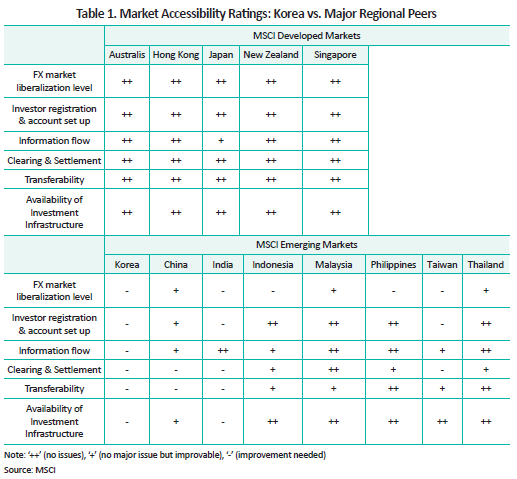
This gap in market accessibility compared with major regional peers is also evident in individual evaluation categories. In the foreign exchange market liberalization category, Korea—together with India, Indonesia, the Philippines, and Taiwan—still enforces a complete ban on offshore spot transactions. Although some other markets allow offshore trading under certain restrictions, Korea continues to be rated “–” despite phased liberalization measures introduced since 2024. In the information flow category, Korea likewise stands out as the only major regional market receiving a “–” reflecting shortcomings in both English-language disclosures and dividend transparency. While recent reforms have sought to gradually expand mandatory English disclosures, their scope and implementation remain limited compared to peers such as Japan and Taiwan.1)
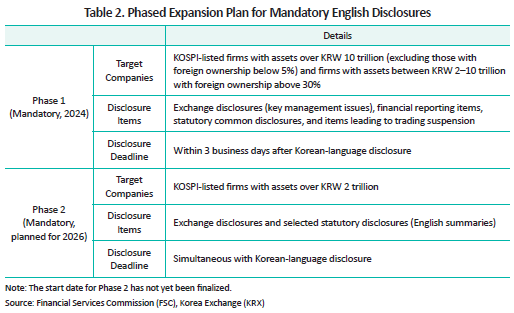
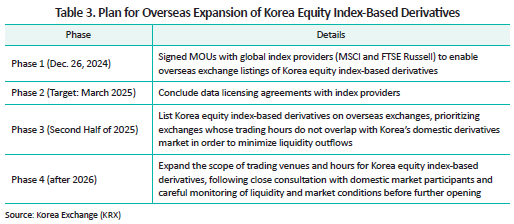
In clearing and settlement, Korea is grouped with China, India, and Taiwan at the lowest level, largely due to restrictive rules on omnibus accounts. While omnibus accounts have become actively utilized in the government bond market following Korea’s inclusion in the World Government Bond Index (WGBI), they remain effectively unused in the equity market.2) In the transferability category, restrictions on OTC transactions similarly place Korea alongside China, India, and Indonesia at the lowest rating. By contrast, Malaysia and Taiwan permit OTC trading, albeit with certain limitations, and thus received a “+” rating. Finally, in the investment infrastructure category, Korea continues to restrict access to market data and overseas trading of related products. Although the overseas listing of derivatives was permitted in December 2024, the market remains at an early stage, keeping Korea at a “–” rating.
presents the Korea Exchange’s roadmap for enabling the overseas use of Korean equity index licenses.
The comparison of market accessibility categories across major regional peers highlights that Korea remains broadly constrained relative to global standards. Persistent restrictions in areas such as foreign exchange market liberalization, investor registration, information disclosure, clearing and settlement, capital transferability, and investment instruments have limited the tangible benefits of recent reforms for market participants. These shortcomings are evident not only when compared with developed markets but also against key regional emerging markets, reinforcing foreign investors’ perception of Korea’s structural barriers. As a result, MSCI continues to classify Korea as an emerging market, and these constraints remain a central factor behind its lower accessibility scores.
Implications
MSCI’s market accessibility assessment goes beyond the mere existence of regulations and focuses on whether a market’s practices and infrastructure are truly aligned with developed-market standards. The key benchmark is whether foreign investors can enjoy the same level of trading convenience in Korea as they do in advanced markets such as the U.K. or the U.S. Category-by-category comparisons show that Korea continues to face structural constraints, resulting in lower evaluations not only relative to developed economies but also to some regional emerging markets. This highlights the need for fundamental and comprehensive reforms to enhance the international competitiveness of Korea’s capital markets.
Korea must therefore rethink its approach in the six categories where it is rated poorly. These are areas in which all MSCI-developed market constituents receive the highest rating, underscoring the limitations of Korea’s current policies. Recent steps to partially open the FX market—for example, allowing selective participation by registered foreign institutions (RFIs)—represent progress, but they fall short of the 24-hour offshore trading environment available in all 23 developed market currencies, which are freely tradable across global financial centers such as London, New York, Hong Kong, and Singapore.
By contrast, Korea’s continued prohibition of offshore won trading imposes fundamental constraints on market access and liquidity. This increases hedging costs, reduces trading efficiency, and diminishes Korea’s weight in global portfolios. While such restrictions remain a central obstacle to MSCI developed-market inclusion, full liberalization is inherently challenging due to its implications for exchange rate volatility management, reserve operations, and the resilience of domestic financial institutions.
Accordingly, Korea’s MSCI upgrade strategy must clearly differentiate between short-term and long-term priorities. Near-term reforms—such as expanding the scope of English-language disclosures, abolishing ex-post approval requirements for OTC transactions, and streamlining settlement and reporting procedures—could deliver tangible improvements in investor experience. Structural reforms, such as allowing an offshore won market, should instead be pursued gradually, with careful attention to market stability, regulatory coherence, and stakeholder consultation.
Ultimately, Korea’s path to MSCI developed-market inclusion requires more than incremental regulatory changes. It demands a comprehensive overhaul of institutions and practices centered on investor experience, with freedom of transaction and transparency brought in line with global standards. Achieving this will require close coordination between government, regulators, and market participants under a clear and consistent roadmap. Only through such efforts can Korea secure developed-market recognition and strengthen its long-term position in the global financial system.
1) Japan is the only country among those included in the MSCI Developed Markets Index to have received a “+” (improvable) rating in the information flow category due to insufficient English disclosures. To address this, in April 2025 the Tokyo Stock Exchange mandated the immediate disclosure in English of material information by companies listed on the Prime Market.
2) According to the Korea Securities Depository, omnibus accounts are actively utilized in the government bond market, with balances exceeding KRW 6 trillion as of June 2025, whereas in the equity market they remain unused.
Review of Market Accessibility Assessment
MSCI’s market classification framework encompasses both quantitative indicators and qualitative evaluation criteria. The quantitative indicators include economic size, level of development, stock market scale, and liquidity—all of which Korea already satisfies. Thus, the primary challenge for Korea’s potential inclusion in the MSCI Developed Markets Index lies in enhancing the qualitative dimension of market accessibility. MSCI evaluates market accessibility across five broad categories—openness to foreign investment, ease of capital inflows and outflows, efficiency of the operational framework, availability of investment instruments, and institutional stability—covering 18 detailed criteria. Each criterion is assessed on a three-tier scale: “++” (no issues), “+” (no major issues but improvable), and “–” (improvement needed).
In the June 2025 MSCI Market Accessibility Review, 22 of the 23 developed markets received no “–” ratings. Spain was the sole exception, downgraded in the “Foreign Room Level” category due to regulatory limits on foreign ownership of International Airlines Group (IAG). Among the developed markets, 17 countries achieved the highest rating (“++”) across all criteria, while five countries—excluding Spain—recorded no more than two “+” ratings. This outcome underscores that the presence of any “–” ratings renders developed market classification virtually unattainable, and that securing top-tier ratings across most categories is effectively a prerequisite for recognition as a developed market.
Nonetheless, MSCI acknowledged Korea’s recent reforms aimed at improving access to its foreign exchange and capital markets. Positive steps highlighted in the review include expanding offshore FX market access, extending trading hours, simplifying settlement and reporting procedures, abolishing the foreign investor registration system, and introducing Legal Entity Identifiers (LEIs). However, persistent operational hurdles remain, while reforms such as omnibus accounts and over-the-counter (OTC) trading have yet to be implemented in practice. This suggests that despite regulatory adjustments, structural constraints—such as complex procedures, limited trading hours and instruments, and misalignment with global standards—remain unresolved. Lasting improvements in accessibility will therefore require not only regulatory easing but also parallel enhancements in market infrastructure.
Comparison of Market Accessibility with Major Regional Peers
A comparison with major regional peers reveals Korea’s relative weakness. As shown in , Korea is the only country in the region to receive the lowest rating (“–”) across all six underperforming categories identified by MSCI, while developed markets such as Japan, Hong Kong, and Singapore maintain the highest rating (“++”) in most areas. In terms of the total number of “–” ratings out of the 18 criteria, Korea and China each received six, Taiwan and Thailand three, and Malaysia none. These results indicate that Korea’s accessibility lags not only behind developed markets but also behind key emerging markets in the region, underscoring the urgency of structural and institutional reforms.
This gap in market accessibility compared with major regional peers is also evident in individual evaluation categories. In the foreign exchange market liberalization category, Korea—together with India, Indonesia, the Philippines, and Taiwan—still enforces a complete ban on offshore spot transactions. Although some other markets allow offshore trading under certain restrictions, Korea continues to be rated “–” despite phased liberalization measures introduced since 2024. In the information flow category, Korea likewise stands out as the only major regional market receiving a “–” reflecting shortcomings in both English-language disclosures and dividend transparency. While recent reforms have sought to gradually expand mandatory English disclosures, their scope and implementation remain limited compared to peers such as Japan and Taiwan.1)
In clearing and settlement, Korea is grouped with China, India, and Taiwan at the lowest level, largely due to restrictive rules on omnibus accounts. While omnibus accounts have become actively utilized in the government bond market following Korea’s inclusion in the World Government Bond Index (WGBI), they remain effectively unused in the equity market.2) In the transferability category, restrictions on OTC transactions similarly place Korea alongside China, India, and Indonesia at the lowest rating. By contrast, Malaysia and Taiwan permit OTC trading, albeit with certain limitations, and thus received a “+” rating. Finally, in the investment infrastructure category, Korea continues to restrict access to market data and overseas trading of related products. Although the overseas listing of derivatives was permitted in December 2024, the market remains at an early stage, keeping Korea at a “–” rating.
The comparison of market accessibility categories across major regional peers highlights that Korea remains broadly constrained relative to global standards. Persistent restrictions in areas such as foreign exchange market liberalization, investor registration, information disclosure, clearing and settlement, capital transferability, and investment instruments have limited the tangible benefits of recent reforms for market participants. These shortcomings are evident not only when compared with developed markets but also against key regional emerging markets, reinforcing foreign investors’ perception of Korea’s structural barriers. As a result, MSCI continues to classify Korea as an emerging market, and these constraints remain a central factor behind its lower accessibility scores.
Implications
MSCI’s market accessibility assessment goes beyond the mere existence of regulations and focuses on whether a market’s practices and infrastructure are truly aligned with developed-market standards. The key benchmark is whether foreign investors can enjoy the same level of trading convenience in Korea as they do in advanced markets such as the U.K. or the U.S. Category-by-category comparisons show that Korea continues to face structural constraints, resulting in lower evaluations not only relative to developed economies but also to some regional emerging markets. This highlights the need for fundamental and comprehensive reforms to enhance the international competitiveness of Korea’s capital markets.
Korea must therefore rethink its approach in the six categories where it is rated poorly. These are areas in which all MSCI-developed market constituents receive the highest rating, underscoring the limitations of Korea’s current policies. Recent steps to partially open the FX market—for example, allowing selective participation by registered foreign institutions (RFIs)—represent progress, but they fall short of the 24-hour offshore trading environment available in all 23 developed market currencies, which are freely tradable across global financial centers such as London, New York, Hong Kong, and Singapore.
By contrast, Korea’s continued prohibition of offshore won trading imposes fundamental constraints on market access and liquidity. This increases hedging costs, reduces trading efficiency, and diminishes Korea’s weight in global portfolios. While such restrictions remain a central obstacle to MSCI developed-market inclusion, full liberalization is inherently challenging due to its implications for exchange rate volatility management, reserve operations, and the resilience of domestic financial institutions.
Accordingly, Korea’s MSCI upgrade strategy must clearly differentiate between short-term and long-term priorities. Near-term reforms—such as expanding the scope of English-language disclosures, abolishing ex-post approval requirements for OTC transactions, and streamlining settlement and reporting procedures—could deliver tangible improvements in investor experience. Structural reforms, such as allowing an offshore won market, should instead be pursued gradually, with careful attention to market stability, regulatory coherence, and stakeholder consultation.
Ultimately, Korea’s path to MSCI developed-market inclusion requires more than incremental regulatory changes. It demands a comprehensive overhaul of institutions and practices centered on investor experience, with freedom of transaction and transparency brought in line with global standards. Achieving this will require close coordination between government, regulators, and market participants under a clear and consistent roadmap. Only through such efforts can Korea secure developed-market recognition and strengthen its long-term position in the global financial system.
1) Japan is the only country among those included in the MSCI Developed Markets Index to have received a “+” (improvable) rating in the information flow category due to insufficient English disclosures. To address this, in April 2025 the Tokyo Stock Exchange mandated the immediate disclosure in English of material information by companies listed on the Prime Market.
2) According to the Korea Securities Depository, omnibus accounts are actively utilized in the government bond market, with balances exceeding KRW 6 trillion as of June 2025, whereas in the equity market they remain unused.