Our bi-weekly Opinion provides you with latest updates and analysis on major capital market and financial investment industry issues.

The Necessity of Improving the Treasury Stock System and Key Issues in the Proposed Amendment to the Commercial Act
Publication date Mar. 10, 2026

Summary
The acquisition and retirement of treasury shares are among the most representative means by which companies return corporate performance to shareholders. However, while listed companies in Korea have been active in holding and utilizing treasury shares, they have been passive in retiring them, even though retirement directly enhances shareholder value. As of the end of 2025, approximately 66% of all listed companies held treasury shares, and in some cases, such shares have been used as tools to influence corporate governance by being transferred to controlling shareholders or related parties during disposal. Yet under the current legal framework, while strict funding restrictions and procedures are imposed at the acquisition stage, shareholder protection mechanisms at the disposal stage remain insufficient. This structural limitation has made it difficult to adequately prevent wealth transfers among shareholders or the unfair consolidation of control.
Against this backdrop, the need to improve the treasury share system has been continuously raised. Recently, an amendment to the Commercial Act—aimed at establishing, in principle, the mandatory retirement of treasury shares and strengthening disposal procedures—has been proposed and is awaiting passage by the National Assembly plenary session. The amendment contains four key elements.
First, it clarifies that treasury shares are not “assets,” thereby prohibiting their use as collateral and the issuance of exchangeable bonds based on them, while regulating their disposal in a manner equivalent to the issuance of new shares.
Second, it transfers decision-making authority over the holding and disposal of treasury shares from the board of directors to the general meeting of shareholders, while allowing their use in accordance with a plan approved by the shareholders’ meeting and limiting the grounds for disposal to those applicable to new share issuance.
Third, it introduces safeguards to prevent abusive or evasive use, including administrative fines for violations, the application of identical regulations to acquisitions made through trust agreements, and the recognition of shareholders’ rights to seek injunctions against unfair disposals and to file actions for invalidation.
Fourth, while preserving the legislative intent, it takes into account companies’ specific circumstances by allowing treasury shares acquired for specific purposes to be retired by board resolution and by establishing exceptions for industries subject to foreign ownership restrictions, thereby preventing violations of law that could arise from the retirement of treasury shares.
Improving the treasury share system is not intended to restrict corporate activity, but rather to restore market fairness and substantively protect shareholders’ rights. The current amendment seeks to strike a balance between financial flexibility and shareholder protection. If accompanied by follow-up legislative measures in areas such as tax law and the Capital Markets Act, as well as voluntary retirement efforts by companies, it is expected that both trust in Korea’s capital markets and corporate value will rise together.
The acquisition and retirement of treasury shares are among the most representative means of returning value to shareholders by sharing corporate performance with them. However, while listed companies in Korea have been active in holding and utilizing treasury shares, they have remained passive when it comes to retiring them, even though retirement directly enhances shareholder value. Furthermore, there have been numerous cases in which treasury shares have been used during disposal as a means of influencing corporate governance, and such distorted use has been identified as a factor undermining trust in the capital market. Against this backdrop, the need to improve the treasury share system has been continuously raised, leading recently to discussions on amendments to the Commercial Act.
This paper examines the current status of treasury share utilization by listed companies and the problems inherent in the existing legal framework, highlights the need for institutional improvement on that basis, and reviews the main contents of the currently proposed amendments to the Commercial Act as well as the tasks that lie ahead.
Current Status and Issues of Treasury Shares Held by Domestic Listed Companies
As of the end of December 2025, 1,723 companies—approximately 66.2% of all listed companies—held treasury shares, among which 8.4% had treasury shares accounting for 10% or more of their outstanding shares (see <Table 1>).
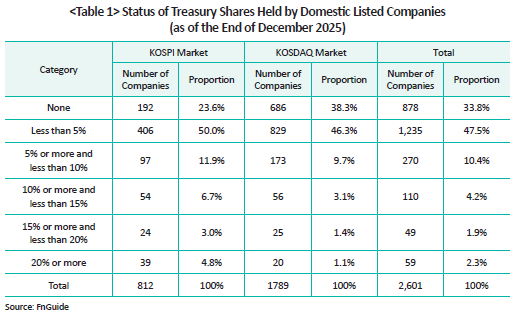
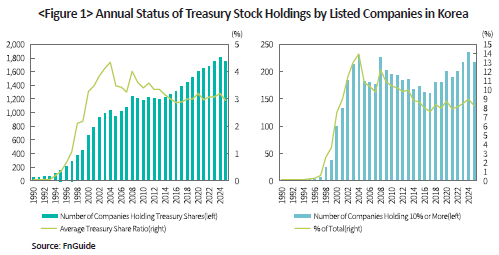
This pattern of treasury stock holdings is not a temporary phenomenon but a structural characteristic that has persisted over a long period (see <Figure 1>).1)
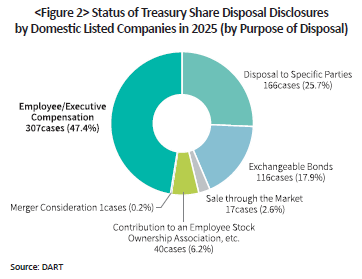
The issue lies in how treasury shares held in this manner are disposed of, as distortions in corporate governance or impairment of shareholder value may occur depending on the purpose and recipient of the disposal. From January to December 2025, there were a total of 647 disclosures of treasury share disposals by listed companies—245 cases on the KOSPI market and 402 cases on the KOSDAQ market. By type of disposal, employee compensation accounted for the largest share at 47.4%, followed by disposals to specific individuals or companies at 25.7%, and issuance of exchangeable bonds at 17.9%. Disposals to specific recipients included cases involving the largest shareholder, the largest shareholder’s lineal descendants, related parties, and affiliated companies.
Disposing of treasury shares for employee compensation or delivering treasury shares instead of newly issued shares as merger consideration does not raise concerns about shareholder value impairment. Likewise, contributing treasury shares to an employee stock ownership association or using them as friendly shares to defend against hostile M&A attempts is distinct from strengthening the control of a particular shareholder. However, disposing of treasury shares to related parties such as the largest shareholder personally or affiliated companies is clearly problematic.
Cases in which the specific recipient was not disclosed despite the disposal being targeted to a particular individual, or in which friendly shareholders were created through the issuance of exchangeable bonds or exchanges of treasury shares, may also pose problems. In particular, disposing of treasury shares to the children of the largest shareholder raises the issue of illegitimate succession of management control. In the case of exchangeable bonds, it should also be noted that subsequent adjustments to the exchange price may increase the number of treasury shares to be delivered.2)
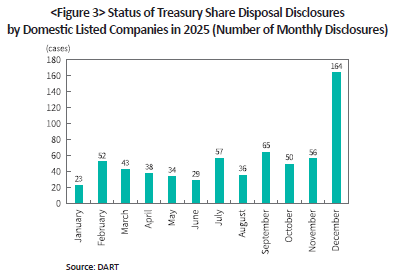
It is noteworthy that disposals of treasury shares surged as the likelihood of passing the bill mandating their cancellation increased. In December 2025 alone, there were 164 disclosures of treasury share disposals, accounting for 25.3% of all such disclosures for the year.3) Notably, the proportion of disposals to specific counterparties in December reached 55.5%, more than double the annual average of 25.7%, and there were also 23 issuances of exchangeable bonds. This provides strong evidence that, ahead of the regulatory change, there was a significant incentive to use treasury shares to stabilize control or restructure succession arrangements.
Problems with the Current Legal Framework and the Need for Reform
The ease with which companies can freely utilize treasury shares stems from structural problems inherent in the current legal framework. The 2011 amendment to the Commercial Act relaxed the obligation to retire or dispose of treasury shares, thereby allowing companies to hold them freely, while the 2015 amendment further expanded the scope of their use. However, this expanded discretion in holding treasury shares has gone beyond the original legislative intent of securing financial flexibility and has led to abuses, as treasury shares are used as a means of strengthening control in the absence of adequate shareholder protection mechanisms. In particular, while the acquisition of treasury shares is subject to strict source-of-funds regulations and procedural requirements under the principle of shareholder equality, there are virtually no institutional safeguards at the disposal stage to prevent transfers of wealth among shareholders or unfair exercises of control. This situation is inconsistent with the legislative intent underlying the 2011 and 2015 amendments to the Commercial Act.
The 2011 amendment to the Commercial Act treated the acquisition of treasury shares as equivalent to the payment of dividends and strictly ensured compliance with the principle of shareholder equality by regulating the relevant procedures and financial sources.4) The acquisition of treasury shares in violation of the principle of shareholder equality is void,5) Directors may also incur liability for damages.6) However, because these principles do not apply at the disposal stage, problems such as transfers of wealth among shareholders or the unfair strengthening of control may arise.
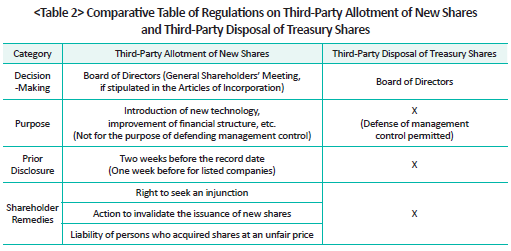
The 2015 amendment to the Commercial Act allowed treasury shares to be used in a manner equivalent to the issuance of new shares. The disposal of treasury shares has the same economic effect as issuing new shares and similarly affects the interests of existing shareholders through changes in shareholder composition. Yet under current law, the level of regulation applied to the issuance of new shares and to the disposal of treasury shares differs significantly. When new shares are allotted to a third party, the Commercial Act strictly requires a legitimate business purpose—such as introducing new technology or improving the company’s financial structure—and provides various protective measures, including prior disclosure and shareholders’ rights to seek injunctive relief. By contrast, the disposal of treasury shares to a third party can be carried out solely by a resolution of the board of directors and may be used for purposes such as defending against hostile takeovers without any particular business justification. This regulatory gap creates an incentive for companies to circumvent the strict regulations governing third-party allotments of new shares by disposing of treasury shares to specific friendly parties.
Major foreign jurisdictions also grant companies discretion to hold treasury shares, but from the company’s standpoint, there is little practical benefit in holding or using them. Some U.S. states, such as California, as well as Germany, impose restrictions on the holding of treasury shares. In U.S. states that follow the Model Business Corporation Act, including California, acquired treasury shares are treated as authorized but unissued shares, having the same effect as mandatory cancellation. In Germany, treasury shares exceeding 10% of capital must be disposed of, and if they cannot be disposed of, they must be cancelled.
In Delaware, the United Kingdom, Japan, and certain other jurisdictions, free retention of treasury shares is permitted. However, in major foreign jurisdictions, treasury shares are not entitled to dividends or voting rights, and they are also excluded from receiving allocations of new shares in mergers or demergers. As a result, they are afforded virtually no rights, and their use is therefore limited. In particular, the level of shareholder protection regarding the disposal of treasury shares is significantly higher in major foreign jurisdictions than in Korea. In the United Kingdom and Germany, shareholders are granted preemptive rights even in the disposal of treasury shares, and when such shares are to be sold to third parties, additional procedures such as a resolution of the general meeting of shareholders are required. In the United States and Japan, shareholders are not granted preemptive rights in either the issuance of new shares or the disposal of treasury shares; however, separate remedies are provided to shareholders to prevent treasury shares from being arbitrarily disposed of to third parties and used to strengthen control.7)
Taking into comprehensive consideration the legislative intent of the amended Commercial Act, legislative examples from major foreign jurisdictions, and the actual practices of listed companies in Korea regarding the disposal of treasury shares, the need to improve the treasury share system can be clearly recognized.
Main Provisions and Significance of the Proposed Amendment to the Commercial Act
First, it clarifies that treasury shares are not “assets” and regulates their disposal in a manner analogous to the issuance of new shares. There has long been debate over whether treasury shares should be regarded as “unissued shares” or as “assets,” and Korean legislation and case law have, to some extent, contributed to this controversy. Under the current Commercial Act, treasury shares are treated like unissued shares in that they carry neither voting rights nor dividend rights, yet they may also be used like assets—for example, as collateral or as consideration for exchangeable bonds.8) From an accounting perspective, treasury shares are treated as a deduction from equity, and gains or losses arising from their acquisition, disposal, or cancellation are not recognized in current profit or loss. In contrast, tax law treats the disposal of treasury shares as a profit-and-loss transaction subject to taxation, and the courts have also taken the view that the essential nature of treasury shares is that of “assets.” This reflects the understanding that the disposal of treasury shares is equivalent to the disposition of the company’s general property.
In response, the amendment makes clear that treasury shares are not “assets” but rather have the character of “unissued shares,” and it revises provisions that had allowed them to be used as if they were “assets.” Specifically, it codifies that treasury shares carry no rights whatsoever and prohibits the allotment of new shares to treasury shares in the event of a merger or spin-off. It also prohibits the use of treasury shares as collateral and the issuance of bonds that may be exchanged for or redeemed with treasury shares. Furthermore, the procedures and grounds for disposing of treasury shares are to be governed by the same rules applicable to the issuance of new shares, while allowing flexible application in light of the nature of the disposal.
Second, the authority to decide on the cancellation, retention, and disposal of treasury shares is granted to shareholders. Rather than mandating unconditional cancellation, the amendment establishes an exception that allows treasury shares to be retained or disposed of with shareholder approval. Previously, the board of directors could unilaterally determine the recipients and purposes of disposal. Under the amendment, however, a treasury share retention and disposal plan must be prepared and approved by the general meeting of shareholders, and treasury shares must then be held or disposed of in accordance with that plan. The permissible grounds for disposal are aligned with those applicable to the issuance of new shares, and disposal is permitted in cases where cancellation of treasury shares or issuance of new shares would be allowed. These include pro rata disposal to shareholders, compensation for executives and employees, contributions to employee stock ownership plans, and payment of merger consideration. Even when disposal is for management purposes, it is restricted—just as in third-party allotments of new shares—to cases “necessary to achieve the company’s business objectives, such as the introduction of new technology or the improvement of its financial structure.”
Third, the amendment establishes safeguards to prevent the improper or abusive use of treasury shares and to protect shareholders. Where a listed company acquires treasury shares through a trust arrangement, the same cancellation obligation and disposal restrictions apply. The trustee may not dispose of the treasury shares during the term of the trust, and treasury shares acquired through a trust must either be canceled within one year or retained and used only in accordance with restrictions approved by the general meeting of shareholders. If the board of directors violates the cancellation obligation or holds or disposes of treasury shares without shareholder approval, each director may be subject to an administrative fine of up to KRW 50 million, the maximum under the Commercial Act. In the event of an unfair disposal of treasury shares, shareholders may seek an injunction or bring an action to invalidate the disposal, and any person who acquires treasury shares at an unfair price is liable to pay the company the difference between that price and the fair issue price.
Fourth, while preserving the legislative intent, the amendment provides reasonable alternatives that take into account the particular circumstances of companies. Under Article 341-2 of the Commercial Act, treasury shares acquired for specific purposes—such as a merger or the exercise of appraisal rights—may be canceled only after a special resolution of the general meeting of shareholders and completion of creditor protection procedures. Accordingly, requests had been made to exempt such shares from the mandatory cancellation requirement. In response, while maintaining the legislative intent of mandatory cancellation and shareholder approval for the holding, disposal, and other uses of treasury shares, the amendment revises the relevant provisions so that treasury shares acquired for specific purposes may also be canceled by a board resolution alone, thereby reducing the procedural burden on companies.
In addition, concerns were raised that in industries subject to foreign ownership restrictions under laws such as the Aviation Safety Act, the Broadcasting Act, and the Telecommunications Business Act, the cancellation of treasury shares could increase the foreign shareholding ratio and thereby result in a violation of law. Accordingly, where the cancellation of treasury shares would cause such a legal violation, the amendment allows the cancellation obligation to be deferred, permitting the shares to be disposed of within three years or, with annual approval from the general meeting of shareholders, to be retained or disposed of.
Future Tasks
If the proposed amendment to the Commercial Act passes the plenary session of the National Assembly, follow-up legislation will be required, as it will bring about various institutional improvements related to treasury shares. First, the relevant provisions of the Corporate Tax Act—which currently treat treasury shares as “assets” and handle their disposal as profit-and-loss transactions—must be revised. A comprehensive review of tax laws will also be necessary, including how to treat the cancellation of treasury shares acquired through mergers. In addition, it will be necessary to refine the provisions of the Financial Investment Services and Capital Markets Act by, for example, establishing mandatory rules prohibiting trustees from disposing of treasury shares in cases of indirect acquisition, and deleting the provision that requires treasury shares acquired through appraisal rights to be disposed of within five years. Furthermore, the improved 2025 disclosure system for treasury share holdings and disposal plans should be reorganized to ensure consistency with the “Treasury Share Holding and Disposal Plan” under the amendment, which is subject to shareholder approval at a general meeting.
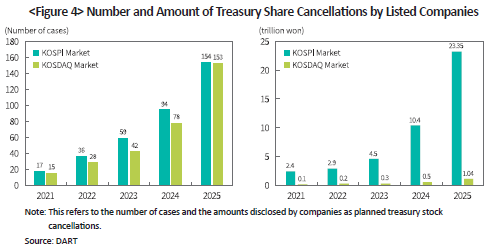
Above all, the most important factor is companies’ voluntary efforts to enhance shareholder value through the cancellation of treasury shares. As voluntary cancellations have been increasing since 2024 (see <Figure 4>), companies are being called upon to take a more proactive approach to improving shareholder value through such cancellations.
If the amendment passes, the revised Commercial Act will apply not only to newly acquired treasury shares but also to those already held, so companies should review this in advance.9) Once the law takes effect, all disposals must be approved by a shareholders’ meeting. Therefore, if a company wishes to dispose of treasury shares this year, it must obtain approval for its Treasury Share Holding and Disposal Plan at either the annual general meeting or an extraordinary general meeting. In addition, if treasury shares are to be disposed of for management purposes, a basis for doing so must be provided in the articles of incorporation—similar to a third-party allotment of newly issued shares—which requires a special resolution of the shareholders’ meeting. It should also be noted that the shareholders’ meeting must approve a one-year plan, and individual disposals may then be carried out within the approved scope by a board resolution; however, under the amendment, prior disclosure must be made one week before each disposal (Commercial Act Article 418(4); Financial Investment Services and Capital Markets Act Article 165-9).
Conclusion
Improving the treasury share system is essential to enhancing the fairness and transparency of the capital market. The currently proposed amendment to the Commercial Act seeks to balance flexibility in corporate financial activities with shareholder protection. It clarifies the legal nature of treasury shares, vests decision-making authority in shareholders, and establishes safeguards to prevent their improper or abusive use. At the same time, its balanced nature is evident in that it provides sufficient exceptions for rational corporate financial management. Therefore, the amendment does not impose unnecessary restrictions on corporate activity; rather, it is an essential measure to restore market fairness and substantively protect shareholders’ rights. It is hoped that this will strengthen confidence in Korea’s capital market and ultimately lead to an increase in corporate value.
In the amendment passed by the National Assembly’s Legislation and Judiciary Committee, the transitional provisions stipulate the following: treasury shares acquired directly must be canceled within one year from the date six months after this Act takes effect; treasury shares over which a pledge has been created must be canceled within one year from the date the pledge is released after this Act takes effect; exchangeable or redeemable bonds must be canceled within one year from the date the claim is extinguished or the exchange/redemption period expires after this Act takes effect; and treasury shares acquired indirectly must be canceled within one year from the date the company receives them back from the trustee after this Act takes effect.
1) A 1994 amendment to the Securities and Exchange Act permitted companies to acquire treasury shares up to 10% of total issued shares, using distributable profits, and a 1998 amendment removed the 10% acquisition limit. In addition, the 2011 amendment to the Commercial Act relaxed the obligation to retire or dispose of treasury shares, and in line with this policy objective, the Financial Investment Services and Capital Markets Act was also amended, allowing companies to hold such shares freely.
2) Company D, for example, disclosed at the time of its issuance of exchangeable bonds in December 2024 that 688,073 treasury shares were scheduled for disposal, but only four months later, in April 2025, it disclosed that the number of shares subject to exchange had increased to 785,751 due to an adjustment to the exchange price.
3) Given that there were 29 disposal disclosures in December 2023 and 43 in December 2024, it can be confirmed that the number nearly quadrupled in December 2025.
4) Ministry of Justice, 2012, Commentary on the Corporate Provisions of the Commercial Act, Donggang Publishing.
5) Supreme Court Decision 2020Da208058, rendered on October 28, 2021.
6) Supreme Court Decision 2018Da298744, rendered on July 15, 2021.
7) For more detailed information on foreign legislative examples, please refer to the following report: Hwang Hyun-young and Jung Su-min, 2024, Tasks for Improving the Treasury Share System to Enhance Shareholder Value, Issue Report 24-13.
8) Supreme Court Decision 2010Da51413, rendered on October 28, 2010.
9) Under the amendment passed by the National Assembly’s Legislation and Judiciary Committee, the supplementary provisions stipulate that directly acquired treasury shares must be canceled within one year from the date six months after the law’s effective date; treasury shares pledged as collateral must be canceled within one year from the date the pledge is released after the law takes effect; exchangeable or redeemable bonds must be canceled within one year from the date the claim is extinguished or the exchange/redemption period expires after the law takes effect; and indirectly acquired treasury shares must be canceled within one year from the date the company receives them back from the trustee after the law takes effect.
This paper examines the current status of treasury share utilization by listed companies and the problems inherent in the existing legal framework, highlights the need for institutional improvement on that basis, and reviews the main contents of the currently proposed amendments to the Commercial Act as well as the tasks that lie ahead.
Current Status and Issues of Treasury Shares Held by Domestic Listed Companies
As of the end of December 2025, 1,723 companies—approximately 66.2% of all listed companies—held treasury shares, among which 8.4% had treasury shares accounting for 10% or more of their outstanding shares (see <Table 1>).
This pattern of treasury stock holdings is not a temporary phenomenon but a structural characteristic that has persisted over a long period (see <Figure 1>).1)
The issue lies in how treasury shares held in this manner are disposed of, as distortions in corporate governance or impairment of shareholder value may occur depending on the purpose and recipient of the disposal. From January to December 2025, there were a total of 647 disclosures of treasury share disposals by listed companies—245 cases on the KOSPI market and 402 cases on the KOSDAQ market. By type of disposal, employee compensation accounted for the largest share at 47.4%, followed by disposals to specific individuals or companies at 25.7%, and issuance of exchangeable bonds at 17.9%. Disposals to specific recipients included cases involving the largest shareholder, the largest shareholder’s lineal descendants, related parties, and affiliated companies.
Disposing of treasury shares for employee compensation or delivering treasury shares instead of newly issued shares as merger consideration does not raise concerns about shareholder value impairment. Likewise, contributing treasury shares to an employee stock ownership association or using them as friendly shares to defend against hostile M&A attempts is distinct from strengthening the control of a particular shareholder. However, disposing of treasury shares to related parties such as the largest shareholder personally or affiliated companies is clearly problematic.
Cases in which the specific recipient was not disclosed despite the disposal being targeted to a particular individual, or in which friendly shareholders were created through the issuance of exchangeable bonds or exchanges of treasury shares, may also pose problems. In particular, disposing of treasury shares to the children of the largest shareholder raises the issue of illegitimate succession of management control. In the case of exchangeable bonds, it should also be noted that subsequent adjustments to the exchange price may increase the number of treasury shares to be delivered.2)
It is noteworthy that disposals of treasury shares surged as the likelihood of passing the bill mandating their cancellation increased. In December 2025 alone, there were 164 disclosures of treasury share disposals, accounting for 25.3% of all such disclosures for the year.3) Notably, the proportion of disposals to specific counterparties in December reached 55.5%, more than double the annual average of 25.7%, and there were also 23 issuances of exchangeable bonds. This provides strong evidence that, ahead of the regulatory change, there was a significant incentive to use treasury shares to stabilize control or restructure succession arrangements.
Problems with the Current Legal Framework and the Need for Reform
The ease with which companies can freely utilize treasury shares stems from structural problems inherent in the current legal framework. The 2011 amendment to the Commercial Act relaxed the obligation to retire or dispose of treasury shares, thereby allowing companies to hold them freely, while the 2015 amendment further expanded the scope of their use. However, this expanded discretion in holding treasury shares has gone beyond the original legislative intent of securing financial flexibility and has led to abuses, as treasury shares are used as a means of strengthening control in the absence of adequate shareholder protection mechanisms. In particular, while the acquisition of treasury shares is subject to strict source-of-funds regulations and procedural requirements under the principle of shareholder equality, there are virtually no institutional safeguards at the disposal stage to prevent transfers of wealth among shareholders or unfair exercises of control. This situation is inconsistent with the legislative intent underlying the 2011 and 2015 amendments to the Commercial Act.
The 2011 amendment to the Commercial Act treated the acquisition of treasury shares as equivalent to the payment of dividends and strictly ensured compliance with the principle of shareholder equality by regulating the relevant procedures and financial sources.4) The acquisition of treasury shares in violation of the principle of shareholder equality is void,5) Directors may also incur liability for damages.6) However, because these principles do not apply at the disposal stage, problems such as transfers of wealth among shareholders or the unfair strengthening of control may arise.
The 2015 amendment to the Commercial Act allowed treasury shares to be used in a manner equivalent to the issuance of new shares. The disposal of treasury shares has the same economic effect as issuing new shares and similarly affects the interests of existing shareholders through changes in shareholder composition. Yet under current law, the level of regulation applied to the issuance of new shares and to the disposal of treasury shares differs significantly. When new shares are allotted to a third party, the Commercial Act strictly requires a legitimate business purpose—such as introducing new technology or improving the company’s financial structure—and provides various protective measures, including prior disclosure and shareholders’ rights to seek injunctive relief. By contrast, the disposal of treasury shares to a third party can be carried out solely by a resolution of the board of directors and may be used for purposes such as defending against hostile takeovers without any particular business justification. This regulatory gap creates an incentive for companies to circumvent the strict regulations governing third-party allotments of new shares by disposing of treasury shares to specific friendly parties.
Major foreign jurisdictions also grant companies discretion to hold treasury shares, but from the company’s standpoint, there is little practical benefit in holding or using them. Some U.S. states, such as California, as well as Germany, impose restrictions on the holding of treasury shares. In U.S. states that follow the Model Business Corporation Act, including California, acquired treasury shares are treated as authorized but unissued shares, having the same effect as mandatory cancellation. In Germany, treasury shares exceeding 10% of capital must be disposed of, and if they cannot be disposed of, they must be cancelled.
In Delaware, the United Kingdom, Japan, and certain other jurisdictions, free retention of treasury shares is permitted. However, in major foreign jurisdictions, treasury shares are not entitled to dividends or voting rights, and they are also excluded from receiving allocations of new shares in mergers or demergers. As a result, they are afforded virtually no rights, and their use is therefore limited. In particular, the level of shareholder protection regarding the disposal of treasury shares is significantly higher in major foreign jurisdictions than in Korea. In the United Kingdom and Germany, shareholders are granted preemptive rights even in the disposal of treasury shares, and when such shares are to be sold to third parties, additional procedures such as a resolution of the general meeting of shareholders are required. In the United States and Japan, shareholders are not granted preemptive rights in either the issuance of new shares or the disposal of treasury shares; however, separate remedies are provided to shareholders to prevent treasury shares from being arbitrarily disposed of to third parties and used to strengthen control.7)
Taking into comprehensive consideration the legislative intent of the amended Commercial Act, legislative examples from major foreign jurisdictions, and the actual practices of listed companies in Korea regarding the disposal of treasury shares, the need to improve the treasury share system can be clearly recognized.
Main Provisions and Significance of the Proposed Amendment to the Commercial Act
First, it clarifies that treasury shares are not “assets” and regulates their disposal in a manner analogous to the issuance of new shares. There has long been debate over whether treasury shares should be regarded as “unissued shares” or as “assets,” and Korean legislation and case law have, to some extent, contributed to this controversy. Under the current Commercial Act, treasury shares are treated like unissued shares in that they carry neither voting rights nor dividend rights, yet they may also be used like assets—for example, as collateral or as consideration for exchangeable bonds.8) From an accounting perspective, treasury shares are treated as a deduction from equity, and gains or losses arising from their acquisition, disposal, or cancellation are not recognized in current profit or loss. In contrast, tax law treats the disposal of treasury shares as a profit-and-loss transaction subject to taxation, and the courts have also taken the view that the essential nature of treasury shares is that of “assets.” This reflects the understanding that the disposal of treasury shares is equivalent to the disposition of the company’s general property.
In response, the amendment makes clear that treasury shares are not “assets” but rather have the character of “unissued shares,” and it revises provisions that had allowed them to be used as if they were “assets.” Specifically, it codifies that treasury shares carry no rights whatsoever and prohibits the allotment of new shares to treasury shares in the event of a merger or spin-off. It also prohibits the use of treasury shares as collateral and the issuance of bonds that may be exchanged for or redeemed with treasury shares. Furthermore, the procedures and grounds for disposing of treasury shares are to be governed by the same rules applicable to the issuance of new shares, while allowing flexible application in light of the nature of the disposal.
Second, the authority to decide on the cancellation, retention, and disposal of treasury shares is granted to shareholders. Rather than mandating unconditional cancellation, the amendment establishes an exception that allows treasury shares to be retained or disposed of with shareholder approval. Previously, the board of directors could unilaterally determine the recipients and purposes of disposal. Under the amendment, however, a treasury share retention and disposal plan must be prepared and approved by the general meeting of shareholders, and treasury shares must then be held or disposed of in accordance with that plan. The permissible grounds for disposal are aligned with those applicable to the issuance of new shares, and disposal is permitted in cases where cancellation of treasury shares or issuance of new shares would be allowed. These include pro rata disposal to shareholders, compensation for executives and employees, contributions to employee stock ownership plans, and payment of merger consideration. Even when disposal is for management purposes, it is restricted—just as in third-party allotments of new shares—to cases “necessary to achieve the company’s business objectives, such as the introduction of new technology or the improvement of its financial structure.”
Third, the amendment establishes safeguards to prevent the improper or abusive use of treasury shares and to protect shareholders. Where a listed company acquires treasury shares through a trust arrangement, the same cancellation obligation and disposal restrictions apply. The trustee may not dispose of the treasury shares during the term of the trust, and treasury shares acquired through a trust must either be canceled within one year or retained and used only in accordance with restrictions approved by the general meeting of shareholders. If the board of directors violates the cancellation obligation or holds or disposes of treasury shares without shareholder approval, each director may be subject to an administrative fine of up to KRW 50 million, the maximum under the Commercial Act. In the event of an unfair disposal of treasury shares, shareholders may seek an injunction or bring an action to invalidate the disposal, and any person who acquires treasury shares at an unfair price is liable to pay the company the difference between that price and the fair issue price.
Fourth, while preserving the legislative intent, the amendment provides reasonable alternatives that take into account the particular circumstances of companies. Under Article 341-2 of the Commercial Act, treasury shares acquired for specific purposes—such as a merger or the exercise of appraisal rights—may be canceled only after a special resolution of the general meeting of shareholders and completion of creditor protection procedures. Accordingly, requests had been made to exempt such shares from the mandatory cancellation requirement. In response, while maintaining the legislative intent of mandatory cancellation and shareholder approval for the holding, disposal, and other uses of treasury shares, the amendment revises the relevant provisions so that treasury shares acquired for specific purposes may also be canceled by a board resolution alone, thereby reducing the procedural burden on companies.
In addition, concerns were raised that in industries subject to foreign ownership restrictions under laws such as the Aviation Safety Act, the Broadcasting Act, and the Telecommunications Business Act, the cancellation of treasury shares could increase the foreign shareholding ratio and thereby result in a violation of law. Accordingly, where the cancellation of treasury shares would cause such a legal violation, the amendment allows the cancellation obligation to be deferred, permitting the shares to be disposed of within three years or, with annual approval from the general meeting of shareholders, to be retained or disposed of.
Future Tasks
If the proposed amendment to the Commercial Act passes the plenary session of the National Assembly, follow-up legislation will be required, as it will bring about various institutional improvements related to treasury shares. First, the relevant provisions of the Corporate Tax Act—which currently treat treasury shares as “assets” and handle their disposal as profit-and-loss transactions—must be revised. A comprehensive review of tax laws will also be necessary, including how to treat the cancellation of treasury shares acquired through mergers. In addition, it will be necessary to refine the provisions of the Financial Investment Services and Capital Markets Act by, for example, establishing mandatory rules prohibiting trustees from disposing of treasury shares in cases of indirect acquisition, and deleting the provision that requires treasury shares acquired through appraisal rights to be disposed of within five years. Furthermore, the improved 2025 disclosure system for treasury share holdings and disposal plans should be reorganized to ensure consistency with the “Treasury Share Holding and Disposal Plan” under the amendment, which is subject to shareholder approval at a general meeting.
Above all, the most important factor is companies’ voluntary efforts to enhance shareholder value through the cancellation of treasury shares. As voluntary cancellations have been increasing since 2024 (see <Figure 4>), companies are being called upon to take a more proactive approach to improving shareholder value through such cancellations.
If the amendment passes, the revised Commercial Act will apply not only to newly acquired treasury shares but also to those already held, so companies should review this in advance.9) Once the law takes effect, all disposals must be approved by a shareholders’ meeting. Therefore, if a company wishes to dispose of treasury shares this year, it must obtain approval for its Treasury Share Holding and Disposal Plan at either the annual general meeting or an extraordinary general meeting. In addition, if treasury shares are to be disposed of for management purposes, a basis for doing so must be provided in the articles of incorporation—similar to a third-party allotment of newly issued shares—which requires a special resolution of the shareholders’ meeting. It should also be noted that the shareholders’ meeting must approve a one-year plan, and individual disposals may then be carried out within the approved scope by a board resolution; however, under the amendment, prior disclosure must be made one week before each disposal (Commercial Act Article 418(4); Financial Investment Services and Capital Markets Act Article 165-9).
Conclusion
Improving the treasury share system is essential to enhancing the fairness and transparency of the capital market. The currently proposed amendment to the Commercial Act seeks to balance flexibility in corporate financial activities with shareholder protection. It clarifies the legal nature of treasury shares, vests decision-making authority in shareholders, and establishes safeguards to prevent their improper or abusive use. At the same time, its balanced nature is evident in that it provides sufficient exceptions for rational corporate financial management. Therefore, the amendment does not impose unnecessary restrictions on corporate activity; rather, it is an essential measure to restore market fairness and substantively protect shareholders’ rights. It is hoped that this will strengthen confidence in Korea’s capital market and ultimately lead to an increase in corporate value.
In the amendment passed by the National Assembly’s Legislation and Judiciary Committee, the transitional provisions stipulate the following: treasury shares acquired directly must be canceled within one year from the date six months after this Act takes effect; treasury shares over which a pledge has been created must be canceled within one year from the date the pledge is released after this Act takes effect; exchangeable or redeemable bonds must be canceled within one year from the date the claim is extinguished or the exchange/redemption period expires after this Act takes effect; and treasury shares acquired indirectly must be canceled within one year from the date the company receives them back from the trustee after this Act takes effect.
1) A 1994 amendment to the Securities and Exchange Act permitted companies to acquire treasury shares up to 10% of total issued shares, using distributable profits, and a 1998 amendment removed the 10% acquisition limit. In addition, the 2011 amendment to the Commercial Act relaxed the obligation to retire or dispose of treasury shares, and in line with this policy objective, the Financial Investment Services and Capital Markets Act was also amended, allowing companies to hold such shares freely.
2) Company D, for example, disclosed at the time of its issuance of exchangeable bonds in December 2024 that 688,073 treasury shares were scheduled for disposal, but only four months later, in April 2025, it disclosed that the number of shares subject to exchange had increased to 785,751 due to an adjustment to the exchange price.
3) Given that there were 29 disposal disclosures in December 2023 and 43 in December 2024, it can be confirmed that the number nearly quadrupled in December 2025.
4) Ministry of Justice, 2012, Commentary on the Corporate Provisions of the Commercial Act, Donggang Publishing.
5) Supreme Court Decision 2020Da208058, rendered on October 28, 2021.
6) Supreme Court Decision 2018Da298744, rendered on July 15, 2021.
7) For more detailed information on foreign legislative examples, please refer to the following report: Hwang Hyun-young and Jung Su-min, 2024, Tasks for Improving the Treasury Share System to Enhance Shareholder Value, Issue Report 24-13.
8) Supreme Court Decision 2010Da51413, rendered on October 28, 2010.
9) Under the amendment passed by the National Assembly’s Legislation and Judiciary Committee, the supplementary provisions stipulate that directly acquired treasury shares must be canceled within one year from the date six months after the law’s effective date; treasury shares pledged as collateral must be canceled within one year from the date the pledge is released after the law takes effect; exchangeable or redeemable bonds must be canceled within one year from the date the claim is extinguished or the exchange/redemption period expires after the law takes effect; and indirectly acquired treasury shares must be canceled within one year from the date the company receives them back from the trustee after the law takes effect.