Our bi-weekly Opinion provides you with latest updates and analysis on major capital market and financial investment industry issues.
Structural Characteristics of the Financial Assets and Liabilities of Korean Non-financial Corporations and their Implications
Publication date Sep. 08, 2026
Summary
Corporate dependence on banks is very high in Korea. Although the share of investment assets in the financial assets of Korean corporations has increased, a substantial portion of their financial assets continues to be held in short-term deposits. On the liability side, the share of loan liabilities has also increased. In addition, a large portion of corporate financial assets is channeled back to financial institutions, mainly in the form of deposits, and is subsequently used as a funding source by those institutions.
By contrast, U.S. corporations exhibit relatively low dependence on banks because a large share of their external financing is raised through market-based instruments such as corporate bonds. German corporations also exhibit relatively low dependence on banks. Although loan liabilities account for a very large share of their financial liabilities, intra-group financing and cash pooling among affiliated firms are widely used.
These differences appear to reflect not only the fact that Korea has developed a bank-based financial system, but also the fact that the supply channels of corporate finance have not been sufficiently diversified. Accordingly, there is a need to diversify the channels through which corporate finance is provided so that corporate financial assets can be managed more efficiently and financial resources can be supplied in a timely manner to productive sectors of the economy.
The financial activities of non-financial corporations are no less important than their production activities. For corporations to sustain their production activities, they must be able to manage surplus funds efficiently and raise necessary funds in a timely manner.1) Corporate financial activities may be influenced not only by firms’ demand for finance but also by the structure through which corporate finance is supplied. From this perspective, this article examines the structural characteristics of the financial assets and liabilities of Korean non-financial corporations using financial accounts data and draws implications for Korea through a comparison with non-financial corporations in the United States and Germany.
Structural Characteristics of the Financial Assets and Liabilities of Korean Corporations
The financial assets of Korean corporations amounted to KRW 1,332.1 trillion at the end of 2025, representing a 3.4-fold increase from KRW 395.3 trillion at the end of 2010. Over the same period, financial liabilities increased 2.5-fold, from KRW 1,016.5 trillion to KRW 2,507.8 trillion. As a result, the ratio of financial assets to financial liabilities rose from 38.9% at the end of 2010 to 53.1% at the end of 2025, an increase of 14.2 percentage points.
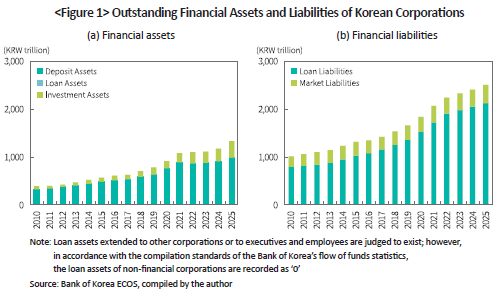
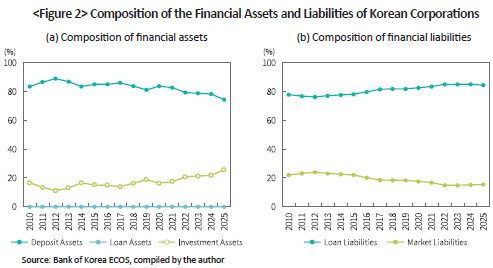
Examining changes in the composition of the financial assets and liabilities of Korean corporations from 2010 to 2025, the share of investment assets increased on the asset side, while the share of loan liabilities increased on the liability side. The share of deposit assets fell by 9.2 percentage points, from 83.6% at the end of 2010 to 74.4% at the end of 2025, while the share of investment assets increased by the same amount, from 16.4% to 25.6%. On the liability side, the share of loan liabilities rose by 6.7 percentage points to 84.7% at the end of 2025, while the share of market liabilities declined by 6.7 percentage points to 15.3%.
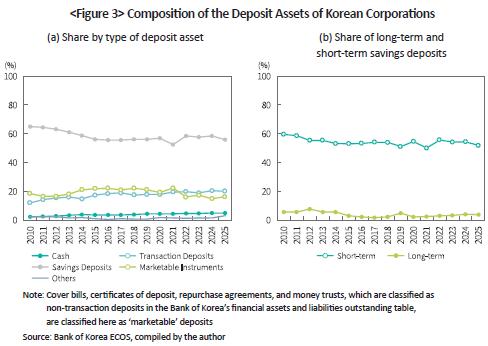
Examining the composition of the financial assets and liabilities of Korean corporations in greater detail reveals four main characteristics. First, Korean corporations tend to manage their surplus funds primarily through short-term deposits. Although the share of deposit assets has declined, it remained high at around 75% at the end of 2025. Within deposit assets, savings deposits accounted for 55.8%, most of which were held in short-term deposits, while long-term deposits accounted for less than 5%. This suggests that, even when corporations place their surplus funds in deposits, they tend to place greater emphasis on liquidity than on profitability.
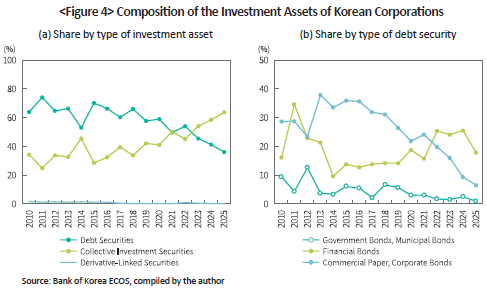
Second, compared with the past, more Korean corporations appear to take the profitability of surplus-fund management into account. This is directly reflected in the decline in the share of deposit assets and the corresponding increase in the share of investment assets within total financial assets. Within investment assets, however, the share of debt securities has declined, while the share of collective investment securities has increased. Within debt securities, the shares of government and local government bonds, as well as commercial paper and corporate bonds, have continued to fall, whereas the share of financial debentures has shown an upward trend since 2014.
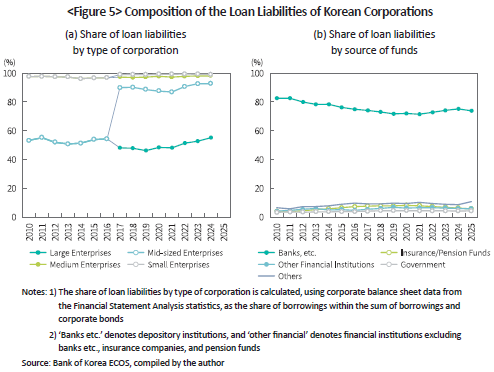
Third, Korean corporations rely heavily on loans to finance their funding needs. Large corporations raise around 50% of their financial liabilities through loans, while mid-sized enterprises and small and medium-sized enterprises rely on loans for 90% or more of their financial liabilities. Meanwhile, dependence on loans from banks and other depository institutions has gradually declined. Their share in total loan liabilities fell by 8.7 percentage points, from 82.6% in 2010 to 73.9% in 2025. Nevertheless, loans from banks and other depository institutions still account for a substantial majority of total loan liabilities.
Fourth, the surplus funds of Korean corporations are used as funding sources for financial institutions. When the financial assets of Korean corporations are classified by the ultimate destination of funds, around 90% are found to be channeled back to financial institutions. By contrast, the share of funds flowing to other corporations declined from 5.7% at the end of 2010 to 2.4% at the end of 2025.
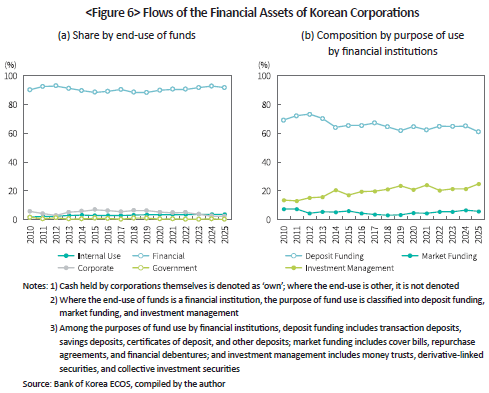
When the funds channeled from corporations to financial institutions are classified by their purpose, the share used as funding sources for financial institutions declined from 76.6% at the end of 2010 to 66.8% at the end of 2025, as the share allocated for investment management increased with corporations placing greater emphasis on profitability. Nevertheless, the share used as funding sources for financial institutions remains overwhelmingly high. In particular, although the share accounted for by deposits has gradually declined, it still stands at around 60%.
Comparison with U.S. and German Corporations
Examining the composition of the financial assets of U.S. corporations, a pattern opposite to that of Korean corporations is observed: the share of deposit assets has increased, while the share of investment assets has declined. Moreover, unlike in Korea, the gap between the shares of deposit assets and investment assets has widened over time. This suggests that U.S. corporations have increasingly placed greater emphasis on liquidity in managing their surplus funds (Bates et al., 2009; Harford et al., 2014; Gao et al., 2021; Falato et al., 2022; Singer and Yang, 2025).
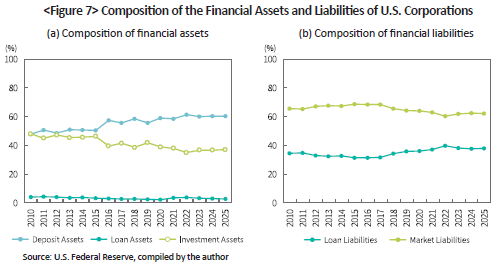
Considerable differences from Korean corporations are also evident in the composition of the financial liabilities of U.S. corporations. For U.S. corporations, loan liabilities account for less than 40% of total financial liabilities, while market liabilities account for more than 60%. Their dependence on bank loans is also relatively low. Although the Federal Reserve data do not identify the lenders of real estate-secured loans, even if all such loans are assumed to have been provided by banks, bank loans would account for only 47.8% of total loan liabilities at the end of 2025, remaining below one-half.2)
German corporations are highly distinctive. Examining the composition of their financial assets, the share of loan assets is larger than the share of deposit assets, and the gap is on a widening trend. Meanwhile, the share of investment assets is at a much lower level than for Korean corporations. A major reason for this distinctive financial structure is the importance of intra-group financing within German corporate groups, including intercompany loans and cash pooling among affiliated firms.3) 4)
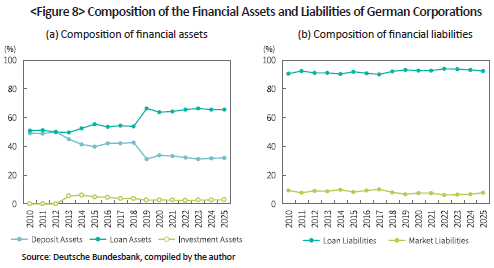
Distinctive characteristics are also evident in the composition of the financial liabilities of German corporations. Loan liabilities account for around 95% of total financial liabilities, a higher share than for Korean corporations. However, unlike in Korea, loans from banks account for a relatively small share of total loan liabilities. Moreover, the share of bank loans has declined over time, while the share of loans from other non-financial corporations has increased (Deutsche Bundesbank, 2012, 2026).5)
Policy Implications
The financial system of the United States has the characteristic of having developed with the capital market at its center, and that of Germany with banks at its center (Allen and Gale, 2000; Levine, 2002; Bank of Korea, 2013, 5. 24). Taking this into account, one might expect that the bank dependence of U.S. corporations would be low and that of German corporations would be high.
However, a closer examination of the financial assets and liabilities of German corporations shows that their dependence on banks is also relatively low. The share of deposit assets in total financial assets is lower than in the United States, and although loan liabilities account for a very large share of total financial liabilities, bank loans account for only a slightly larger share of total loan liabilities than in the United States, or a broadly similar share.
By contrast, Korean corporations exhibit a much higher dependence on banks than U.S. and German corporations. This appears to reflect not only the fact that Korea has developed as a bank-based financial system, but also the insufficient diversification of corporate finance channels and the limited use of intra-group financing practices, such as cash pooling, that are more prevalent in Germany.
At the same time, it would be inappropriate to regard corporate finance as inefficient merely because its supply structure is concentrated in banks. If banks can manage corporate surplus funds efficiently and provide firms with the funds they need in a timely and efficient manner, a bank-centered corporate finance structure can also be efficient.
Given that a substantial portion of the financial assets of Korean corporations is held in short-term bank deposits, it is difficult to conclude that corporate surplus funds are being managed efficiently. This is also consistent with the findings of the annual Survey on the Financial Conditions of Small and Medium-sized Enterprises conducted by the Industrial Bank of Korea (2026).6) In addition, given that banks generally require collateral or guarantees when extending corporate loans, there also appears to be room for improvement in the efficiency of corporate fund allocation from the perspective of productive finance (Financial Services Commission, September 19, 2025; Lee and Kwon, 2021).7)
Accordingly, policy efforts should focus on two complementary objectives: improving the efficiency of corporate surplus-fund management and diversifying the channels through which firms obtain external finance. In particular, corporations should be able to manage surplus funds through a wider range of financial intermediaries, including securities firms, while gaining timely access to market-based and other forms of financing suited to their funding needs.
1) If the financial assets of a corporation are defined as assets in which surplus funds are managed through financial instruments and the like, financial assets can be broadly divided into deposit assets, loan assets, and investment assets; and if the financial liabilities of a corporation are defined as liabilities through which the funds it lacks are raised by means of loans or the issuance of bonds and the like, financial liabilities can be broadly divided into loan liabilities and market liabilities.
2) Taking into account that in the United States mortgage companies, insurance companies, private equity funds, and others also handle a substantial share of real estate-secured lending to corporations, the bank loan dependence of U.S. corporations is judged to be even lower.
3) as of the end of 2025, within loan assets, loans to non-financial corporations account for 68.1%, loans to non-bank financial institutions 6.2%, loans abroad 22.7%, and loans to the government 3.0%. In addition, within loan liabilities, loans from non-financial corporations account for 35.5%, loans from banks 30.0%, loans from non-bank financial institutions 4.6%, loans from abroad 27.5%, and loans from the government 2.4%. Here, ‘non-bank financial institutions’ refers to financial institutions excluding Monetary Financial Institutions such as commercial banks, regional banks, and savings banks.
4) One of the reasons cash pooling, by which business groups internally redistribute liquidity, is actively utilized in Germany is the exemption under Article 2(1)(7) of the German Banking Act (KWG), which excludes from the scope of application of general credit institution regulation those enterprises that conduct banking business among parent companies, subsidiaries, or sister companies (Deutsche Bundesbank, 2013).
5) Within loan liabilities, the share of loans from banks decreased by 28.6 percentage points, from 58.6% as of the end of 2010 to 30.0% as of the end of 2025, whereas the share of loans from non-financial corporations increased by 20.6 percentage points, from 14.9% as of the end of 2010 to 35.5% as of the end of 2025.
6) According to the Industrial Bank of Korea’s 2026 Survey on the Financial Conditions of Small and Medium-sized Enterprises, 39.0% of SMEs responded that they do not manage surplus funds, and among SMEs that do manage surplus funds, 84.9% responded that they manage them in demand-withdrawal deposits and 10.2% in savings deposits.
7) On the basis of empirical analysis results, Lee and Kwon (2021) assess that while Korean banks performed relatively well the function of supplying sufficient funds to corporations, it is difficult to regard them as having performed well the further function of selectively allocating those funds to corporations with high productivity and high value-added creation capacity.
References
Financial Services Commission, 2025. 9. 19, Direction for Promoting the 「Grand Transition to Productive Finance」 , attachment to press release.
Lee, B. Y. and Kwon, H. J., 2021, Corporate Lending by Korean Banks and Corporate Growth, Korea Institute of Finance, Financial Analysis Report Vol. 2021, No. 6.
Bank of Korea, 2013. 5. 24, Key Characteristics of the German Financial System and Its Effects on Small and Medium-sized Enterprises, Frankfurt Office Research Study.
Industrial Bank of Korea, 2026, 2026 Survey on the Financial Conditions of Small and Medium-sized Enterprises.
Allen, F. and Gale, D., 2000, Comparing Financial Systems, Cambridge, MA: MIT Press.
Bates, T. W., Kahle, K. M., and Stulz, R. M., 2009, Why Do U.S. Firms Hold So Much More Cash than They Used To? Journal of Finance 64(5), 1985–2021.
Deutsche Bundesbank, 2012, Long-term Developments in Corporate Financing in Germany: Evidence Based on the Financial Accounts, Monthly Report, January 2012.
Deutsche Bundesbank, 2013, Notice: Netting, clearing and cash pooling.
Deutsche Bundesbank, 2026, “Trends in Corporate Financing in the Euro Area,” Monthly Report, April 2026.
Falato, A., Kadyrzhanova, D., Sim, J., and Steri, R., 2022, Rising Intangible Capital, Shrinking Debt Capacity, and the U.S. Corporate Savings Glut, Journal of Finance 77(5), 2799-2852.
Gao, X., Whited T. M., and Zhang, N., 2021, Corporate Money Demand, The Review of Financial Studies 34(4), 1834-1866.
Harford, J., Klasa, S., and Maxwell, W. F., 2014, Refinancing Risk and Cash Holdings, Journal of Finance 69(3), 975–1012.
Levine, R., 2002, Bank-Based or Market-Based Financial Systems: Which Is Better? Journal of Financial Intermediation 11(4), 398–428.
Singer, E. and Yang, J., 2025, Corporate Cash Accumulation During the COVID-19 Pandemic, Federal Reserve FEDS Notes.
Structural Characteristics of the Financial Assets and Liabilities of Korean Corporations
The financial assets of Korean corporations amounted to KRW 1,332.1 trillion at the end of 2025, representing a 3.4-fold increase from KRW 395.3 trillion at the end of 2010. Over the same period, financial liabilities increased 2.5-fold, from KRW 1,016.5 trillion to KRW 2,507.8 trillion. As a result, the ratio of financial assets to financial liabilities rose from 38.9% at the end of 2010 to 53.1% at the end of 2025, an increase of 14.2 percentage points.
Examining changes in the composition of the financial assets and liabilities of Korean corporations from 2010 to 2025, the share of investment assets increased on the asset side, while the share of loan liabilities increased on the liability side. The share of deposit assets fell by 9.2 percentage points, from 83.6% at the end of 2010 to 74.4% at the end of 2025, while the share of investment assets increased by the same amount, from 16.4% to 25.6%. On the liability side, the share of loan liabilities rose by 6.7 percentage points to 84.7% at the end of 2025, while the share of market liabilities declined by 6.7 percentage points to 15.3%.
Examining the composition of the financial assets and liabilities of Korean corporations in greater detail reveals four main characteristics. First, Korean corporations tend to manage their surplus funds primarily through short-term deposits. Although the share of deposit assets has declined, it remained high at around 75% at the end of 2025. Within deposit assets, savings deposits accounted for 55.8%, most of which were held in short-term deposits, while long-term deposits accounted for less than 5%. This suggests that, even when corporations place their surplus funds in deposits, they tend to place greater emphasis on liquidity than on profitability.
Second, compared with the past, more Korean corporations appear to take the profitability of surplus-fund management into account. This is directly reflected in the decline in the share of deposit assets and the corresponding increase in the share of investment assets within total financial assets. Within investment assets, however, the share of debt securities has declined, while the share of collective investment securities has increased. Within debt securities, the shares of government and local government bonds, as well as commercial paper and corporate bonds, have continued to fall, whereas the share of financial debentures has shown an upward trend since 2014.
Third, Korean corporations rely heavily on loans to finance their funding needs. Large corporations raise around 50% of their financial liabilities through loans, while mid-sized enterprises and small and medium-sized enterprises rely on loans for 90% or more of their financial liabilities. Meanwhile, dependence on loans from banks and other depository institutions has gradually declined. Their share in total loan liabilities fell by 8.7 percentage points, from 82.6% in 2010 to 73.9% in 2025. Nevertheless, loans from banks and other depository institutions still account for a substantial majority of total loan liabilities.
Fourth, the surplus funds of Korean corporations are used as funding sources for financial institutions. When the financial assets of Korean corporations are classified by the ultimate destination of funds, around 90% are found to be channeled back to financial institutions. By contrast, the share of funds flowing to other corporations declined from 5.7% at the end of 2010 to 2.4% at the end of 2025.
When the funds channeled from corporations to financial institutions are classified by their purpose, the share used as funding sources for financial institutions declined from 76.6% at the end of 2010 to 66.8% at the end of 2025, as the share allocated for investment management increased with corporations placing greater emphasis on profitability. Nevertheless, the share used as funding sources for financial institutions remains overwhelmingly high. In particular, although the share accounted for by deposits has gradually declined, it still stands at around 60%.
Comparison with U.S. and German Corporations
Examining the composition of the financial assets of U.S. corporations, a pattern opposite to that of Korean corporations is observed: the share of deposit assets has increased, while the share of investment assets has declined. Moreover, unlike in Korea, the gap between the shares of deposit assets and investment assets has widened over time. This suggests that U.S. corporations have increasingly placed greater emphasis on liquidity in managing their surplus funds (Bates et al., 2009; Harford et al., 2014; Gao et al., 2021; Falato et al., 2022; Singer and Yang, 2025).
Considerable differences from Korean corporations are also evident in the composition of the financial liabilities of U.S. corporations. For U.S. corporations, loan liabilities account for less than 40% of total financial liabilities, while market liabilities account for more than 60%. Their dependence on bank loans is also relatively low. Although the Federal Reserve data do not identify the lenders of real estate-secured loans, even if all such loans are assumed to have been provided by banks, bank loans would account for only 47.8% of total loan liabilities at the end of 2025, remaining below one-half.2)
German corporations are highly distinctive. Examining the composition of their financial assets, the share of loan assets is larger than the share of deposit assets, and the gap is on a widening trend. Meanwhile, the share of investment assets is at a much lower level than for Korean corporations. A major reason for this distinctive financial structure is the importance of intra-group financing within German corporate groups, including intercompany loans and cash pooling among affiliated firms.3) 4)
Distinctive characteristics are also evident in the composition of the financial liabilities of German corporations. Loan liabilities account for around 95% of total financial liabilities, a higher share than for Korean corporations. However, unlike in Korea, loans from banks account for a relatively small share of total loan liabilities. Moreover, the share of bank loans has declined over time, while the share of loans from other non-financial corporations has increased (Deutsche Bundesbank, 2012, 2026).5)
Policy Implications
The financial system of the United States has the characteristic of having developed with the capital market at its center, and that of Germany with banks at its center (Allen and Gale, 2000; Levine, 2002; Bank of Korea, 2013, 5. 24). Taking this into account, one might expect that the bank dependence of U.S. corporations would be low and that of German corporations would be high.
However, a closer examination of the financial assets and liabilities of German corporations shows that their dependence on banks is also relatively low. The share of deposit assets in total financial assets is lower than in the United States, and although loan liabilities account for a very large share of total financial liabilities, bank loans account for only a slightly larger share of total loan liabilities than in the United States, or a broadly similar share.
By contrast, Korean corporations exhibit a much higher dependence on banks than U.S. and German corporations. This appears to reflect not only the fact that Korea has developed as a bank-based financial system, but also the insufficient diversification of corporate finance channels and the limited use of intra-group financing practices, such as cash pooling, that are more prevalent in Germany.
At the same time, it would be inappropriate to regard corporate finance as inefficient merely because its supply structure is concentrated in banks. If banks can manage corporate surplus funds efficiently and provide firms with the funds they need in a timely and efficient manner, a bank-centered corporate finance structure can also be efficient.
Given that a substantial portion of the financial assets of Korean corporations is held in short-term bank deposits, it is difficult to conclude that corporate surplus funds are being managed efficiently. This is also consistent with the findings of the annual Survey on the Financial Conditions of Small and Medium-sized Enterprises conducted by the Industrial Bank of Korea (2026).6) In addition, given that banks generally require collateral or guarantees when extending corporate loans, there also appears to be room for improvement in the efficiency of corporate fund allocation from the perspective of productive finance (Financial Services Commission, September 19, 2025; Lee and Kwon, 2021).7)
Accordingly, policy efforts should focus on two complementary objectives: improving the efficiency of corporate surplus-fund management and diversifying the channels through which firms obtain external finance. In particular, corporations should be able to manage surplus funds through a wider range of financial intermediaries, including securities firms, while gaining timely access to market-based and other forms of financing suited to their funding needs.
1) If the financial assets of a corporation are defined as assets in which surplus funds are managed through financial instruments and the like, financial assets can be broadly divided into deposit assets, loan assets, and investment assets; and if the financial liabilities of a corporation are defined as liabilities through which the funds it lacks are raised by means of loans or the issuance of bonds and the like, financial liabilities can be broadly divided into loan liabilities and market liabilities.
2) Taking into account that in the United States mortgage companies, insurance companies, private equity funds, and others also handle a substantial share of real estate-secured lending to corporations, the bank loan dependence of U.S. corporations is judged to be even lower.
3) as of the end of 2025, within loan assets, loans to non-financial corporations account for 68.1%, loans to non-bank financial institutions 6.2%, loans abroad 22.7%, and loans to the government 3.0%. In addition, within loan liabilities, loans from non-financial corporations account for 35.5%, loans from banks 30.0%, loans from non-bank financial institutions 4.6%, loans from abroad 27.5%, and loans from the government 2.4%. Here, ‘non-bank financial institutions’ refers to financial institutions excluding Monetary Financial Institutions such as commercial banks, regional banks, and savings banks.
4) One of the reasons cash pooling, by which business groups internally redistribute liquidity, is actively utilized in Germany is the exemption under Article 2(1)(7) of the German Banking Act (KWG), which excludes from the scope of application of general credit institution regulation those enterprises that conduct banking business among parent companies, subsidiaries, or sister companies (Deutsche Bundesbank, 2013).
5) Within loan liabilities, the share of loans from banks decreased by 28.6 percentage points, from 58.6% as of the end of 2010 to 30.0% as of the end of 2025, whereas the share of loans from non-financial corporations increased by 20.6 percentage points, from 14.9% as of the end of 2010 to 35.5% as of the end of 2025.
6) According to the Industrial Bank of Korea’s 2026 Survey on the Financial Conditions of Small and Medium-sized Enterprises, 39.0% of SMEs responded that they do not manage surplus funds, and among SMEs that do manage surplus funds, 84.9% responded that they manage them in demand-withdrawal deposits and 10.2% in savings deposits.
7) On the basis of empirical analysis results, Lee and Kwon (2021) assess that while Korean banks performed relatively well the function of supplying sufficient funds to corporations, it is difficult to regard them as having performed well the further function of selectively allocating those funds to corporations with high productivity and high value-added creation capacity.
References
Financial Services Commission, 2025. 9. 19, Direction for Promoting the 「Grand Transition to Productive Finance」 , attachment to press release.
Lee, B. Y. and Kwon, H. J., 2021, Corporate Lending by Korean Banks and Corporate Growth, Korea Institute of Finance, Financial Analysis Report Vol. 2021, No. 6.
Bank of Korea, 2013. 5. 24, Key Characteristics of the German Financial System and Its Effects on Small and Medium-sized Enterprises, Frankfurt Office Research Study.
Industrial Bank of Korea, 2026, 2026 Survey on the Financial Conditions of Small and Medium-sized Enterprises.
Allen, F. and Gale, D., 2000, Comparing Financial Systems, Cambridge, MA: MIT Press.
Bates, T. W., Kahle, K. M., and Stulz, R. M., 2009, Why Do U.S. Firms Hold So Much More Cash than They Used To? Journal of Finance 64(5), 1985–2021.
Deutsche Bundesbank, 2012, Long-term Developments in Corporate Financing in Germany: Evidence Based on the Financial Accounts, Monthly Report, January 2012.
Deutsche Bundesbank, 2013, Notice: Netting, clearing and cash pooling.
Deutsche Bundesbank, 2026, “Trends in Corporate Financing in the Euro Area,” Monthly Report, April 2026.
Falato, A., Kadyrzhanova, D., Sim, J., and Steri, R., 2022, Rising Intangible Capital, Shrinking Debt Capacity, and the U.S. Corporate Savings Glut, Journal of Finance 77(5), 2799-2852.
Gao, X., Whited T. M., and Zhang, N., 2021, Corporate Money Demand, The Review of Financial Studies 34(4), 1834-1866.
Harford, J., Klasa, S., and Maxwell, W. F., 2014, Refinancing Risk and Cash Holdings, Journal of Finance 69(3), 975–1012.
Levine, R., 2002, Bank-Based or Market-Based Financial Systems: Which Is Better? Journal of Financial Intermediation 11(4), 398–428.
Singer, E. and Yang, J., 2025, Corporate Cash Accumulation During the COVID-19 Pandemic, Federal Reserve FEDS Notes.