Our bi-weekly Opinion provides you with latest updates and analysis on major capital market and financial investment industry issues.
Comparative Analysis of Private Fund Access Regulations and Policy Implications for Korea
Publication date Sep. 22, 2026

Summary
As private market assets—including private equity, private credit, and infrastructure—have expanded in scale and become an important component of institutional investors’ asset allocation, major jurisdictions have increasingly discussed the need to broaden retail investors’ access to these investment opportunities. Given that direct investment in private market assets entails substantial risks for retail investors due to low liquidity, significant information asymmetry, and valuation difficulties, major jurisdictions have sought to expand access not simply by relaxing entry restrictions, but by combining investor eligibility requirements with product-level regulation.
In the United States, access to private markets has traditionally centered on the accredited investor framework, while investor eligibility criteria have gradually become more sophisticated. In addition to income and net-worth thresholds, the framework now recognizes financial expertise as a separate criterion by including holders of certain professional financial certifications and knowledgeable employees. At the same time, retail investors have been given greater opportunities to gain indirect exposure to private market assets through regulated investment vehicles such as Business Development Companies (BDCs), interval funds, and registered closed-end funds. The European Union places relatively greater emphasis on expanding access through regulated investment products. Under ELTIF 2.0, the previous minimum investment requirement of EUR 10,000 and the 10% cap on a retail investor’s financial portfolio have been abolished. Instead, investor protection is achieved through suitability assessments under MiFID II, diversification requirements, and liquidity management. Singapore has maintained its framework centered on institutional investors and accredited investors while proposing a Long-term Investment Fund (LIF) for retail investors.
These international developments suggest that Korea should shift the focus of its policy from simply “relaxing entry restrictions on private funds” toward “diversifying the channels through which retail investors can access private market assets.” Given the strengthened investor protection framework introduced in the aftermath of the Lime and Optimus fund scandals, direct access should be expanded gradually for investors with professional financial qualifications, investment experience, and expertise, while retail investors should be provided with regulated fund-of-funds vehicles offering diversified exposure to private market assets. Independent valuation, diversification, leverage management, adequate risk disclosure, and redemption arrangements aligned with the liquidity of underlying assets should accompany this approach.
Changes in Korea’s Private Fund Regulatory Framework
Korea’s private fund regime has undergone substantial changes over the past decade, alternating between regulatory relaxation aimed at expanding the supply of risk capital and stronger investor protection following large-scale fund redemption suspensions. Following the 2015 reform of the private fund regime, entry and operational regulations for private funds were relaxed, contributing to rapid growth in Korea’s private fund market.1) The policy was intended to enhance the competitiveness of the asset management industry and facilitate the provision of growth and restructuring capital to companies by allowing private funds greater operational flexibility than publicly offered funds. However, shortcomings emerged in asset managers’ internal controls, distributors’ product due diligence, custodians’ oversight, and information disclosure to retail investors.
These weaknesses became particularly evident in the Lime Asset Management scandal beginning in 2019 and the Optimus Asset Management scandal in 2020. In the Lime case, multilayered and circular investments among funds, liquidity mismatches between illiquid assets and open-ended fund structures, and leverage through total return swaps (TRS) ultimately resulted in large-scale redemption suspensions and substantial losses for retail investors. In the Optimus case, concerns centered on discrepancies between investment targets described in offering materials and assets actually held by the funds, as well as inadequate controls throughout asset management, distribution, and custody. These incidents demonstrated that expanded managerial discretion had not been accompanied by sufficiently robust oversight and retail investor safeguards.
A major turning point came with the Final Plan for the Assessment and Reform of the Private Fund Regime, announced in April 2020.2) While recognizing the positive role of private funds in supplying risk capital, the government adopted the principle of selectively strengthening regulations necessary for investor protection and the prevention of systemic risk. Measures included stronger internal controls and fund valuation, clearer monitoring responsibilities for distributors, custodians, and prime brokerage service providers (PBSs), enhanced information disclosure, and stronger management of liquidity risk, circular investment structures, and TRS-based leverage.
The framework changed again after amendments to the Financial Investment Services and Capital Markets Act (FSCMA) passed the National Assembly in March 2021.3) The previous distinction between professional investor-type private funds and management participation-type private funds was replaced by a classification based on investor type: general private funds and institution-only private funds. Retail investors may participate in general private funds when they invest above the prescribed minimum, but may not invest in institution-only private funds. General private funds accepting retail investors are subject to enhanced safeguards, including stronger monitoring by distributors and custodians. The minimum investment amount for retail investors, previously KRW 100 million or more, was set at KRW 300 million or more.
The regulatory trajectory since 2015 can thus be summarized as: relaxation of entry and operational rules → the Lime and Optimus scandals → strengthened retail investor protection → redesign of the regime based on investor type. Importantly, the reforms did not completely prohibit retail access to private market investments; instead, they imposed stronger safeguards on private funds in which retail investors participate.
More recently, attention has shifted toward how far retail access to private market assets should be expanded while preserving investor protection. As private equity, private credit, infrastructure, and other private asset markets grow, and companies remain private for longer, investment opportunities generated in private markets may increasingly be concentrated among institutional investors and high-net-worth individuals. Korea therefore faces the task of creating regulated channels through which retail investors can gain exposure to high-quality private market assets without weakening the safeguards established after the Lime and Optimus scandals.
Private Fund Regulation in the United States
The US regulatory framework has traditionally restricted retail investors’ direct participation in private markets while providing broad investment opportunities to investors possessing certain levels of wealth, income, or financial expertise. More recently, the growth of private markets and the expansion of capital raising by private companies have prompted a gradual relaxation of this binary structure, with policy increasingly seeking to broaden indirect retail access through regulated collective investment vehicles and retirement plans.
Understanding US private fund access regulation requires consideration of both the Securities Act of 1933 and the Investment Company Act of 1940. Private funds generally raise capital through securities offerings but extensively rely on private offering exemptions under Regulation D. Rule 506, which imposes no ceiling on the amount raised, is a representative private offering route. Venture capital and private equity funds use such exemptions to avoid registration costs, disclosure obligations, and continuing regulatory burdens.4)
For individuals, principal accredited investor thresholds include net worth exceeding USD 1 million excluding the primary residence, or individual income exceeding USD 200,000—or joint income with a spouse or partner exceeding USD 300,000—in each of the preceding two years, with the same level reasonably expected in the current year.5)
The Investment Company Act generally requires private funds either to limit beneficial owners to no more than 100 under Section 3(c)(1), or to ensure that all investors are qualified purchasers under Section 3(c)(7). An individual generally must own at least USD 5 million in investments to qualify as a qualified purchaser. The traditional US framework therefore centers private market access on investors deemed capable of absorbing financial losses or possessing sufficient sophistication.
A representative shift toward recognizing financial sophistication was the SEC’s 2020 amendment to the accredited investor definition. The amendment expanded eligibility to individuals with certain professional certifications and expertise. Holders of Series 7,6) Series 65,7) and Series 828) licenses may qualify regardless of wealth or income, and knowledgeable employees of private funds may also qualify.9) The framework has thus evolved from a predominantly wealth-based test toward one combining financial capacity and financial sophistication.
Retail access is also expanding through regulated investment vehicles. Business Development Companies (BDCs), many of which register securities, sell to the public, and list on exchanges, allow retail investors to gain indirect exposure to unlisted SMEs and private credit.10) Interval funds and tender offer funds are registered closed-end funds whose limited redemption frequency permits investment in illiquid assets.11) In August 2025, the SEC announced that it would no longer require, during registration review, the accredited investor and USD 25,000 minimum investment conditions previously applied in practice to registered closed-end funds investing more than 15% of assets in private funds.12)
This trend has extended to retirement plans. In August 2025, the Trump administration issued the executive order “Democratizing Access to Alternative Assets for 401(k) Investors,” aimed at expanding opportunities for more than 90 million defined-contribution plan participants to invest in alternative assets, including private equity and private credit.13) In March 2026, the Department of Labor proposed a process-based safe harbor for fiduciaries selecting investment options containing alternative assets.14) The approach seeks to reduce legal uncertainty where fiduciaries appropriately assess returns, costs, liquidity, valuation, benchmarks, and product complexity.
Recent US developments can therefore be characterized as a two-track approach: broadening direct-investment eligibility by recognizing sophistication, while expanding retail access through professionally managed and regulated intermediaries such as registered closed-end funds, BDCs, and retirement plans. This retains the investor-protection objective while seeking to prevent private-market opportunities from being confined to institutional investors and high-net-worth individuals.
Private Fund Regulation in the European Union
Unlike the United States, the EU does not generally determine private fund eligibility through uniform wealth or income thresholds for individuals. Instead, it distinguishes professional and retail investors, restricts direct retail access to private funds, and expands opportunities to invest in private assets through regulated collective investment vehicles. The EU has responded to growing demand for broader access by reforming European Long-Term Investment Funds (ELTIFs) while maintaining investor protection.
The principal EU legal framework is the Alternative Investment Fund Managers Directive (AIFMD), introduced in 2011. It regulates managers of alternative investment funds other than UCITS, including private equity, hedge, and real estate funds. Authorized EU managers may use the passporting regime to market AIFs to professional investors across Member States. Retail marketing is not uniformly permitted at EU level; under Article 43, each Member State may determine whether it is allowed and impose additional investor-protection requirements.15)
A more important development has been ELTIF 2.0. ELTIFs were introduced under Regulation (EU) 2015/760 to channel capital toward unlisted companies, private assets, infrastructure, and other long-term assets while providing retail investors with long-term investment opportunities. The original framework imposed strict requirements on eligible investments, portfolio composition, and retail distribution, and market take-up fell short of expectations. Regulation (EU) 2023/606 introduced ELTIF 2.0 from January 2024.
Under the original regime, retail investors with financial instrument portfolios of EUR 500,000 or less had to invest at least EUR 10,000 and could not allocate more than 10% of their financial instrument portfolios to ELTIFs. ELTIF 2.0 abolished both requirements.16) EU legislation states that these requirements constituted a substantial barrier inconsistent with the objective of developing alternative investment fund products for retail investors.17)
The relaxation does not represent weaker investor protection. ELTIF 2.0 replaces monetary entry restrictions with MiFID II-based suitability assessments and suitability statements, written warnings where necessary, and liquidity-management arrangements such as minimum holding periods, conditional redemptions, and matching of redemption requests with new subscriptions. The regulatory emphasis has therefore shifted from restricting access through wealth or minimum investment thresholds toward protection through suitability assessment, product design, portfolio construction, and liquidity management.
The EU approach does not eliminate restrictions on direct retail access to private funds. Rather, it broadens indirect access through professionally managed and supervised vehicles. This differs from the US expansion of accredited investor eligibility but is consistent with the broader trend toward expanding retail access through regulated investment products.
Private Fund Regulation in Singapore
Singapore’s framework has traditionally allowed access primarily to institutional investors and accredited investors (AIs) while restricting direct participation by retail investors. This reflects the long investment horizons, low liquidity, valuation difficulties, and information asymmetry associated with private equity, private credit, infrastructure, and other private assets.
Under the Securities and Futures Act (SFA), individuals satisfying specified income or asset requirements may qualify as AIs, and offerings to AIs are subject to less stringent rules than public offerings. Unlike the US framework, however, Singapore does not automatically treat investors meeting economic thresholds as AIs. Under the opt-in framework introduced in 2019, financial institutions must notify investors that they qualify and explain the protections they would forgo; investors are generally treated as AIs only after explicit consent.
In March 2025, the Monetary Authority of Singapore (MAS) proposed a Long-term Investment Fund (LIF) framework designed to allow retail investors to invest in private market assets.18) MAS cited constraints on retail access, growing portfolio-diversification demand, and financial institutions’ willingness to supply such products.19) It explicitly referenced international developments including the UK’s LTAF and the EU’s ELTIF reforms.
The proposed LIF regime would not permit unrestricted retail distribution of private funds themselves. Instead, retail investors would access private assets through separately regulated long-term investment vehicles authorized by MAS. A Direct Fund would invest directly in private equity, private credit, infrastructure, and other private assets. A Long-term Investment Fund-of-Funds (LIFF) would invest in multiple private market funds, enabling professional fund selection and diversification across managers, strategies, industries, and regions. MAS has proposed both listed and unlisted LIFs; unlisted vehicles may provide limited redemption opportunities, while listed closed-end vehicles may trade at prices that diverge from underlying asset value.
The LIF proposal combines accessibility with explicit safeguards. MAS is considering requiring Direct Funds to be managed by licensed retail fund managers with sufficient private-market experience and AUM, with documented due diligence for investment selection and ongoing monitoring. Initial eligible investments may be limited to relatively lower-risk private assets.
The framework would also restrict excessive exposure to individual private assets, require diversification and regular independent valuation, and establish liquidity arrangements appropriate to underlying assets. Unlisted Direct Funds could be required to offer redemption at least annually and pay accepted redemptions within 90 days, while listed LIFs could be closed-end without mandatory redemption. Specific risk warnings would explain that investors may not be able to exit at their desired time or price.
Singapore can thus be viewed as moving toward a two-track model beyond its traditional AI-centered eligibility framework: maintaining direct access for eligible investors while providing retail access through MAS-authorized LIFs with additional safeguards. The LIF proposal combines manager expertise, investment restrictions, diversification, independent valuation, liquidity management, and risk disclosure as an integrated investor-protection package.
Comparison of International Developments and Policy Implications for Korea
A comparison of the United States, the EU, and Singapore reveals a common direction toward expanding retail investment opportunities as private markets grow, although the regulatory mechanisms differ. The United States has traditionally relied on accredited investor eligibility and since 2020 has incorporated financial expertise, while also expanding indirect access through registered closed-end funds. The EU emphasizes regulated long-term vehicles such as ELTIFs rather than broadening investor eligibility itself. Singapore retains its AI-centered framework while seeking to add a regulated retail channel through LIFs.
The common feature is that retail access is not simply being liberalized. Instead, access is broadened either by recognizing investor sophistication or by using regulated collective investment vehicles, with corresponding investor-protection safeguards.
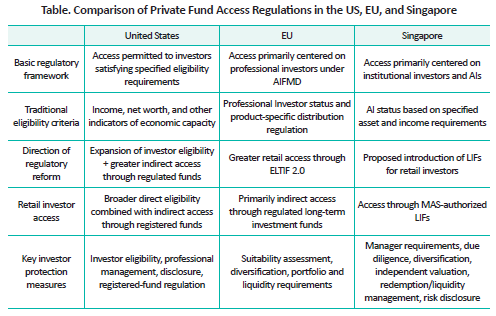
The differences can also be understood in terms of regulatory philosophy. The US framework places relatively greater emphasis on “who should be allowed to invest,” whereas the EU focuses more on “through what types of products investors should be allowed to invest.” Singapore combines the two approaches, asking which investors should be permitted direct access and through what protected vehicles retail investors should gain access. However, the differences are narrowing as the United States also expands retail access through registered funds.
The experiences of the United States, the EU, and Singapore suggest that Korea should also expand retail investors’ access to private market assets, but not simply by relaxing investor eligibility restrictions for private funds. Given Korea’s strengthened investor protection framework following the Lime and Optimus scandals, a reasonable approach would be to expand direct private fund investment gradually for investors possessing adequate financial sophistication while simultaneously making greater use of regulated indirect investment vehicles.
First, Korea could draw on the US experience to develop a more sophisticated framework for determining professional investor status. Rather than relying primarily on assets or minimum investment amounts as proxies for loss-bearing capacity, the framework could place greater weight on professional financial qualifications, investment experience, and occupational expertise that demonstrate an investor’s actual ability to understand investment risks.
Second, improvements in retail access could focus on indirect investment through regulated collective investment vehicles, drawing on the EU’s ELTIF and Singapore’s LIF. Korea could promote long-term funds or publicly offered fund-of-private-funds investing in private equity, private credit, infrastructure, and other private assets, accompanied by requirements concerning manager expertise, diversification, independent valuation, leverage limits, adequate risk disclosure, and redemption frequencies aligned with the liquidity of underlying assets.
Ultimately, the central objective of Korea’s private fund policy should not be “deregulation of private funds,” but rather “the rational diversification of channels through which investors can access private market assets.” Direct investment opportunities could gradually be expanded for investors possessing both financial sophistication and risk-bearing capacity, while retail investors could gain access through professionally managed and adequately diversified fund-of-funds structures. Such a dual-track approach would enable retail investors to share in the performance of unlisted companies and long-term growth assets without undermining the investor protection framework established after the Lime and Optimus scandals.
1) Financial Services Commission, Oct. 23, 2015, “Notice on Major Changes Following the En Bloc Implementation of Amendments to the Financial Investment Services and Capital Markets Act and Its Subordinate Regulations to Revitalize Private Funds,” press release.
2) Financial Services Commission and Financial Supervisory Service, Apr. 27, 2020, “Final Plan for the Assessment and Reform of the Private Fund Regime,” press release.
3) Financial Services Commission, Mar. 24, 2021, “Amendment to the Financial Investment Services and Capital Markets Act to Strengthen Investor Protection and Restructure the Private Fund Regime Passed by the National Assembly,” press reference.
4) Morgan, Lewis & Bockius (2015), U.S. Securities Laws Overview: Making Sense of “Accredited Investors,” “Qualified Purchasers,” and “Qualified Clients.”
5) U.S. Securities and Exchange Commission (SEC), official website.
6) Series 7: a professional qualification covering trading and solicitation of a broad range of securities products, including equities, bonds, mutual funds, and options.
7) Series 65: an investment adviser qualification covering investment theory, portfolio management, investment products, ethics, and relevant laws and regulations.
8) Series 82: a qualification for professionals engaged in solicitation and sale of private securities offerings.
9) SEC, Aug. 26, 2020, “SEC Modernizes the Accredited Investor Definition.”
10) Anna T. Pinedo, Brian Hirshberg, and Shayda Milani (2022), Business Development Company Guide for Capital Markets, Mayer Brown LLP.
11) James Audette, Walter Draney, Jonathan Koff, and Morrison Warren (2019), “Interval and Tender Offer Closed-End Funds: Investment Company Alternatives to Traditional Funds,” Journal of Investment Compliance, 20(4), pp. 21–34.
12) SEC (2025), ADI 2025-16 - Registered Closed-End Funds of Private Funds.
13) The White House, Aug. 7, 2025, “Democratizing Access to Alternative Assets for 401(k) Investors.”
14) U.S. Department of Labor, Mar. 30, 2026, “U.S. Department of Labor Proposes Landmark Rule to Democratize Access to Alternative Investments in 401(k) Plans.”
15) Directive 2011/61/EU of the European Parliament and of the Council of 8 June 2011 on Alternative Investment Fund Managers and amending Directives 2003/41/EC and 2009/65/EC and Regulations (EC) No 1060/2009 and (EU) No 1095/2010.
16) Antonios Nezeritis, Arnaud Julien, Marc Hirtz, and Amina-Nadège Guelaoui (2023), “European Long Term Investment Funds (ELTIF) 2.0: A New Era for Private Funds Sponsors?”, Ashurst.
17) Regulation (EU) 2023/606 of the European Parliament and of the Council of 15 March 2023 amending Regulation (EU) 2015/760 regarding investment policies and operating conditions of European long-term investment funds, eligible assets, portfolio composition, diversification requirements, borrowing, and other fund rules.
18) Monetary Authority of Singapore (2025), Consultation Paper on Providing Retail Access to Private Market Investment Funds.
19) Monetary Authority of Singapore, Media Release, Mar. 27, 2026, “MAS Proposes a Regulatory Framework for Retail Private Market Investment Funds.”
Korea’s private fund regime has undergone substantial changes over the past decade, alternating between regulatory relaxation aimed at expanding the supply of risk capital and stronger investor protection following large-scale fund redemption suspensions. Following the 2015 reform of the private fund regime, entry and operational regulations for private funds were relaxed, contributing to rapid growth in Korea’s private fund market.1) The policy was intended to enhance the competitiveness of the asset management industry and facilitate the provision of growth and restructuring capital to companies by allowing private funds greater operational flexibility than publicly offered funds. However, shortcomings emerged in asset managers’ internal controls, distributors’ product due diligence, custodians’ oversight, and information disclosure to retail investors.
These weaknesses became particularly evident in the Lime Asset Management scandal beginning in 2019 and the Optimus Asset Management scandal in 2020. In the Lime case, multilayered and circular investments among funds, liquidity mismatches between illiquid assets and open-ended fund structures, and leverage through total return swaps (TRS) ultimately resulted in large-scale redemption suspensions and substantial losses for retail investors. In the Optimus case, concerns centered on discrepancies between investment targets described in offering materials and assets actually held by the funds, as well as inadequate controls throughout asset management, distribution, and custody. These incidents demonstrated that expanded managerial discretion had not been accompanied by sufficiently robust oversight and retail investor safeguards.
A major turning point came with the Final Plan for the Assessment and Reform of the Private Fund Regime, announced in April 2020.2) While recognizing the positive role of private funds in supplying risk capital, the government adopted the principle of selectively strengthening regulations necessary for investor protection and the prevention of systemic risk. Measures included stronger internal controls and fund valuation, clearer monitoring responsibilities for distributors, custodians, and prime brokerage service providers (PBSs), enhanced information disclosure, and stronger management of liquidity risk, circular investment structures, and TRS-based leverage.
The framework changed again after amendments to the Financial Investment Services and Capital Markets Act (FSCMA) passed the National Assembly in March 2021.3) The previous distinction between professional investor-type private funds and management participation-type private funds was replaced by a classification based on investor type: general private funds and institution-only private funds. Retail investors may participate in general private funds when they invest above the prescribed minimum, but may not invest in institution-only private funds. General private funds accepting retail investors are subject to enhanced safeguards, including stronger monitoring by distributors and custodians. The minimum investment amount for retail investors, previously KRW 100 million or more, was set at KRW 300 million or more.
The regulatory trajectory since 2015 can thus be summarized as: relaxation of entry and operational rules → the Lime and Optimus scandals → strengthened retail investor protection → redesign of the regime based on investor type. Importantly, the reforms did not completely prohibit retail access to private market investments; instead, they imposed stronger safeguards on private funds in which retail investors participate.
More recently, attention has shifted toward how far retail access to private market assets should be expanded while preserving investor protection. As private equity, private credit, infrastructure, and other private asset markets grow, and companies remain private for longer, investment opportunities generated in private markets may increasingly be concentrated among institutional investors and high-net-worth individuals. Korea therefore faces the task of creating regulated channels through which retail investors can gain exposure to high-quality private market assets without weakening the safeguards established after the Lime and Optimus scandals.
Private Fund Regulation in the United States
The US regulatory framework has traditionally restricted retail investors’ direct participation in private markets while providing broad investment opportunities to investors possessing certain levels of wealth, income, or financial expertise. More recently, the growth of private markets and the expansion of capital raising by private companies have prompted a gradual relaxation of this binary structure, with policy increasingly seeking to broaden indirect retail access through regulated collective investment vehicles and retirement plans.
Understanding US private fund access regulation requires consideration of both the Securities Act of 1933 and the Investment Company Act of 1940. Private funds generally raise capital through securities offerings but extensively rely on private offering exemptions under Regulation D. Rule 506, which imposes no ceiling on the amount raised, is a representative private offering route. Venture capital and private equity funds use such exemptions to avoid registration costs, disclosure obligations, and continuing regulatory burdens.4)
For individuals, principal accredited investor thresholds include net worth exceeding USD 1 million excluding the primary residence, or individual income exceeding USD 200,000—or joint income with a spouse or partner exceeding USD 300,000—in each of the preceding two years, with the same level reasonably expected in the current year.5)
The Investment Company Act generally requires private funds either to limit beneficial owners to no more than 100 under Section 3(c)(1), or to ensure that all investors are qualified purchasers under Section 3(c)(7). An individual generally must own at least USD 5 million in investments to qualify as a qualified purchaser. The traditional US framework therefore centers private market access on investors deemed capable of absorbing financial losses or possessing sufficient sophistication.
A representative shift toward recognizing financial sophistication was the SEC’s 2020 amendment to the accredited investor definition. The amendment expanded eligibility to individuals with certain professional certifications and expertise. Holders of Series 7,6) Series 65,7) and Series 828) licenses may qualify regardless of wealth or income, and knowledgeable employees of private funds may also qualify.9) The framework has thus evolved from a predominantly wealth-based test toward one combining financial capacity and financial sophistication.
Retail access is also expanding through regulated investment vehicles. Business Development Companies (BDCs), many of which register securities, sell to the public, and list on exchanges, allow retail investors to gain indirect exposure to unlisted SMEs and private credit.10) Interval funds and tender offer funds are registered closed-end funds whose limited redemption frequency permits investment in illiquid assets.11) In August 2025, the SEC announced that it would no longer require, during registration review, the accredited investor and USD 25,000 minimum investment conditions previously applied in practice to registered closed-end funds investing more than 15% of assets in private funds.12)
This trend has extended to retirement plans. In August 2025, the Trump administration issued the executive order “Democratizing Access to Alternative Assets for 401(k) Investors,” aimed at expanding opportunities for more than 90 million defined-contribution plan participants to invest in alternative assets, including private equity and private credit.13) In March 2026, the Department of Labor proposed a process-based safe harbor for fiduciaries selecting investment options containing alternative assets.14) The approach seeks to reduce legal uncertainty where fiduciaries appropriately assess returns, costs, liquidity, valuation, benchmarks, and product complexity.
Recent US developments can therefore be characterized as a two-track approach: broadening direct-investment eligibility by recognizing sophistication, while expanding retail access through professionally managed and regulated intermediaries such as registered closed-end funds, BDCs, and retirement plans. This retains the investor-protection objective while seeking to prevent private-market opportunities from being confined to institutional investors and high-net-worth individuals.
Private Fund Regulation in the European Union
Unlike the United States, the EU does not generally determine private fund eligibility through uniform wealth or income thresholds for individuals. Instead, it distinguishes professional and retail investors, restricts direct retail access to private funds, and expands opportunities to invest in private assets through regulated collective investment vehicles. The EU has responded to growing demand for broader access by reforming European Long-Term Investment Funds (ELTIFs) while maintaining investor protection.
The principal EU legal framework is the Alternative Investment Fund Managers Directive (AIFMD), introduced in 2011. It regulates managers of alternative investment funds other than UCITS, including private equity, hedge, and real estate funds. Authorized EU managers may use the passporting regime to market AIFs to professional investors across Member States. Retail marketing is not uniformly permitted at EU level; under Article 43, each Member State may determine whether it is allowed and impose additional investor-protection requirements.15)
A more important development has been ELTIF 2.0. ELTIFs were introduced under Regulation (EU) 2015/760 to channel capital toward unlisted companies, private assets, infrastructure, and other long-term assets while providing retail investors with long-term investment opportunities. The original framework imposed strict requirements on eligible investments, portfolio composition, and retail distribution, and market take-up fell short of expectations. Regulation (EU) 2023/606 introduced ELTIF 2.0 from January 2024.
Under the original regime, retail investors with financial instrument portfolios of EUR 500,000 or less had to invest at least EUR 10,000 and could not allocate more than 10% of their financial instrument portfolios to ELTIFs. ELTIF 2.0 abolished both requirements.16) EU legislation states that these requirements constituted a substantial barrier inconsistent with the objective of developing alternative investment fund products for retail investors.17)
The relaxation does not represent weaker investor protection. ELTIF 2.0 replaces monetary entry restrictions with MiFID II-based suitability assessments and suitability statements, written warnings where necessary, and liquidity-management arrangements such as minimum holding periods, conditional redemptions, and matching of redemption requests with new subscriptions. The regulatory emphasis has therefore shifted from restricting access through wealth or minimum investment thresholds toward protection through suitability assessment, product design, portfolio construction, and liquidity management.
The EU approach does not eliminate restrictions on direct retail access to private funds. Rather, it broadens indirect access through professionally managed and supervised vehicles. This differs from the US expansion of accredited investor eligibility but is consistent with the broader trend toward expanding retail access through regulated investment products.
Private Fund Regulation in Singapore
Singapore’s framework has traditionally allowed access primarily to institutional investors and accredited investors (AIs) while restricting direct participation by retail investors. This reflects the long investment horizons, low liquidity, valuation difficulties, and information asymmetry associated with private equity, private credit, infrastructure, and other private assets.
Under the Securities and Futures Act (SFA), individuals satisfying specified income or asset requirements may qualify as AIs, and offerings to AIs are subject to less stringent rules than public offerings. Unlike the US framework, however, Singapore does not automatically treat investors meeting economic thresholds as AIs. Under the opt-in framework introduced in 2019, financial institutions must notify investors that they qualify and explain the protections they would forgo; investors are generally treated as AIs only after explicit consent.
In March 2025, the Monetary Authority of Singapore (MAS) proposed a Long-term Investment Fund (LIF) framework designed to allow retail investors to invest in private market assets.18) MAS cited constraints on retail access, growing portfolio-diversification demand, and financial institutions’ willingness to supply such products.19) It explicitly referenced international developments including the UK’s LTAF and the EU’s ELTIF reforms.
The proposed LIF regime would not permit unrestricted retail distribution of private funds themselves. Instead, retail investors would access private assets through separately regulated long-term investment vehicles authorized by MAS. A Direct Fund would invest directly in private equity, private credit, infrastructure, and other private assets. A Long-term Investment Fund-of-Funds (LIFF) would invest in multiple private market funds, enabling professional fund selection and diversification across managers, strategies, industries, and regions. MAS has proposed both listed and unlisted LIFs; unlisted vehicles may provide limited redemption opportunities, while listed closed-end vehicles may trade at prices that diverge from underlying asset value.
The LIF proposal combines accessibility with explicit safeguards. MAS is considering requiring Direct Funds to be managed by licensed retail fund managers with sufficient private-market experience and AUM, with documented due diligence for investment selection and ongoing monitoring. Initial eligible investments may be limited to relatively lower-risk private assets.
The framework would also restrict excessive exposure to individual private assets, require diversification and regular independent valuation, and establish liquidity arrangements appropriate to underlying assets. Unlisted Direct Funds could be required to offer redemption at least annually and pay accepted redemptions within 90 days, while listed LIFs could be closed-end without mandatory redemption. Specific risk warnings would explain that investors may not be able to exit at their desired time or price.
Singapore can thus be viewed as moving toward a two-track model beyond its traditional AI-centered eligibility framework: maintaining direct access for eligible investors while providing retail access through MAS-authorized LIFs with additional safeguards. The LIF proposal combines manager expertise, investment restrictions, diversification, independent valuation, liquidity management, and risk disclosure as an integrated investor-protection package.
Comparison of International Developments and Policy Implications for Korea
A comparison of the United States, the EU, and Singapore reveals a common direction toward expanding retail investment opportunities as private markets grow, although the regulatory mechanisms differ. The United States has traditionally relied on accredited investor eligibility and since 2020 has incorporated financial expertise, while also expanding indirect access through registered closed-end funds. The EU emphasizes regulated long-term vehicles such as ELTIFs rather than broadening investor eligibility itself. Singapore retains its AI-centered framework while seeking to add a regulated retail channel through LIFs.
The common feature is that retail access is not simply being liberalized. Instead, access is broadened either by recognizing investor sophistication or by using regulated collective investment vehicles, with corresponding investor-protection safeguards.
The experiences of the United States, the EU, and Singapore suggest that Korea should also expand retail investors’ access to private market assets, but not simply by relaxing investor eligibility restrictions for private funds. Given Korea’s strengthened investor protection framework following the Lime and Optimus scandals, a reasonable approach would be to expand direct private fund investment gradually for investors possessing adequate financial sophistication while simultaneously making greater use of regulated indirect investment vehicles.
First, Korea could draw on the US experience to develop a more sophisticated framework for determining professional investor status. Rather than relying primarily on assets or minimum investment amounts as proxies for loss-bearing capacity, the framework could place greater weight on professional financial qualifications, investment experience, and occupational expertise that demonstrate an investor’s actual ability to understand investment risks.
Second, improvements in retail access could focus on indirect investment through regulated collective investment vehicles, drawing on the EU’s ELTIF and Singapore’s LIF. Korea could promote long-term funds or publicly offered fund-of-private-funds investing in private equity, private credit, infrastructure, and other private assets, accompanied by requirements concerning manager expertise, diversification, independent valuation, leverage limits, adequate risk disclosure, and redemption frequencies aligned with the liquidity of underlying assets.
Ultimately, the central objective of Korea’s private fund policy should not be “deregulation of private funds,” but rather “the rational diversification of channels through which investors can access private market assets.” Direct investment opportunities could gradually be expanded for investors possessing both financial sophistication and risk-bearing capacity, while retail investors could gain access through professionally managed and adequately diversified fund-of-funds structures. Such a dual-track approach would enable retail investors to share in the performance of unlisted companies and long-term growth assets without undermining the investor protection framework established after the Lime and Optimus scandals.
1) Financial Services Commission, Oct. 23, 2015, “Notice on Major Changes Following the En Bloc Implementation of Amendments to the Financial Investment Services and Capital Markets Act and Its Subordinate Regulations to Revitalize Private Funds,” press release.
2) Financial Services Commission and Financial Supervisory Service, Apr. 27, 2020, “Final Plan for the Assessment and Reform of the Private Fund Regime,” press release.
3) Financial Services Commission, Mar. 24, 2021, “Amendment to the Financial Investment Services and Capital Markets Act to Strengthen Investor Protection and Restructure the Private Fund Regime Passed by the National Assembly,” press reference.
4) Morgan, Lewis & Bockius (2015), U.S. Securities Laws Overview: Making Sense of “Accredited Investors,” “Qualified Purchasers,” and “Qualified Clients.”
5) U.S. Securities and Exchange Commission (SEC), official website.
6) Series 7: a professional qualification covering trading and solicitation of a broad range of securities products, including equities, bonds, mutual funds, and options.
7) Series 65: an investment adviser qualification covering investment theory, portfolio management, investment products, ethics, and relevant laws and regulations.
8) Series 82: a qualification for professionals engaged in solicitation and sale of private securities offerings.
9) SEC, Aug. 26, 2020, “SEC Modernizes the Accredited Investor Definition.”
10) Anna T. Pinedo, Brian Hirshberg, and Shayda Milani (2022), Business Development Company Guide for Capital Markets, Mayer Brown LLP.
11) James Audette, Walter Draney, Jonathan Koff, and Morrison Warren (2019), “Interval and Tender Offer Closed-End Funds: Investment Company Alternatives to Traditional Funds,” Journal of Investment Compliance, 20(4), pp. 21–34.
12) SEC (2025), ADI 2025-16 - Registered Closed-End Funds of Private Funds.
13) The White House, Aug. 7, 2025, “Democratizing Access to Alternative Assets for 401(k) Investors.”
14) U.S. Department of Labor, Mar. 30, 2026, “U.S. Department of Labor Proposes Landmark Rule to Democratize Access to Alternative Investments in 401(k) Plans.”
15) Directive 2011/61/EU of the European Parliament and of the Council of 8 June 2011 on Alternative Investment Fund Managers and amending Directives 2003/41/EC and 2009/65/EC and Regulations (EC) No 1060/2009 and (EU) No 1095/2010.
16) Antonios Nezeritis, Arnaud Julien, Marc Hirtz, and Amina-Nadège Guelaoui (2023), “European Long Term Investment Funds (ELTIF) 2.0: A New Era for Private Funds Sponsors?”, Ashurst.
17) Regulation (EU) 2023/606 of the European Parliament and of the Council of 15 March 2023 amending Regulation (EU) 2015/760 regarding investment policies and operating conditions of European long-term investment funds, eligible assets, portfolio composition, diversification requirements, borrowing, and other fund rules.
18) Monetary Authority of Singapore (2025), Consultation Paper on Providing Retail Access to Private Market Investment Funds.
19) Monetary Authority of Singapore, Media Release, Mar. 27, 2026, “MAS Proposes a Regulatory Framework for Retail Private Market Investment Funds.”