Our bi-weekly Opinion provides you with latest updates and analysis on major capital market and financial investment industry issues.
The High Won-Dollar Exchange Rate and Economic Polarization
Publication date Sep. 22, 2026

Summary
Despite the recent decline in the won-dollar exchange rate, its persistently high level over the past several years has heightened concerns among businesses and households. These concerns appear to reflect fears that, despite the positive effects of a weaker won on the overall economy, it may deepen economic polarization by pushing up domestic prices and affecting different sectors unevenly. In particular, attention should be paid to the possibility that the differential effects of exchange rate movements on large corporations, small and medium-sized enterprises (SMEs), and domestic-demand-oriented firms; on exports and domestic demand; and across income groups could undermine employment stability and growth potential. If the won-dollar exchange rate rises sharply again, effective support measures should be put in place for SMEs and domestic-demand-oriented firms, while SMEs should also strengthen the domestic production of materials, parts, and equipment to better prepare for instability in global supply chains. In addition, careful policy consideration will be needed to ensure that exchange-rate-driven increases in the cost of living for low-income households do not worsen household income inequality.
Although the won-dollar exchange rate has recently declined and regained some stability, structural factors that could lead to further won depreciation remain, including the possibility of renewed U.S. dollar strength and the continued increase in overseas securities investment by Korean investors. The current exchange rate remains high compared with the KRW 1,000–1,200 range in which it fluctuated for an extended period before the COVID-19 pandemic, and expectations that the exchange rate will remain elevated also appear to be becoming entrenched.
Despite the weaker won, the likelihood of a foreign currency liquidity crisis in Korea remains low, while there are also significant positive effects, including improved export price competitiveness and higher won-denominated returns on overseas investments. Nevertheless, concerns over the persistently high exchange rate appear to stem from fears that, beyond adding to inflationary pressures, it could affect different sectors of the economy unevenly and thereby deepen economic polarization. This paper examines the differential effects of won depreciation across economic sectors, including large corporations versus small and medium-sized domestic-demand-oriented firms, exports versus domestic demand, and different household income groups, and discusses the implications.
Diverging Effects on Export-Oriented Large Corporations and Domestic-Market-Focused SMEs
An increase in the won-dollar exchange rate can support export growth and overall economic growth in Korea’s export-driven economy. When the won depreciates, large export-oriented corporations can benefit from greater price competitiveness in overseas markets, while the won value of their export proceeds also increases. As a result, their profitability may improve, providing a positive boost to the overall economy.
However, even as a weaker won supports export performance, import-dependent and domestic-demand-oriented firms may continue to face difficulties. Although total exports may increase as the exchange rate rises, much of the benefit accrues to large export-oriented corporations, while small and medium-sized import-dependent or domestic-demand-oriented firms face pressure on profitability. Under the subcontracting relationships between large corporations and SMEs, won depreciation raises import and production costs for SMEs that import and process raw materials or intermediate goods for supply to large corporations. SMEs also tend to have limited bargaining power in negotiating global import prices and therefore bear much of the direct impact of exchange rate increases through higher import costs. Moreover, their relatively weak bargaining position with large corporations limits their ability to pass these higher costs on through supply prices, putting further pressure on profitability.
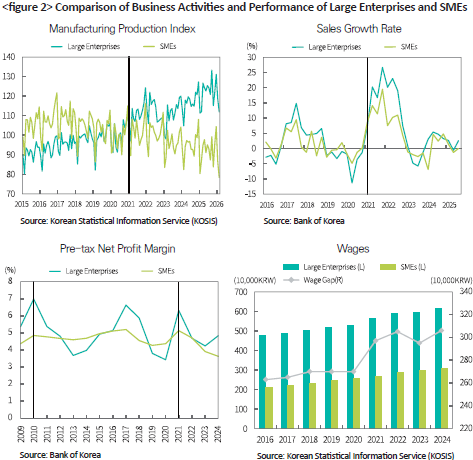
A comparison of Corporate Management Analysis statistics and other data for the period of relative exchange rate stability (2016–2020) and the period of won depreciation (2021–2025) reveals notable differences in business performance, profitability, and wages between large enterprises and SMEs. Between the two periods, the sales growth rate of large enterprises increased 6.8-fold, from an annual average of 1.16% to 7.90%, whereas that of SMEs increased only 4.9-fold, from 0.90% to 4.43%. In particular, the pre-tax net profit margin, a measure of profitability, rose from an average of 5.18% to 5.83% for large enterprises, while declining from 4.73% to 4.35% for SMEs.1)
Since around 2021, the widening gap in business performance and profitability between large enterprises and SMEs has also been reflected in workers’ average monthly earnings. As of 2024, employees of large enterprises earned an average of KRW 6.13 million per month, approximately twice the KRW 3.07 million earned by SME employees. This suggests that during the past several years of sustained increases in the won-dollar exchange rate, SMEs’ business performance and profitability have deteriorated relative to those of large enterprises, potentially prompting SMEs to cut production and sales and restrain wage growth.
Growing Imbalance Between Exports and Domestic Demand
Despite robust export performance supported by won depreciation, continued weakness in domestic demand, including consumption and investment, could deepen the imbalance between exports and domestic demand in the Korean economy, slowing employment growth and weakening growth potential. This reflects the weakening, compared with the past, of the so-called trickle-down effect, whereby the benefits of export growth spread to other parts of the economy, including subcontractors, small business owners, and households.
The trickle-down effect weakens when the contraction in aggregate supply caused by rising production costs, including import costs, exceeds the expansion in aggregate demand resulting from increased net exports (exports minus imports). This can reduce real purchasing power and income across the economy by worsening business conditions for domestic-demand-oriented firms and SMEs and constraining nominal wage growth.
Moreover, rapid technological progress in recent years has shifted the industrial structure away from the labor-intensive industries of the past toward technology- and capital-intensive advanced industries such as semiconductors, AI, and automated production. Together with the increased use of global value chains (GVCs), this has further weakened the trickle-down effect. As a result, while export growth may disproportionately benefit large corporations and high-income households, SMEs and low-income households may face relatively greater difficulties. This raises concerns that export-led growth under a weaker won could exacerbate broader structural problems in the economy, including asset and income polarization, a weakened domestic consumption base, and a growing imbalance between exports and domestic demand.
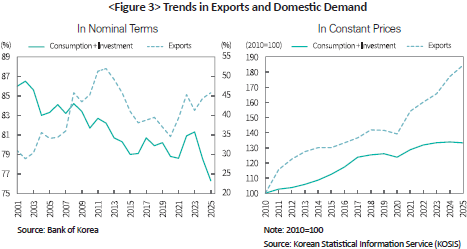
Indeed, Korea’s GDP statistics show that the share of domestic demand, including consumption and investment, in nominal gross domestic product has been trending downward. Until the early 2000s, private consumption and investment accounted for more than 85% of GDP at current prices, but their combined share fell to 76% in 2025.2) In constant-price terms (2010=100), domestic demand in 2025 was only 32% higher than in 2010, whereas exports rose by 85% over the same period, making the relative weakness of domestic demand compared with exports even more pronounced. In particular, this gap appears to have widened further since 2020, when the won-dollar exchange rate began to rise sharply.
Potential Deepening of Household Income Inequality
A persistently high won-dollar exchange rate may also contribute to greater household income inequality. Income inequality refers to disparities in income between high- and low-income households.3) One of the main channels through which won depreciation can affect household income inequality is the rise in domestic prices caused by higher import prices.
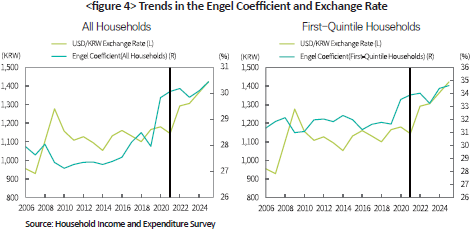
The impact of inflation differs by income level. Low-income households spend a substantial share of their income on necessities such as food4), heating, and transportation, whereas high-income households devote a smaller share of their spending to necessities and have greater purchasing power, making them relatively less affected by rising prices. Recent trends in Korea’s Engel coefficient show increases for both all households and first-income-quintile households. As of 2025, the Engel coefficient stood at 30.4% for all households and 34.6% for first-quintile households, indicating that rising food expenditure shares among low-income households have contributed to the increase in the overall Engel coefficient. In particular, the Engel coefficient has risen sharply since 2021, when the won-dollar exchange rate began to increase steeply, suggesting a close link with the pass-through of higher import prices to consumer prices for food and beverages.5)
Moreover, among low-income households, housing-related expenses such as water and heating costs, along with transportation costs, were found to be the largest expenditures after food and grocery purchases.6) A weaker won may therefore exacerbate household income inequality by raising energy prices, including oil prices, and placing a disproportionate burden on low-income households through higher housing, heating, and transportation costs.
If wages at SMEs and small businesses fail to keep pace with these price increases, households’ real purchasing power will decline. Furthermore, if the central bank adopts a more restrictive monetary policy or raises the policy interest rate to curb inflation, the debt-servicing burden on vulnerable households and small business owners with relatively high levels of financial debt may increase, potentially worsening income distribution further.
Implications
For Korea, a small open economy, it is important to allow the won exchange rate to adjust flexibly to market supply and demand so that it can serve as a macroeconomic stabilizer. In particular, won depreciation can have favorable effects by strengthening Korea’s export competitiveness and supporting economic growth. However, if the won-dollar exchange rate remains elevated for a prolonged period, attention should be paid not only to mounting inflationary pressures but also to the potential deepening of economic polarization, as the differing effects across sectors—including between large corporations and domestic-demand-oriented SMEs, between exports and domestic demand, and across household income groups—may become more pronounced.
Since changes in domestic and external conditions could again push the won-dollar exchange rate higher, multifaceted policy efforts are needed. If a renewed period of high exchange rates worsens business conditions for SMEs and domestic-demand-oriented firms, effective support measures should be put in place. To prevent the burden of higher import costs from being concentrated on these firms, the effectiveness of the raw material price linkage system should be strengthened so that increases in imported raw material prices can be reflected, at least in part, in the prices paid by large corporations.
Government-led foreign exchange risk management programs, such as exchange-rate fluctuation insurance, should also be strengthened to help SMEs manage foreign exchange risks. SMEs should likewise enhance their competitiveness and reduce their exposure to exchange rate fluctuations by diversifying their export products and markets. In particular, domestic production of materials, parts, and equipment should be expanded to reduce import dependence and strengthen resilience to instability in global supply chains.
In addition, social welfare measures should continue to be strengthened to ease the growing burden of essential expenses, including food, on vulnerable households as a result of exchange rate increases, as well as the greater debt-servicing burden that may arise from higher interest rates. Mitigating economic polarization is essential to employment stability and sustainable economic growth.
1) In addition, the operating profit margin of large enterprises has consistently exceeded that of SMEs. Regarding the interest coverage ratio, large enterprises saw a slight decline from 455.2% to 446.8% during the same period due to rising interest rates, whereas SMEs recorded a much sharper decline from 234.9% to 187.1%.
2) Of these, private consumption and investment accounted for 48.0% and 28.3%, respectively, as of 2025, representing declines of 3.2 percentage points and 2.2 percentage points from 2010. Meanwhile, despite fluctuations caused by exchange rate movements and other factors, the share of exports has remained close to 50% in recent years.
3) In general, household income inequality is influenced in complex ways by various socioeconomic factors, including a country’s economic growth and technological progress, changes in macroeconomic policy, social welfare spending, demographic structure, and labor market institutions. In Korea, income inequality indicators—the Gini coefficient, the quintile ratio, and the relative poverty rate—gradually improved from 2015 onward, but have shown slight deterioration again since 2024.
4) The proportion of food expenditures in total household expenditures is referred to as the Engel coefficient, which tends to be higher among lower-income groups.
5) Food prices are also closely related to the global grain price index, which rose from January 2020 to May 2022 and has continued to decline since then.
6) According to the Household Trend Survey, the expenditure share of households in the first income quintile was approximately 50%, substantially higher than the roughly 35% recorded by households in the fifth quintile.
Despite the weaker won, the likelihood of a foreign currency liquidity crisis in Korea remains low, while there are also significant positive effects, including improved export price competitiveness and higher won-denominated returns on overseas investments. Nevertheless, concerns over the persistently high exchange rate appear to stem from fears that, beyond adding to inflationary pressures, it could affect different sectors of the economy unevenly and thereby deepen economic polarization. This paper examines the differential effects of won depreciation across economic sectors, including large corporations versus small and medium-sized domestic-demand-oriented firms, exports versus domestic demand, and different household income groups, and discusses the implications.
Diverging Effects on Export-Oriented Large Corporations and Domestic-Market-Focused SMEs
An increase in the won-dollar exchange rate can support export growth and overall economic growth in Korea’s export-driven economy. When the won depreciates, large export-oriented corporations can benefit from greater price competitiveness in overseas markets, while the won value of their export proceeds also increases. As a result, their profitability may improve, providing a positive boost to the overall economy.
However, even as a weaker won supports export performance, import-dependent and domestic-demand-oriented firms may continue to face difficulties. Although total exports may increase as the exchange rate rises, much of the benefit accrues to large export-oriented corporations, while small and medium-sized import-dependent or domestic-demand-oriented firms face pressure on profitability. Under the subcontracting relationships between large corporations and SMEs, won depreciation raises import and production costs for SMEs that import and process raw materials or intermediate goods for supply to large corporations. SMEs also tend to have limited bargaining power in negotiating global import prices and therefore bear much of the direct impact of exchange rate increases through higher import costs. Moreover, their relatively weak bargaining position with large corporations limits their ability to pass these higher costs on through supply prices, putting further pressure on profitability.
A comparison of Corporate Management Analysis statistics and other data for the period of relative exchange rate stability (2016–2020) and the period of won depreciation (2021–2025) reveals notable differences in business performance, profitability, and wages between large enterprises and SMEs. Between the two periods, the sales growth rate of large enterprises increased 6.8-fold, from an annual average of 1.16% to 7.90%, whereas that of SMEs increased only 4.9-fold, from 0.90% to 4.43%. In particular, the pre-tax net profit margin, a measure of profitability, rose from an average of 5.18% to 5.83% for large enterprises, while declining from 4.73% to 4.35% for SMEs.1)
Since around 2021, the widening gap in business performance and profitability between large enterprises and SMEs has also been reflected in workers’ average monthly earnings. As of 2024, employees of large enterprises earned an average of KRW 6.13 million per month, approximately twice the KRW 3.07 million earned by SME employees. This suggests that during the past several years of sustained increases in the won-dollar exchange rate, SMEs’ business performance and profitability have deteriorated relative to those of large enterprises, potentially prompting SMEs to cut production and sales and restrain wage growth.
Growing Imbalance Between Exports and Domestic Demand
Despite robust export performance supported by won depreciation, continued weakness in domestic demand, including consumption and investment, could deepen the imbalance between exports and domestic demand in the Korean economy, slowing employment growth and weakening growth potential. This reflects the weakening, compared with the past, of the so-called trickle-down effect, whereby the benefits of export growth spread to other parts of the economy, including subcontractors, small business owners, and households.
The trickle-down effect weakens when the contraction in aggregate supply caused by rising production costs, including import costs, exceeds the expansion in aggregate demand resulting from increased net exports (exports minus imports). This can reduce real purchasing power and income across the economy by worsening business conditions for domestic-demand-oriented firms and SMEs and constraining nominal wage growth.
Moreover, rapid technological progress in recent years has shifted the industrial structure away from the labor-intensive industries of the past toward technology- and capital-intensive advanced industries such as semiconductors, AI, and automated production. Together with the increased use of global value chains (GVCs), this has further weakened the trickle-down effect. As a result, while export growth may disproportionately benefit large corporations and high-income households, SMEs and low-income households may face relatively greater difficulties. This raises concerns that export-led growth under a weaker won could exacerbate broader structural problems in the economy, including asset and income polarization, a weakened domestic consumption base, and a growing imbalance between exports and domestic demand.
Indeed, Korea’s GDP statistics show that the share of domestic demand, including consumption and investment, in nominal gross domestic product has been trending downward. Until the early 2000s, private consumption and investment accounted for more than 85% of GDP at current prices, but their combined share fell to 76% in 2025.2) In constant-price terms (2010=100), domestic demand in 2025 was only 32% higher than in 2010, whereas exports rose by 85% over the same period, making the relative weakness of domestic demand compared with exports even more pronounced. In particular, this gap appears to have widened further since 2020, when the won-dollar exchange rate began to rise sharply.
Potential Deepening of Household Income Inequality
A persistently high won-dollar exchange rate may also contribute to greater household income inequality. Income inequality refers to disparities in income between high- and low-income households.3) One of the main channels through which won depreciation can affect household income inequality is the rise in domestic prices caused by higher import prices.
The impact of inflation differs by income level. Low-income households spend a substantial share of their income on necessities such as food4), heating, and transportation, whereas high-income households devote a smaller share of their spending to necessities and have greater purchasing power, making them relatively less affected by rising prices. Recent trends in Korea’s Engel coefficient show increases for both all households and first-income-quintile households. As of 2025, the Engel coefficient stood at 30.4% for all households and 34.6% for first-quintile households, indicating that rising food expenditure shares among low-income households have contributed to the increase in the overall Engel coefficient. In particular, the Engel coefficient has risen sharply since 2021, when the won-dollar exchange rate began to increase steeply, suggesting a close link with the pass-through of higher import prices to consumer prices for food and beverages.5)
Moreover, among low-income households, housing-related expenses such as water and heating costs, along with transportation costs, were found to be the largest expenditures after food and grocery purchases.6) A weaker won may therefore exacerbate household income inequality by raising energy prices, including oil prices, and placing a disproportionate burden on low-income households through higher housing, heating, and transportation costs.
If wages at SMEs and small businesses fail to keep pace with these price increases, households’ real purchasing power will decline. Furthermore, if the central bank adopts a more restrictive monetary policy or raises the policy interest rate to curb inflation, the debt-servicing burden on vulnerable households and small business owners with relatively high levels of financial debt may increase, potentially worsening income distribution further.
Implications
For Korea, a small open economy, it is important to allow the won exchange rate to adjust flexibly to market supply and demand so that it can serve as a macroeconomic stabilizer. In particular, won depreciation can have favorable effects by strengthening Korea’s export competitiveness and supporting economic growth. However, if the won-dollar exchange rate remains elevated for a prolonged period, attention should be paid not only to mounting inflationary pressures but also to the potential deepening of economic polarization, as the differing effects across sectors—including between large corporations and domestic-demand-oriented SMEs, between exports and domestic demand, and across household income groups—may become more pronounced.
Since changes in domestic and external conditions could again push the won-dollar exchange rate higher, multifaceted policy efforts are needed. If a renewed period of high exchange rates worsens business conditions for SMEs and domestic-demand-oriented firms, effective support measures should be put in place. To prevent the burden of higher import costs from being concentrated on these firms, the effectiveness of the raw material price linkage system should be strengthened so that increases in imported raw material prices can be reflected, at least in part, in the prices paid by large corporations.
Government-led foreign exchange risk management programs, such as exchange-rate fluctuation insurance, should also be strengthened to help SMEs manage foreign exchange risks. SMEs should likewise enhance their competitiveness and reduce their exposure to exchange rate fluctuations by diversifying their export products and markets. In particular, domestic production of materials, parts, and equipment should be expanded to reduce import dependence and strengthen resilience to instability in global supply chains.
In addition, social welfare measures should continue to be strengthened to ease the growing burden of essential expenses, including food, on vulnerable households as a result of exchange rate increases, as well as the greater debt-servicing burden that may arise from higher interest rates. Mitigating economic polarization is essential to employment stability and sustainable economic growth.
1) In addition, the operating profit margin of large enterprises has consistently exceeded that of SMEs. Regarding the interest coverage ratio, large enterprises saw a slight decline from 455.2% to 446.8% during the same period due to rising interest rates, whereas SMEs recorded a much sharper decline from 234.9% to 187.1%.
2) Of these, private consumption and investment accounted for 48.0% and 28.3%, respectively, as of 2025, representing declines of 3.2 percentage points and 2.2 percentage points from 2010. Meanwhile, despite fluctuations caused by exchange rate movements and other factors, the share of exports has remained close to 50% in recent years.
3) In general, household income inequality is influenced in complex ways by various socioeconomic factors, including a country’s economic growth and technological progress, changes in macroeconomic policy, social welfare spending, demographic structure, and labor market institutions. In Korea, income inequality indicators—the Gini coefficient, the quintile ratio, and the relative poverty rate—gradually improved from 2015 onward, but have shown slight deterioration again since 2024.
4) The proportion of food expenditures in total household expenditures is referred to as the Engel coefficient, which tends to be higher among lower-income groups.
5) Food prices are also closely related to the global grain price index, which rose from January 2020 to May 2022 and has continued to decline since then.
6) According to the Household Trend Survey, the expenditure share of households in the first income quintile was approximately 50%, substantially higher than the roughly 35% recorded by households in the fifth quintile.