Our bi-weekly Opinion provides you with latest updates and analysis on major capital market and financial investment industry issues.
The Integration of Perpetual Futures into Regulated Markets and Changes in Derivatives Markets
Publication date Oct. 20, 2026

Summary
Perpetual futures are futures contracts without an expiration date. They have grown rapidly in crypto markets owing to their advantages of requiring no contract-month rollover and allowing trading liquidity to be concentrated in a single contract. In 2026 in particular, perpetual futures have been expanding into traditional underlying assets for derivatives, such as equities and equity index ETFs, and in the United States, bitcoin perpetual futures entered the regulated market upon being approved as a formal futures contract. The growth of perpetual futures is putting pressure on the trading practices and revenue structures of traditional derivatives exchanges, which have relied on regular rollover trading and limited trading hours. Korea also needs to prepare a response to perpetual futures. Measures to protect domestic investors are needed in light of the growth of offshore perpetual futures linked to Korean equities, and a strategy to maintain the competitiveness of Korea’s derivatives market should be formulated with reference to the responses of major global derivatives exchanges.
Perpetual futures, which developed in crypto markets, have been expanding into traditional underlying assets such as individual stocks and equity index ETFs since the beginning of 2026, and their international influence is growing following their formal approval as exchange-traded derivatives in the United States. Against this backdrop, this paper examines the concept and pricing mechanism of perpetual futures and, focusing on recent developments, discusses their implications for derivatives markets and possible policy responses.
What Are Perpetual Futures?
Perpetual futures collectively refer to derivative contracts that provide exposure to the price movements of an underlying asset without a scheduled final expiration. In 1992, Professor Robert J. Shiller of Yale University proposed perpetual futures as a means of gauging the value of real assets that trade infrequently or are not standardized.1) He designed perpetual futures so that the values of assets that are difficult to observe directly, such as real estate and unlisted firms, could be discovered in the market.2) Because the perpetual futures he proposed took the form of claims on continuing cash flows, such as dividends and rents, the cash flows and settlement structure mattered more than any specific maturity.
Commercialization and Pricing Mechanism of Perpetual Futures
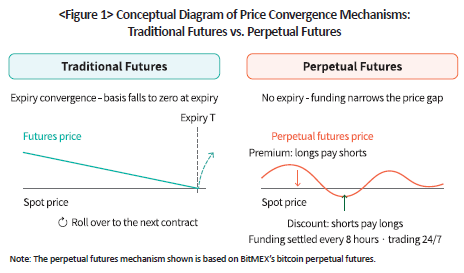
A structure similar to Shiller’s perpetual futures was commercialized in May 2016, when the crypto exchange BitMEX launched bitcoin perpetual futures as an alternative to existing bitcoin futures.3) At the time, BitMEX, a latecomer among crypto exchanges, developed bitcoin perpetual futures without expiration, having noted that retail investors found it difficult to roll their futures positions into the next contract month at expiry and that liquidity was fragmented across multiple maturities. As a mechanism to narrow the price gap between the spot market and perpetual futures, BitMEX calculated a funding rate from a time-weighted average of the price gap and an interest rate component, and required long and short position holders to exchange funding payments calculated by applying this rate to their position values. BitMEX also combined leverage of up to 100x with continuous 24/7 trading (neither of which is unique to perpetual futures), and this structure became the prototype of the standard perpetual futures contract targeting investors who prefer leveraged trading.
Expansion into Traditional Assets and Integration into Regulated Markets
Beginning in 2017, perpetual futures became established as a standard product in crypto markets, and many crypto exchanges launched their own perpetual contracts. Under the earlier coin-margined model, however, the value of collateral fell together with crypto prices during downturns, increasing liquidation risk. Beginning in 2019–2020, perpetual futures margined and settled in USDT (Tether, a U.S. dollar–pegged stablecoin) became widespread, easing the participation burden associated with fluctuating coin collateral values and complex profit-and-loss calculations. In addition, the adoption of USDT made it easier to trade multiple contracts using common collateral, contributing to the expansion of the market.
In 2026 in particular, the perpetual futures market has been expanding into traditional underlying assets and regulated markets. Binance, the world’s largest crypto exchange, launched ‘TradFi Perpetual Futures,’ a perpetual futures category covering the underlying assets of traditional futures contracts, such as equities, ETFs, precious metals, industrial metals, and energy. Starting with gold and silver in January, it has since expanded the category to individual stocks and equity index ETFs.
Significant progress has also been made in integrating perpetual futures into regulated markets. On May 29, 2026, the U.S. derivatives regulator, the Commodity Futures Trading Commission (CFTC), approved KalshiEX’s bitcoin perpetual futures contract (BTCPERP) as an exchange-traded derivative. The key issue in the CFTC’s approval process was whether a contract without expiration could be regarded as a futures contract. KalshiEX argued that an expiration date or final settlement date is not an essential element of a futures contract, and that perpetual futures possess “futurity,” an attribute of futures contracts, because they involve future performance obligations and a value determined in the future.4) In response, the CFTC found that the bitcoin perpetual futures contract does not violate the Commodity Exchange Act or the Commission’s regulations. It further noted that the reference price can be observed continuously because bitcoin spot trades around the clock across widely distributed venues, that the deep liquidity of the bitcoin spot market makes the reference price difficult to manipulate, and that arbitrage between perpetual futures and spot is possible.5)
Responses by Derivatives Exchanges
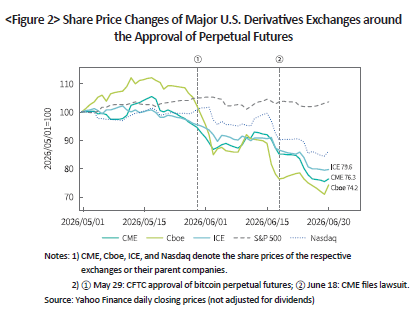
The CFTC’s approval of bitcoin perpetual futures came as a major shock to traditional derivatives markets. In conventional futures trading, rollovers occur periodically at each expiry, allowing derivatives exchanges to earn stable fee revenue from the resulting trades; this revenue structure has now come under threat. Moreover, continuous 24/7 trading, which has become the norm for perpetual futures, is bound to bring about changes in traditional trading hours as well as clearing and settlement practices. On June 1, the first trading day after the CFTC’s approval of bitcoin perpetual futures, the share prices of the major U.S. derivatives exchanges CME, Cboe, and ICE fell by 5.8%, 9.8%, and 2.0%, respectively (see <Figure 2>). This suggests that investors were pricing in concerns about potential new competition.6)
Since 2025, traditional derivatives exchanges have responded to the rapid rise of perpetual futures in a variety of ways. First, exchanges have taken legal action challenging the classification of perpetual futures as futures and the legality of the approval process. CME filed a lawsuit against the CFTC’s approval order on June 18, 2026, arguing that KalshiEX’s perpetual contract is not a futures contract but a swap, because it carries no obligation of final delivery or cash settlement at a specified future date.7) Second, exchanges have introduced long-dated products that incorporate some features of perpetual futures. In June 2025, CME listed ‘Spot-Quoted Futures’ on bitcoin, ether, and the four major U.S. equity indices. These small-sized, long-dated contracts are quoted in spot price terms, are subject to a daily financing adjustment, and, as initially announced, can be held for up to five years without rollover. In late 2025, Cboe likewise listed Cboe Continuous Futures, 10-year futures on bitcoin and ether that apply a funding-based daily financing adjustment. These can be seen as responses that adopt the convenience of perpetual futures while maintaining the contract and clearing frameworks of existing futures. Third, exchanges have extended trading hours. Beginning May 29, 2026, CME expanded trading in its crypto futures and options to 24/7, and it subsequently extended 24/7 trading to 1-ounce gold futures on July 24 and 100-ounce silver futures on September 11. CME has thus brought the round-the-clock trading characteristic of perpetual futures to part of its exchange-traded derivatives lineup. Fourth, exchanges have sought to monetize their benchmarks through licensing or equity partnerships. ICE announced a strategic equity investment in the crypto exchange OKX in March 2026, and on July 2, OKX launched crude oil perpetual futures using ICE Brent and WTI benchmarks as their reference prices. Through this arrangement, ICE has secured a new benchmark licensing business and new client touchpoints. Fifth, some exchanges have listed perpetual futures outright. Singapore Exchange (SGX), a traditional securities and derivatives exchange, launched bitcoin and ether perpetual futures on November 24, 2025.
The Need for a Domestic Response
The integration of perpetual futures into regulated markets does not necessarily mean that new entrants will prevail. The high leverage offered in offshore markets does not carry over to regulated products, and the robust central clearing systems of exchange-traded derivatives and benchmark data on underlying assets can serve as competitive advantages for incumbent derivatives exchanges. Nevertheless, because this integration may reshape trading practices and revenue structures built around contract-month rollovers and limited trading hours,8) Korea also needs to prepare a response.
Perpetual futures are not yet traded on domestic crypto exchanges, nor have there been visible moves to launch them as exchange-traded derivatives in Korea. However, offshore crypto exchanges such as Binance, through its TradFi Perpetual Futures category, now list high-leverage perpetual futures on Samsung Electronics, SK hynix, and Korea-related equity index ETFs, and this market is growing rapidly, increasing the need to protect domestic investors.9) With respect to offshore virtual asset trading, Korea has so far regulated the domestic business activities of virtual asset service providers that have not filed a report with the Korea Financial Intelligence Unit (KoFIU), on the basis of the Act on Reporting and Using Specified Financial Transaction Information. Perpetual futures referencing equities and equity index ETFs, whose underlying assets are not virtual assets, instead call for financial investment business regulation and investor protection rules. Although perpetual futures are not explicitly enumerated as derivatives under the current Financial Investment Services and Capital Markets Act (FSCMA), the possibility of covering them as derivatives on the basis of their contractual structure or economic substance should first be examined,10) and, if necessary, the FSCMA Enforcement Decree should be amended to expressly include derivative contracts with no expiration date or whose terms are effectively extended.
Institutional preparations are also needed for the possible introduction of perpetual futures into Korea’s exchange-traded derivatives market. If Korean equity-related perpetual futures traded continuously in offshore markets become more active, price discovery could be dispersed overseas, lowering the domestic market’s contribution to price discovery and its concentration of order flow. Therefore, drawing on how derivatives exchanges have responded to perpetual futures, Korea needs to formulate a strategy to maintain the competitiveness of its derivatives market—even short of launching perpetual futures—through measures feasible under the current framework, such as listing long-dated products and extending trading hours, and, where appropriate, monetizing benchmark data.
1) Apart from Shiller’s theoretical proposal, two arrangements can be regarded as similar to perpetual futures in that they allow continuous price exposure to an underlying asset: the 20th-century practice in Hong Kong gold and silver trading of automatically rolling over one-day futures contracts every day, and contracts for difference (CFDs), which emerged in London in the early 1990s.
2) For details of Shiller’s perpetual futures, see Shiller, R. J., 1993, Measuring asset values for cash settlement in derivative markets: Hedonic repeated measures indices and perpetual futures, Journal of Finance 48(3), 911–931.
3) The two concepts share the feature of being contracts without expiration, but Shiller focused on price discovery for illiquid assets, whereas BitMEX focused on easing the burden of managing expiries and on concentrating trading liquidity.
4) KalshiEX also presented the following as grounds for treating the bitcoin perpetual futures contract as a futures contract: it is traded on a standardized basis with the same fixed contract unit and terms; positions can be closed by offsetting transactions in contracts with identical terms; performance is guaranteed through novation to a central counterparty (CCP); it is margined; it is traded for the purpose of risk transfer; it is traded on the centralized market of a licensed exchange; and it is offered to the general public, including retail investors.
5) The CFTC also made clear that the analysis in this approval does not extend to perpetual contracts referencing asset classes other than digital commodities. Specifically, it stated that perpetual contracts are “likely particularly ill-suited for agricultural products,” while perpetual contracts that reference equity securities or narrow-based security indexes “would benefit from review by the Commission and the U.S. Securities and Exchange Commission.”
6) From May 28, the day before the approval, to June 29, the share prices of CME, Cboe, and ICE fell by 21%, 33%, and 17%, respectively. However, because the share price of Nasdaq, which is less exposed to perpetual futures, also weakened over the same period, the declines in CME, ICE, and Cboe shares cannot be attributed solely to the approval of perpetual futures. Meanwhile, the larger decline in Cboe’s share price may reflect market perceptions that Cboe is more vulnerable to the changes in the competitive environment brought about by the approval.
7) The CFTC subsequently filed a motion to dismiss CME’s lawsuit on September 2, 2026.
8) On the day of the approval of bitcoin perpetual futures, CFTC Chairman Michael S. Selig noted that a traditional futures contract “was designed for markets that close overnight and on weekends.”
9) According to a report by Eugene Investment & Securities dated August 12, 2026, the cumulative trading value of Korean single-stock perpetual futures traded on 11 offshore crypto exchanges worldwide from February 19 to August 8, 2026 was approximately USD 176 billion. Of this, contracts linked to SK hynix accounted for about USD 161 billion, or approximately 92% of the total, while those linked to Samsung Electronics and Hyundai Motor amounted to USD 14.4 billion and USD 530 million, respectively. Some products offer leverage of up to 50x.
10) In February 2026, the European Securities and Markets Authority (ESMA), the EU’s financial markets regulator and supervisor, stated that perpetual futures meeting the definition of a CFD are “likely to fall within the scope of the existing national product intervention measures on CFDs.” This means that existing financial product regulation can be applied to perpetual futures based on an assessment of their economic substance.
What Are Perpetual Futures?
Perpetual futures collectively refer to derivative contracts that provide exposure to the price movements of an underlying asset without a scheduled final expiration. In 1992, Professor Robert J. Shiller of Yale University proposed perpetual futures as a means of gauging the value of real assets that trade infrequently or are not standardized.1) He designed perpetual futures so that the values of assets that are difficult to observe directly, such as real estate and unlisted firms, could be discovered in the market.2) Because the perpetual futures he proposed took the form of claims on continuing cash flows, such as dividends and rents, the cash flows and settlement structure mattered more than any specific maturity.
Commercialization and Pricing Mechanism of Perpetual Futures
A structure similar to Shiller’s perpetual futures was commercialized in May 2016, when the crypto exchange BitMEX launched bitcoin perpetual futures as an alternative to existing bitcoin futures.3) At the time, BitMEX, a latecomer among crypto exchanges, developed bitcoin perpetual futures without expiration, having noted that retail investors found it difficult to roll their futures positions into the next contract month at expiry and that liquidity was fragmented across multiple maturities. As a mechanism to narrow the price gap between the spot market and perpetual futures, BitMEX calculated a funding rate from a time-weighted average of the price gap and an interest rate component, and required long and short position holders to exchange funding payments calculated by applying this rate to their position values. BitMEX also combined leverage of up to 100x with continuous 24/7 trading (neither of which is unique to perpetual futures), and this structure became the prototype of the standard perpetual futures contract targeting investors who prefer leveraged trading.
Expansion into Traditional Assets and Integration into Regulated Markets
Beginning in 2017, perpetual futures became established as a standard product in crypto markets, and many crypto exchanges launched their own perpetual contracts. Under the earlier coin-margined model, however, the value of collateral fell together with crypto prices during downturns, increasing liquidation risk. Beginning in 2019–2020, perpetual futures margined and settled in USDT (Tether, a U.S. dollar–pegged stablecoin) became widespread, easing the participation burden associated with fluctuating coin collateral values and complex profit-and-loss calculations. In addition, the adoption of USDT made it easier to trade multiple contracts using common collateral, contributing to the expansion of the market.
In 2026 in particular, the perpetual futures market has been expanding into traditional underlying assets and regulated markets. Binance, the world’s largest crypto exchange, launched ‘TradFi Perpetual Futures,’ a perpetual futures category covering the underlying assets of traditional futures contracts, such as equities, ETFs, precious metals, industrial metals, and energy. Starting with gold and silver in January, it has since expanded the category to individual stocks and equity index ETFs.
Significant progress has also been made in integrating perpetual futures into regulated markets. On May 29, 2026, the U.S. derivatives regulator, the Commodity Futures Trading Commission (CFTC), approved KalshiEX’s bitcoin perpetual futures contract (BTCPERP) as an exchange-traded derivative. The key issue in the CFTC’s approval process was whether a contract without expiration could be regarded as a futures contract. KalshiEX argued that an expiration date or final settlement date is not an essential element of a futures contract, and that perpetual futures possess “futurity,” an attribute of futures contracts, because they involve future performance obligations and a value determined in the future.4) In response, the CFTC found that the bitcoin perpetual futures contract does not violate the Commodity Exchange Act or the Commission’s regulations. It further noted that the reference price can be observed continuously because bitcoin spot trades around the clock across widely distributed venues, that the deep liquidity of the bitcoin spot market makes the reference price difficult to manipulate, and that arbitrage between perpetual futures and spot is possible.5)
Responses by Derivatives Exchanges
The CFTC’s approval of bitcoin perpetual futures came as a major shock to traditional derivatives markets. In conventional futures trading, rollovers occur periodically at each expiry, allowing derivatives exchanges to earn stable fee revenue from the resulting trades; this revenue structure has now come under threat. Moreover, continuous 24/7 trading, which has become the norm for perpetual futures, is bound to bring about changes in traditional trading hours as well as clearing and settlement practices. On June 1, the first trading day after the CFTC’s approval of bitcoin perpetual futures, the share prices of the major U.S. derivatives exchanges CME, Cboe, and ICE fell by 5.8%, 9.8%, and 2.0%, respectively (see <Figure 2>). This suggests that investors were pricing in concerns about potential new competition.6)
Since 2025, traditional derivatives exchanges have responded to the rapid rise of perpetual futures in a variety of ways. First, exchanges have taken legal action challenging the classification of perpetual futures as futures and the legality of the approval process. CME filed a lawsuit against the CFTC’s approval order on June 18, 2026, arguing that KalshiEX’s perpetual contract is not a futures contract but a swap, because it carries no obligation of final delivery or cash settlement at a specified future date.7) Second, exchanges have introduced long-dated products that incorporate some features of perpetual futures. In June 2025, CME listed ‘Spot-Quoted Futures’ on bitcoin, ether, and the four major U.S. equity indices. These small-sized, long-dated contracts are quoted in spot price terms, are subject to a daily financing adjustment, and, as initially announced, can be held for up to five years without rollover. In late 2025, Cboe likewise listed Cboe Continuous Futures, 10-year futures on bitcoin and ether that apply a funding-based daily financing adjustment. These can be seen as responses that adopt the convenience of perpetual futures while maintaining the contract and clearing frameworks of existing futures. Third, exchanges have extended trading hours. Beginning May 29, 2026, CME expanded trading in its crypto futures and options to 24/7, and it subsequently extended 24/7 trading to 1-ounce gold futures on July 24 and 100-ounce silver futures on September 11. CME has thus brought the round-the-clock trading characteristic of perpetual futures to part of its exchange-traded derivatives lineup. Fourth, exchanges have sought to monetize their benchmarks through licensing or equity partnerships. ICE announced a strategic equity investment in the crypto exchange OKX in March 2026, and on July 2, OKX launched crude oil perpetual futures using ICE Brent and WTI benchmarks as their reference prices. Through this arrangement, ICE has secured a new benchmark licensing business and new client touchpoints. Fifth, some exchanges have listed perpetual futures outright. Singapore Exchange (SGX), a traditional securities and derivatives exchange, launched bitcoin and ether perpetual futures on November 24, 2025.
The Need for a Domestic Response
The integration of perpetual futures into regulated markets does not necessarily mean that new entrants will prevail. The high leverage offered in offshore markets does not carry over to regulated products, and the robust central clearing systems of exchange-traded derivatives and benchmark data on underlying assets can serve as competitive advantages for incumbent derivatives exchanges. Nevertheless, because this integration may reshape trading practices and revenue structures built around contract-month rollovers and limited trading hours,8) Korea also needs to prepare a response.
Perpetual futures are not yet traded on domestic crypto exchanges, nor have there been visible moves to launch them as exchange-traded derivatives in Korea. However, offshore crypto exchanges such as Binance, through its TradFi Perpetual Futures category, now list high-leverage perpetual futures on Samsung Electronics, SK hynix, and Korea-related equity index ETFs, and this market is growing rapidly, increasing the need to protect domestic investors.9) With respect to offshore virtual asset trading, Korea has so far regulated the domestic business activities of virtual asset service providers that have not filed a report with the Korea Financial Intelligence Unit (KoFIU), on the basis of the Act on Reporting and Using Specified Financial Transaction Information. Perpetual futures referencing equities and equity index ETFs, whose underlying assets are not virtual assets, instead call for financial investment business regulation and investor protection rules. Although perpetual futures are not explicitly enumerated as derivatives under the current Financial Investment Services and Capital Markets Act (FSCMA), the possibility of covering them as derivatives on the basis of their contractual structure or economic substance should first be examined,10) and, if necessary, the FSCMA Enforcement Decree should be amended to expressly include derivative contracts with no expiration date or whose terms are effectively extended.
Institutional preparations are also needed for the possible introduction of perpetual futures into Korea’s exchange-traded derivatives market. If Korean equity-related perpetual futures traded continuously in offshore markets become more active, price discovery could be dispersed overseas, lowering the domestic market’s contribution to price discovery and its concentration of order flow. Therefore, drawing on how derivatives exchanges have responded to perpetual futures, Korea needs to formulate a strategy to maintain the competitiveness of its derivatives market—even short of launching perpetual futures—through measures feasible under the current framework, such as listing long-dated products and extending trading hours, and, where appropriate, monetizing benchmark data.
1) Apart from Shiller’s theoretical proposal, two arrangements can be regarded as similar to perpetual futures in that they allow continuous price exposure to an underlying asset: the 20th-century practice in Hong Kong gold and silver trading of automatically rolling over one-day futures contracts every day, and contracts for difference (CFDs), which emerged in London in the early 1990s.
2) For details of Shiller’s perpetual futures, see Shiller, R. J., 1993, Measuring asset values for cash settlement in derivative markets: Hedonic repeated measures indices and perpetual futures, Journal of Finance 48(3), 911–931.
3) The two concepts share the feature of being contracts without expiration, but Shiller focused on price discovery for illiquid assets, whereas BitMEX focused on easing the burden of managing expiries and on concentrating trading liquidity.
4) KalshiEX also presented the following as grounds for treating the bitcoin perpetual futures contract as a futures contract: it is traded on a standardized basis with the same fixed contract unit and terms; positions can be closed by offsetting transactions in contracts with identical terms; performance is guaranteed through novation to a central counterparty (CCP); it is margined; it is traded for the purpose of risk transfer; it is traded on the centralized market of a licensed exchange; and it is offered to the general public, including retail investors.
5) The CFTC also made clear that the analysis in this approval does not extend to perpetual contracts referencing asset classes other than digital commodities. Specifically, it stated that perpetual contracts are “likely particularly ill-suited for agricultural products,” while perpetual contracts that reference equity securities or narrow-based security indexes “would benefit from review by the Commission and the U.S. Securities and Exchange Commission.”
6) From May 28, the day before the approval, to June 29, the share prices of CME, Cboe, and ICE fell by 21%, 33%, and 17%, respectively. However, because the share price of Nasdaq, which is less exposed to perpetual futures, also weakened over the same period, the declines in CME, ICE, and Cboe shares cannot be attributed solely to the approval of perpetual futures. Meanwhile, the larger decline in Cboe’s share price may reflect market perceptions that Cboe is more vulnerable to the changes in the competitive environment brought about by the approval.
7) The CFTC subsequently filed a motion to dismiss CME’s lawsuit on September 2, 2026.
8) On the day of the approval of bitcoin perpetual futures, CFTC Chairman Michael S. Selig noted that a traditional futures contract “was designed for markets that close overnight and on weekends.”
9) According to a report by Eugene Investment & Securities dated August 12, 2026, the cumulative trading value of Korean single-stock perpetual futures traded on 11 offshore crypto exchanges worldwide from February 19 to August 8, 2026 was approximately USD 176 billion. Of this, contracts linked to SK hynix accounted for about USD 161 billion, or approximately 92% of the total, while those linked to Samsung Electronics and Hyundai Motor amounted to USD 14.4 billion and USD 530 million, respectively. Some products offer leverage of up to 50x.
10) In February 2026, the European Securities and Markets Authority (ESMA), the EU’s financial markets regulator and supervisor, stated that perpetual futures meeting the definition of a CFD are “likely to fall within the scope of the existing national product intervention measures on CFDs.” This means that existing financial product regulation can be applied to perpetual futures based on an assessment of their economic substance.