Our bi-weekly Opinion provides you with latest updates and analysis on major capital market and financial investment industry issues.
Asset Revaluation: Current Status and Economic Implications
Publication date Oct. 20, 2026

Summary
Growing attention to the valuation of low-PBR firms in Korea has brought questions about whether the book values of corporate assets accurately reflect their underlying economic values. Asset revaluation is an accounting treatment in which the carrying amounts of tangible assets such as land and buildings are remeasured at fair value. When asset revaluation increases the carrying amount of assets, total assets and shareholders’ equity increase, which can reduce the debt-to-equity ratio. However, these changes do not generate new earnings or cash flows, and the increase in equity may even lower the PBR. In Korea, asset revaluation disclosures were concentrated in 2009–2010, shortly after firms were permitted to apply the revaluation model, and most revaluations involved land. When the carrying amount of land differs substantially from its current market value, revaluation can reveal asset values that are not fully reflected in financial statements, thereby helping investors make more informed investment decisions. This paper finds that firms with greater land holdings, higher debt-to-equity ratios, lower PBRs, and lower cash holdings are more likely to disclose asset revaluations. Asset revaluation can provide the market with better information about the current value of a firm’s assets, but it does not, by itself, enhance firm value. Revaluation may contribute to firm value when accompanied by value-creating actions, such as more efficient use of revalued assets, improvements in profitability, productive investment, and shareholder payouts.
Recent attention to low-PBR firms in Korea has raised questions about whether the book values reported on firms’ balance sheets adequately reflect the value of their underlying assets.1) This concern is particularly relevant for land held for long periods, as its carrying amount may remain based on historical acquisition cost and may therefore differ substantially from its current market value.
When a firm acquires property, plant, and equipment (PP&E), it initially recognizes the asset at cost. For subsequent measurement, the firm may choose either the cost model or the revaluation model for each class of assets, such as land, buildings, and machinery. Under the cost model, assets are reported in the financial statements at acquisition cost less accumulated depreciation and accumulated impairment losses. Following the global financial crisis, Korean accounting standards were amended at the end of 2008 to permit the use of the revaluation model for PP&E, ahead of the mandatory adoption of K-IFRS in 2011, as part of efforts to improve firms’ financial positions. Since then, the revaluation model has remained an accounting policy choice alongside the cost model.
For example, if a firm applies the revaluation model to land, the carrying amount of the relevant land asset class is remeasured at fair value. Fair value is the price that would be received to sell an asset in an orderly transaction between market participants at the measurement date. In other words, it is based on the price that market participants would assign to the asset rather than on a value determined internally by the firm.
When market prices for certain parcels of land or specialized machinery are not directly observable, fair value is typically estimated using appropriate valuation techniques, including appraisals, together with various assumptions and inputs. In such cases, the estimated value may vary depending on the assumptions and inputs used, increasing measurement uncertainty.
In addition, when a firm chooses the revaluation model for a particular asset class, it has to apply the model to the entire class rather than selectively revaluing individual assets. Thus, while a firm may choose whether to adopt the revaluation model initially, once it does so, it needs to revalue the relevant asset class with sufficient regularity to ensure that its carrying amount appropriately reflects fair value.
Consider a simple example of asset revaluation.2) Suppose a firm applies the revaluation model for the first time to land originally acquired for KRW 10 billion and revalues it at its current fair value of KRW 30 billion. The land is then reported at KRW 30 billion in the financial statements. The KRW 20 billion difference between the previous carrying amount and the revalued amount is recognized in other comprehensive income and accumulated in equity as a revaluation surplus. As a result, total assets and shareholders’ equity increase, and the book debt-to-equity ratio may decline. Meanwhile, if the market value remains unchanged, the increase in book equity may lower its PBR.
Asset revaluation therefore does not necessarily increase firm value. It simply updates the measured value of assets that the firm already holds, so changes in financial ratios resulting from increases in assets and equity do not necessarily indicate improvements in profitability or cash-generating capacity. Nevertheless, asset revaluation can be an important accounting policy choice because it may bring the reported value of assets closer to their current economic value and alter the firm’s reported financial structure.
Trends in Asset Revaluation Disclosures
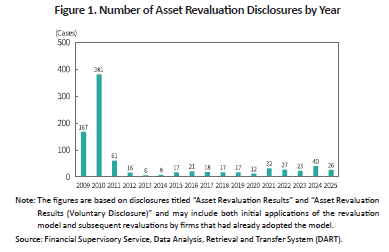
Based on asset revaluation result disclosures filed with the Financial Supervisory Service’s Data Analysis, Retrieval and Transfer System (DART), this paper uses a total of 889 asset revaluation cases from 2009 to 2025.3) Asset revaluation disclosures were heavily concentrated in 2009–2010, shortly after firms were permitted to apply the revaluation model. There were 167 cases in 2009 and 381 cases in 2010, together accounting for approximately 62% of the total. Although 61 cases were still reported in 2011, the number declined sharply thereafter, with only a few dozen cases disclosed annually in recent years (<Figure 1>).
The concentration of asset revaluation disclosures in 2009–2010 may partly reflect institutional changes introduced at the time. In late 2008, Korean authorities moved to allow firms to apply the revaluation model to PP&E to help firms strengthen their financial positions and improve their access to financing after the global financial crisis. Accordingly, the annual pattern of revaluation disclosures was likely influenced not only by firms’ financial conditions and asset characteristics but also by the institutional environment prevailing at the time.
Most Asset Revaluations Involve Land
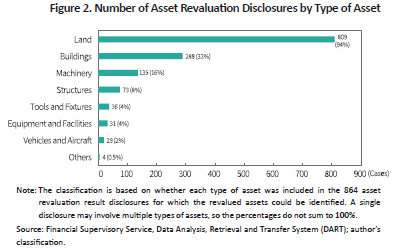
Another notable feature of asset revaluation in Korea is that revaluations are heavily concentrated in land. Among the 864 asset revaluation result disclosures for which the revalued assets could be identified, 809 cases, or approximately 94%, involved land. Buildings were included in 288 cases (33%), machinery in 135 cases (16%), and structures in 73 cases (8%) (<Figure 2>).
The predominance of land provides important insight into the economic incentives underlying firms’ revaluation decisions. Unlike buildings and machinery, land is not depreciated, and the gap between its historical acquisition cost and current market value can become substantial when it is held for a long period. In addition, an upward revaluation of land does not result in additional depreciation expense in subsequent periods. Firms may therefore have stronger incentives to revalue land than depreciable assets such as buildings or machinery.4) Asset revaluation can thus serve as a useful means of better reflecting the current value of land in financial statements.
Impact of Asset Revaluation on Financial Statements
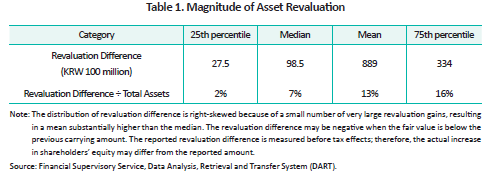
The size of the revaluation difference indicates that asset revaluation can have a substantial impact on firms’ financial statements. Among the 886 disclosures for which the revaluation difference can be identified, the median was approximately KRW 9.85 billion. The 25th percentile was approximately KRW 2.75 billion, while the 75th percentile was approximately KRW 33.4 billion, indicating considerable variation across firms. When the revaluation difference is scaled by total assets prior to revaluation to account for differences in firm size, the median is approximately 7% of total assets, with the 25th and 75th percentiles at approximately 2% and 16%, respectively (<Table 1>).
These results show that asset revaluation can substantially change the reported amounts of total assets and equity and, consequently, affect financial ratios such as the debt-to-equity ratio and PBR. However, a revaluation gain of KRW 10 billion does not mean that net income increases by KRW 10 billion or that the firm receives KRW 10 billion in new cash. It simply reflects a change in the measured value of assets that the firm already holds. Changes in financial ratios following revaluation should therefore be distinguished from improvements in the firm’s profitability or cash-generating capacity.
Incentives for Asset Revaluation and Firm Characteristics
Prior research has examined firms’ decisions to revalue assets from two perspectives. The first is an information-related motive. When firms hold assets whose carrying amounts differ substantially from their current fair values, revaluation can provide investors and creditors with useful information by revealing asset values that are not fully reflected in the financial statements.
The second relates to firms’ financial structure. When asset revaluation increases assets and shareholders’ equity, the book debt-to-equity ratio may decline. Firms with heavier debt burdens or greater financing needs may therefore have stronger incentives to revalue their assets. Prior studies find that revaluation incentives are stronger for firms with higher land intensity and leverage and a lower proportion of current assets.5) Research examining Korean firms during the global financial crisis also finds that increases in financing following revaluation were particularly pronounced for long-term private debt among financially constrained firms.6) However, asset revaluation itself does not generate new capital inflows, and the specific economic conditions prevailing during the financial crisis should be considered when interpreting these findings.
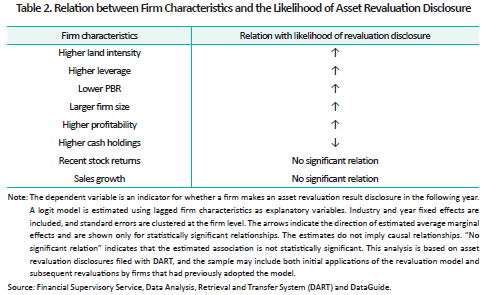
This paper examines how firm characteristics are associated with the likelihood of an asset revaluation result disclosure among listed firms in Korea (<Table 2>). The results show that firms with higher land intensity and higher leverage are more likely to disclose an asset revaluation in the following year, whereas firms with higher cash holdings are less likely to do so. In addition, the probability of making an asset revaluation disclosure in the following year is estimated to be approximately 3.3 percentage points higher for firms with a PBR below one than for other firms. The results are similar when PBR is used as a continuous variable: lower PBRs are associated with a higher likelihood of revaluation disclosure. However, because PBR also reflects market assessments of the firm’s profitability, growth prospects, and future risk, a low PBR should not necessarily be interpreted as evidence that the firm’s underlying assets are undervalued. Moreover, these findings show associations between firm characteristics and asset revaluation rather than providing causal evidence on firms’ decisions to adopt the revaluation model. The results also suggest that asset revaluation is not limited to financially distressed firms. Firms with higher profitability are also more likely to make revaluation disclosures, while recent stock returns and sales growth show no statistically significant relationship with revaluation likelihood.
Overall, revaluation appears more common among firms that hold substantial amounts of revaluable land—where the gap between book value and current asset value may be large—and that have financial-structure-related incentives to adjust reported book values.
Economic Implications of Asset Revaluation
Asset revaluation can be valuable because it brings the reported values of long-held assets closer to their current fair values, thereby providing investors with more relevant information for decision-making. This role may be particularly important in Korea, where most asset revaluation cases involve land. For land acquired many years ago, revaluation can help inform investors about the gap between carrying amounts based on historical acquisition costs and current asset values.
However, an increase in the revalued amount of assets does not necessarily imply an improvement in a firm’s intrinsic value or operating performance. A lower debt-to-equity ratio resulting from an increase in shareholders’ equity does not mean that the firm has repaid its existing debt. Likewise, revaluing assets does not by itself improve productivity or generate additional operating cash flows. PBR may also decline mechanically as book equity increases.
From the perspective of enhancing firm value, it is therefore important to distinguish between revealing the value of existing assets more accurately and creating new economic value. Asset revaluation can improve the information available about assets already held by the firm, but actual value creation requires substantive actions, including more efficient use of existing assets, productive investment, restructuring, and shareholder payouts.
From a policy perspective, it is important to provide sufficient information for investors to assess the gap between the carrying amounts of corporate assets and their current economic values. In this regard, the September 2026 amendment to K-IFRS 1016 requires firms applying the cost model to land to disclose the officially assessed land value in the notes, beginning with annual financial statements for fiscal years ending on December 31, 2026.7) Although the officially assessed land value is a government-determined reference value and does not necessarily represent fair value under the revaluation model, it can provide useful external information that helps investors assess the gap between carrying amounts and external measures of land value even for firms that do not apply the revaluation model. For firms that do apply the revaluation model, information about the valuation process is also important. These firms should therefore provide sufficient disclosure regarding valuation methods, key assumptions, and other relevant inputs so that investors can understand not only the reported valuation amounts but also the uncertainty associated with their measurement.
In conclusion, what matters more for enhancing firm value is not the revaluation itself but how the revalued assets are subsequently used. Even with the same revaluation gain, a firm that continues to hold non-core land and a firm that sells the land and reallocates the proceeds to growth investment or shareholder payouts may experience very different subsequent economic outcomes. The value of asset revaluation comes not simply from increasing reported book values, but from providing the market with better information about the current value of a firm’s existing assets. For this information to translate into value creation, firms need to use revalued assets more efficiently and take follow-up actions that improve profitability and cash flows.
1) PBR is calculated as market capitalization divided by the book value of equity.
2) This simplified example does not consider tax effects. In practice, asset revaluation may give rise to deferred tax effects, so the increase in shareholders’ equity may differ from the amount of the revaluation surplus.
3) To examine the current state of asset revaluation in Korea, this paper identifies 889 asset revaluation cases from 2009 to 2025 based on asset revaluation result disclosures filed with the Financial Supervisory Service’s Data Analysis, Retrieval and Transfer System (DART). Subsequent revaluations after adoption of the revaluation model may be reported only in the notes to annual reports or audit reports; therefore, DART result disclosures do not capture all accounting revaluations undertaken by firms. Nevertheless, these disclosures provide comparable information on revaluation timing, the assets subject to revaluation, revalued amounts, and revaluation differences. Accordingly, this paper uses DART result disclosures as the basis for identifying and analyzing asset revaluation cases.
4) Choi, T. H., Pae, J., Park, S., & Song, Y. (2013). Asset revaluations: motives and choice of items to revalue. Asia-Pacific Journal of Accounting & Economics, 20(2), 144-171.
5) Kim, J. A., & Choi, J. S. (2010). A study on the motivations for revaluation of property, plant, and equipment. Accounting Information Review, 28(4), 49–76.
6) Cho, H., Chung, J. R., & Kim, Y. J. (2021). Fixed asset revaluation and external financing during the financial crisis: Evidence from Korea. Pacific-Basin Finance Journal, 67, 101517.
7) Financial Services Commission (September 23, 2026). “Officially Assessed Land Values to Be Disclosed in the Notes to Financial Statements to Better Reflect Firms’ Value.”
When a firm acquires property, plant, and equipment (PP&E), it initially recognizes the asset at cost. For subsequent measurement, the firm may choose either the cost model or the revaluation model for each class of assets, such as land, buildings, and machinery. Under the cost model, assets are reported in the financial statements at acquisition cost less accumulated depreciation and accumulated impairment losses. Following the global financial crisis, Korean accounting standards were amended at the end of 2008 to permit the use of the revaluation model for PP&E, ahead of the mandatory adoption of K-IFRS in 2011, as part of efforts to improve firms’ financial positions. Since then, the revaluation model has remained an accounting policy choice alongside the cost model.
For example, if a firm applies the revaluation model to land, the carrying amount of the relevant land asset class is remeasured at fair value. Fair value is the price that would be received to sell an asset in an orderly transaction between market participants at the measurement date. In other words, it is based on the price that market participants would assign to the asset rather than on a value determined internally by the firm.
When market prices for certain parcels of land or specialized machinery are not directly observable, fair value is typically estimated using appropriate valuation techniques, including appraisals, together with various assumptions and inputs. In such cases, the estimated value may vary depending on the assumptions and inputs used, increasing measurement uncertainty.
In addition, when a firm chooses the revaluation model for a particular asset class, it has to apply the model to the entire class rather than selectively revaluing individual assets. Thus, while a firm may choose whether to adopt the revaluation model initially, once it does so, it needs to revalue the relevant asset class with sufficient regularity to ensure that its carrying amount appropriately reflects fair value.
Consider a simple example of asset revaluation.2) Suppose a firm applies the revaluation model for the first time to land originally acquired for KRW 10 billion and revalues it at its current fair value of KRW 30 billion. The land is then reported at KRW 30 billion in the financial statements. The KRW 20 billion difference between the previous carrying amount and the revalued amount is recognized in other comprehensive income and accumulated in equity as a revaluation surplus. As a result, total assets and shareholders’ equity increase, and the book debt-to-equity ratio may decline. Meanwhile, if the market value remains unchanged, the increase in book equity may lower its PBR.
Asset revaluation therefore does not necessarily increase firm value. It simply updates the measured value of assets that the firm already holds, so changes in financial ratios resulting from increases in assets and equity do not necessarily indicate improvements in profitability or cash-generating capacity. Nevertheless, asset revaluation can be an important accounting policy choice because it may bring the reported value of assets closer to their current economic value and alter the firm’s reported financial structure.
Trends in Asset Revaluation Disclosures
Based on asset revaluation result disclosures filed with the Financial Supervisory Service’s Data Analysis, Retrieval and Transfer System (DART), this paper uses a total of 889 asset revaluation cases from 2009 to 2025.3) Asset revaluation disclosures were heavily concentrated in 2009–2010, shortly after firms were permitted to apply the revaluation model. There were 167 cases in 2009 and 381 cases in 2010, together accounting for approximately 62% of the total. Although 61 cases were still reported in 2011, the number declined sharply thereafter, with only a few dozen cases disclosed annually in recent years (<Figure 1>).
Most Asset Revaluations Involve Land
Another notable feature of asset revaluation in Korea is that revaluations are heavily concentrated in land. Among the 864 asset revaluation result disclosures for which the revalued assets could be identified, 809 cases, or approximately 94%, involved land. Buildings were included in 288 cases (33%), machinery in 135 cases (16%), and structures in 73 cases (8%) (<Figure 2>).
Impact of Asset Revaluation on Financial Statements
The size of the revaluation difference indicates that asset revaluation can have a substantial impact on firms’ financial statements. Among the 886 disclosures for which the revaluation difference can be identified, the median was approximately KRW 9.85 billion. The 25th percentile was approximately KRW 2.75 billion, while the 75th percentile was approximately KRW 33.4 billion, indicating considerable variation across firms. When the revaluation difference is scaled by total assets prior to revaluation to account for differences in firm size, the median is approximately 7% of total assets, with the 25th and 75th percentiles at approximately 2% and 16%, respectively (<Table 1>).
Incentives for Asset Revaluation and Firm Characteristics
Prior research has examined firms’ decisions to revalue assets from two perspectives. The first is an information-related motive. When firms hold assets whose carrying amounts differ substantially from their current fair values, revaluation can provide investors and creditors with useful information by revealing asset values that are not fully reflected in the financial statements.
The second relates to firms’ financial structure. When asset revaluation increases assets and shareholders’ equity, the book debt-to-equity ratio may decline. Firms with heavier debt burdens or greater financing needs may therefore have stronger incentives to revalue their assets. Prior studies find that revaluation incentives are stronger for firms with higher land intensity and leverage and a lower proportion of current assets.5) Research examining Korean firms during the global financial crisis also finds that increases in financing following revaluation were particularly pronounced for long-term private debt among financially constrained firms.6) However, asset revaluation itself does not generate new capital inflows, and the specific economic conditions prevailing during the financial crisis should be considered when interpreting these findings.
This paper examines how firm characteristics are associated with the likelihood of an asset revaluation result disclosure among listed firms in Korea (<Table 2>). The results show that firms with higher land intensity and higher leverage are more likely to disclose an asset revaluation in the following year, whereas firms with higher cash holdings are less likely to do so. In addition, the probability of making an asset revaluation disclosure in the following year is estimated to be approximately 3.3 percentage points higher for firms with a PBR below one than for other firms. The results are similar when PBR is used as a continuous variable: lower PBRs are associated with a higher likelihood of revaluation disclosure. However, because PBR also reflects market assessments of the firm’s profitability, growth prospects, and future risk, a low PBR should not necessarily be interpreted as evidence that the firm’s underlying assets are undervalued. Moreover, these findings show associations between firm characteristics and asset revaluation rather than providing causal evidence on firms’ decisions to adopt the revaluation model. The results also suggest that asset revaluation is not limited to financially distressed firms. Firms with higher profitability are also more likely to make revaluation disclosures, while recent stock returns and sales growth show no statistically significant relationship with revaluation likelihood.
Overall, revaluation appears more common among firms that hold substantial amounts of revaluable land—where the gap between book value and current asset value may be large—and that have financial-structure-related incentives to adjust reported book values.
Asset revaluation can be valuable because it brings the reported values of long-held assets closer to their current fair values, thereby providing investors with more relevant information for decision-making. This role may be particularly important in Korea, where most asset revaluation cases involve land. For land acquired many years ago, revaluation can help inform investors about the gap between carrying amounts based on historical acquisition costs and current asset values.
However, an increase in the revalued amount of assets does not necessarily imply an improvement in a firm’s intrinsic value or operating performance. A lower debt-to-equity ratio resulting from an increase in shareholders’ equity does not mean that the firm has repaid its existing debt. Likewise, revaluing assets does not by itself improve productivity or generate additional operating cash flows. PBR may also decline mechanically as book equity increases.
From the perspective of enhancing firm value, it is therefore important to distinguish between revealing the value of existing assets more accurately and creating new economic value. Asset revaluation can improve the information available about assets already held by the firm, but actual value creation requires substantive actions, including more efficient use of existing assets, productive investment, restructuring, and shareholder payouts.
From a policy perspective, it is important to provide sufficient information for investors to assess the gap between the carrying amounts of corporate assets and their current economic values. In this regard, the September 2026 amendment to K-IFRS 1016 requires firms applying the cost model to land to disclose the officially assessed land value in the notes, beginning with annual financial statements for fiscal years ending on December 31, 2026.7) Although the officially assessed land value is a government-determined reference value and does not necessarily represent fair value under the revaluation model, it can provide useful external information that helps investors assess the gap between carrying amounts and external measures of land value even for firms that do not apply the revaluation model. For firms that do apply the revaluation model, information about the valuation process is also important. These firms should therefore provide sufficient disclosure regarding valuation methods, key assumptions, and other relevant inputs so that investors can understand not only the reported valuation amounts but also the uncertainty associated with their measurement.
In conclusion, what matters more for enhancing firm value is not the revaluation itself but how the revalued assets are subsequently used. Even with the same revaluation gain, a firm that continues to hold non-core land and a firm that sells the land and reallocates the proceeds to growth investment or shareholder payouts may experience very different subsequent economic outcomes. The value of asset revaluation comes not simply from increasing reported book values, but from providing the market with better information about the current value of a firm’s existing assets. For this information to translate into value creation, firms need to use revalued assets more efficiently and take follow-up actions that improve profitability and cash flows.
1) PBR is calculated as market capitalization divided by the book value of equity.
2) This simplified example does not consider tax effects. In practice, asset revaluation may give rise to deferred tax effects, so the increase in shareholders’ equity may differ from the amount of the revaluation surplus.
3) To examine the current state of asset revaluation in Korea, this paper identifies 889 asset revaluation cases from 2009 to 2025 based on asset revaluation result disclosures filed with the Financial Supervisory Service’s Data Analysis, Retrieval and Transfer System (DART). Subsequent revaluations after adoption of the revaluation model may be reported only in the notes to annual reports or audit reports; therefore, DART result disclosures do not capture all accounting revaluations undertaken by firms. Nevertheless, these disclosures provide comparable information on revaluation timing, the assets subject to revaluation, revalued amounts, and revaluation differences. Accordingly, this paper uses DART result disclosures as the basis for identifying and analyzing asset revaluation cases.
4) Choi, T. H., Pae, J., Park, S., & Song, Y. (2013). Asset revaluations: motives and choice of items to revalue. Asia-Pacific Journal of Accounting & Economics, 20(2), 144-171.
5) Kim, J. A., & Choi, J. S. (2010). A study on the motivations for revaluation of property, plant, and equipment. Accounting Information Review, 28(4), 49–76.
6) Cho, H., Chung, J. R., & Kim, Y. J. (2021). Fixed asset revaluation and external financing during the financial crisis: Evidence from Korea. Pacific-Basin Finance Journal, 67, 101517.
7) Financial Services Commission (September 23, 2026). “Officially Assessed Land Values to Be Disclosed in the Notes to Financial Statements to Better Reflect Firms’ Value.”