Our bi-weekly Opinion provides you with latest updates and analysis on major capital market and financial investment industry issues.
Developing Korea’s Secondary Market: Lessons from Global Markets
Publication date Nov. 03, 2026

Summary
Secondary markets allow investors to exit and redeploy capital while giving companies the time they need to grow. Globally, both limited partner (LP)-led and general partner (GP)-led transactions are expanding in response to constraints on traditional exit routes and longer holding periods. LP-led transactions have become an established means of generating liquidity and managing portfolios. GP-led transactions, particularly continuation funds, allow existing investors to exit while enabling continued investment in promising assets. In Korea, government-backed funds, securities firms, and securities market institutions are also increasing their investment in secondaries. As capital supply expands, asset quality, price validation, and fund management capabilities require scrutiny.
The growth of global secondary markets rests on more than the supply of capital: it also depends on specialist intermediation and advisory capabilities and established practices that enable transactions to close. In LP-led transactions, specialist advisers coordinate the process, from constructing sale portfolios and running competitive auctions to obtaining GP consent and negotiating transaction documents. In GP-led transactions, managing conflicts of interest is essential because the same manager is involved on both sides of the transaction. Industry guidance in overseas markets therefore emphasizes competitive processes, independent price validation, adequate information and review periods, and existing investors’ right to choose between cashing out and rolling over their interests.
Developing Korea’s secondary market requires action in three areas. First, uncertainty surrounding information disclosure and contractual procedures for LP interest transfers should be reduced, and specialist advisory capabilities should be developed. Government-backed funds of funds can help establish market practices, while securities firms should strengthen their intermediation and advisory capabilities. Second, principles for price validation and the protection of existing investors in GP-led transactions are needed. Third, information on transaction structures, risk-return profiles, and exit track records should be provided to broaden participation by institutional investors, including pension funds, credit unions, and insurance companies. With sound transaction procedures, investor protection, specialist advisory capabilities, and long-term capital in place, the secondary market can become part of the capital market infrastructure that supports both investor exits and sustained corporate growth.
Importance of the Secondary Market
The sustainability of venture capital and private equity investment depends both on the ability to provide companies with capital and on the ability to realize investments and recycle the proceeds. Companies need time to grow, but investors’ capital allocation plans and the lives of investment funds may not align with that timetable. If a company with further growth potential must be sold as a fund approaches the end of its life, its value may not be fully realized. Conversely, repeatedly deferring exits can constrain LPs’ capacity to make new commitments. Secondary transactions bridge this timing gap by transferring existing interests to new investors.
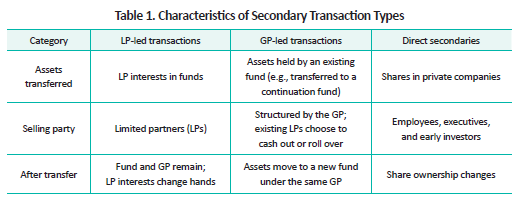
Secondary transactions should be distinguished by the assets being transferred and the party initiating the transaction. In an LP-led transaction, a limited partner (LP) sells its interest in a fund, while the fund holding the underlying assets and its general partner typically remain in place. In a GP-led transaction, the general partner (GP) structures the sale or reorganization of assets held in an existing fund. A prominent example is a continuation fund, which transfers existing assets into a new fund and gives existing LPs the option to cash out or roll over their interests. Separately, direct secondary transactions involve employees, executives, or early investors selling shares in private companies. The scope of due diligence, the parties whose consent is required, and the nature of conflicts of interest differ across these transaction types. A single policy instrument is therefore unlikely to stimulate every segment of the market (Table 1).
Growth of the Global Secondary Market
The growth of the secondary market is closely linked to constraints on traditional exit routes. IPOs and M&A remain highly sensitive to market conditions. As private markets have expanded, holding periods for private companies have lengthened, and cash distributions to LPs have declined. According to global investment bank Jefferies, the annualized distribution rate to LPs was approximately 10% in the first half of 2026, well below the average of 25% since 2001.1) PitchBook estimates that, at the end of 2025, funds more than seven years old held approximately USD 5 trillion in remaining net asset value (NAV) worldwide, representing 39% of total NAV.2) As exits are delayed, investors increasingly seek liquidity by transferring their interests to other investors, and the private sector-led secondary market is meeting this demand.
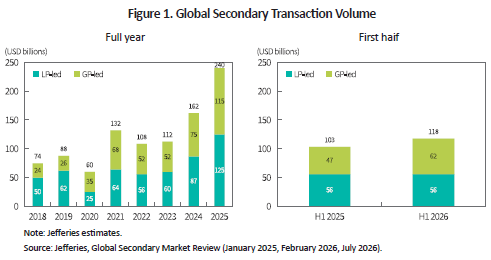
The global secondary market is expanding rapidly. Jefferies estimates that transaction volume reached USD 240 billion in 2025, an increase of 48% from the previous year. LP-led transactions accounted for USD 125 billion, or 52% of the total, and GP-led transactions for USD 115 billion, or 48% (Figure 1).3) Evercore estimates that transaction volume reached USD 121 billion in the first half of 2026, up approximately 19% year on year. GP-led transactions accounted for USD 65 billion, exceeding the USD 56 billion recorded for LP-led transactions.4) Although the two firms differ in coverage and estimation methodology, both point to growth in LP liquidity transactions and GP-led asset restructurings.
The pool of buyer capital has also deepened. Dedicated secondary capital reached USD 327 billion at the end of 2025, up 14% from a year earlier.5) The buyer base is broadening as buyout managers and new entrants join established secondary specialists. Jefferies projects that full-year transaction volume will exceed USD 260 billion in 2026.6)
LP-Led Transactions: From Liquidity to Portfolio Management
In an LP-led transaction, an investor sells fund interests to generate portfolio liquidity or adjust its asset allocation. As distributions to paid-in capital (DPI) decline, more investors seek to sell interests to fund new commitments. According to Jefferies, pension funds and sovereign wealth funds were the largest sellers in the first half of 2026, accounting for 48% of sales, followed by funds of funds and secondary funds at 27%, endowments and foundations at 16%, and family offices at 5%. The reasons for selling included liquidity generation (45%), the disposal of tail-end positions (26%), and portfolio rebalancing (16%).7) These figures indicate that LP-led transactions have become a routine portfolio management tool for institutional investors, rather than simply a means of disposing of distressed assets. In 2025, 27 LP-led transactions exceeded USD 1 billion, and average transaction size rose to USD 450 million from USD 425 million a year earlier.8)
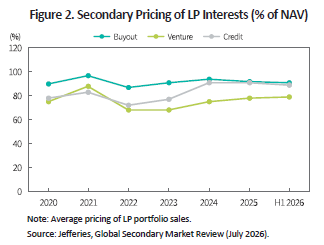
LP-led transactions typically take place at a discount to NAV. Sellers accept a discount in exchange for earlier liquidity, while buyers price in the remaining holding period and uncertainty over exits. Jefferies’ data for 2020 through the first half of 2026 show substantial variation in average LP interest pricing by strategy: 92% of NAV for buyout funds, 76% for venture funds, and 83% for credit funds. Pricing also varied over time in response to external factors, including interest rate increases and changes in public market valuations (Figure 2). NAV is only the starting point for negotiations; pricing also reflects capital calls and distributions after the reference date, as well as the exit prospects of the remaining assets.
LP-led transactions, particularly those involving large portfolios, tend to be conducted through competitive auctions designed by specialist intermediaries and advisers. According to Evercore, 88% of LP-led transactions in the first half of 2026 were completed through adviser-led auction processes involving multiple prospective buyers.9) The Private Capital Advisory teams of global investment banks such as Evercore, Jefferies, Lazard, and PJT Park Hill coordinate the entire transaction process. Their role extends beyond introducing assets for sale to constructing sale portfolios, facilitating price discovery, managing auctions, negotiating GP consent, and coordinating transaction documentation.
Transfers of fund interests generally require GP consent and may be subject to rights of first refusal or advance notice requirements. Common market practices include adjusting the purchase price for capital calls and distributions after the reference date and executing transfer agreements among the seller, buyer, and GP. Nevertheless, documentation and terms vary across managers and funds.10) Specialist intermediaries and advisers have played an important role in navigating these differences and closing transactions. While liquidity needs arising from delayed exits have driven market growth, the intermediation and advisory capabilities and transaction practices developed by the private sector have enabled that demand to translate into completed deals.
GP-Led Transactions: The Growth and Governance of Continuation Funds
GP-led transactions are a rapidly growing segment. While LP-led activity has expanded in response to investors’ liquidity needs, GP-led transactions often exclude underperforming assets from an existing fund, focus on a select group of high-potential assets, and provide additional growth capital. As a result, they tend to target higher returns.11) Global GP-led transaction volume reached USD 115 billion in 2025, up 53% from USD 75 billion in the previous year. In the first half of 2026, it reached USD 62 billion, accounting for 53% of the market and exceeding LP-led volume for the first time since 2021.12) Continuation funds are central to this growth. They accounted for 89% of GP-led transactions in the first half of 2026, with single-asset vehicles holding just one company representing 68% of continuation fund activity. Of the top 100 managers by assets under management, 82 had completed a continuation fund transaction.13) The share of existing LPs choosing to roll over rather than cash out also rose from 11% in 2023 to 15% in 2025, suggesting that investors are beginning to accept this structure as a standard transaction option.14)
Because the same manager is involved in both the selling and purchasing funds, managing conflicts of interest is essential. Industry guidance serves as an important benchmark in overseas markets. The Institutional Limited Partners Association (ILPA), in its 2023 guidance, recommends providing existing LPs with adequate information and time to review the transaction, a choice between cashing out and rolling over, and safeguards for fair pricing through competitive processes and independent third-party validation.15)
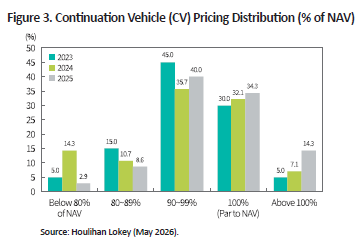
Actual economic terms and pricing distributions illustrate the need for such scrutiny. According to Evercore, more than one-third of GP-led transactions in the first half of 2026 included carried interest above 20%.16) In Houlihan Lokey’s sample of continuation fund transactions, 34.3% of deals in 2025 were priced at par to NAV (Figure 3).17) These terms are not inherently unfavorable to LPs. They do, however, warrant close examination of whether the GP’s compensation incentives align with LP interests and whether asset transfer prices have been established on a reasonable basis.
To improve the management of GP conflicts of interest in GP-led secondary transactions, ILPA released draft revisions to its continuation fund guidance in June 2026, setting out more specific expectations for price validation and investor protection. The draft recommends supporting fair pricing through sufficiently competitive transaction processes and the provision of valuation information.18) NAV, bid prices, and fairness opinions should be considered together, and investors should be able to understand the information and processes underlying the transaction price. This points to greater scrutiny of price formation, alongside the existing emphasis on preserving LP choice. As Korea introduces continuation funds, it should establish principles for competitive processes, disclosure of the basis for valuations, and independent price validation, as well as protect existing investors’ right to choose.
Implications for Korea
Policy support for the exit market is also strengthening in Korea. In January 2026, the Ministry of SMEs and Startups (MSS) announced plans to establish KRW 300 billion in dedicated M&A and secondary funds as part of the Korea Fund of Funds’ first regular commitment round of the year.19) In the private sector, the Korea Financial Investment Association (KOFIA) announced the securities industry’s secondary investment plans in August 2026.20) In September, securities market institutions, including the Korea Exchange (KRX), announced plans to establish approximately KRW 1 trillion in secondary funds.21) Further details were presented at a KOFIA policy seminar on October 8. The securities industry’s plans comprise individual investments by comprehensive financial investment business entities (CFIBEs) and a KRW 300 billion joint fund involving 15 securities firms and KOFIA. The joint fund is expected to select a manager by year-end and begin investing early the following year.22)
Expanding the supply of capital to the secondary market supports the growing allocation of Korean venture investment to deep tech, which requires long investment horizons.23) Because technology development and commercialization take considerable time, a mechanism that provides interim liquidity to existing investors while allowing investment in companies to continue is essential. However, as the scale of secondary fundraising increases rapidly to meet these needs, it is also necessary to assess whether asset quality, price validation, and fund management capabilities can support that expansion.
First, analysis of global markets highlights the importance of specialist advisory capabilities in facilitating transaction execution. Advisers need a sound understanding of the information requirements and contractual procedures for LP interest transfers, together with the capacity to support the entire transaction process. Korea should therefore strengthen securities firms’ capabilities in secondary transaction origination, intermediation, and advisory services, while encouraging participation by independent M&A advisers and independent private capital advisers to broaden deal origination. These advisers should be able to support the full process, from constructing sale portfolios, identifying prospective buyers, and establishing prices through competitive auctions to obtaining GP consent and negotiating transaction documents. However, conflicts of interest may arise when a securities firm both invests in a secondary transaction and provides sell-side advice. Principles for managing these conflicts, including separation of investment and advisory roles and independent price validation, are therefore also needed.
Government-sponsored funds of funds also have a role in laying the foundations for transactions in LP interests. Drawing on their participation in multiple underlying funds, they can identify LPs’ demand to sell fund interests, standardize the provision of transaction information and transfer procedures, and work with securities firms and specialist advisers to support buyer searches and price negotiations. Within the limits permitted by applicable regulations, they can also sell part of their existing fund interests or commit capital to secondary funds established to acquire LP interests. These activities would help build a transaction track record and pricing data, and encourage private investor participation.
Second, to support the development of GP-led transactions, industry associations or financial authorities should establish basic principles for price validation and the protection of existing investors. Pricing should be tested through independent valuations and competition among multiple buyers. Existing LPs should receive the terms for both cashing out and rolling over at the same time, with sufficient information and review periods to make an informed choice. Public-sector LPs can help embed investor protection and transparent price formation in market practice by proactively incorporating these principles into their commitment terms.
Third, institutional investor interest in the secondary market should be encouraged. Pension funds, credit unions, and insurance companies need information on the structures and risk-return profiles of LP interest transactions, as well as analysis of the returns and exit track records of GP-led transactions, to assess their investment appeal. This would broaden the basis for institutional participation in line with each investor’s objectives and asset management requirements.
Developing Korea’s secondary market requires guidelines for transaction procedures, price validation and investor protection, specialist intermediation and advisory capabilities, and long-term investment capital. Policy should bring these elements together to create an environment in which market participants can transact on predictable terms. As transactions recur and pricing information and exit track records accumulate, investors will have a stronger basis for their decisions, encouraging additional capital to enter the market. Through this virtuous cycle, the secondary market can become part of the capital market infrastructure that offers existing investors opportunities to exit while giving companies the investment horizon they need to grow.
1) Jefferies, July 2026, Global Secondary Market Review.
2) PitchBook, September 2026, Q2 2026 Global Private Market Fundraising Report.
3) Jefferies, February 2026, 2025 Global Secondary Market Review: Another Record-Breaking Year. Transaction volumes are the firm’s estimates.
4) Evercore, July 2026, H1 2026 Secondary Market Review.
5) Jefferies, February 2026, 2025 Global Secondary Market Review: Another Record-Breaking Year.
6) Jefferies, July 2026, Global Secondary Market Review.
7) Jefferies, July 2026, Global Secondary Market Review. Percentages are based on transaction value.
8) Jefferies, January 2026, Global Secondary Market Review.
9) Evercore, July 2026, H1 2026 Secondary Market Review. Percentages are based on transaction value.
10) Morgan Lewis, 2025, Limited Partner Secondary Sales 101.
11) Lazard, 2025 Secondary Market Report. According to Lazard’s survey of transactions in 2025, underwritten net IRR targets for GP-led secondary transactions were 20.6% for single-asset buyout continuation funds and 19.3% for multi-asset buyout continuation funds. Targets for other GP-led secondary strategies were 22.6% for venture/growth and 16.3% for private credit.
12) Jefferies, July 2026, Global Secondary Market Review.
13) Jefferies, July 2026, Global Secondary Market Review.
14) Jefferies, January 2026, Global Secondary Market Review.
15) ILPA, 2023, Continuation Funds: Considerations for Limited Partners and General Partners.
16) Evercore, July 2026, H1 2026 Secondary Market Review.
17) Houlihan Lokey, May 2026, 2025 Continuation Fund Study.
18) In 2023, the US Securities and Exchange Commission (SEC) sought to require an independent fairness opinion or valuation opinion for adviser-led secondary transactions. On June 5, 2024, however, the US Court of Appeals for the Fifth Circuit vacated the rule (National Association of Private Fund Managers v. SEC).
19) Ministry of SMEs and Startups, January 23, 2026, “KRW 2.1 Trillion in Korea Fund of Funds Commitments to Mobilize KRW 4.4 Trillion in Venture Funds,” press release.
20) KOFIA announcement, August 31, 2026. The plans comprise approximately KRW 618.5 billion in individual investments by seven major securities firms operating promissory note and investment management account (IMA) businesses, plus a KRW 300 billion joint fund involving 15 securities firms and KOFIA.
21) Korea Securities Depository (KSD) announcement, September 30, 2026. Participating institutions include the Korea Exchange, Korea Securities Finance Corporation, and Koscom. Funding is subject to each institution’s internal approval procedures.
22) KOFIA, October 8, 2026, presentation at the “Policy Seminar on Revitalizing the Venture Exit Market through the Securities Industry.” Cited in Yonhap Infomax, October 8, 2026, “KOFIA Considers a Fund-of-Funds Structure for KRW 300 Billion Joint Secondary Fund; Manager to Be Selected by Year-End.”
23) Ministry of SMEs and Startups, April 8, 2025, “Venture Investment Trends in Ten Major Deep Tech Sectors in 2024.”
The sustainability of venture capital and private equity investment depends both on the ability to provide companies with capital and on the ability to realize investments and recycle the proceeds. Companies need time to grow, but investors’ capital allocation plans and the lives of investment funds may not align with that timetable. If a company with further growth potential must be sold as a fund approaches the end of its life, its value may not be fully realized. Conversely, repeatedly deferring exits can constrain LPs’ capacity to make new commitments. Secondary transactions bridge this timing gap by transferring existing interests to new investors.
Secondary transactions should be distinguished by the assets being transferred and the party initiating the transaction. In an LP-led transaction, a limited partner (LP) sells its interest in a fund, while the fund holding the underlying assets and its general partner typically remain in place. In a GP-led transaction, the general partner (GP) structures the sale or reorganization of assets held in an existing fund. A prominent example is a continuation fund, which transfers existing assets into a new fund and gives existing LPs the option to cash out or roll over their interests. Separately, direct secondary transactions involve employees, executives, or early investors selling shares in private companies. The scope of due diligence, the parties whose consent is required, and the nature of conflicts of interest differ across these transaction types. A single policy instrument is therefore unlikely to stimulate every segment of the market (Table 1).
Growth of the Global Secondary Market
The growth of the secondary market is closely linked to constraints on traditional exit routes. IPOs and M&A remain highly sensitive to market conditions. As private markets have expanded, holding periods for private companies have lengthened, and cash distributions to LPs have declined. According to global investment bank Jefferies, the annualized distribution rate to LPs was approximately 10% in the first half of 2026, well below the average of 25% since 2001.1) PitchBook estimates that, at the end of 2025, funds more than seven years old held approximately USD 5 trillion in remaining net asset value (NAV) worldwide, representing 39% of total NAV.2) As exits are delayed, investors increasingly seek liquidity by transferring their interests to other investors, and the private sector-led secondary market is meeting this demand.
The global secondary market is expanding rapidly. Jefferies estimates that transaction volume reached USD 240 billion in 2025, an increase of 48% from the previous year. LP-led transactions accounted for USD 125 billion, or 52% of the total, and GP-led transactions for USD 115 billion, or 48% (Figure 1).3) Evercore estimates that transaction volume reached USD 121 billion in the first half of 2026, up approximately 19% year on year. GP-led transactions accounted for USD 65 billion, exceeding the USD 56 billion recorded for LP-led transactions.4) Although the two firms differ in coverage and estimation methodology, both point to growth in LP liquidity transactions and GP-led asset restructurings.
The pool of buyer capital has also deepened. Dedicated secondary capital reached USD 327 billion at the end of 2025, up 14% from a year earlier.5) The buyer base is broadening as buyout managers and new entrants join established secondary specialists. Jefferies projects that full-year transaction volume will exceed USD 260 billion in 2026.6)
LP-Led Transactions: From Liquidity to Portfolio Management
In an LP-led transaction, an investor sells fund interests to generate portfolio liquidity or adjust its asset allocation. As distributions to paid-in capital (DPI) decline, more investors seek to sell interests to fund new commitments. According to Jefferies, pension funds and sovereign wealth funds were the largest sellers in the first half of 2026, accounting for 48% of sales, followed by funds of funds and secondary funds at 27%, endowments and foundations at 16%, and family offices at 5%. The reasons for selling included liquidity generation (45%), the disposal of tail-end positions (26%), and portfolio rebalancing (16%).7) These figures indicate that LP-led transactions have become a routine portfolio management tool for institutional investors, rather than simply a means of disposing of distressed assets. In 2025, 27 LP-led transactions exceeded USD 1 billion, and average transaction size rose to USD 450 million from USD 425 million a year earlier.8)
LP-led transactions typically take place at a discount to NAV. Sellers accept a discount in exchange for earlier liquidity, while buyers price in the remaining holding period and uncertainty over exits. Jefferies’ data for 2020 through the first half of 2026 show substantial variation in average LP interest pricing by strategy: 92% of NAV for buyout funds, 76% for venture funds, and 83% for credit funds. Pricing also varied over time in response to external factors, including interest rate increases and changes in public market valuations (Figure 2). NAV is only the starting point for negotiations; pricing also reflects capital calls and distributions after the reference date, as well as the exit prospects of the remaining assets.
LP-led transactions, particularly those involving large portfolios, tend to be conducted through competitive auctions designed by specialist intermediaries and advisers. According to Evercore, 88% of LP-led transactions in the first half of 2026 were completed through adviser-led auction processes involving multiple prospective buyers.9) The Private Capital Advisory teams of global investment banks such as Evercore, Jefferies, Lazard, and PJT Park Hill coordinate the entire transaction process. Their role extends beyond introducing assets for sale to constructing sale portfolios, facilitating price discovery, managing auctions, negotiating GP consent, and coordinating transaction documentation.
Transfers of fund interests generally require GP consent and may be subject to rights of first refusal or advance notice requirements. Common market practices include adjusting the purchase price for capital calls and distributions after the reference date and executing transfer agreements among the seller, buyer, and GP. Nevertheless, documentation and terms vary across managers and funds.10) Specialist intermediaries and advisers have played an important role in navigating these differences and closing transactions. While liquidity needs arising from delayed exits have driven market growth, the intermediation and advisory capabilities and transaction practices developed by the private sector have enabled that demand to translate into completed deals.
GP-Led Transactions: The Growth and Governance of Continuation Funds
GP-led transactions are a rapidly growing segment. While LP-led activity has expanded in response to investors’ liquidity needs, GP-led transactions often exclude underperforming assets from an existing fund, focus on a select group of high-potential assets, and provide additional growth capital. As a result, they tend to target higher returns.11) Global GP-led transaction volume reached USD 115 billion in 2025, up 53% from USD 75 billion in the previous year. In the first half of 2026, it reached USD 62 billion, accounting for 53% of the market and exceeding LP-led volume for the first time since 2021.12) Continuation funds are central to this growth. They accounted for 89% of GP-led transactions in the first half of 2026, with single-asset vehicles holding just one company representing 68% of continuation fund activity. Of the top 100 managers by assets under management, 82 had completed a continuation fund transaction.13) The share of existing LPs choosing to roll over rather than cash out also rose from 11% in 2023 to 15% in 2025, suggesting that investors are beginning to accept this structure as a standard transaction option.14)
Because the same manager is involved in both the selling and purchasing funds, managing conflicts of interest is essential. Industry guidance serves as an important benchmark in overseas markets. The Institutional Limited Partners Association (ILPA), in its 2023 guidance, recommends providing existing LPs with adequate information and time to review the transaction, a choice between cashing out and rolling over, and safeguards for fair pricing through competitive processes and independent third-party validation.15)
Actual economic terms and pricing distributions illustrate the need for such scrutiny. According to Evercore, more than one-third of GP-led transactions in the first half of 2026 included carried interest above 20%.16) In Houlihan Lokey’s sample of continuation fund transactions, 34.3% of deals in 2025 were priced at par to NAV (Figure 3).17) These terms are not inherently unfavorable to LPs. They do, however, warrant close examination of whether the GP’s compensation incentives align with LP interests and whether asset transfer prices have been established on a reasonable basis.
To improve the management of GP conflicts of interest in GP-led secondary transactions, ILPA released draft revisions to its continuation fund guidance in June 2026, setting out more specific expectations for price validation and investor protection. The draft recommends supporting fair pricing through sufficiently competitive transaction processes and the provision of valuation information.18) NAV, bid prices, and fairness opinions should be considered together, and investors should be able to understand the information and processes underlying the transaction price. This points to greater scrutiny of price formation, alongside the existing emphasis on preserving LP choice. As Korea introduces continuation funds, it should establish principles for competitive processes, disclosure of the basis for valuations, and independent price validation, as well as protect existing investors’ right to choose.
Implications for Korea
Policy support for the exit market is also strengthening in Korea. In January 2026, the Ministry of SMEs and Startups (MSS) announced plans to establish KRW 300 billion in dedicated M&A and secondary funds as part of the Korea Fund of Funds’ first regular commitment round of the year.19) In the private sector, the Korea Financial Investment Association (KOFIA) announced the securities industry’s secondary investment plans in August 2026.20) In September, securities market institutions, including the Korea Exchange (KRX), announced plans to establish approximately KRW 1 trillion in secondary funds.21) Further details were presented at a KOFIA policy seminar on October 8. The securities industry’s plans comprise individual investments by comprehensive financial investment business entities (CFIBEs) and a KRW 300 billion joint fund involving 15 securities firms and KOFIA. The joint fund is expected to select a manager by year-end and begin investing early the following year.22)
Expanding the supply of capital to the secondary market supports the growing allocation of Korean venture investment to deep tech, which requires long investment horizons.23) Because technology development and commercialization take considerable time, a mechanism that provides interim liquidity to existing investors while allowing investment in companies to continue is essential. However, as the scale of secondary fundraising increases rapidly to meet these needs, it is also necessary to assess whether asset quality, price validation, and fund management capabilities can support that expansion.
First, analysis of global markets highlights the importance of specialist advisory capabilities in facilitating transaction execution. Advisers need a sound understanding of the information requirements and contractual procedures for LP interest transfers, together with the capacity to support the entire transaction process. Korea should therefore strengthen securities firms’ capabilities in secondary transaction origination, intermediation, and advisory services, while encouraging participation by independent M&A advisers and independent private capital advisers to broaden deal origination. These advisers should be able to support the full process, from constructing sale portfolios, identifying prospective buyers, and establishing prices through competitive auctions to obtaining GP consent and negotiating transaction documents. However, conflicts of interest may arise when a securities firm both invests in a secondary transaction and provides sell-side advice. Principles for managing these conflicts, including separation of investment and advisory roles and independent price validation, are therefore also needed.
Government-sponsored funds of funds also have a role in laying the foundations for transactions in LP interests. Drawing on their participation in multiple underlying funds, they can identify LPs’ demand to sell fund interests, standardize the provision of transaction information and transfer procedures, and work with securities firms and specialist advisers to support buyer searches and price negotiations. Within the limits permitted by applicable regulations, they can also sell part of their existing fund interests or commit capital to secondary funds established to acquire LP interests. These activities would help build a transaction track record and pricing data, and encourage private investor participation.
Second, to support the development of GP-led transactions, industry associations or financial authorities should establish basic principles for price validation and the protection of existing investors. Pricing should be tested through independent valuations and competition among multiple buyers. Existing LPs should receive the terms for both cashing out and rolling over at the same time, with sufficient information and review periods to make an informed choice. Public-sector LPs can help embed investor protection and transparent price formation in market practice by proactively incorporating these principles into their commitment terms.
Third, institutional investor interest in the secondary market should be encouraged. Pension funds, credit unions, and insurance companies need information on the structures and risk-return profiles of LP interest transactions, as well as analysis of the returns and exit track records of GP-led transactions, to assess their investment appeal. This would broaden the basis for institutional participation in line with each investor’s objectives and asset management requirements.
Developing Korea’s secondary market requires guidelines for transaction procedures, price validation and investor protection, specialist intermediation and advisory capabilities, and long-term investment capital. Policy should bring these elements together to create an environment in which market participants can transact on predictable terms. As transactions recur and pricing information and exit track records accumulate, investors will have a stronger basis for their decisions, encouraging additional capital to enter the market. Through this virtuous cycle, the secondary market can become part of the capital market infrastructure that offers existing investors opportunities to exit while giving companies the investment horizon they need to grow.
1) Jefferies, July 2026, Global Secondary Market Review.
2) PitchBook, September 2026, Q2 2026 Global Private Market Fundraising Report.
3) Jefferies, February 2026, 2025 Global Secondary Market Review: Another Record-Breaking Year. Transaction volumes are the firm’s estimates.
4) Evercore, July 2026, H1 2026 Secondary Market Review.
5) Jefferies, February 2026, 2025 Global Secondary Market Review: Another Record-Breaking Year.
6) Jefferies, July 2026, Global Secondary Market Review.
7) Jefferies, July 2026, Global Secondary Market Review. Percentages are based on transaction value.
8) Jefferies, January 2026, Global Secondary Market Review.
9) Evercore, July 2026, H1 2026 Secondary Market Review. Percentages are based on transaction value.
10) Morgan Lewis, 2025, Limited Partner Secondary Sales 101.
11) Lazard, 2025 Secondary Market Report. According to Lazard’s survey of transactions in 2025, underwritten net IRR targets for GP-led secondary transactions were 20.6% for single-asset buyout continuation funds and 19.3% for multi-asset buyout continuation funds. Targets for other GP-led secondary strategies were 22.6% for venture/growth and 16.3% for private credit.
12) Jefferies, July 2026, Global Secondary Market Review.
13) Jefferies, July 2026, Global Secondary Market Review.
14) Jefferies, January 2026, Global Secondary Market Review.
15) ILPA, 2023, Continuation Funds: Considerations for Limited Partners and General Partners.
16) Evercore, July 2026, H1 2026 Secondary Market Review.
17) Houlihan Lokey, May 2026, 2025 Continuation Fund Study.
18) In 2023, the US Securities and Exchange Commission (SEC) sought to require an independent fairness opinion or valuation opinion for adviser-led secondary transactions. On June 5, 2024, however, the US Court of Appeals for the Fifth Circuit vacated the rule (National Association of Private Fund Managers v. SEC).
19) Ministry of SMEs and Startups, January 23, 2026, “KRW 2.1 Trillion in Korea Fund of Funds Commitments to Mobilize KRW 4.4 Trillion in Venture Funds,” press release.
20) KOFIA announcement, August 31, 2026. The plans comprise approximately KRW 618.5 billion in individual investments by seven major securities firms operating promissory note and investment management account (IMA) businesses, plus a KRW 300 billion joint fund involving 15 securities firms and KOFIA.
21) Korea Securities Depository (KSD) announcement, September 30, 2026. Participating institutions include the Korea Exchange, Korea Securities Finance Corporation, and Koscom. Funding is subject to each institution’s internal approval procedures.
22) KOFIA, October 8, 2026, presentation at the “Policy Seminar on Revitalizing the Venture Exit Market through the Securities Industry.” Cited in Yonhap Infomax, October 8, 2026, “KOFIA Considers a Fund-of-Funds Structure for KRW 300 Billion Joint Secondary Fund; Manager to Be Selected by Year-End.”
23) Ministry of SMEs and Startups, April 8, 2025, “Venture Investment Trends in Ten Major Deep Tech Sectors in 2024.”