Our bi-weekly Opinion provides you with latest updates and analysis on major capital market and financial investment industry issues.
Major Countries’ Progress in Developing Alternative Benchmark Rates and Implications
Publication date Mar. 12, 2019

Summary
Amid regulatory reforms led by major countries to enhance the reliability and transparency of interest rate benchmarks, Andrew Bailey, the chief executive of the UK Financial Conduct Authority (FCA), revealed recently that LIBOR may cease in 2022. Against this backdrop, the US, the UK, the EU, Switzerland, and Japan, just to name a few, put every effort into developing and adopting alternative risk-free rates (RFRs) to replace LIBOR.
The end of LIBOR is expected to have considerable impacts on Korea as well. Korean financial services companies need to closely monitor overseas trends and proactively participate in global benchmark discussions as they prepare for the discontinuation of major interest rate benchmarks.
Furthermore, major countries are striving hard for replacing existing benchmarks such as LIBOR, which are calculated from estimates submitted by banks, with alternative benchmarks based on transactions in liquid markets. This could reduce the international acceptance and reliability of CD rates, one of Korea’s benchmark rates. Given that it will take considerable time to develop and adopt new benchmarks, there is an urgent need for Korea to have discussions on the development of alternative RFRs.
Following the LIBOR fixing scandal, regulatory reforms have been being carried out mostly in major countries to enhance the reliability and transparency of interest rate benchmarks. In July 2017 and July 2018, Andrew Bailey, the chief executive of the UK Financial Conduct Authority (FCA), said that LIBOR could no longer be produced from 2022 onward.2) As a result, the development and adoption of LIBOR alternatives is fast becoming a vital global issue.
The disappearance of LIBOR that played a pivotal role in international financial transactions over the past three decades is likely to bring significant changes to domestic and global financial markets. This article outlines the highlights of ongoing global financial benchmark reforms since 2012 with a particular focus on the development of alternative benchmarks, and discuss their implications.3)
Highlights and progress of global financial benchmark reforms
Reference rates or benchmark rates are used as benchmarks for a wide range of financial products and contracts (especially derivatives, loans and bonds), having vital impacts on the economic activities of financial institutions, corporations and households. As for LIBOR, the most common benchmark in the global financial markets, financial transactions referencing LIBOR totaled more than USD 300 trillion.4)
Recognizing that the LIBOR scandal stemmed from the production and management of benchmark rates relying on market discipline, G20 and the Financial Stability Board (FSB) have made concerted global efforts to reform benchmark rates to promote better financial consumer protection and stronger financial stability by restoring the reliability and transparency of benchmark rates, which are public goods.
The benchmark reforms that began around 2013 have been underway in two directions: Strengthening regulation of financial benchmarks and enhancing existing interest rate benchmarks. First, public sector intervention in activities associated with benchmark rates has greatly increased. This effort is pronounced in the European Union (EU) and the United Kingdom (UK). The Benchmarks Regulation (BMR)5) that came into effect in January 2018 in the EU and the UK regulates activities related to financial benchmarks (provision of information required for benchmark calculation, and production, governance and use of benchmarks). The BMR has significant effects with respect to the end of LIBOR and the development of alternative benchmark rates.6) The BMR classifies benchmarks that significantly affect the financial markets and the real economy as “critical” and requires administrators of critical benchmarks to satisfy regulatory requirements and obtain an authorization by competent regulatory authorities by the end of 2019. In accordance with the BMR, the use of unauthorized benchmarks in new financial transactions will be prohibited from 2020, and regulatory authorities will have the power to compel financial institutions to submit the daily rates used to calculate critical benchmarks.
Second, G20 asked the Financial Stability Board (FSB) to oversee the implementation of the benchmark reforms on the globe. The FSB designated interbank offered rates (IBORs) including London Interbank Offered Rate (LIBOR), Euro Interbank Offered Rate (EURIBOR), and Tokyo Interbank Offered Rate (TIBOR) as major financial market benchmarks, and has been pushing for policies to improve the production of such benchmarks. To that end, the benchmark administrators in collaboration with national competent authorities have been pressing ahead with the reforms to improve control and governance mechanisms for benchmarks and to promote the use of actual transactions input data. These reform efforts are intended to reduce the possibility of benchmark manipulation and make the benchmarks more reliable.
Furthermore, the FSB has been developing new risk-free rates (RFRs) to replace existing benchmark rates such as LIBOR in which bank credit risk is embedded. This is based on the view that it is desirable to develop and use new RFRs for certain financial instruments or contracts like derivatives. The development of RFRs has been undertaken by working groups set up for each of five LIBOR currencies (USD, EUR, JPY, GBP, and CHF) to develop RFRs.
As explained above, the FSB-led benchmark reforms have been based on a multi-rate approach7) that seeks to improve and maintain existing LIBOR, EURIBOR and TIBOR and to develop alternative RFRs for use in derivatives and other specified financial transactions.8)
Progress on the development and adoption of RFRs by country
The implementation of the BMR in the EU and the UK, and the efforts to improve the benchmark calculation have drastically reduced the likelihood of intentional benchmark manipulation. Nonetheless, a sharp contraction in unsecured interbank transactions9) since the financial crisis creates constraints on keeping and enhancing the existing benchmark interest rates calculated from estimates submitted by banks. In practice, it is known that LIBOR contributor banks are reluctant to submit rates by relying on expert judgement because of very sluggish actual transactions.10)
Regulatory authorities in major countries recognize the limitations in the efforts to enhance the production of key benchmarks, giving an impetus to the development and adoption of RFRs. RFRs for five LIBOR currencies have been developing by competent national authorities. For example, the US and Japan are responsible for developing and adopting USD LIBOR, and JPY LIBOR, respectively.
Each of the countries established its own working group on alternative reference rates that consists of regulatory agencies, the central bank and market participants, and determined the appropriate RFR to use, which reflects country-specific circumstances and is aligned with the International Organization of Securities Commissions (IOSCO) Principles for Financial Benchmarks.11) Those countries plan to complete the transition from LIBOR to new RFRs for legacy financial contracts by 2021. The table below shows the RFRs chosen by each of the countries.12)
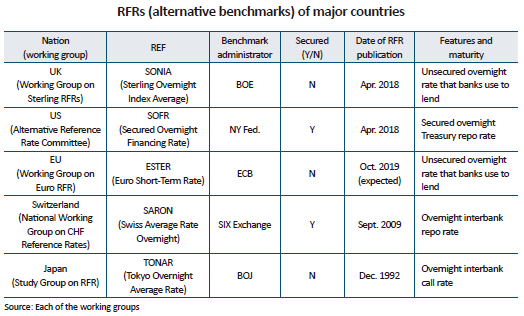
Countries selected alternative RFRs based on highly liquid unsecured or secured transactions depending on their unique circumstances. It should note that all RFRs are overnight rates. Because the FSB and member countries have developed RFRs that will be used in certain financial contracts such as derivatives, preparation for the transition to overnight RFRs for derivatives trading has been smoothly going on across the countries (FSB, 2018a).
However, it would be very difficult to use overnight rates as alternative reference rates in other financial instruments including loans and floating-rate notes (Clifford Chance, 2018). For instance, a loan borrower needs to know in advance the amount of interest that will be payable on each due date to manage cash flows. If the overnight rate is applied to the loan, the borrower would be unable to calculate the interest before the due date in case that the interest is paid on a daily, monthly or quarterly basis. Banks usually apply LIBOR (term rate) plus a margin to existing loans and manage interest rate risk with interest rate swaps.
Participants in the loan and bond markets indicated the need to develop forward-looking term rates such as LIBOR (e.g., lock-in short-term rates for forward three-month periods) (Loan Market Association, 2018). The UK, the US, and the EU are seeking methods of producing alternative term rates based on overnight RFR-referencing derivatives transactions.13) However, the FSB expressed concerns about the development of term rates grounded in derivatives because the liquidity of the derivatives market varies from one country to another. Particular attention should be paid to where the development of term rates is heading (FSB, 2018b).
Implications
If LIBOR is no longer available from 2022, countries need to complete the transition to alternative RFRs by 2021. The FSB and national authorities expect the transition to be completed for a number of financial instruments including derivatives except for the loan and bond markets. Nevertheless, there are many challenges ahead to ensure the adoption of alternative benchmark rates. For example, the RFRs chosen draw on secured or unsecured transactions and their production methods and publication timing vary across the countries. In addition, the countries have different transition schedules. On top of that, it should be considered whether it is appropriate to choose term rates based on derivatives transactions as benchmarks for bank loans without ensuring a variety of derivatives market participants and market stability in the event of financial unrest.
Despite those uncertainties, domestic market participants need to prepare for the end of existing quote-based benchmarks including LIBOR, and actively participate in global discussions on the relevant issues to advocate for domestic financial institutions. The International Swaps and Derivatives Association (ISDA), at the request of the FSB, is working on developing fallback agreements for derivatives contracts in preparation for the cessation of LIBOR, EURIBOR, and TIBOR. As part of this effort, ISDA is seeking comments on new benchmark fallbacks from market participants in member countries. Korean financial services firms should actively express their views on the development of fallbacks.
In the meantime, CD rates, a benchmark for bank loans in South Korea, have the same limitations as LIBOR (albeit to different degrees). Given that not only the LIBOR currency jurisdictions but also other jurisdictions have been developing their own RFRs, Korea also needs to discuss this issue. First, the international acceptance and reliability of CD rates are likely to deteriorate as major countries use their RFRs in financial transactions. There is uncertainty over whether domestic financial institutions will be able to use quote-based term CD rates in cross currency transactions when their swap counterparties use overnight RFRs based on actual underlying transactions.14) Moreover, we should not rule out the possibility that foreign financial institutions and regulators would raise the reliability issue of CD rates.
Second, some market participants aboard expect that LIBOR will be available after 2022. In the long run, however, if the transition to alternative benchmarks goes well as anticipated, the regulators in major countries could discontinue the use of existing benchmarks including LIBOR regardless of whether banks submit interest rate estimates. We should keep in mind the prevailing view of global regulators that it is neither desirable nor sustainable for benchmark rates, which are used to set financial deals worth in the trillions of dollars, to be determined by professional judgement of a small number of banks based on illiquid transactions. ICE Benchmark Administration (IBA), the administrator of LIBOR, obtained authorization from the FCA pursuant to the BMR in April 2018. But the FCA’s CEO hinted that the FCA could reconsider the IBA’s authorization under the BMR if LIBOR production is deemed inappropriate. It should be noted that EU supervised entities should not use a third country benchmark (e.g., Korea’s CD rates) which is not authorized under the BMR. Given the EU-wide efforts to reform quote-based interest rate benchmarks, it is hard to exclude the likelihood that the EU would require third country benchmarks to comply with similar requirements.
It will take considerable time to develop and adopt new benchmarks to replace CD rates. Hence, there is an urgent need for Korea to have discussions on whether to develop alternative reference rates as is the case in other countries, taking into account the various possibilities described above.
1) Special thanks to ISDA staff for their contributions of time and ideas to make my work productive and stimulating.
2) Bailey, A., July 2017, The future of Libor, FCA; July 2018, Interest rate benchmark reform: Transition to a world without Libor, FCA
3) The benchmark reforms in major countries are far-reaching and technical. Since this article does not go over the details of the benchmark reforms, there may be a lack of accuracy with respect to some uses of terminology.
4) Working group on Sterling risk-free reference rates, November 2018, Preparing for 2022: What you need to know about Libor transition.
5) Regulation (EU) 2016/1011 on indices used as benchmarks in financial instruments and financial contracts or to measure the performance of investment funds.
6) Legislation on the administration of financial benchmarks is completed or underway in South Korea, Japan, Australia, Singapore, and Canada in addition to the EU and the UK.
7) In 2014, the FSB published a report on reforming major interest rate benchmarks based on a multi-rate approach (FSB, 2014). Since then, it has monitored and published an annual progress report on implementation of reforms to interest rate benchmarks by major countries (FSB, 2015, 2016, 2017, 2018a). The FSB established an Official Sector Steering Group (OSSG) which comprises central banks and regulatory agencies from 12 countries including the US, the EU, and the UK to monitor and oversee the efforts to the benchmark reforms. The benchmark reform efforts are managed by currency-level teams of the OSSG, one for each of five LIBOR currencies, under the overall supervision of the FSB. For other reference rates, each of national authorities has been executing the benchmark reforms, which are not compulsory but recommended. South Korea is not a member of the OSSG.
8) However, as Bailey, the head of the FCA, stated the possible discontinuation of LIBOR, the direction of the reform has been rapidly shifting from improving the current benchmarks towards developing and adopting RFRs.
9) For USD LIBOR, the median volume of transactions underlying the 3-month USD LIBOR (the most commonly quoted rate) was around USD 1 billion. On most days, the transaction volume was less than USD 500 million (Dudley, W.C., May 2018, The transition to a robust reference rate regime, FRB New York.).
10) This is due mainly to the increased legal accountability that is imposed on contributor banks as a result of the BMR implementation. Under the BMR, regulatory authorities may compel banks or financial services firms to submit quotes for critical benchmark rates such as LIBOR. The remarks made by Bailey, the FCA’s CEO, on the potential end of LIBOR in 2022 imply that from 2022, the FCA will no longer require banks to submit rates even if they refuse to do so.
11) In 2013, the IOSCO issued Principles for Financial Benchmarks, outlining benchmark requirements. The IOSCO Principles for Financial Benchmarks are used as guidelines for not only alternative benchmarks but also the BMR and the benchmark improvement.
12) Other OSSG-participating countries also selected or are developing alternative benchmark rates. For instance, Australia, Brazil, and Singapore chose alternative RFRs while Canada, Mexico, Hong Kong, and South Africa are working to select RFRs.
13) Major countries are considering the creation of term rates based on overnight index swaps (OIS) or futures referencing overnight rates.
14) This issue is, of course, not confined to Korea only. Similar difficulties are highly likely to arise in countries that have not yet to develop alternative benchmarks or have been slow to transition towards alternative benchmarks. Accordingly, the FSB highlighted the need to coordinate at international levels transactions between countries using alternative benchmarks and countries using quote-based interest rate benchmarks (FSB, 2018a).
References
Clifford Chance, 2018, LIBOR-Cross product review.
FSB (Financial Stability Board), 2014, Reforming major interest rate benchmarks.
FSB, 2015, 2016, 2017, 2018a, Reforming major interest rate benchmarks: Progress report. FSB, 2018b, Interest rate benchmark reform: Overnight risk-free rates and term rates.
IOSCO (International Organization of Securities Commissions), 2013, Principles for financial benchmarks.
Loan Market Association, 2018, Syndicated loans and forward-looking term rates.
The disappearance of LIBOR that played a pivotal role in international financial transactions over the past three decades is likely to bring significant changes to domestic and global financial markets. This article outlines the highlights of ongoing global financial benchmark reforms since 2012 with a particular focus on the development of alternative benchmarks, and discuss their implications.3)
Highlights and progress of global financial benchmark reforms
Reference rates or benchmark rates are used as benchmarks for a wide range of financial products and contracts (especially derivatives, loans and bonds), having vital impacts on the economic activities of financial institutions, corporations and households. As for LIBOR, the most common benchmark in the global financial markets, financial transactions referencing LIBOR totaled more than USD 300 trillion.4)
Recognizing that the LIBOR scandal stemmed from the production and management of benchmark rates relying on market discipline, G20 and the Financial Stability Board (FSB) have made concerted global efforts to reform benchmark rates to promote better financial consumer protection and stronger financial stability by restoring the reliability and transparency of benchmark rates, which are public goods.
The benchmark reforms that began around 2013 have been underway in two directions: Strengthening regulation of financial benchmarks and enhancing existing interest rate benchmarks. First, public sector intervention in activities associated with benchmark rates has greatly increased. This effort is pronounced in the European Union (EU) and the United Kingdom (UK). The Benchmarks Regulation (BMR)5) that came into effect in January 2018 in the EU and the UK regulates activities related to financial benchmarks (provision of information required for benchmark calculation, and production, governance and use of benchmarks). The BMR has significant effects with respect to the end of LIBOR and the development of alternative benchmark rates.6) The BMR classifies benchmarks that significantly affect the financial markets and the real economy as “critical” and requires administrators of critical benchmarks to satisfy regulatory requirements and obtain an authorization by competent regulatory authorities by the end of 2019. In accordance with the BMR, the use of unauthorized benchmarks in new financial transactions will be prohibited from 2020, and regulatory authorities will have the power to compel financial institutions to submit the daily rates used to calculate critical benchmarks.
Second, G20 asked the Financial Stability Board (FSB) to oversee the implementation of the benchmark reforms on the globe. The FSB designated interbank offered rates (IBORs) including London Interbank Offered Rate (LIBOR), Euro Interbank Offered Rate (EURIBOR), and Tokyo Interbank Offered Rate (TIBOR) as major financial market benchmarks, and has been pushing for policies to improve the production of such benchmarks. To that end, the benchmark administrators in collaboration with national competent authorities have been pressing ahead with the reforms to improve control and governance mechanisms for benchmarks and to promote the use of actual transactions input data. These reform efforts are intended to reduce the possibility of benchmark manipulation and make the benchmarks more reliable.
Furthermore, the FSB has been developing new risk-free rates (RFRs) to replace existing benchmark rates such as LIBOR in which bank credit risk is embedded. This is based on the view that it is desirable to develop and use new RFRs for certain financial instruments or contracts like derivatives. The development of RFRs has been undertaken by working groups set up for each of five LIBOR currencies (USD, EUR, JPY, GBP, and CHF) to develop RFRs.
As explained above, the FSB-led benchmark reforms have been based on a multi-rate approach7) that seeks to improve and maintain existing LIBOR, EURIBOR and TIBOR and to develop alternative RFRs for use in derivatives and other specified financial transactions.8)
Progress on the development and adoption of RFRs by country
The implementation of the BMR in the EU and the UK, and the efforts to improve the benchmark calculation have drastically reduced the likelihood of intentional benchmark manipulation. Nonetheless, a sharp contraction in unsecured interbank transactions9) since the financial crisis creates constraints on keeping and enhancing the existing benchmark interest rates calculated from estimates submitted by banks. In practice, it is known that LIBOR contributor banks are reluctant to submit rates by relying on expert judgement because of very sluggish actual transactions.10)
Regulatory authorities in major countries recognize the limitations in the efforts to enhance the production of key benchmarks, giving an impetus to the development and adoption of RFRs. RFRs for five LIBOR currencies have been developing by competent national authorities. For example, the US and Japan are responsible for developing and adopting USD LIBOR, and JPY LIBOR, respectively.
Each of the countries established its own working group on alternative reference rates that consists of regulatory agencies, the central bank and market participants, and determined the appropriate RFR to use, which reflects country-specific circumstances and is aligned with the International Organization of Securities Commissions (IOSCO) Principles for Financial Benchmarks.11) Those countries plan to complete the transition from LIBOR to new RFRs for legacy financial contracts by 2021. The table below shows the RFRs chosen by each of the countries.12)
However, it would be very difficult to use overnight rates as alternative reference rates in other financial instruments including loans and floating-rate notes (Clifford Chance, 2018). For instance, a loan borrower needs to know in advance the amount of interest that will be payable on each due date to manage cash flows. If the overnight rate is applied to the loan, the borrower would be unable to calculate the interest before the due date in case that the interest is paid on a daily, monthly or quarterly basis. Banks usually apply LIBOR (term rate) plus a margin to existing loans and manage interest rate risk with interest rate swaps.
Participants in the loan and bond markets indicated the need to develop forward-looking term rates such as LIBOR (e.g., lock-in short-term rates for forward three-month periods) (Loan Market Association, 2018). The UK, the US, and the EU are seeking methods of producing alternative term rates based on overnight RFR-referencing derivatives transactions.13) However, the FSB expressed concerns about the development of term rates grounded in derivatives because the liquidity of the derivatives market varies from one country to another. Particular attention should be paid to where the development of term rates is heading (FSB, 2018b).
Implications
If LIBOR is no longer available from 2022, countries need to complete the transition to alternative RFRs by 2021. The FSB and national authorities expect the transition to be completed for a number of financial instruments including derivatives except for the loan and bond markets. Nevertheless, there are many challenges ahead to ensure the adoption of alternative benchmark rates. For example, the RFRs chosen draw on secured or unsecured transactions and their production methods and publication timing vary across the countries. In addition, the countries have different transition schedules. On top of that, it should be considered whether it is appropriate to choose term rates based on derivatives transactions as benchmarks for bank loans without ensuring a variety of derivatives market participants and market stability in the event of financial unrest.
Despite those uncertainties, domestic market participants need to prepare for the end of existing quote-based benchmarks including LIBOR, and actively participate in global discussions on the relevant issues to advocate for domestic financial institutions. The International Swaps and Derivatives Association (ISDA), at the request of the FSB, is working on developing fallback agreements for derivatives contracts in preparation for the cessation of LIBOR, EURIBOR, and TIBOR. As part of this effort, ISDA is seeking comments on new benchmark fallbacks from market participants in member countries. Korean financial services firms should actively express their views on the development of fallbacks.
In the meantime, CD rates, a benchmark for bank loans in South Korea, have the same limitations as LIBOR (albeit to different degrees). Given that not only the LIBOR currency jurisdictions but also other jurisdictions have been developing their own RFRs, Korea also needs to discuss this issue. First, the international acceptance and reliability of CD rates are likely to deteriorate as major countries use their RFRs in financial transactions. There is uncertainty over whether domestic financial institutions will be able to use quote-based term CD rates in cross currency transactions when their swap counterparties use overnight RFRs based on actual underlying transactions.14) Moreover, we should not rule out the possibility that foreign financial institutions and regulators would raise the reliability issue of CD rates.
Second, some market participants aboard expect that LIBOR will be available after 2022. In the long run, however, if the transition to alternative benchmarks goes well as anticipated, the regulators in major countries could discontinue the use of existing benchmarks including LIBOR regardless of whether banks submit interest rate estimates. We should keep in mind the prevailing view of global regulators that it is neither desirable nor sustainable for benchmark rates, which are used to set financial deals worth in the trillions of dollars, to be determined by professional judgement of a small number of banks based on illiquid transactions. ICE Benchmark Administration (IBA), the administrator of LIBOR, obtained authorization from the FCA pursuant to the BMR in April 2018. But the FCA’s CEO hinted that the FCA could reconsider the IBA’s authorization under the BMR if LIBOR production is deemed inappropriate. It should be noted that EU supervised entities should not use a third country benchmark (e.g., Korea’s CD rates) which is not authorized under the BMR. Given the EU-wide efforts to reform quote-based interest rate benchmarks, it is hard to exclude the likelihood that the EU would require third country benchmarks to comply with similar requirements.
It will take considerable time to develop and adopt new benchmarks to replace CD rates. Hence, there is an urgent need for Korea to have discussions on whether to develop alternative reference rates as is the case in other countries, taking into account the various possibilities described above.
1) Special thanks to ISDA staff for their contributions of time and ideas to make my work productive and stimulating.
2) Bailey, A., July 2017, The future of Libor, FCA; July 2018, Interest rate benchmark reform: Transition to a world without Libor, FCA
3) The benchmark reforms in major countries are far-reaching and technical. Since this article does not go over the details of the benchmark reforms, there may be a lack of accuracy with respect to some uses of terminology.
4) Working group on Sterling risk-free reference rates, November 2018, Preparing for 2022: What you need to know about Libor transition.
5) Regulation (EU) 2016/1011 on indices used as benchmarks in financial instruments and financial contracts or to measure the performance of investment funds.
6) Legislation on the administration of financial benchmarks is completed or underway in South Korea, Japan, Australia, Singapore, and Canada in addition to the EU and the UK.
7) In 2014, the FSB published a report on reforming major interest rate benchmarks based on a multi-rate approach (FSB, 2014). Since then, it has monitored and published an annual progress report on implementation of reforms to interest rate benchmarks by major countries (FSB, 2015, 2016, 2017, 2018a). The FSB established an Official Sector Steering Group (OSSG) which comprises central banks and regulatory agencies from 12 countries including the US, the EU, and the UK to monitor and oversee the efforts to the benchmark reforms. The benchmark reform efforts are managed by currency-level teams of the OSSG, one for each of five LIBOR currencies, under the overall supervision of the FSB. For other reference rates, each of national authorities has been executing the benchmark reforms, which are not compulsory but recommended. South Korea is not a member of the OSSG.
8) However, as Bailey, the head of the FCA, stated the possible discontinuation of LIBOR, the direction of the reform has been rapidly shifting from improving the current benchmarks towards developing and adopting RFRs.
9) For USD LIBOR, the median volume of transactions underlying the 3-month USD LIBOR (the most commonly quoted rate) was around USD 1 billion. On most days, the transaction volume was less than USD 500 million (Dudley, W.C., May 2018, The transition to a robust reference rate regime, FRB New York.).
10) This is due mainly to the increased legal accountability that is imposed on contributor banks as a result of the BMR implementation. Under the BMR, regulatory authorities may compel banks or financial services firms to submit quotes for critical benchmark rates such as LIBOR. The remarks made by Bailey, the FCA’s CEO, on the potential end of LIBOR in 2022 imply that from 2022, the FCA will no longer require banks to submit rates even if they refuse to do so.
11) In 2013, the IOSCO issued Principles for Financial Benchmarks, outlining benchmark requirements. The IOSCO Principles for Financial Benchmarks are used as guidelines for not only alternative benchmarks but also the BMR and the benchmark improvement.
12) Other OSSG-participating countries also selected or are developing alternative benchmark rates. For instance, Australia, Brazil, and Singapore chose alternative RFRs while Canada, Mexico, Hong Kong, and South Africa are working to select RFRs.
13) Major countries are considering the creation of term rates based on overnight index swaps (OIS) or futures referencing overnight rates.
14) This issue is, of course, not confined to Korea only. Similar difficulties are highly likely to arise in countries that have not yet to develop alternative benchmarks or have been slow to transition towards alternative benchmarks. Accordingly, the FSB highlighted the need to coordinate at international levels transactions between countries using alternative benchmarks and countries using quote-based interest rate benchmarks (FSB, 2018a).
References
Clifford Chance, 2018, LIBOR-Cross product review.
FSB (Financial Stability Board), 2014, Reforming major interest rate benchmarks.
FSB, 2015, 2016, 2017, 2018a, Reforming major interest rate benchmarks: Progress report. FSB, 2018b, Interest rate benchmark reform: Overnight risk-free rates and term rates.
IOSCO (International Organization of Securities Commissions), 2013, Principles for financial benchmarks.
Loan Market Association, 2018, Syndicated loans and forward-looking term rates.