Our bi-weekly Opinion provides you with latest updates and analysis on major capital market and financial investment industry issues.

Increasing Demand for Overseas-Listed ETFs in Korea: Causes and Policy Challenges
Publication date Sep. 02, 2025

Summary
Amid the growing trend of overseas investment by Korean investors, demand for overseas-listed ETFs has also been steadily rising. Analysis of related data suggests that this is not merely a temporary trend, but rather a structural phenomenon driven by the interplay of domestic–foreign tax and regulatory disparities and individual investors’ risk appetite. While domestically listed overseas ETFs are taxed as dividend income and aggregated into comprehensive financial income, overseas-listed ETFs are subject to separate capital gains tax. Since the marginal tax rate for Korea’s comprehensive financial income tax is higher than the capital gain tax rate, this has led high-net-worth investors to prefer overseas-listed ETFs. Furthermore, derivative ETFs, such as leveraged or inverse ETFs, and single-stock ETFs, which are tightly regulated in Korea, are actively traded abroad, fueling Korean investors’ preference for overseas markets. Accordingly, policymakers need to rationally narrow institutional gaps between domestic and overseas financial investment products through tax system reforms and regulatory arbitrage mitigation, while enhancing the competitiveness and diversity of the Korean ETF market.
As interest in overseas assets grows and access to foreign markets improves, demand for financial investment products listed on overseas exchanges has been steadily increasing. ETFs (Exchange Traded Funds) are no exception, with Korean investors’ purchases of overseas-listed ETFs expanding rapidly.
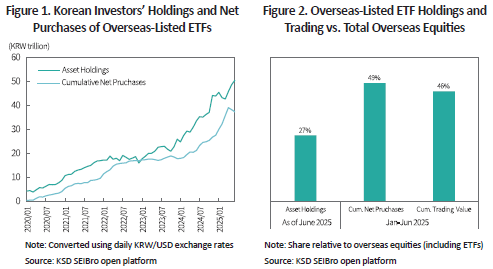
According to data compiled via the Korea Securities Depository(KSD)’s SEIBro open platform1), as of the end of June 2025, Korean investors held approximately KRW 50.5 trillion in overseas-listed ETFs. Since 2020, an estimated KRW 37.3 trillion of domestic investor funds have flowed into overseas-listed ETFs (see <Figure 1>). This represents 27% of total overseas equity holdings (including ETFs) during the same period, a share that has risen in tandem with growing demand for overseas-listed ETFs. In 2025 alone, ETFs accounted for 49% of Korean investors’ net purchases of overseas equities and 46% of total trading value, implying that investors are actively trading overseas-listed ETFs in addition to foreign stocks (see <Figure 2>).
Considering that the size of overseas-asset ETFs listed on the Korea Exchange (KRX) stood at KRW 77.1 trillion as of June 2025, and that KRW 62.5 trillion has flowed into domestically listed overseas ETFs since 20202), the relative proportion of overseas-listed ETFs—65% and 60%, respectively—is highly significant. Notably, despite the rapid growth of domestically listed overseas ETFs in recent years3), Korean investors have continued to trade ETFs listed abroad.
This trend cannot be explained solely by the competitive advantages of overseas-listed ETFs, such as higher liquidity, operational efficiency, and broader asset coverage. Even though fee competition among domestic ETF managers—particularly for flagship overseas index ETFs—has sharply reduced investor costs4), Korean investors continue to actively trade overseas-listed ETFs despite higher expenses. Multiple factors likely contribute to this, but this paper focuses on institutional disparities between domestic and overseas ETF markets that underpin Korean investors’ preference for overseas-listed ETFs.
ETF Taxation Disparities and High-Net-Worth Investors’ Preferences for Overseas-Listed ETFs
One of the most significant differences between domestically listed overseas ETFs and overseas-listed ETFs lies in taxation. For example, a domestically listed ETF tracking a foreign index, such as TIGER S&P 500, is classified as an investment trust under Korean tax law, with both capital gains and distributions taxed as dividend income. Dividend income is aggregated into comprehensive financial income, which is the summation of interest and dividend income. If annual comprehensive financial income exceeds KRW 20 million, progressive marginal tax rates of up to 49.5% may apply. By contrast, for overseas-listed ETFs such as SPY or QQQ, distributions are taxed as dividend income in the same way, but capital gains are taxed as capital gains on foreign equities at a flat 22%. Capital gains are subject to separate taxation and are not aggregated into total financial income.
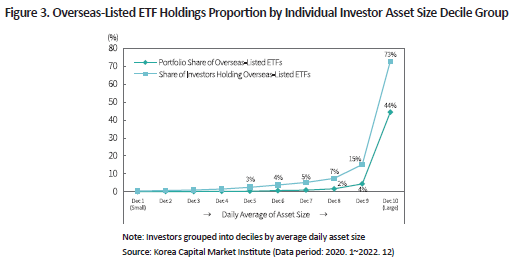
This tax disparity creates strong incentives for high-net-worth investors with substantial financial income to prefer overseas-listed ETFs over domestically listed ones. Numerous studies have empirically demonstrated that tax regimes significantly influence investment decisions, and this holds true for funds as well.5) For investors facing high marginal tax rates, these tax rates become a very critical investment decision variable. <Figure 3> illustrates this point, analyzing sample data of Korean retail investors6), grouped into deciles by asset size. The chart shows both the average portfolio share of overseas-listed ETFs (◆) and the proportion of investors holding overseas-listed ETFs (■) within each group. The results indicate that the larger the asset group, the higher both the likelihood of holding overseas-listed ETFs and their portfolio weight. Given that investment assets are concentrated among a small number of wealthy investors, the particularly high share of overseas-listed ETFs in the top decile suggests that the tax regime has disproportionately favored overseas-listed ETFs for high-net-worth individuals.
ETF Regulatory Disparities and Risk-Seeking Investors’ Preference for High-Risk ETFs
Beyond taxation, another key driver of demand for overseas-listed ETFs is Korean investors’ preference for high-risk products. The Korean financial authority imposes strict structural regulations on ETFs to prioritize investor protection and market stability. For example, leveraged and inverse ETFs are capped at 2x exposure, and diversification rules prohibit any single stock from exceeding 30% of the underlying index. In contrast, overseas markets impose looser restrictions, allowing higher-leverage ETFs and single-stock ETFs that track the price of individual equities. For investors, using overseas products to implement strategies unavailable domestically is a natural choice. However, the issue is that products restricted in Korea for investor protection are being actively traded abroad. Following the U.S. and Europe, Hong Kong recently approved the listing of single-stock leveraged and inverse ETFs, partly driven by Korean investors’ strong appetite for high-risk products.7)
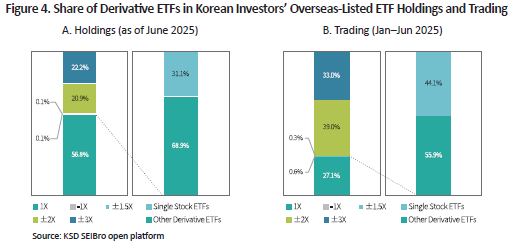
<Figure 4> shows the share of derivative ETFs in Korean investors’ overseas-listed ETF holdings and trading between January and June 2025. As of June 2025, leveraged and inverse ETFs (excluding plain 1x products) accounted for 43.2% of holdings, with ±3x products—unavailable in Korea—making up 22.2%. Within derivative ETFs, single-stock products represented 31.1%. On a trading basis, the shares of derivative and single-stock ETFs were even higher, and the trend has been strengthening in recent years. Given the overall scale of Korean investors’ overseas-listed ETF holdings and trading, this represents a substantial volume. Clearly, risk-seeking Korean investors are actively utilizing highly volatile overseas-listed derivative ETFs.
Concluding Remarks
The rising demand for overseas-listed ETFs in Korea is not a temporary fad but a structural outcome shaped by both the competitive features of overseas products and the interplay of domestic tax and ETF regulatory disparities and investors’ risk appetite. Tax arbitrage primarily drives demand among high-net-worth individuals seeking tax efficiency, while regulatory arbitrage expands the options available to risk-seeking investors. Though these dynamics affect different types of investor groups, both ultimately channel capital away from domestic markets into overseas-listed ETFs.
In this context, Korea’s policymakers need to explore ways to rationally narrow the institutional gaps. On the tax front, reforming the complex taxation of collective investment vehicles and, above all, ensuring tax neutrality between domestically listed overseas ETFs and overseas-listed ETFs is essential. Encouraging high-net-worth individuals to utilize domestic financial products, even when investing in overseas assets, would strengthen the foundation of the Korean asset management industry and support sustainable growth.
At the same time, there is a need to mitigate the outflow of capital chasing regulatory arbitrage in high-risk products. While adhering to investor protection principles, regulators could strengthen disclosure, suitability requirements, and investor education, while also considering the introduction of alternative products within reasonable bounds. This would not only help redirect capital back into Korean financial product markets but also serve as a long-term strategy to deepen and diversify Korea’s ETF market.
1) Data compiled via SEIBro’s foreign securities information API, covering custody and settlement records of overseas-listed ETFs held by Korean investors. From 2020 to June 2025, the top 50 daily traded securities were screened for ETFs.
2) Net inflows were estimated by subtracting the previous day’s NAV × (1+daily return) from the current day’s NAV for each ETF, then aggregating across securities.
3) As of June 2025, overseas-asset ETFs listed on the Korea Exchange accounted for 37% of total ETF AUM, about four times higher than five years ago.
4) Min Kyeong Kwon, 2025, An Analysis of Competitive Fee Reductions in Korea’s ETF Market, Capital Market Focus Opinion, June 10, 2025.
5) Prior research shows that after-tax returns, rather than pre-tax returns, significantly affect fund flows (Bergstresser, D., Poterba, J., 2002, Do after-tax returns affect mutual fund inflows?, Journal of Financial Economics 63(3), 381–414).
6) Based on sample retail investor data from a major Korean securities firm, covering more than 120 thousands retail investors’ holdings and transactions in domestic/foreign equities, ETPs, funds, and other listed securities (Data periods: 2020~2022).
7) PR Newswire, 2025. 3. 24, Asia’s First Single Stock Leveraged & Inverse Products to Debut on HKEX.
According to data compiled via the Korea Securities Depository(KSD)’s SEIBro open platform1), as of the end of June 2025, Korean investors held approximately KRW 50.5 trillion in overseas-listed ETFs. Since 2020, an estimated KRW 37.3 trillion of domestic investor funds have flowed into overseas-listed ETFs (see <Figure 1>). This represents 27% of total overseas equity holdings (including ETFs) during the same period, a share that has risen in tandem with growing demand for overseas-listed ETFs. In 2025 alone, ETFs accounted for 49% of Korean investors’ net purchases of overseas equities and 46% of total trading value, implying that investors are actively trading overseas-listed ETFs in addition to foreign stocks (see <Figure 2>).
This trend cannot be explained solely by the competitive advantages of overseas-listed ETFs, such as higher liquidity, operational efficiency, and broader asset coverage. Even though fee competition among domestic ETF managers—particularly for flagship overseas index ETFs—has sharply reduced investor costs4), Korean investors continue to actively trade overseas-listed ETFs despite higher expenses. Multiple factors likely contribute to this, but this paper focuses on institutional disparities between domestic and overseas ETF markets that underpin Korean investors’ preference for overseas-listed ETFs.
ETF Taxation Disparities and High-Net-Worth Investors’ Preferences for Overseas-Listed ETFs
One of the most significant differences between domestically listed overseas ETFs and overseas-listed ETFs lies in taxation. For example, a domestically listed ETF tracking a foreign index, such as TIGER S&P 500, is classified as an investment trust under Korean tax law, with both capital gains and distributions taxed as dividend income. Dividend income is aggregated into comprehensive financial income, which is the summation of interest and dividend income. If annual comprehensive financial income exceeds KRW 20 million, progressive marginal tax rates of up to 49.5% may apply. By contrast, for overseas-listed ETFs such as SPY or QQQ, distributions are taxed as dividend income in the same way, but capital gains are taxed as capital gains on foreign equities at a flat 22%. Capital gains are subject to separate taxation and are not aggregated into total financial income.
This tax disparity creates strong incentives for high-net-worth investors with substantial financial income to prefer overseas-listed ETFs over domestically listed ones. Numerous studies have empirically demonstrated that tax regimes significantly influence investment decisions, and this holds true for funds as well.5) For investors facing high marginal tax rates, these tax rates become a very critical investment decision variable. <Figure 3> illustrates this point, analyzing sample data of Korean retail investors6), grouped into deciles by asset size. The chart shows both the average portfolio share of overseas-listed ETFs (◆) and the proportion of investors holding overseas-listed ETFs (■) within each group. The results indicate that the larger the asset group, the higher both the likelihood of holding overseas-listed ETFs and their portfolio weight. Given that investment assets are concentrated among a small number of wealthy investors, the particularly high share of overseas-listed ETFs in the top decile suggests that the tax regime has disproportionately favored overseas-listed ETFs for high-net-worth individuals.
Beyond taxation, another key driver of demand for overseas-listed ETFs is Korean investors’ preference for high-risk products. The Korean financial authority imposes strict structural regulations on ETFs to prioritize investor protection and market stability. For example, leveraged and inverse ETFs are capped at 2x exposure, and diversification rules prohibit any single stock from exceeding 30% of the underlying index. In contrast, overseas markets impose looser restrictions, allowing higher-leverage ETFs and single-stock ETFs that track the price of individual equities. For investors, using overseas products to implement strategies unavailable domestically is a natural choice. However, the issue is that products restricted in Korea for investor protection are being actively traded abroad. Following the U.S. and Europe, Hong Kong recently approved the listing of single-stock leveraged and inverse ETFs, partly driven by Korean investors’ strong appetite for high-risk products.7)
<Figure 4> shows the share of derivative ETFs in Korean investors’ overseas-listed ETF holdings and trading between January and June 2025. As of June 2025, leveraged and inverse ETFs (excluding plain 1x products) accounted for 43.2% of holdings, with ±3x products—unavailable in Korea—making up 22.2%. Within derivative ETFs, single-stock products represented 31.1%. On a trading basis, the shares of derivative and single-stock ETFs were even higher, and the trend has been strengthening in recent years. Given the overall scale of Korean investors’ overseas-listed ETF holdings and trading, this represents a substantial volume. Clearly, risk-seeking Korean investors are actively utilizing highly volatile overseas-listed derivative ETFs.
The rising demand for overseas-listed ETFs in Korea is not a temporary fad but a structural outcome shaped by both the competitive features of overseas products and the interplay of domestic tax and ETF regulatory disparities and investors’ risk appetite. Tax arbitrage primarily drives demand among high-net-worth individuals seeking tax efficiency, while regulatory arbitrage expands the options available to risk-seeking investors. Though these dynamics affect different types of investor groups, both ultimately channel capital away from domestic markets into overseas-listed ETFs.
In this context, Korea’s policymakers need to explore ways to rationally narrow the institutional gaps. On the tax front, reforming the complex taxation of collective investment vehicles and, above all, ensuring tax neutrality between domestically listed overseas ETFs and overseas-listed ETFs is essential. Encouraging high-net-worth individuals to utilize domestic financial products, even when investing in overseas assets, would strengthen the foundation of the Korean asset management industry and support sustainable growth.
At the same time, there is a need to mitigate the outflow of capital chasing regulatory arbitrage in high-risk products. While adhering to investor protection principles, regulators could strengthen disclosure, suitability requirements, and investor education, while also considering the introduction of alternative products within reasonable bounds. This would not only help redirect capital back into Korean financial product markets but also serve as a long-term strategy to deepen and diversify Korea’s ETF market.
1) Data compiled via SEIBro’s foreign securities information API, covering custody and settlement records of overseas-listed ETFs held by Korean investors. From 2020 to June 2025, the top 50 daily traded securities were screened for ETFs.
2) Net inflows were estimated by subtracting the previous day’s NAV × (1+daily return) from the current day’s NAV for each ETF, then aggregating across securities.
3) As of June 2025, overseas-asset ETFs listed on the Korea Exchange accounted for 37% of total ETF AUM, about four times higher than five years ago.
4) Min Kyeong Kwon, 2025, An Analysis of Competitive Fee Reductions in Korea’s ETF Market, Capital Market Focus Opinion, June 10, 2025.
5) Prior research shows that after-tax returns, rather than pre-tax returns, significantly affect fund flows (Bergstresser, D., Poterba, J., 2002, Do after-tax returns affect mutual fund inflows?, Journal of Financial Economics 63(3), 381–414).
6) Based on sample retail investor data from a major Korean securities firm, covering more than 120 thousands retail investors’ holdings and transactions in domestic/foreign equities, ETPs, funds, and other listed securities (Data periods: 2020~2022).
7) PR Newswire, 2025. 3. 24, Asia’s First Single Stock Leveraged & Inverse Products to Debut on HKEX.