Our bi-weekly Opinion provides you with latest updates and analysis on major capital market and financial investment industry issues.

Impact of Won-Denominated Stablecoins on the Foreign Exchange Stability and Directions for Global Scalability
Publication date Sep. 16, 2025

Summary
Amid active discussions on the introduction of a Korean won-based stablecoin, expectations for financial innovation are rising, while concerns are also emerging over potential risks to foreign exchange stability. However, since it is difficult to identify clear channels for capital outflows, and unless exceptional situations such as a coin run occur, the negative impact on foreign exchange stability is expected to remain limited. That said, given the nature of coin transactions—where many individuals can bypass the foreign exchange system and conduct cross-border transfers quickly and conveniently—there is a need to maintain consistency with existing foreign exchange policies. Moreover, for a won-based stablecoin to succeed, global scalability is essential. This will require not only building international trust in the reserve assets backing the stablecoin, but also broadening the demand base for the won through its internationalization.
In July of this year, the Genius Act was passed in the United States, and as other major countries also began preparing legislation, global interest in stablecoins—a digital payment instrument—has been rapidly expanding. In Korea, active legislative discussions are also underway on a won-based stablecoin as part of the new government’s policy agenda to build a ‘digital asset ecosystem’. With expectations for financial innovation stemming from the speed, transparency, and low cost of stablecoins, their adoption already appears to have become an irreversible global trend.
At the same time, considerable concerns have been raised about the potential impact of introducing a won-based stablecoin on foreign exchange stability. Because a won-based stablecoin would simultaneously possess the characteristics of both currency and foreign exchange, it could serve as a channel for capital outflows abroad while also making monitoring more difficult—potentially undermining the current foreign exchange management system.1) This paper examines the impact of introducing a won-based stablecoin on Korea’s foreign exchange stability, and then discusses the tasks of maintaining consistency with the current foreign exchange management system as well as policy directions needed for global scalability.
Impact on Foreign Exchange Stability
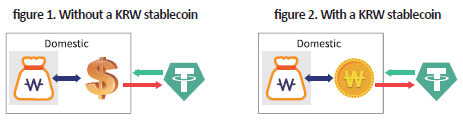
When considering the potential for foreign exchange2) outflows with the introduction of a won-based stablecoin. The situation can be divided into before and after the introduction of a won-based stablecoin. Currently, in the absence of a won-based stablecoin, when domestic demand for dollar-based stablecoins (e.g., Tether (USDT)) increases, transactions are ultimately settled in U.S. dollars, since overseas sellers of Tether seek payment in dollars. In other words, when residents acquire Tether, won is exchanged for dollars, and those dollars are then exchanged for Tether—creating the possibility of foreign exchange outflows.
By contrast, if a won-based stablecoin is issued and circulated, and then exchanged for Tether, the transaction would occur using won-based stablecoins instead of U.S. dollars, thereby eliminating the possibility of outflows of domestically held dollars. However, this would require that the won-based stablecoin be listed not only on domestic virtual asset exchanges but also on overseas exchanges, so that it can be freely exchanged with Tether. Some argue that this could lead to indiscriminate outflows of won-based stablecoins, effectively creating a channel for capital outflows. Yet this differs in nature from outflows of U.S. dollars. In fact, as the won-based stablecoin—issued and circulated by the Korean economy—spreads abroad as a new external means of payment, it would signify an increase in the international use of the won through digital currency.
Nevertheless, persistent concerns about potential capital outflows can be understood as stemming from the possibility that, in abnormal crisis situations—such as heightened global uncertainty or escalating geopolitical risks on the Korean Peninsula—unexpected disruptions may occur. For example, in a scenario where many individual traders increase their demand for Tether for speculative purposes or to move capital abroad during a crisis, and then deposit it in overseas exchanges or transfer it between personal wallets, there could be a large-scale outflow of foreign assets in the form of Tether, which functions as a near-equivalent to the U.S. dollar. Moreover, since this would involve the outflow of Tether rather than U.S. dollars themselves, it differs from conventional foreign exchange outflows.3) If, during a crisis, overseas demand for won-denominated stablecoins were to plummet, increased demand for Tether could still lead to U.S. dollar outflows regardless of the existence of won-denominated stablecoins.
Looking at the current conditions of Korea’s foreign exchange market, while the possibility of speculative attacks by non-residents is already open through the offshore KRW/USD NDF market, the concern with won-denominated stablecoins lies not with institutional investors abroad, but with the fact that numerous domestic individual crypto traders could easily and quickly engage in speculative or illicit transactions. This represents a structural change and a challenge to the current foreign exchange management system, which has been operated very conservatively by foreign exchange banks. Therefore, even if the probability is not high, it may still pose a potential risk factor to foreign exchange stability, making it necessary to prepare countermeasures.
As long as the circulation of won-denominated stablecoins does not act unidirectionally in terms of cross-border inflows and outflows, it is difficult to regard them as a factor that inherently increases exchange rate volatility. In other words, since won-denominated stablecoins are pegged 1:1 to the Korean won, and Tether is pegged to the U.S. dollar, at least in theory, the exchange rate between the two currencies determines the price ratio between the two coins (won-denominated stablecoin: Tether), not the other way around. However, If depegging4) occurs and stablecoins fail to maintain perfect parity with fiat currency values, dual pricing may emerge due to price divergence between exchange rates and stablecoins, potentially creating differences between foreign exchange rates, which represent exchange ratios between legal tender currencies, and exchange ratios between stablecoins. Yet, as long as such discrepancies remain within a normal range, arbitrage opportunities would arise, pushing the exchange rate back toward its market equilibrium.5)
However, if depegging persists for an extended period or if an extreme situation such as a coin run occurs, it cannot be ruled out that instability in the crypto market could spill over into greater exchange rate volatility. This is because, in the event of a coin run triggered by the issuer’s credit risk or poor management of reserve assets, widespread anxiety could spread across the financial market, inevitably exerting negative effects on exchange rate determination in the foreign exchange market. This would not be an exchange rate effect caused directly by stablecoins themselves, but rather a situation in which heightened uncertainty across the financial market amplifies exchange rate volatility, with instability in the stablecoin market transmitting into the foreign exchange market and further worsening the situation.
Tasks for Maintaining Consistency with the Foreign Exchange Management System
To maintain stability in the foreign exchange sector when introducing a won-based stablecoin, it is essential to ensure consistency with the foreign exchange management system through follow-up legislation. This includes clarifying its status as a means of external payment, strengthening monitoring of cross-border coin flows, improving reporting systems, and establishing emergency powers in times of crisis.
First, if the introduction of a won-based stablecoin leads to widespread exchange with Tether and its role as a substantial means of external payment expands, it will be necessary to explicitly define it as a foreign payment instrument under the Foreign Exchange Transactions Act. This would bring won-based stablecoins under the existing regulatory framework of the foreign exchange management system. Otherwise, they could fall into regulatory blind spots, potentially enabling practices such as illegal remittances through wallet-to-wallet transfers, rampant illicit transactions, or even capital flight.
The designation of a means of external payment can be achieved through amendments to individual laws such as the current Foreign Exchange Transactions Act,6) the Foreign Exchange Transactions Regulations,7) or the Electronic Financial Transactions Act. Furthermore, if a won-denominated stablecoin is recognized as a means of external payment, it will be necessary to revise the current foreign exchange system with respect to qualification requirements for remitters and recipients, as well as transaction amount limits. Under the current Foreign Exchange Transactions Act, the payment and receipt of external means of payment are, in principle, conducted through designated foreign exchange banks.8) However, due to the nature of stablecoins, transfers between coins via virtual asset exchanges or personal wallets do not require going through a foreign exchange bank. This indicates that changes will be necessary in Korea’s current foreign exchange framework, which imposes strict distinctions on the permissible scope of foreign exchange operations between foreign exchange banks and other financial institutions.
Second, because there is a strong need to prevent illegal overseas remittances, money laundering, and underground banking in the issuance and circulation of KRW-denominated stablecoins, monitoring in this area must be reinforced. Cross-border transfers of stablecoins can be divided into two categories: transfers through custodial wallets provided by exchanges and transfers through non-custodial wallets. In the former case, cross-border transaction records can be relatively easily identified through monitoring or by requesting data from virtual asset exchanges. However, in the case of transfers between personal wallets that bypass exchanges, more detailed monitoring measures are required. This is because such transfers resemble underground banking transactions and settlement methods (e.g., payments using KRW stablecoins for current account transactions), and they can be exploited for illicit fund transfers or quickly converted into dollar-denominated stablecoins for speculative purposes during times of crisis.
Therefore, it is necessary to establish a framework defining the scope of monitoring and regulation to be applied to individuals holding coin wallets. For instance, in the case of coins transferred from custodial wallets to personal wallets—which are currently treated as potentially involving cross-border movement at any time under the Travel Rule9)—it should be carefully reviewed whether improvements to the rule are needed. In addition, effective measures should be introduced to enable timely monitoring of cross-border coin inflows and outflows, such as strengthening oversight of high-frequency trading or large-scale overseas-linked transfers, and setting predefined transaction limits for registered addresses.
Third, the information obtained in this way could be centrally managed through a reporting system utilizing the foreign exchange network currently operated by the Bank of Korea. In this system, the reporting entities for cross-border transfers of won-denominated stablecoins would be designated as relevant coin exchanges or associations with primary access to transaction data, while the Travel Rule would also be applied to individual traders, allowing the Bank of Korea to obtain information through the exchanges. As the central institution for foreign exchange information, the Bank of Korea would determine the specific details—such as the content, frequency, and method of reporting—to promote foreign exchange market stability and macroprudential soundness. At the same time, it should provide the collected information to relevant authorities to strengthen oversight and prevent illegal transactions.10)
Fourth, in preparation for unforeseen emergencies where the use of won-denominated stablecoins in cross-border transfers could undermine foreign exchange stability, it may be necessary to implement measures such as restricting coin trading or overseas transfers. This is because, given the nature of coins, transactions are carried out quickly and conveniently by numerous individuals under the premise of anonymity, which could lead to rapid and significant spillover effects. According to the bill currently proposed in Korea,11) emergency measures may be taken in urgent situations concerning cross-border transactions and payments in order to protect users of won-denominated stablecoins, maintain sound trading practices, and safeguard financial stability. This is regarded as a desirable step, and to strengthen the practical function and role of such emergency authority, it will also be important to establish a constant and close system of cooperation among relevant institutions, including the Financial Services Commission, the Bank of Korea, and the Ministry of Economy and Finance.
Policy Direction for Global Scalability
If the issuance and circulation of a Korean won-based stablecoin were confined solely to the domestic market after its introduction, the practical benefits of adoption would be significantly reduced. Therefore, enhancing global scalability is a critical task. At present, most stablecoins circulating worldwide are U.S. dollar-based, such as Tether (USDT) and Circle (USDC). Given the limited internationalization of the Korean won, a won-based stablecoin inevitably faces constraints in competing with these established players. Accordingly, securing international trust in the reserve assets backing a won-based stablecoin and broadening the demand base for the won are key challenges.
To build international trust in the reserve assets of a won-based stablecoin, it is essential that collateral such as won deposits (or won-denominated government bonds) be recognized and accepted in overseas markets. Currently, won deposits are not handled by foreign financial institutions, which means their effectiveness as collateral is limited to the domestic market and cannot be extended to foreign investors. If the collateral value is not recognized abroad, listing a won-based stablecoin on overseas exchanges and enabling free exchange with Tether could be hindered, ultimately constraining its long-term international scalability. In the European Union, the trading of stablecoins issued outside the EU is generally prohibited. For such stablecoins to circulate within the EU, issuers must obtain a license in the EU and comply with the Markets in Crypto-Assets Regulation (MiCA), the EU’s primary regulatory framework for virtual assets. This effectively means that, for a won-based stablecoin to circulate within the EU, its reserve assets—such as won deposits—must be held or managed within the EU.
To build international trust in reserve assets such as Korean won (KRW) deposits, a priority task is to establish offshore spot foreign exchange markets for the won in major global financial centers like New York and London. This would enable overseas financial institutions to handle KRW deposits and foster the development of KRW-linked financial products. Currently, Korea is excluded from the status of a (quasi-)vehicle currency or partially convertible currency, which is enjoyed by the currencies of 28 countries worldwide. In contrast, not only the United States, the EU, and Japan—issuers of (quasi-)vehicle currencies—but also Hong Kong and Singapore, which are preparing legislation for stablecoins, already have their currencies traded as convertible currencies. The establishment of offshore KRW spot markets would grant the won the status of a partially convertible currency, marking significant progress in its internationalization and strengthening international trust in the reserve assets backing a KRW-denominated stablecoin.
At present, overseas demand and trading activity for a KRW stablecoin are expected to remain very limited, except in specific cases such as certain foreign workers, tourists, or the cultural industry (e.g., BTS concerts). Therefore, it is important to first focus on areas where the use of a KRW stablecoin would be convenient, ensuring low-cost and rapid currency exchange, while gradually expanding the international usage base of the won and generating broader demand for KRW stablecoins across diverse sectors.
Some argue that the lack of internationalization of the won poses an obstacle to the introduction of a KRW stablecoin. However, the global expansion of KRW stablecoins and the internationalization of the won should be seen as mutually complementary. In other words, the global spread of KRW stablecoins as a means of cross-border payment and settlement would enhance the international acceptance of the digital won by bypassing traditional foreign exchange markets, thereby serving as a catalyst for the won’s internationalization. Conversely, the internationalization of the won—by strengthening its credibility and usability as a means of payment, settlement, and value storage—would help increase global demand for KRW stablecoins and support their scalability.12) Therefore, to leverage KRW stablecoins as a stepping stone to accelerate the internationalization of the won, it is necessary to proactively pursue institutional reforms that would establish the won as a convertible currency and support its broader international use.13)
Implication
Expectations and concerns are intertwined regarding the introduction of a Korean won stablecoin. The fear that such a stablecoin could serve as a channel for capital outflows appears somewhat overstated, as it would in fact block the outflow of U.S. dollars that currently occurs when Tether flows into the domestic market. Moreover, unless in exceptional cases such as a coin run, its impact on exchange rate volatility is expected to be limited. Therefore, it is difficult to justify resisting the global trend of financial innovation solely on the grounds of foreign exchange stability concerns.
That said, due to the nature of cryptocurrency trading, it could provide a pathway for many individuals to conduct cross-border transfers quickly and conveniently, bypassing the existing foreign exchange management system. In abnormal situations where uncertainties are compounded—such as heightened global instability or geopolitical risks on the Korean Peninsula—there is also the possibility of speculative or illicit transactions becoming concentrated. For this reason, it is urgent to devise measures that ensure greater consistency with the foreign exchange management system. Key tasks include clarifying the definition of external payment instruments, strengthening monitoring and reporting mechanisms, and establishing emergency command authority.
For a won stablecoin to succeed, global scalability is of paramount importance, requiring sustained policy efforts. To this end, it is first necessary to build international trust in the reserve assets of the won stablecoin by establishing offshore won spot markets in major international financial centers, thereby enabling foreign financial institutions to handle won deposits. Furthermore, by proactively advancing the internationalization of the won, the overseas demand base for the currency should be expanded. This would not only fulfill expectations for financial innovation through the introduction of a won stablecoin but also enhance the global utility of the won, accelerating financial development. Ultimately, the introduction of a won stablecoin is expected to serve as a catalyst for financial innovation, allowing Korea’s foreign exchange management system to move beyond its outdated framework and transform into a truly open system.
1) Bank of Korea Governor Rhee Chang-yong has warned that “if the issuance of unregulated won-based stablecoins is permitted, their conversion into dollar-based stablecoins will accelerate, creating channels for capital outflows and weakening traditional capital flow management policies.”
2) ‘Foreign exchange’ in its narrow sense, refers to foreign currency assets held domestically, such as U.S. dollars.
3) However, even in such a case, the likelihood is considered low, as it would require: 1) widespread domestic circulation of Tether, 2) no restrictions on exchanging Tether for won-denominated stablecoins even in a crisis, and 3) significant excess demand for Tether from a large number of individual traders for capital flight or speculative purposes.
4) During the 2023 Silicon Valley Bank bankruptcy crisis in the United States, the value of Circle (USDC) that was deposited at the bank fell to as low as 0.88 against the US dollar.
5) However, since foreigners are currently unable to open accounts at domestic virtual asset exchanges, it is difficult to conclude that such arbitrage trading occurs without restrictions.
6) Article 3 (1) 4 of the Foreign Exchange Transactions Act defines ‘means of international payment’ as foreign currency, payment instruments denominated in foreign currency, , or other means of payment which can be used in a foreign country regardless of currency denomination.
7) Foreign Exchange Transaction Regulations Article 1-2 (34): The term “means of payment” means government notes, bank notes, coins, checks, postal money orders, letters of credit, bills of exchange, promissory notes, gift certificates, other postal or telegraphic payment instructions indicating the details of any entitlement to payment, or means of payment by electronic means such as electronic money and prepaid electronic means of payment under the Electronic Financial Transactions Act, as provided in Article 3 (1) 3 of the Act; provided that gold coins, etc. that are traded in excess of their face value are excluded from coins.
8) This is stipulated in Article 15 (payment procedures) of the Foreign Exchange Transactions Act. For small-value overseas remittances, Article 2-31(1) of the Foreign Exchange Transactions Regulations provides that “small-value overseas remittance services may be conducted by companies established under the Commercial Act, such as fintech firms that are not financial institutions, allowing remittances of up to USD 5,000 per transaction and USD 50,000 per year per individual.” Furthermore, to ease regulations on fintech, person-to-person overseas remittances in both Korean won and foreign currencies are currently permitted through prepaid electronic payment instruments such as mobile wallets, with an annual limit of KRW 2 million.
9) The travel rule is a type of real-name verification system for cryptocurrency transactions, requiring exchanges to record and share sender and recipient information during virtual asset transfers to prevent money laundering and other illicit activities. In South Korea, it currently applies to deposits and withdrawals of 1 million won or more.
10) Currently, the inflows and outflows of cross-border payment instruments are centralized at the Bank of Korea through designated foreign exchange banks, and the Bank of Korea provides this information to various user agencies such as the Korea Customs Service and the FIU.
11) Refer to the ‘Act on the Issuance and Distribution of Value-Stable Digital Assets’ proposed by National Assembly Member Ahn Dogeol.
12) For the necessity of Korean won internationalization, please refer to ‘Lee, Seungho, 2025, Korean Won Internationalization: Assessing Benefits, Risks, and Implications, Capital Market Focus Opinion, March 18, 2025’
13) The institutional factors currently hindering the internationalization of the Korean won include the borrowing limit for non-residents in won (KRW 30 billion, subject to reporting), the prohibition of transfers between won accounts held by non-residents, and restrictions on the deposit and use of non-residents’ free won accounts (prohibition of capital transactions).
At the same time, considerable concerns have been raised about the potential impact of introducing a won-based stablecoin on foreign exchange stability. Because a won-based stablecoin would simultaneously possess the characteristics of both currency and foreign exchange, it could serve as a channel for capital outflows abroad while also making monitoring more difficult—potentially undermining the current foreign exchange management system.1) This paper examines the impact of introducing a won-based stablecoin on Korea’s foreign exchange stability, and then discusses the tasks of maintaining consistency with the current foreign exchange management system as well as policy directions needed for global scalability.
Impact on Foreign Exchange Stability
When considering the potential for foreign exchange2) outflows with the introduction of a won-based stablecoin. The situation can be divided into before and after the introduction of a won-based stablecoin. Currently, in the absence of a won-based stablecoin, when domestic demand for dollar-based stablecoins (e.g., Tether (USDT)) increases, transactions are ultimately settled in U.S. dollars, since overseas sellers of Tether seek payment in dollars. In other words, when residents acquire Tether, won is exchanged for dollars, and those dollars are then exchanged for Tether—creating the possibility of foreign exchange outflows.
By contrast, if a won-based stablecoin is issued and circulated, and then exchanged for Tether, the transaction would occur using won-based stablecoins instead of U.S. dollars, thereby eliminating the possibility of outflows of domestically held dollars. However, this would require that the won-based stablecoin be listed not only on domestic virtual asset exchanges but also on overseas exchanges, so that it can be freely exchanged with Tether. Some argue that this could lead to indiscriminate outflows of won-based stablecoins, effectively creating a channel for capital outflows. Yet this differs in nature from outflows of U.S. dollars. In fact, as the won-based stablecoin—issued and circulated by the Korean economy—spreads abroad as a new external means of payment, it would signify an increase in the international use of the won through digital currency.
Nevertheless, persistent concerns about potential capital outflows can be understood as stemming from the possibility that, in abnormal crisis situations—such as heightened global uncertainty or escalating geopolitical risks on the Korean Peninsula—unexpected disruptions may occur. For example, in a scenario where many individual traders increase their demand for Tether for speculative purposes or to move capital abroad during a crisis, and then deposit it in overseas exchanges or transfer it between personal wallets, there could be a large-scale outflow of foreign assets in the form of Tether, which functions as a near-equivalent to the U.S. dollar. Moreover, since this would involve the outflow of Tether rather than U.S. dollars themselves, it differs from conventional foreign exchange outflows.3) If, during a crisis, overseas demand for won-denominated stablecoins were to plummet, increased demand for Tether could still lead to U.S. dollar outflows regardless of the existence of won-denominated stablecoins.
Looking at the current conditions of Korea’s foreign exchange market, while the possibility of speculative attacks by non-residents is already open through the offshore KRW/USD NDF market, the concern with won-denominated stablecoins lies not with institutional investors abroad, but with the fact that numerous domestic individual crypto traders could easily and quickly engage in speculative or illicit transactions. This represents a structural change and a challenge to the current foreign exchange management system, which has been operated very conservatively by foreign exchange banks. Therefore, even if the probability is not high, it may still pose a potential risk factor to foreign exchange stability, making it necessary to prepare countermeasures.
As long as the circulation of won-denominated stablecoins does not act unidirectionally in terms of cross-border inflows and outflows, it is difficult to regard them as a factor that inherently increases exchange rate volatility. In other words, since won-denominated stablecoins are pegged 1:1 to the Korean won, and Tether is pegged to the U.S. dollar, at least in theory, the exchange rate between the two currencies determines the price ratio between the two coins (won-denominated stablecoin: Tether), not the other way around. However, If depegging4) occurs and stablecoins fail to maintain perfect parity with fiat currency values, dual pricing may emerge due to price divergence between exchange rates and stablecoins, potentially creating differences between foreign exchange rates, which represent exchange ratios between legal tender currencies, and exchange ratios between stablecoins. Yet, as long as such discrepancies remain within a normal range, arbitrage opportunities would arise, pushing the exchange rate back toward its market equilibrium.5)
However, if depegging persists for an extended period or if an extreme situation such as a coin run occurs, it cannot be ruled out that instability in the crypto market could spill over into greater exchange rate volatility. This is because, in the event of a coin run triggered by the issuer’s credit risk or poor management of reserve assets, widespread anxiety could spread across the financial market, inevitably exerting negative effects on exchange rate determination in the foreign exchange market. This would not be an exchange rate effect caused directly by stablecoins themselves, but rather a situation in which heightened uncertainty across the financial market amplifies exchange rate volatility, with instability in the stablecoin market transmitting into the foreign exchange market and further worsening the situation.
Tasks for Maintaining Consistency with the Foreign Exchange Management System
To maintain stability in the foreign exchange sector when introducing a won-based stablecoin, it is essential to ensure consistency with the foreign exchange management system through follow-up legislation. This includes clarifying its status as a means of external payment, strengthening monitoring of cross-border coin flows, improving reporting systems, and establishing emergency powers in times of crisis.
First, if the introduction of a won-based stablecoin leads to widespread exchange with Tether and its role as a substantial means of external payment expands, it will be necessary to explicitly define it as a foreign payment instrument under the Foreign Exchange Transactions Act. This would bring won-based stablecoins under the existing regulatory framework of the foreign exchange management system. Otherwise, they could fall into regulatory blind spots, potentially enabling practices such as illegal remittances through wallet-to-wallet transfers, rampant illicit transactions, or even capital flight.
The designation of a means of external payment can be achieved through amendments to individual laws such as the current Foreign Exchange Transactions Act,6) the Foreign Exchange Transactions Regulations,7) or the Electronic Financial Transactions Act. Furthermore, if a won-denominated stablecoin is recognized as a means of external payment, it will be necessary to revise the current foreign exchange system with respect to qualification requirements for remitters and recipients, as well as transaction amount limits. Under the current Foreign Exchange Transactions Act, the payment and receipt of external means of payment are, in principle, conducted through designated foreign exchange banks.8) However, due to the nature of stablecoins, transfers between coins via virtual asset exchanges or personal wallets do not require going through a foreign exchange bank. This indicates that changes will be necessary in Korea’s current foreign exchange framework, which imposes strict distinctions on the permissible scope of foreign exchange operations between foreign exchange banks and other financial institutions.
Second, because there is a strong need to prevent illegal overseas remittances, money laundering, and underground banking in the issuance and circulation of KRW-denominated stablecoins, monitoring in this area must be reinforced. Cross-border transfers of stablecoins can be divided into two categories: transfers through custodial wallets provided by exchanges and transfers through non-custodial wallets. In the former case, cross-border transaction records can be relatively easily identified through monitoring or by requesting data from virtual asset exchanges. However, in the case of transfers between personal wallets that bypass exchanges, more detailed monitoring measures are required. This is because such transfers resemble underground banking transactions and settlement methods (e.g., payments using KRW stablecoins for current account transactions), and they can be exploited for illicit fund transfers or quickly converted into dollar-denominated stablecoins for speculative purposes during times of crisis.
Therefore, it is necessary to establish a framework defining the scope of monitoring and regulation to be applied to individuals holding coin wallets. For instance, in the case of coins transferred from custodial wallets to personal wallets—which are currently treated as potentially involving cross-border movement at any time under the Travel Rule9)—it should be carefully reviewed whether improvements to the rule are needed. In addition, effective measures should be introduced to enable timely monitoring of cross-border coin inflows and outflows, such as strengthening oversight of high-frequency trading or large-scale overseas-linked transfers, and setting predefined transaction limits for registered addresses.
Third, the information obtained in this way could be centrally managed through a reporting system utilizing the foreign exchange network currently operated by the Bank of Korea. In this system, the reporting entities for cross-border transfers of won-denominated stablecoins would be designated as relevant coin exchanges or associations with primary access to transaction data, while the Travel Rule would also be applied to individual traders, allowing the Bank of Korea to obtain information through the exchanges. As the central institution for foreign exchange information, the Bank of Korea would determine the specific details—such as the content, frequency, and method of reporting—to promote foreign exchange market stability and macroprudential soundness. At the same time, it should provide the collected information to relevant authorities to strengthen oversight and prevent illegal transactions.10)
Fourth, in preparation for unforeseen emergencies where the use of won-denominated stablecoins in cross-border transfers could undermine foreign exchange stability, it may be necessary to implement measures such as restricting coin trading or overseas transfers. This is because, given the nature of coins, transactions are carried out quickly and conveniently by numerous individuals under the premise of anonymity, which could lead to rapid and significant spillover effects. According to the bill currently proposed in Korea,11) emergency measures may be taken in urgent situations concerning cross-border transactions and payments in order to protect users of won-denominated stablecoins, maintain sound trading practices, and safeguard financial stability. This is regarded as a desirable step, and to strengthen the practical function and role of such emergency authority, it will also be important to establish a constant and close system of cooperation among relevant institutions, including the Financial Services Commission, the Bank of Korea, and the Ministry of Economy and Finance.
Policy Direction for Global Scalability
If the issuance and circulation of a Korean won-based stablecoin were confined solely to the domestic market after its introduction, the practical benefits of adoption would be significantly reduced. Therefore, enhancing global scalability is a critical task. At present, most stablecoins circulating worldwide are U.S. dollar-based, such as Tether (USDT) and Circle (USDC). Given the limited internationalization of the Korean won, a won-based stablecoin inevitably faces constraints in competing with these established players. Accordingly, securing international trust in the reserve assets backing a won-based stablecoin and broadening the demand base for the won are key challenges.
To build international trust in the reserve assets of a won-based stablecoin, it is essential that collateral such as won deposits (or won-denominated government bonds) be recognized and accepted in overseas markets. Currently, won deposits are not handled by foreign financial institutions, which means their effectiveness as collateral is limited to the domestic market and cannot be extended to foreign investors. If the collateral value is not recognized abroad, listing a won-based stablecoin on overseas exchanges and enabling free exchange with Tether could be hindered, ultimately constraining its long-term international scalability. In the European Union, the trading of stablecoins issued outside the EU is generally prohibited. For such stablecoins to circulate within the EU, issuers must obtain a license in the EU and comply with the Markets in Crypto-Assets Regulation (MiCA), the EU’s primary regulatory framework for virtual assets. This effectively means that, for a won-based stablecoin to circulate within the EU, its reserve assets—such as won deposits—must be held or managed within the EU.
To build international trust in reserve assets such as Korean won (KRW) deposits, a priority task is to establish offshore spot foreign exchange markets for the won in major global financial centers like New York and London. This would enable overseas financial institutions to handle KRW deposits and foster the development of KRW-linked financial products. Currently, Korea is excluded from the status of a (quasi-)vehicle currency or partially convertible currency, which is enjoyed by the currencies of 28 countries worldwide. In contrast, not only the United States, the EU, and Japan—issuers of (quasi-)vehicle currencies—but also Hong Kong and Singapore, which are preparing legislation for stablecoins, already have their currencies traded as convertible currencies. The establishment of offshore KRW spot markets would grant the won the status of a partially convertible currency, marking significant progress in its internationalization and strengthening international trust in the reserve assets backing a KRW-denominated stablecoin.
At present, overseas demand and trading activity for a KRW stablecoin are expected to remain very limited, except in specific cases such as certain foreign workers, tourists, or the cultural industry (e.g., BTS concerts). Therefore, it is important to first focus on areas where the use of a KRW stablecoin would be convenient, ensuring low-cost and rapid currency exchange, while gradually expanding the international usage base of the won and generating broader demand for KRW stablecoins across diverse sectors.
Some argue that the lack of internationalization of the won poses an obstacle to the introduction of a KRW stablecoin. However, the global expansion of KRW stablecoins and the internationalization of the won should be seen as mutually complementary. In other words, the global spread of KRW stablecoins as a means of cross-border payment and settlement would enhance the international acceptance of the digital won by bypassing traditional foreign exchange markets, thereby serving as a catalyst for the won’s internationalization. Conversely, the internationalization of the won—by strengthening its credibility and usability as a means of payment, settlement, and value storage—would help increase global demand for KRW stablecoins and support their scalability.12) Therefore, to leverage KRW stablecoins as a stepping stone to accelerate the internationalization of the won, it is necessary to proactively pursue institutional reforms that would establish the won as a convertible currency and support its broader international use.13)
Implication
Expectations and concerns are intertwined regarding the introduction of a Korean won stablecoin. The fear that such a stablecoin could serve as a channel for capital outflows appears somewhat overstated, as it would in fact block the outflow of U.S. dollars that currently occurs when Tether flows into the domestic market. Moreover, unless in exceptional cases such as a coin run, its impact on exchange rate volatility is expected to be limited. Therefore, it is difficult to justify resisting the global trend of financial innovation solely on the grounds of foreign exchange stability concerns.
That said, due to the nature of cryptocurrency trading, it could provide a pathway for many individuals to conduct cross-border transfers quickly and conveniently, bypassing the existing foreign exchange management system. In abnormal situations where uncertainties are compounded—such as heightened global instability or geopolitical risks on the Korean Peninsula—there is also the possibility of speculative or illicit transactions becoming concentrated. For this reason, it is urgent to devise measures that ensure greater consistency with the foreign exchange management system. Key tasks include clarifying the definition of external payment instruments, strengthening monitoring and reporting mechanisms, and establishing emergency command authority.
For a won stablecoin to succeed, global scalability is of paramount importance, requiring sustained policy efforts. To this end, it is first necessary to build international trust in the reserve assets of the won stablecoin by establishing offshore won spot markets in major international financial centers, thereby enabling foreign financial institutions to handle won deposits. Furthermore, by proactively advancing the internationalization of the won, the overseas demand base for the currency should be expanded. This would not only fulfill expectations for financial innovation through the introduction of a won stablecoin but also enhance the global utility of the won, accelerating financial development. Ultimately, the introduction of a won stablecoin is expected to serve as a catalyst for financial innovation, allowing Korea’s foreign exchange management system to move beyond its outdated framework and transform into a truly open system.
1) Bank of Korea Governor Rhee Chang-yong has warned that “if the issuance of unregulated won-based stablecoins is permitted, their conversion into dollar-based stablecoins will accelerate, creating channels for capital outflows and weakening traditional capital flow management policies.”
2) ‘Foreign exchange’ in its narrow sense, refers to foreign currency assets held domestically, such as U.S. dollars.
3) However, even in such a case, the likelihood is considered low, as it would require: 1) widespread domestic circulation of Tether, 2) no restrictions on exchanging Tether for won-denominated stablecoins even in a crisis, and 3) significant excess demand for Tether from a large number of individual traders for capital flight or speculative purposes.
4) During the 2023 Silicon Valley Bank bankruptcy crisis in the United States, the value of Circle (USDC) that was deposited at the bank fell to as low as 0.88 against the US dollar.
5) However, since foreigners are currently unable to open accounts at domestic virtual asset exchanges, it is difficult to conclude that such arbitrage trading occurs without restrictions.
6) Article 3 (1) 4 of the Foreign Exchange Transactions Act defines ‘means of international payment’ as foreign currency, payment instruments denominated in foreign currency, , or other means of payment which can be used in a foreign country regardless of currency denomination.
7) Foreign Exchange Transaction Regulations Article 1-2 (34): The term “means of payment” means government notes, bank notes, coins, checks, postal money orders, letters of credit, bills of exchange, promissory notes, gift certificates, other postal or telegraphic payment instructions indicating the details of any entitlement to payment, or means of payment by electronic means such as electronic money and prepaid electronic means of payment under the Electronic Financial Transactions Act, as provided in Article 3 (1) 3 of the Act; provided that gold coins, etc. that are traded in excess of their face value are excluded from coins.
8) This is stipulated in Article 15 (payment procedures) of the Foreign Exchange Transactions Act. For small-value overseas remittances, Article 2-31(1) of the Foreign Exchange Transactions Regulations provides that “small-value overseas remittance services may be conducted by companies established under the Commercial Act, such as fintech firms that are not financial institutions, allowing remittances of up to USD 5,000 per transaction and USD 50,000 per year per individual.” Furthermore, to ease regulations on fintech, person-to-person overseas remittances in both Korean won and foreign currencies are currently permitted through prepaid electronic payment instruments such as mobile wallets, with an annual limit of KRW 2 million.
9) The travel rule is a type of real-name verification system for cryptocurrency transactions, requiring exchanges to record and share sender and recipient information during virtual asset transfers to prevent money laundering and other illicit activities. In South Korea, it currently applies to deposits and withdrawals of 1 million won or more.
10) Currently, the inflows and outflows of cross-border payment instruments are centralized at the Bank of Korea through designated foreign exchange banks, and the Bank of Korea provides this information to various user agencies such as the Korea Customs Service and the FIU.
11) Refer to the ‘Act on the Issuance and Distribution of Value-Stable Digital Assets’ proposed by National Assembly Member Ahn Dogeol.
12) For the necessity of Korean won internationalization, please refer to ‘Lee, Seungho, 2025, Korean Won Internationalization: Assessing Benefits, Risks, and Implications, Capital Market Focus Opinion, March 18, 2025’
13) The institutional factors currently hindering the internationalization of the Korean won include the borrowing limit for non-residents in won (KRW 30 billion, subject to reporting), the prohibition of transfers between won accounts held by non-residents, and restrictions on the deposit and use of non-residents’ free won accounts (prohibition of capital transactions).