Our bi-weekly Opinion provides you with latest updates and analysis on major capital market and financial investment industry issues.

Summary
The domestic asset management market in 2025 reached KRW 2,194 trillion, a 22% increase from the previous year, expanding to 84% of GDP. In particular, net assets of public funds(including ETFs) recorded KRW 609 trillion, representing a significant growth rate of 39.7% year-over-year. ETFs, which expanded to KRW 297 trillion, accounted for 72% of the increase in public fund net assets. As a result, the share of ETFs within public funds expanded from 40% in the previous year to 49%, now representing nearly half of the market. Growth in institutional client assets also continued, with the private fund market recovering to a relatively high growth rate of 15.7%, rebounding from the low growth trend(6.1%) that persisted until the previous year, while the discretionary investment management market also demonstrated solid growth of 16.4%.
The appreciation of equity assets drove the overall increase in assets under management for the asset management industry, and this trend is expected to continue or strengthen this year. In a strong domestic equity market, the expansion of domestic investment allocation by institutional investors and government-level policy efforts to encourage individual investors to return to the domestic market have emerged as key issues. For this trend to become structurally established, the fundamental resolution of the Korea discount must be firmly recognized by both domestic and foreign investors, as well as institutional and individual investors alike. To accumulate retirement assets or facilitate individual wealth formation, reform of the pension system and coordination of tax incentives across related accounts are required. Under the policy direction of transitioning to productive finance, capital inflows into the venture capital market are expected to expand, with visible growth anticipated in the public and private fund markets as well as the fund of funds market.
The appreciation of equity assets drove the overall increase in assets under management for the asset management industry, and this trend is expected to continue or strengthen this year. In a strong domestic equity market, the expansion of domestic investment allocation by institutional investors and government-level policy efforts to encourage individual investors to return to the domestic market have emerged as key issues. For this trend to become structurally established, the fundamental resolution of the Korea discount must be firmly recognized by both domestic and foreign investors, as well as institutional and individual investors alike. To accumulate retirement assets or facilitate individual wealth formation, reform of the pension system and coordination of tax incentives across related accounts are required. Under the policy direction of transitioning to productive finance, capital inflows into the venture capital market are expected to expand, with visible growth anticipated in the public and private fund markets as well as the fund of funds market.
Asset Management Market Review and Outlook
The domestic asset management market in 2025 expanded to KRW 2,194 trillion, a 22% increase from the previous year, accounting for 84% of GDP.1) Considering the 42% relative ratio in 2013, it took 12 years for the market to double in size. This signifies that the importance of the asset management industry in the national economy has expanded accordingly. Public funds(including ETFs), which recorded net assets of KRW 609 trillion with the highest growth rate of 39.7% year-over-year, drove the overall market expansion. Due to the booming stock market, the net asset value of equity funds within public funds increased significantly(KRW 96 trillion), explaining 56% of the public fund market expansion.
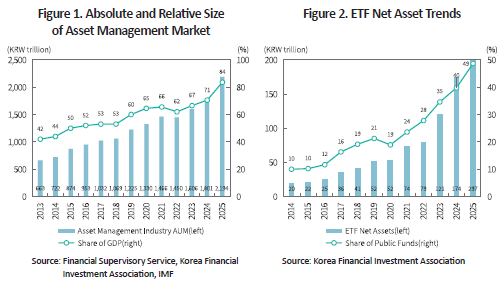
The expansion of the public fund market is attributable to the growth of the ETF market, which accounts for 72% of the net asset increase. The domestic ETF market expanded from KRW 174 trillion in the previous year to KRW 297 trillion, recording high growth exceeding 70% year-over-year. Consequently, the ETF share within public funds increased from 40% in the previous year to 49%. While the profitability(ROAUM) of asset management companies declined to 23bp due to the increased proportion of low-cost products(discretionary investment, bond funds, ETFs, etc.), operating profit(KRW 2.8 trillion) and ROE(18%) of asset management companies increased significantly owing to continuous cost control and expanded assets under management.
Analyzing the causes of net asset increases, net inflows of funds were observed across all public fund types; however, for equity funds, the increase in valuation due to the stock market boom amounted to KRW 56 trillion, exceeding the new fund inflows(KRW 40 trillion). If stock index increases continue and various government policies for expanding domestic investment show synergistic effects, new fund inflows into equity funds are expected to expand significantly this year as well.
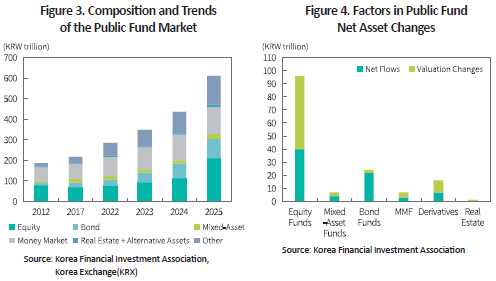
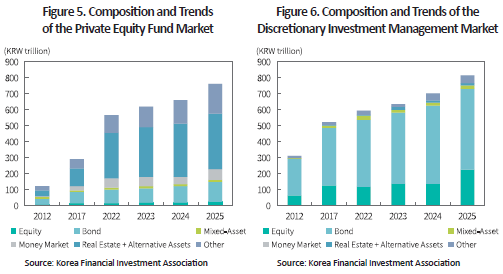
The growth trend in institutional client assets also continued, with the private equity fund market recovering a relatively high growth rate of 15.7%, making up for the sustained low growth(6.1%) until the previous year, and the discretionary investment market also demonstrating robust growth of 16.4%. While the growth of the private equity fund market is led by the short-term money(MMF) market(40.4%), it is noteworthy that the equity private equity fund market's growth reaches 35.0%, whereas the real estate fund market shows only 6.0% growth. In the case of equity private equity funds, there is a net outflow of KRW 1.5 trillion in terms of fund flows, but the overall net asset scale increased by KRW 7.5 trillion due to valuation increases(KRW 9.0 trillion).
Issue 1: Expansion of Domestic Investment Ratio by Institutional and Retail Investors
The first major issue in the asset management market this year is the so-called capital reshoring, where institutional and retail investors expand their domestic investment ratio as the government's firm policy commitment to revitalizing domestic stock markets such as KOSPI and KOSDAQ has been confirmed. The modification of rebalancing strategies and adjustment of strategic asset allocation(SAA) by large institutional investors including 67 statutory funds is already becoming visible. Most institutional investors manage fund allocation by proportion rather than amount, and when investment proportions increase due to market price rises, the process of returning them to pre-set target proportions is called portfolio rebalancing.
Notably, the National Pension Service(NPS) raised the annual target proportion for domestic equities from 14.4% to 14.9%, a 0.5%p increase, through the "National Pension Fund Portfolio Improvement Plan." In a situation where it is already approaching the allowable limit for excess proportion(±3%p), this measure is interpreted to mean that the possibility of mechanical selling due to rebalancing has been reduced rather than additional fund allocation. Therefore, a more meaningful measure is the temporary suspension of the rebalancing strategy announced together. The NPS's rebalancing strategy is designed so that when market prices rise, the "effective target proportion" can move up with the market within a certain range. This is called the reference proportion, and the portfolio rebalancing strategy is executed around this reference proportion. Therefore, the suspension of rebalancing is a measure that completely opens the upper limit of the reference proportion; for example, if the domestic stock market continues to rise, it means that the NPS's effective target proportion for domestic equities can increase above 17.9% without limit. This can be considered a drastic measure that fundamentally blocks the possibility of asset sales by the NPS due to rising domestic stock markets. However, it should be noted from a risk management perspective that negative consequences that may arise from excessive concentration in specific assets are ultimately risk factors that the fund management entity must bear.
The introduction of the Reshoring Investment Account(RIA) is being discussed as a government policy to induce retail investors to return to the domestic market. Among the foreign currency securities custody amounts of overseas securities direct investors, known as "Seohaggaemi"(ants studying abroad), 73% consists of U.S. stocks(USD 170.4 billion), and the return of these overseas funds to the domestic market is expected to improve supply-demand conditions in the domestic stock market and partially alleviate upward pressure on exchange rates in the domestic foreign exchange market. To fully achieve these policy objectives, measures are being discussed to expand eligible investment targets for returned funds to bonds and cash in addition to domestic stocks, and to differentially apply tax reductions based on the timing of return. From the supervisory authority's perspective, integrated management measures for securities companies' overseas investment accounts should be prepared to ensure that such reshoring accounts are not misused for purposes other than the system's intent.
Considering that a significant portion of individual overseas investment is centered on equity and derivative ETFs, the need to relax operational regulations differentially applied to domestic ETFs in line with international standards is also raised. This refers to derivative ETFs that maximize leverage effects, which are currently prohibited domestically. Separate investor protection mechanisms should be devised for these ultra-high-risk public funds. In the long term, it is most important to secure investor confidence that domestic stocks are not inferior investment products compared to U.S. stocks through fundamental improvement of the domestic stock market's constitution. This is why commercial law amendments and strengthening of the stewardship code for fundamental corporate value enhancement should be actively promoted, beyond simply driving stock indices from a market supply-demand perspective.
Issue 2: Retirement Asset Accumulation and Wealth Building Support
2025 marks the 20th anniversary of the introduction of the retirement pension system. Based on recent standards, the retirement pension reserve scale is observed to have exceeded KRW 500 trillion. This signifies that the influence of the retirement pension system in the asset management market is increasing. Despite this quantitative growth, qualitatively, improving the poor investment returns that fall short of even the inflation rate remains a pressing issue for the retirement pension system. In the operation of pension assets, improving returns is the role and responsibility of the asset management industry. Conversely, the pension system should actively utilize capital markets to improve returns. From the government's standpoint, it is important to establish institutional mechanisms related to this and actively promote them as policy.
The introduction of the fund-type retirement pension system can be cited as a representative example. The impact of introducing the fund-type retirement pension system on the domestic asset management market is expected to be very significant. Currently, the labor-management-government TF centered on the Ministry of Employment and Labor is developing a consensus plan for the fund-type system. While there may be various claims regarding system design, what is important is that the fund governance structure should be designed in a direction that can fully achieve the institutional establishment purpose of improving retirement pension returns. This is why for-profit retirement pension funds with active participation from private financial institutions should be permitted. Public-type retirement pension funds need to clearly limit their coverage to small and medium-sized enterprises accompanied by public support and expand their role and scale.
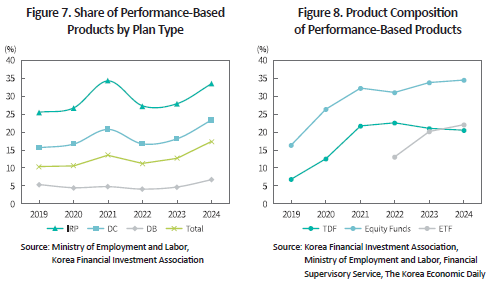
The proportion of DC-type and IRP-type retirement pensions is increasing, leading to an increase in the proportion of performance-based products(17%). Within the composition of performance-based products, the proportion of aggressive investment products such as equity funds(34.5%) and ETFs(22.0%) is expanding. The proportion of TDFs has been relatively stagnant or declining since peaking in 2022. Under the current contract-based governance structure, improvement of the default option system is urgent. Portfolios consisting only of principal-guaranteed products and TDF vintage combination portfolios should be avoided, and the opt-out nature of default options should be strengthened by presenting only one eligible product for each risk preference. Through this, it is important to create a competitive environment among financial institutions by expanding the responsibilities and roles of retirement pension operators.
Multi-faceted government support is being implemented for the purpose of increasing national wealth through tax benefits. Tax benefits for Individual Savings Accounts(ISA) are representative. For the 2030 generation, direct investment in stocks and ETFs through investment-brokerage ISAs has become the norm. As investment-brokerage ISAs centered on ETFs(45.6%) and stocks(33.4%) have established themselves as a Korean-style comprehensive investment platform, the proportion of securities company subscriptions is rapidly increasing to 85.9% compared to banks. Similar forms of tax benefits are provided to personal pensions corresponding to the third tier of the multi-pillar pension system and Individual Retirement Pension(IRP) in the second tier. The issue is also raised that overseas investment through pension savings becomes an obstacle to the return of domestic investment in that it has a significant lock-in effect on funds. In coordinating operational regulations and tax benefits among various support policies for increasing national wealth, balanced policy implementation is required between maintaining the characteristics of long-term investment and active investment rebalancing.
Issue 3: Expanding Fund Inflows to the Venture Capital Market
According to the government policy of transition to productive finance, expanded fund inflows to the venture capital market are anticipated. The venture capital market is typically divided into the venture investment market for fostering venture startups and the PEF market for private market fundraising. The National Growth Fund, ambitiously launched under the new government with a scale of KRW 150 trillion+α, aims to strengthen the investment ecosystem by improving the financial environment and providing investment support for fostering AI and other deep tech-based industries. Efficient and swift policy implementation is required. The 2026 Fund of Funds investment budget is approximately KRW 1.1 trillion, the largest ever. Half of this is allocated to the "NEXT UNICORN Project," which invests in AI and deep tech fields. The "Jump-Up Program" support for the advancement of mid-sized and global companies is also expected to expand significantly.
Along with this, policies for the inflow of 67 statutory funds and KRW 500 trillion in retirement pension reserves into the venture market are being promoted at the pan-government level. To expand venture investment by statutory funds, a plan to grant separate bonus points for venture investment in the fund evaluation system of the Ministry of Economy and Finance is being considered. The plan to include the KOSDAQ index in the fund evaluation benchmark return for domestic equities to revitalize KOSDAQ investment by statutory funds, which are institutional investors, is also interpreted as part of measures to strengthen the exit market for venture investment. To channel retirement pension reserves into the venture market, related laws or regulations must first be amended. Amendment of supervisory regulations that fundamentally prohibit retirement pension investment in unlisted stocks is required, and the supervisory authority's active authoritative interpretation should accompany this.
The PEF market, another pillar of the venture capital market, continues to face negative public opinion and strengthened regulations due to past incidents such as the Homeplus case. A total of 21 PEF regulation-related bills were submitted during the past year, and additional submissions and promotions are scheduled for this year. The main issues in PEF-related legal amendments are: first, leverage regulation limiting excessive leveraged investment by reducing the borrowing limit from 400% to 200% of net assets. Second is the operation and recovery method, seeking to establish restrictions on mandatory holding periods and bolt-on strategies. Third is strengthening disclosure and reporting obligations, mandating detailed reporting on fee structures and operational performance and accounting audits. Finally, strengthening internal control includes establishing GP qualification requirements and discussing an immediate exit(one-strike-out) system for serious violations.
Conclusion and Implications
The year 2025 was a year in which the domestic asset management market grew significantly both quantitatively and qualitatively. The cause of the increase in assets under management lies more in valuation increases than in new fund inflows. This is because the valuation of equity funds increased significantly due to the boom in the domestic stock market. For this growth momentum to continue this year, institutional reforms to strengthen new fund inflows should be actively promoted. As the government's firm policy commitment to revitalizing domestic stock markets such as KOSPI and KOSDAQ has been confirmed in the market, it is projected that this year, both individuals and institutions will actively expand their domestic investment proportion in their overall investment portfolios. Related institutional reforms or government policies should be implemented in a timely manner so that this movement can become a structural transformation rather than a temporary phenomenon. It is most important to fundamentally strengthen investor confidence that the Korea discount has been converted to a Korea premium through commercial law amendments and establishment of the stewardship code to bring individual investors back to the domestic market.
1) The asset management market is defined as the sum of public funds, private funds, and discretionary investment management, based on total net assets and valuation. The 2025 nominal GDP uses the IMF WEO(October 2025) forecast.
The domestic asset management market in 2025 expanded to KRW 2,194 trillion, a 22% increase from the previous year, accounting for 84% of GDP.1) Considering the 42% relative ratio in 2013, it took 12 years for the market to double in size. This signifies that the importance of the asset management industry in the national economy has expanded accordingly. Public funds(including ETFs), which recorded net assets of KRW 609 trillion with the highest growth rate of 39.7% year-over-year, drove the overall market expansion. Due to the booming stock market, the net asset value of equity funds within public funds increased significantly(KRW 96 trillion), explaining 56% of the public fund market expansion.
The expansion of the public fund market is attributable to the growth of the ETF market, which accounts for 72% of the net asset increase. The domestic ETF market expanded from KRW 174 trillion in the previous year to KRW 297 trillion, recording high growth exceeding 70% year-over-year. Consequently, the ETF share within public funds increased from 40% in the previous year to 49%. While the profitability(ROAUM) of asset management companies declined to 23bp due to the increased proportion of low-cost products(discretionary investment, bond funds, ETFs, etc.), operating profit(KRW 2.8 trillion) and ROE(18%) of asset management companies increased significantly owing to continuous cost control and expanded assets under management.
Analyzing the causes of net asset increases, net inflows of funds were observed across all public fund types; however, for equity funds, the increase in valuation due to the stock market boom amounted to KRW 56 trillion, exceeding the new fund inflows(KRW 40 trillion). If stock index increases continue and various government policies for expanding domestic investment show synergistic effects, new fund inflows into equity funds are expected to expand significantly this year as well.
The growth trend in institutional client assets also continued, with the private equity fund market recovering a relatively high growth rate of 15.7%, making up for the sustained low growth(6.1%) until the previous year, and the discretionary investment market also demonstrating robust growth of 16.4%. While the growth of the private equity fund market is led by the short-term money(MMF) market(40.4%), it is noteworthy that the equity private equity fund market's growth reaches 35.0%, whereas the real estate fund market shows only 6.0% growth. In the case of equity private equity funds, there is a net outflow of KRW 1.5 trillion in terms of fund flows, but the overall net asset scale increased by KRW 7.5 trillion due to valuation increases(KRW 9.0 trillion).
Issue 1: Expansion of Domestic Investment Ratio by Institutional and Retail Investors
The first major issue in the asset management market this year is the so-called capital reshoring, where institutional and retail investors expand their domestic investment ratio as the government's firm policy commitment to revitalizing domestic stock markets such as KOSPI and KOSDAQ has been confirmed. The modification of rebalancing strategies and adjustment of strategic asset allocation(SAA) by large institutional investors including 67 statutory funds is already becoming visible. Most institutional investors manage fund allocation by proportion rather than amount, and when investment proportions increase due to market price rises, the process of returning them to pre-set target proportions is called portfolio rebalancing.
Notably, the National Pension Service(NPS) raised the annual target proportion for domestic equities from 14.4% to 14.9%, a 0.5%p increase, through the "National Pension Fund Portfolio Improvement Plan." In a situation where it is already approaching the allowable limit for excess proportion(±3%p), this measure is interpreted to mean that the possibility of mechanical selling due to rebalancing has been reduced rather than additional fund allocation. Therefore, a more meaningful measure is the temporary suspension of the rebalancing strategy announced together. The NPS's rebalancing strategy is designed so that when market prices rise, the "effective target proportion" can move up with the market within a certain range. This is called the reference proportion, and the portfolio rebalancing strategy is executed around this reference proportion. Therefore, the suspension of rebalancing is a measure that completely opens the upper limit of the reference proportion; for example, if the domestic stock market continues to rise, it means that the NPS's effective target proportion for domestic equities can increase above 17.9% without limit. This can be considered a drastic measure that fundamentally blocks the possibility of asset sales by the NPS due to rising domestic stock markets. However, it should be noted from a risk management perspective that negative consequences that may arise from excessive concentration in specific assets are ultimately risk factors that the fund management entity must bear.
The introduction of the Reshoring Investment Account(RIA) is being discussed as a government policy to induce retail investors to return to the domestic market. Among the foreign currency securities custody amounts of overseas securities direct investors, known as "Seohaggaemi"(ants studying abroad), 73% consists of U.S. stocks(USD 170.4 billion), and the return of these overseas funds to the domestic market is expected to improve supply-demand conditions in the domestic stock market and partially alleviate upward pressure on exchange rates in the domestic foreign exchange market. To fully achieve these policy objectives, measures are being discussed to expand eligible investment targets for returned funds to bonds and cash in addition to domestic stocks, and to differentially apply tax reductions based on the timing of return. From the supervisory authority's perspective, integrated management measures for securities companies' overseas investment accounts should be prepared to ensure that such reshoring accounts are not misused for purposes other than the system's intent.
Considering that a significant portion of individual overseas investment is centered on equity and derivative ETFs, the need to relax operational regulations differentially applied to domestic ETFs in line with international standards is also raised. This refers to derivative ETFs that maximize leverage effects, which are currently prohibited domestically. Separate investor protection mechanisms should be devised for these ultra-high-risk public funds. In the long term, it is most important to secure investor confidence that domestic stocks are not inferior investment products compared to U.S. stocks through fundamental improvement of the domestic stock market's constitution. This is why commercial law amendments and strengthening of the stewardship code for fundamental corporate value enhancement should be actively promoted, beyond simply driving stock indices from a market supply-demand perspective.
Issue 2: Retirement Asset Accumulation and Wealth Building Support
2025 marks the 20th anniversary of the introduction of the retirement pension system. Based on recent standards, the retirement pension reserve scale is observed to have exceeded KRW 500 trillion. This signifies that the influence of the retirement pension system in the asset management market is increasing. Despite this quantitative growth, qualitatively, improving the poor investment returns that fall short of even the inflation rate remains a pressing issue for the retirement pension system. In the operation of pension assets, improving returns is the role and responsibility of the asset management industry. Conversely, the pension system should actively utilize capital markets to improve returns. From the government's standpoint, it is important to establish institutional mechanisms related to this and actively promote them as policy.
The introduction of the fund-type retirement pension system can be cited as a representative example. The impact of introducing the fund-type retirement pension system on the domestic asset management market is expected to be very significant. Currently, the labor-management-government TF centered on the Ministry of Employment and Labor is developing a consensus plan for the fund-type system. While there may be various claims regarding system design, what is important is that the fund governance structure should be designed in a direction that can fully achieve the institutional establishment purpose of improving retirement pension returns. This is why for-profit retirement pension funds with active participation from private financial institutions should be permitted. Public-type retirement pension funds need to clearly limit their coverage to small and medium-sized enterprises accompanied by public support and expand their role and scale.
The proportion of DC-type and IRP-type retirement pensions is increasing, leading to an increase in the proportion of performance-based products(17%). Within the composition of performance-based products, the proportion of aggressive investment products such as equity funds(34.5%) and ETFs(22.0%) is expanding. The proportion of TDFs has been relatively stagnant or declining since peaking in 2022. Under the current contract-based governance structure, improvement of the default option system is urgent. Portfolios consisting only of principal-guaranteed products and TDF vintage combination portfolios should be avoided, and the opt-out nature of default options should be strengthened by presenting only one eligible product for each risk preference. Through this, it is important to create a competitive environment among financial institutions by expanding the responsibilities and roles of retirement pension operators.
Multi-faceted government support is being implemented for the purpose of increasing national wealth through tax benefits. Tax benefits for Individual Savings Accounts(ISA) are representative. For the 2030 generation, direct investment in stocks and ETFs through investment-brokerage ISAs has become the norm. As investment-brokerage ISAs centered on ETFs(45.6%) and stocks(33.4%) have established themselves as a Korean-style comprehensive investment platform, the proportion of securities company subscriptions is rapidly increasing to 85.9% compared to banks. Similar forms of tax benefits are provided to personal pensions corresponding to the third tier of the multi-pillar pension system and Individual Retirement Pension(IRP) in the second tier. The issue is also raised that overseas investment through pension savings becomes an obstacle to the return of domestic investment in that it has a significant lock-in effect on funds. In coordinating operational regulations and tax benefits among various support policies for increasing national wealth, balanced policy implementation is required between maintaining the characteristics of long-term investment and active investment rebalancing.
Issue 3: Expanding Fund Inflows to the Venture Capital Market
According to the government policy of transition to productive finance, expanded fund inflows to the venture capital market are anticipated. The venture capital market is typically divided into the venture investment market for fostering venture startups and the PEF market for private market fundraising. The National Growth Fund, ambitiously launched under the new government with a scale of KRW 150 trillion+α, aims to strengthen the investment ecosystem by improving the financial environment and providing investment support for fostering AI and other deep tech-based industries. Efficient and swift policy implementation is required. The 2026 Fund of Funds investment budget is approximately KRW 1.1 trillion, the largest ever. Half of this is allocated to the "NEXT UNICORN Project," which invests in AI and deep tech fields. The "Jump-Up Program" support for the advancement of mid-sized and global companies is also expected to expand significantly.
Along with this, policies for the inflow of 67 statutory funds and KRW 500 trillion in retirement pension reserves into the venture market are being promoted at the pan-government level. To expand venture investment by statutory funds, a plan to grant separate bonus points for venture investment in the fund evaluation system of the Ministry of Economy and Finance is being considered. The plan to include the KOSDAQ index in the fund evaluation benchmark return for domestic equities to revitalize KOSDAQ investment by statutory funds, which are institutional investors, is also interpreted as part of measures to strengthen the exit market for venture investment. To channel retirement pension reserves into the venture market, related laws or regulations must first be amended. Amendment of supervisory regulations that fundamentally prohibit retirement pension investment in unlisted stocks is required, and the supervisory authority's active authoritative interpretation should accompany this.
The PEF market, another pillar of the venture capital market, continues to face negative public opinion and strengthened regulations due to past incidents such as the Homeplus case. A total of 21 PEF regulation-related bills were submitted during the past year, and additional submissions and promotions are scheduled for this year. The main issues in PEF-related legal amendments are: first, leverage regulation limiting excessive leveraged investment by reducing the borrowing limit from 400% to 200% of net assets. Second is the operation and recovery method, seeking to establish restrictions on mandatory holding periods and bolt-on strategies. Third is strengthening disclosure and reporting obligations, mandating detailed reporting on fee structures and operational performance and accounting audits. Finally, strengthening internal control includes establishing GP qualification requirements and discussing an immediate exit(one-strike-out) system for serious violations.
Conclusion and Implications
The year 2025 was a year in which the domestic asset management market grew significantly both quantitatively and qualitatively. The cause of the increase in assets under management lies more in valuation increases than in new fund inflows. This is because the valuation of equity funds increased significantly due to the boom in the domestic stock market. For this growth momentum to continue this year, institutional reforms to strengthen new fund inflows should be actively promoted. As the government's firm policy commitment to revitalizing domestic stock markets such as KOSPI and KOSDAQ has been confirmed in the market, it is projected that this year, both individuals and institutions will actively expand their domestic investment proportion in their overall investment portfolios. Related institutional reforms or government policies should be implemented in a timely manner so that this movement can become a structural transformation rather than a temporary phenomenon. It is most important to fundamentally strengthen investor confidence that the Korea discount has been converted to a Korea premium through commercial law amendments and establishment of the stewardship code to bring individual investors back to the domestic market.
1) The asset management market is defined as the sum of public funds, private funds, and discretionary investment management, based on total net assets and valuation. The 2025 nominal GDP uses the IMF WEO(October 2025) forecast.