Our bi-weekly Opinion provides you with latest updates and analysis on major capital market and financial investment industry issues.

Cross-Border Crypto Flows and Its Implications
Publication date Mar. 10, 2026

Summary
Cross-border transactions conducted through crypto assets have expanded rapidly in recent years. Enabled by blockchain networks that operate beyond direct national borders, these transactions have grown due to their efficiency and accessibility relative to traditional cross-border payment infrastructures, with stablecoins emerging as the primary driver of recent growth. As of the end of 2024, global cross-border crypto asset transactions are estimated at approximately USD 2.5 trillion, with their share in global capital flows steadily increasing. These transactions are characterized by strong participation from emerging economies and a geographically dispersed network structure, suggesting that crypto-based transfers are increasingly functioning as an alternative channel for international fund movements—offering faster and lower-cost transfers—while in some cases complementing formal financial channels. At the same time, the expansion of network-based value transfer mechanisms raises policy questions regarding foreign exchange and capital flow management frameworks designed around bank-centered payment systems. In this context, Korea may need to reassess the consistency of its foreign exchange regulatory framework in response to the spread of stablecoins and evolving digital payment infrastructures, while considering medium- to long-term strategies to enhance cross-border payment efficiency and liquidity management.
Cross-border transactions mediated by crypto assets are increasingly emerging as a new channel influencing the structure of international capital movements and payment systems. In this article, such transactions are referred to as cross-border crypto flows (CBCF), defined as the transfer of crypto assets between residents and non-residents across jurisdictions. Unlike traditional cross-border transactions that rely on centralized financial institutions and bank-based payment infrastructures, CBCF are executed on decentralized blockchain networks. As a result, they exhibit distinctive characteristics in terms of transaction channels, speed, and intermediation structure. However, these flows are not easily captured within existing capital flow statistical frameworks. Because blockchain transactions do not inherently contain information on the residency of asset holders, identifying the scale and structure of CBCF poses significant analytical challenges. Against this background, this article reviews the conceptual characteristics and recent developments of CBCF and discusses their economic implications.1)
Concept and Characteristics of CBCF
Crypto assets issued and circulated on distributed ledger technology (DLT) can conceptually be regarded as borderless assets, as transaction records and ownership transfers occur independently of physical national borders. Unlike traditional financial assets—whose ownership is transferred through centralized trading and settlement systems—the ownership and transaction records of crypto assets are verified by participants in decentralized networks. Consequently, physical border concepts do not directly apply to blockchain addresses or transaction paths. Nevertheless, in balance-of-payments and capital flow analysis, cross-border transactions are determined based on the residency of the economic agent controlling the asset, rather than the location of the wallet where the asset is stored. Therefore, even blockchain-based crypto asset transfers constitute cross-border capital movements when ownership shifts between residents and non-residents.
The economic interpretation of CBCF also differs depending on the type of crypto asset involved. Proof-of-work (PoW) assets such as Bitcoin can theoretically circulate through domestic mining and transactions. In practice, however, differences in mining costs and regulatory environments across countries have led many economies—including Korea—to rely largely on cross-border inflows of assets mined overseas.2) By contrast, stablecoins, which are value-linked digital assets, cannot be generated through mining. Instead, they depend on centralized issuance by overseas issuers. As a result, domestic holdings and transactions of stablecoins typically involve cross-border inflows of tokens. While both types of assets are transferred on-chain through transactions between blockchain addresses, stablecoins differ from other crypto assets in that they represent redemption claims on the issuing entity.
Due to the transparency of public blockchains, crypto asset transactions can be observed through on-chain data, which record transactions directly on the blockchain3), but these records do not contain information on the identity or residency of asset holders. In contrast, off-chain data, such as internal records of exchanges and custodians, typically include user identity information obtained through AML and KYC procedures.4) Because blockchain addresses do not inherently reveal residency, on-chain data alone cannot reliably identify ownership transfers between residents and non-residents. To address this limitation, researchers combine on-chain and off-chain information using inference techniques such as address clustering5), custodial jurisdiction identification, and network analysis. As these approaches rely on probabilistic inference, current CBCF statistics are better suited to capturing global trends and relative magnitudes rather than precisely measuring country-level capital flows.
Trends in CBCF
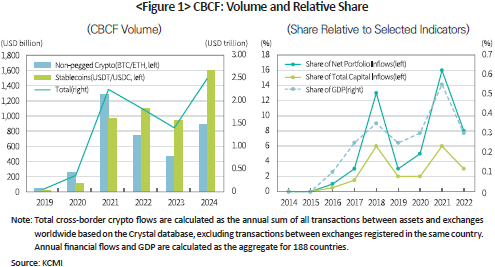
The global volume of cross-border crypto flows (CBCF) is estimated to have reached approximately USD 2.5 trillion as of the end of 2024. CBCF expanded steadily after 2019 and surged around 2021, before moderating in 2022 amid the downturn in the crypto asset market. More recently, CBCF activity has resumed an upward trajectory. Since 2022, stablecoins such as USDT and USDC have accounted for a growing share of CBCF, exceeding the transaction volumes of other crypto assets such as Bitcoin and Ethereum. This shift reflects the differing economic roles of crypto assets: while transactions involving non-stablecoin crypto assets6) tend to fluctuate with price volatility and investment cycles, stablecoins generally maintain relatively stable demand even during periods of market stress. As a result, stablecoins have emerged as a key driver of recent growth in CBCF.
The growing importance of CBCF becomes more evident when compared with traditional capital flows. In 2021, CBCF are estimated to have reached roughly 16 percent of net foreign portfolio inflows and about 6 percent of total global capital flows.7) While these shares remained negligible between 2014 and 2017, they increased markedly after 2018, reflecting the expansion of the crypto asset market and the broader use of crypto assets in cross-border transactions. CBCF are also estimated to account for around 0.5 percent of global GDP in 2021, suggesting that crypto-based cross-border capital movements have reached a scale that is no longer negligible from a macroeconomic perspective in some economies.
The geographical distribution of CBCF also differs from that of traditional cross-border financial flows. While conventional financial transactions are largely concentrated in advanced economies—particularly the United States—CBCF exhibit a relatively greater share of activity involving emerging economies. Since 2020, the share of emerging economies in CBCF has increased markedly. In stablecoin transactions in particular, countries such as Turkey, Russia, and Vietnam account for a larger share of activity than many advanced economies.8) This pattern likely reflects structural conditions in emerging markets, including exchange rate volatility, inflationary pressures, risks of capital outflows, and limited access to domestic financial systems. Under such conditions, crypto assets can function as an informal channel for accessing foreign currency as well as an alternative cross-border payment mechanism.
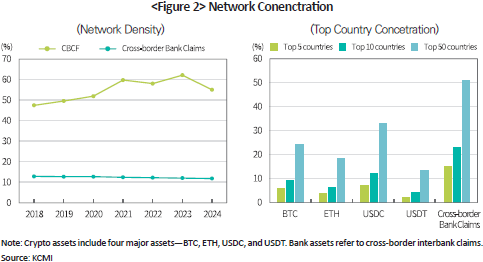
CBCF also differ from traditional financial flows in the structure of international transaction networks. The network density of CBCF—measured by the share of observed bilateral transaction links among all possible country pairs—exceeds 50 percent, significantly higher than that of cross-border bank assets. At the same time, network concentration—measured by the share of the top five bilateral country pairs—is relatively lower than in traditional financial systems.9) These features indicate that CBCF connect a broader range of countries and are less concentrated in a few major financial centers. In other words, international transaction networks associated with CBCF are more widely distributed than those of traditional financial flows. This suggests that CBCF may function not only as volatile investment flows but also as an alternative channel of international financial flows that can partially mitigate macroeconomic shocks and financial access constraints in emerging economies.
Implications
The expansion of CBCF represents more than a simple increase in transaction volumes; it reflects a gradual shift in the mechanisms through which international capital movements and payment systems operate. While traditional cross-border capital flows are largely driven by securities investment and global financial cycles, CBCF are increasingly shaped by the functional use of crypto assets—particularly stablecoins—for payments and transfers. At the same time, blockchain-based transactions enable a more direct and network-based form of value transfer by complementing or partially bypassing existing bank-centered payment infrastructures. As a result, both the channels and speed of cross-border capital movements are evolving, raising questions about the effectiveness of foreign exchange and capital flow management frameworks designed around bank intermediation.
At the regulatory level, the expansion of transactions occurring outside the traditional banking system may weaken the applicability of existing regulatory frameworks. In such an environment, the importance of information-based monitoring mechanisms—including transaction identification, reporting, and ex-post supervision—is likely to increase. At the same time, public-sector initiatives are emerging to integrate digital cross-border payment infrastructures into the formal financial system. The Bank for International Settlements (BIS) has proposed the concept of a Unified Ledger, while Project Agora aims to integrate tokenized deposits, wholesale CBDCs, and private digital assets within a single interoperable settlement layer. Such architectures could reduce cross-border payment costs and settlement risks while potentially shifting foreign exchange transactions from traditional correspondent banking structures toward network-based real-time liquidity exchange systems.
These developments may also influence the microstructure of foreign exchange markets, including bid–ask spreads, the composition of liquidity providers, and the management of settlement risks. Real-time settlement environments could reduce transaction costs while expanding the role of non-bank participants and network-based liquidity providers. From Korea’s perspective, these changes highlight the need to reassess the consistency of existing foreign exchange and capital transaction regulatory frameworks. The growing use of crypto assets in cross-border transfers raises additional policy considerations related to exchange rate volatility and financial stability. At the same time, interoperability frameworks involving wholesale CBDCs, tokenized deposits, and potentially KRW-linked digital assets could improve the efficiency and safety of cross-border foreign exchange settlements while expanding the international payment capabilities of domestic financial institutions. Accordingly, Korea’s policy response should include a medium- to long-term strategic assessment of the role and limitations of won-based digital assets within the evolving global digital liquidity network.
1) This article was prepared by summarizing and restructuring the key content based on the Capital Market Institute Issue Report by Kim Han-su and Lee Seung-ho (2026), ‘Cross-border Crypto Asset Transactions: Trend and Implications’.
2) According to a 2018 survey on Bitcoin mining costs, South Korea was found to have the highest mining costs among the 115 countries surveyed (Investopedia, 2018, Bitcoin Mining Cost by Country).
3) On-chain refers to transaction records that are directly recorded on a blockchain; however, such records do not inherently contain information regarding the owner’s residency or identity. In contrast, off-chain refers to information external to the blockchain, such as internal records maintained by exchanges and custodians, and generally includes account holders’ identity information for compliance with AML and KYC regulations pursuant to applicable laws and regulations.
4) Centralized crypto-asset service providers, such as cryptocurrency exchanges, are required to implement Anti-Money Laundering (AML) and Know Your Customer (KYC) procedures in accordance with applicable laws and regulations.
5) Address clustering refers to a technique that statistically groups multiple blockchain addresses presumed to be managed by a single economic entity, based on on-chain information such as transaction patterns, input/output structures, and the use of common signatures.
6) Refers to cryptographic assets whose prices are determined by market supply and demand, without being pegged to any specific reference asset such as fiat currency or physical assets.
7) The balance of payments records securities investment flows on a net basis (netting inflows and outflows), whereas crypto-asset transactions are measured on a gross basis (total gross flows); accordingly, direct comparisons between the two require interpretive caution.
8) The analysis on the distribution by country is presented in ‘Kim Han-su and Lee Seung-ho, 2026, Cross-Border Crypto-Asset Transactions: Trend and Implications, Korea Capital Market Institute Issue Report.’
9) Network connectivity density is defined as the proportion of links, among all theoretically possible directed bilateral trade links, for which at least one positive transaction is observed, while network concentration is measured by the share of total transaction volume accounted for by the top bilateral country pairs.
Concept and Characteristics of CBCF
Crypto assets issued and circulated on distributed ledger technology (DLT) can conceptually be regarded as borderless assets, as transaction records and ownership transfers occur independently of physical national borders. Unlike traditional financial assets—whose ownership is transferred through centralized trading and settlement systems—the ownership and transaction records of crypto assets are verified by participants in decentralized networks. Consequently, physical border concepts do not directly apply to blockchain addresses or transaction paths. Nevertheless, in balance-of-payments and capital flow analysis, cross-border transactions are determined based on the residency of the economic agent controlling the asset, rather than the location of the wallet where the asset is stored. Therefore, even blockchain-based crypto asset transfers constitute cross-border capital movements when ownership shifts between residents and non-residents.
The economic interpretation of CBCF also differs depending on the type of crypto asset involved. Proof-of-work (PoW) assets such as Bitcoin can theoretically circulate through domestic mining and transactions. In practice, however, differences in mining costs and regulatory environments across countries have led many economies—including Korea—to rely largely on cross-border inflows of assets mined overseas.2) By contrast, stablecoins, which are value-linked digital assets, cannot be generated through mining. Instead, they depend on centralized issuance by overseas issuers. As a result, domestic holdings and transactions of stablecoins typically involve cross-border inflows of tokens. While both types of assets are transferred on-chain through transactions between blockchain addresses, stablecoins differ from other crypto assets in that they represent redemption claims on the issuing entity.
Due to the transparency of public blockchains, crypto asset transactions can be observed through on-chain data, which record transactions directly on the blockchain3), but these records do not contain information on the identity or residency of asset holders. In contrast, off-chain data, such as internal records of exchanges and custodians, typically include user identity information obtained through AML and KYC procedures.4) Because blockchain addresses do not inherently reveal residency, on-chain data alone cannot reliably identify ownership transfers between residents and non-residents. To address this limitation, researchers combine on-chain and off-chain information using inference techniques such as address clustering5), custodial jurisdiction identification, and network analysis. As these approaches rely on probabilistic inference, current CBCF statistics are better suited to capturing global trends and relative magnitudes rather than precisely measuring country-level capital flows.
Trends in CBCF
The global volume of cross-border crypto flows (CBCF) is estimated to have reached approximately USD 2.5 trillion as of the end of 2024. CBCF expanded steadily after 2019 and surged around 2021, before moderating in 2022 amid the downturn in the crypto asset market. More recently, CBCF activity has resumed an upward trajectory. Since 2022, stablecoins such as USDT and USDC have accounted for a growing share of CBCF, exceeding the transaction volumes of other crypto assets such as Bitcoin and Ethereum. This shift reflects the differing economic roles of crypto assets: while transactions involving non-stablecoin crypto assets6) tend to fluctuate with price volatility and investment cycles, stablecoins generally maintain relatively stable demand even during periods of market stress. As a result, stablecoins have emerged as a key driver of recent growth in CBCF.
The growing importance of CBCF becomes more evident when compared with traditional capital flows. In 2021, CBCF are estimated to have reached roughly 16 percent of net foreign portfolio inflows and about 6 percent of total global capital flows.7) While these shares remained negligible between 2014 and 2017, they increased markedly after 2018, reflecting the expansion of the crypto asset market and the broader use of crypto assets in cross-border transactions. CBCF are also estimated to account for around 0.5 percent of global GDP in 2021, suggesting that crypto-based cross-border capital movements have reached a scale that is no longer negligible from a macroeconomic perspective in some economies.
The geographical distribution of CBCF also differs from that of traditional cross-border financial flows. While conventional financial transactions are largely concentrated in advanced economies—particularly the United States—CBCF exhibit a relatively greater share of activity involving emerging economies. Since 2020, the share of emerging economies in CBCF has increased markedly. In stablecoin transactions in particular, countries such as Turkey, Russia, and Vietnam account for a larger share of activity than many advanced economies.8) This pattern likely reflects structural conditions in emerging markets, including exchange rate volatility, inflationary pressures, risks of capital outflows, and limited access to domestic financial systems. Under such conditions, crypto assets can function as an informal channel for accessing foreign currency as well as an alternative cross-border payment mechanism.
CBCF also differ from traditional financial flows in the structure of international transaction networks. The network density of CBCF—measured by the share of observed bilateral transaction links among all possible country pairs—exceeds 50 percent, significantly higher than that of cross-border bank assets. At the same time, network concentration—measured by the share of the top five bilateral country pairs—is relatively lower than in traditional financial systems.9) These features indicate that CBCF connect a broader range of countries and are less concentrated in a few major financial centers. In other words, international transaction networks associated with CBCF are more widely distributed than those of traditional financial flows. This suggests that CBCF may function not only as volatile investment flows but also as an alternative channel of international financial flows that can partially mitigate macroeconomic shocks and financial access constraints in emerging economies.
Implications
The expansion of CBCF represents more than a simple increase in transaction volumes; it reflects a gradual shift in the mechanisms through which international capital movements and payment systems operate. While traditional cross-border capital flows are largely driven by securities investment and global financial cycles, CBCF are increasingly shaped by the functional use of crypto assets—particularly stablecoins—for payments and transfers. At the same time, blockchain-based transactions enable a more direct and network-based form of value transfer by complementing or partially bypassing existing bank-centered payment infrastructures. As a result, both the channels and speed of cross-border capital movements are evolving, raising questions about the effectiveness of foreign exchange and capital flow management frameworks designed around bank intermediation.
At the regulatory level, the expansion of transactions occurring outside the traditional banking system may weaken the applicability of existing regulatory frameworks. In such an environment, the importance of information-based monitoring mechanisms—including transaction identification, reporting, and ex-post supervision—is likely to increase. At the same time, public-sector initiatives are emerging to integrate digital cross-border payment infrastructures into the formal financial system. The Bank for International Settlements (BIS) has proposed the concept of a Unified Ledger, while Project Agora aims to integrate tokenized deposits, wholesale CBDCs, and private digital assets within a single interoperable settlement layer. Such architectures could reduce cross-border payment costs and settlement risks while potentially shifting foreign exchange transactions from traditional correspondent banking structures toward network-based real-time liquidity exchange systems.
These developments may also influence the microstructure of foreign exchange markets, including bid–ask spreads, the composition of liquidity providers, and the management of settlement risks. Real-time settlement environments could reduce transaction costs while expanding the role of non-bank participants and network-based liquidity providers. From Korea’s perspective, these changes highlight the need to reassess the consistency of existing foreign exchange and capital transaction regulatory frameworks. The growing use of crypto assets in cross-border transfers raises additional policy considerations related to exchange rate volatility and financial stability. At the same time, interoperability frameworks involving wholesale CBDCs, tokenized deposits, and potentially KRW-linked digital assets could improve the efficiency and safety of cross-border foreign exchange settlements while expanding the international payment capabilities of domestic financial institutions. Accordingly, Korea’s policy response should include a medium- to long-term strategic assessment of the role and limitations of won-based digital assets within the evolving global digital liquidity network.
1) This article was prepared by summarizing and restructuring the key content based on the Capital Market Institute Issue Report by Kim Han-su and Lee Seung-ho (2026), ‘Cross-border Crypto Asset Transactions: Trend and Implications’.
2) According to a 2018 survey on Bitcoin mining costs, South Korea was found to have the highest mining costs among the 115 countries surveyed (Investopedia, 2018, Bitcoin Mining Cost by Country).
3) On-chain refers to transaction records that are directly recorded on a blockchain; however, such records do not inherently contain information regarding the owner’s residency or identity. In contrast, off-chain refers to information external to the blockchain, such as internal records maintained by exchanges and custodians, and generally includes account holders’ identity information for compliance with AML and KYC regulations pursuant to applicable laws and regulations.
4) Centralized crypto-asset service providers, such as cryptocurrency exchanges, are required to implement Anti-Money Laundering (AML) and Know Your Customer (KYC) procedures in accordance with applicable laws and regulations.
5) Address clustering refers to a technique that statistically groups multiple blockchain addresses presumed to be managed by a single economic entity, based on on-chain information such as transaction patterns, input/output structures, and the use of common signatures.
6) Refers to cryptographic assets whose prices are determined by market supply and demand, without being pegged to any specific reference asset such as fiat currency or physical assets.
7) The balance of payments records securities investment flows on a net basis (netting inflows and outflows), whereas crypto-asset transactions are measured on a gross basis (total gross flows); accordingly, direct comparisons between the two require interpretive caution.
8) The analysis on the distribution by country is presented in ‘Kim Han-su and Lee Seung-ho, 2026, Cross-Border Crypto-Asset Transactions: Trend and Implications, Korea Capital Market Institute Issue Report.’
9) Network connectivity density is defined as the proportion of links, among all theoretically possible directed bilateral trade links, for which at least one positive transaction is observed, while network concentration is measured by the share of total transaction volume accounted for by the top bilateral country pairs.