Our bi-weekly Opinion provides you with latest updates and analysis on major capital market and financial investment industry issues.
Policy Challenges for Stabilizing Exchange Rates and Foreign Exchange Supply and Demand
Publication date Mar. 24, 2026
Summary
The won-dollar exchange rate has recently remained at a high level, adding to the burden on macroeconomic management through inflationary pressures and other factors. One of the main causes behind the rise in the exchange rate has been identified as the reduction in net foreign exchange supply resulting from the expansion of Korea’s overseas securities investment. However, this increase in overseas investment is an inevitable trend driven by current account surpluses and ample foreign currency liquidity, as Korean economic agents seek to enhance investment returns. As seen in the case of Japan, it also contributes to building a stable current account surplus structure based on income balance. Therefore, this is an important moment to pursue two policy objectives in harmony: maximizing the benefits of overseas investment while minimizing instability in the foreign exchange market. To this end, it is necessary to increase net foreign exchange supply by strengthening foreign investors’ confidence in the domestic stock market and securing inclusion in the MSCI Developed Markets Index. In addition, the National Pension Service, which holds the largest share of overseas investment among single institutions, should preferably raise funds for overseas investment by issuing foreign currency bonds in global financial markets rather than relying on the domestic foreign exchange market. Over the medium to long term, a more fundamental approach to stabilizing the exchange rate would be to further broaden and deepen the domestic foreign exchange market, thereby mitigating herding behavior among market participants in response to changes in foreign exchange supply and demand or various external shocks.
Recently, as the won-dollar exchange rate has risen (indicating a depreciation of the won), concerns have been mounting over heightened inflationary pressures, risks to financial stability, and the deepening polarization of the economy caused by heavier burdens on low-income households and small and medium-sized enterprises. Despite a continued current account surplus, changes in foreign exchange supply and demand conditions—such as the expansion of overseas securities investment by residents—have been cited as key factors behind the sustained upward trend in the exchange rate. Some have also argued that domestic pension funds and other institutional investors are investing excessively abroad, calling for a reassessment of such investments to help stabilize the exchange rate. This paper analyzes recent exchange rate movements with a focus on Korea’s foreign exchange supply and demand conditions, and proposes policy directions for stabilizing both the exchange rate and the foreign exchange market.
Won-dollar Exchange Rate and Foreign Exchange Supply and Demand Conditions
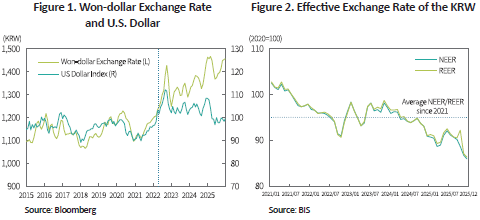
The Korean won (KRW) exchange rate against the U.S. dollar reversed its downward trend in the first half of 2025 and turned upward from the second half onward, closing the year at KRW 1,439.75 per dollar. Since the beginning of this year, the won-dollar rate has continued to fluctuate around KRW 1,450. The persistence of such a high exchange rate level, despite ample foreign exchange supply—including a sizable current account surplus driven by strong exports and net purchases of domestic equities by foreign investors—appears somewhat unusual even compared with the movements of major competitor currencies. A comparison of the movements of the Korean won and the U.S. dollar (Figure 1) shows that the divergence between the two currencies has been widening since around 2022. While the U.S. Dollar Index fell from 108.5 at end-2024 to 98.3 at end-2025, marking a year-on-year decline of 9.4% (indicating dollar weakness), the won-dollar exchange rate declined by only 2.2% on a year-end basis. Moreover, both the Nominal Effective Exchange Rate (NEER) and the Real Effective Exchange Rate (REER)—which reflect export competitiveness against major trading partners—indicate that the won depreciated by about 5%. This suggests that the won-dollar exchange rate is being significantly influenced not only by various international financial market factors but also by domestic factors such as foreign exchange supply and demand conditions.
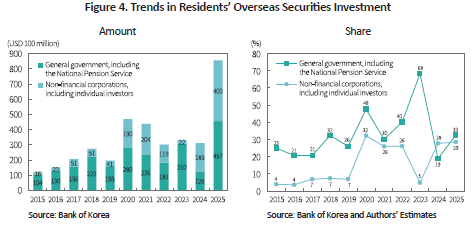
Examining the current state of our country’s foreign exchange supply and demand through balance of payments statistics, on the supply side, sustained large current account surpluses and continued inflows of foreign investment into domestic securities are driving foreign exchange supply. In 2025, the current account surplus amounted to USD 123.1 billion, a substantial figure approaching 7% of GDP, while foreign investment inflows into domestic securities reached USD 52.5 billion, the highest level since 2021. However, between January 29 and February 26 of this year, foreign investors recorded net sales of KRW 16.3 trillion worth of stocks in the domestic equity market. On the demand side, by contrast, the increase in foreign exchange demand and external outflows resulting from residents’ expanding overseas securities investment is particularly notable. In 2025, outflows for overseas securities investment—led by the National Pension Service and individual investors in foreign stocks—reached USD 140.3 billion, exceeding the size of the current account surplus. By investor type, the National Pension Service stands out for its significant expansion of overseas securities investment, while individual overseas investment has also risen sharply in recent years; as of 2025, their respective shares in total overseas securities investment stood at 29% and 33%. In this regard, it is difficult to deny that the recent expansion of overseas securities investment has been one of the main factors contributing to the rise in the exchange rate.
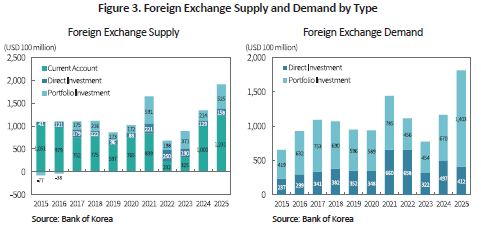
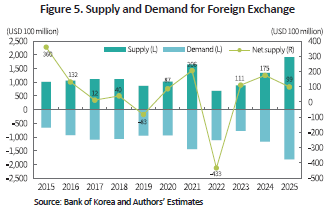
However, considering the foreign exchange supply and demand discussed above,1) the overall foreign exchange balance still shows a supply surplus. In other words, the net foreign exchange supply in 2025 amounted to USD 9.9 billion—about half the level of 2024 (USD 17.5 billion)—yet the overall balance continues to indicate net inflows. In this regard, it may be somewhat difficult to attribute the recent rise in the exchange rate solely to the expansion of residents’ overseas securities investment. Nevertheless, given that the market tends to respond more sensitively to the direction and pace of changes in foreign exchange supply and demand than to their absolute levels, it is clear that the contraction in net foreign exchange supply itself has been an important factor behind the recent appreciation of the won. In addition to this reduction in net foreign exchange supply, the delayed rate cuts by the U.S. Federal Reserve, the growth differential between Korea and the United States, and persistent external uncertainties stemming from tariff policies also appear to be influencing market participants’ herd behavior, thereby accelerating the rise in the exchange rate.
The Expansion of Overseas Securities Investment as an Inevitable Consequence of a Current Account Surplus
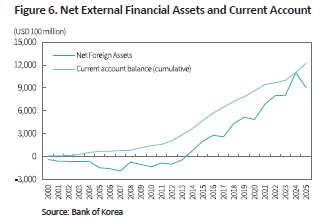
As shown by the balance of payments identity [CA – KA = 0], a current account surplus (capital inflow) inevitably results ex post in a deficit in the capital and financial account (capital outflow). In other words, a current account surplus necessarily appears as an increase in external financial assets through overseas securities investment. As illustrated in <Figure 6>, since 2000, Korea’s cumulative current account surplus has moved in tandem with its net external financial assets, which amounted to USD 904.2 billion at the end of 2025. The current situation is fundamentally different from an exchange rate rise driven by a shortage of foreign currency liquidity; rather, it can be interpreted as a situation in which a considerable portion of the foreign currency liquidity generated by the current account surplus has flowed out in the form of overseas investment, thereby creating demand for foreign currency purchases and upward pressure on the exchange rate.2)
Moreover, it is only natural that domestic institutional investors such as pension funds, as well as individual investors, have been expanding their overseas investments to enhance returns, driven by demographic changes in Korea, weakening domestic growth engines, and the increasing attractiveness of foreign financial assets. For example, during the 2023–2025 period, U.S. stock prices rose by 45.0% for the Dow Jones and 122.1% for the Nasdaq; the economic growth gap between the United States and Korea has persisted; and the reversal in the Korea–U.S. interest rate differential has also continued. If Korea’s current account surplus trend is maintained and the relative appeal of overseas investment remains intact, upward pressure on the exchange rate stemming from foreign securities investment is likely to persist. This growing trend in overseas securities investment closely resembles Japan’s experience in the 1990s. At that time, amid demographic changes, Japan’s cumulative current account surpluses were channeled into large-scale overseas securities investment, leading to a steady increase in its net foreign financial assets. In particular, around the mid-1990s, the yen carry trade—borrowing low-interest yen to fund overseas investments—became highly popular. However, until around 2010, when overseas securities investment was rising sharply, the Japanese yen showed a trend of appreciation, representing a situation opposite to that of the Korean won, which has recently been weakening.
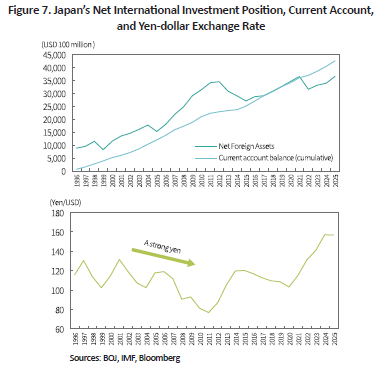
An examination of the composition of Japan’s current account surplus in recent years shows that interest and dividend income from overseas financial assets accounts for more than 80% of the total.3) This reflects Japan’s continued accumulation of foreign financial assets, which has helped it maintain a stable current account surplus that is relatively insulated from global economic fluctuations or trade disputes. Similarly, for South Korea, under structural conditions characterized by a current account surplus, low growth, and an aging population, the expansion of overseas investment is an inevitable trend. Attempts to artificially restrain this could, instead, hinder the establishment of a stable current account structure based on income balance, as seen in Japan.
Policy Challenges for Stabilizing the Exchange Rate and Foreign Exchange Supply and Demand
Taken together, the above discussion suggests that the recent expansion of Korea’s overseas securities investment has, to some extent, exerted upward pressure on the exchange rate. However, this is a natural outcome of the accumulation of current account surpluses and economic agents’ efforts to enhance investment returns. Accordingly, this trend should serve as a foundation for maintaining external soundness and generating stable national wealth. At this juncture, it is essential to harmonize two policy objectives: maximizing the benefits of overseas investment while minimizing instability in the foreign exchange market. To this end, the following policy directions appear desirable.
First, maintaining favorable foreign exchange supply and demand conditions is the most effective way to secure external soundness and achieve exchange rate stability. Therefore, it is necessary not only to sustain the current account surplus but also to strengthen incentives for foreign inflows into domestic securities investment. Greater efforts should be made to enhance foreign investors’ confidence in the domestic stock market, and in particular, tangible progress should be achieved soon toward the inclusion of Korea’s stock market in the MSCI Developed Markets Index. It is important to ensure that the recent sharp rise in stock prices can settle into a new equilibrium through foreign capital inflows, while simultaneously promoting stability in foreign exchange supply and demand and in the exchange rate.
Second, it should be recognized that overseas securities investment by domestic economic agents—driven by efforts to improve investment returns amid ample foreign currency liquidity—can serve as an opportunity to create national wealth and strengthen external soundness through an increase in external financial assets. In particular, under conditions of heightened global trade and tariff disputes and growing geopolitical uncertainty, achieving a stable current account surplus based on income balance is crucial for reinforcing the resilience of the external sector. However, overseas investors should strengthen their risk management efforts, including against foreign exchange risk, alongside their pursuit of higher returns. In particular, if the Korean won were to shift to an appreciating trend due to changes in monetary policy conditions in major economies, exchange rate losses could arise from overseas investments. Therefore, each economic agent needs to establish appropriate currency hedging strategies and other risk management measures suited to their circumstances.
Third, in the case of the National Pension Service (NPS), which as a single domestic institution accounts for the largest share of overseas securities investment, it is necessary to promptly devise measures to ease the burden on the foreign exchange market. This is because expanding overseas securities investment to enhance returns could place sustained upward pressure on the won-dollar exchange rate for a considerable period ahead. To this end, rather than raising the hedging ratio—which could impose additional strain on the domestic foreign exchange market—it would be desirable to actively consider having the NPS directly issue foreign currency–denominated bonds in global financial markets, leveraging its high creditworthiness, and using the proceeds as investment funds. By doing so, the NPS could secure funding without passing through the domestic foreign exchange market, thereby preemptively mitigating its impact on the won-dollar exchange rate while also contributing to improved investment performance.
Fourth, from a medium- to long-term perspective, it is of paramount importance to broaden and deepen the domestic foreign exchange market. The quantitative and qualitative development of the market is the most market-friendly approach to minimizing exchange rate volatility in response to external shocks or shifts in foreign exchange supply and demand. One fundamental reason why the recent expansion of overseas investment has acted as a source of exchange rate instability is that the trading volume and depth of Korea’s foreign exchange market remain insufficient to fully absorb such structural changes. Expanding the range of market participants would help diversify exchange rate expectations, mitigate one-sided herd behavior, and reduce volatility in response to the same external shock. In particular, given that net foreign exchange supply has recently contracted due to increased overseas securities investment, developing the foreign exchange market both quantitatively and qualitatively is a fundamental measure to ease market participants’ vague expectations of exchange rate appreciation and promote overall stability. In this regard, while monitoring the authorities’ plan to introduce a 24-hour foreign exchange market in the second half of this year, consideration should also be given to establishing a won spot foreign exchange market in major global financial centers. This would help absorb the offshore NDF market and provide an opportunity to accelerate the market’s quantitative and qualitative advancement.
1) Transactions in financial derivatives and banks’ lending and borrowing under the capital and financial accounts were excluded, as the impact of exchange rates on these items is unclear.
2) In the past, when Korea’s net external financial assets were small and the burden of external debt repayment was heavy, even when current account surpluses occurred, foreign currency liquidity was directly used to repay external debt rather than being invested in overseas securities, which likely limited the increase in foreign exchange demand and the upward pressure on the exchange rate in the domestic foreign exchange market.
3) In 2025, South Korea’s goods trade surplus surpasses its current account surplus, while the income balance accounts for only 23% of the current account surplus.
Won-dollar Exchange Rate and Foreign Exchange Supply and Demand Conditions
The Korean won (KRW) exchange rate against the U.S. dollar reversed its downward trend in the first half of 2025 and turned upward from the second half onward, closing the year at KRW 1,439.75 per dollar. Since the beginning of this year, the won-dollar rate has continued to fluctuate around KRW 1,450. The persistence of such a high exchange rate level, despite ample foreign exchange supply—including a sizable current account surplus driven by strong exports and net purchases of domestic equities by foreign investors—appears somewhat unusual even compared with the movements of major competitor currencies. A comparison of the movements of the Korean won and the U.S. dollar (Figure 1) shows that the divergence between the two currencies has been widening since around 2022. While the U.S. Dollar Index fell from 108.5 at end-2024 to 98.3 at end-2025, marking a year-on-year decline of 9.4% (indicating dollar weakness), the won-dollar exchange rate declined by only 2.2% on a year-end basis. Moreover, both the Nominal Effective Exchange Rate (NEER) and the Real Effective Exchange Rate (REER)—which reflect export competitiveness against major trading partners—indicate that the won depreciated by about 5%. This suggests that the won-dollar exchange rate is being significantly influenced not only by various international financial market factors but also by domestic factors such as foreign exchange supply and demand conditions.
As shown by the balance of payments identity [CA – KA = 0], a current account surplus (capital inflow) inevitably results ex post in a deficit in the capital and financial account (capital outflow). In other words, a current account surplus necessarily appears as an increase in external financial assets through overseas securities investment. As illustrated in <Figure 6>, since 2000, Korea’s cumulative current account surplus has moved in tandem with its net external financial assets, which amounted to USD 904.2 billion at the end of 2025. The current situation is fundamentally different from an exchange rate rise driven by a shortage of foreign currency liquidity; rather, it can be interpreted as a situation in which a considerable portion of the foreign currency liquidity generated by the current account surplus has flowed out in the form of overseas investment, thereby creating demand for foreign currency purchases and upward pressure on the exchange rate.2)
Policy Challenges for Stabilizing the Exchange Rate and Foreign Exchange Supply and Demand
Taken together, the above discussion suggests that the recent expansion of Korea’s overseas securities investment has, to some extent, exerted upward pressure on the exchange rate. However, this is a natural outcome of the accumulation of current account surpluses and economic agents’ efforts to enhance investment returns. Accordingly, this trend should serve as a foundation for maintaining external soundness and generating stable national wealth. At this juncture, it is essential to harmonize two policy objectives: maximizing the benefits of overseas investment while minimizing instability in the foreign exchange market. To this end, the following policy directions appear desirable.
First, maintaining favorable foreign exchange supply and demand conditions is the most effective way to secure external soundness and achieve exchange rate stability. Therefore, it is necessary not only to sustain the current account surplus but also to strengthen incentives for foreign inflows into domestic securities investment. Greater efforts should be made to enhance foreign investors’ confidence in the domestic stock market, and in particular, tangible progress should be achieved soon toward the inclusion of Korea’s stock market in the MSCI Developed Markets Index. It is important to ensure that the recent sharp rise in stock prices can settle into a new equilibrium through foreign capital inflows, while simultaneously promoting stability in foreign exchange supply and demand and in the exchange rate.
Second, it should be recognized that overseas securities investment by domestic economic agents—driven by efforts to improve investment returns amid ample foreign currency liquidity—can serve as an opportunity to create national wealth and strengthen external soundness through an increase in external financial assets. In particular, under conditions of heightened global trade and tariff disputes and growing geopolitical uncertainty, achieving a stable current account surplus based on income balance is crucial for reinforcing the resilience of the external sector. However, overseas investors should strengthen their risk management efforts, including against foreign exchange risk, alongside their pursuit of higher returns. In particular, if the Korean won were to shift to an appreciating trend due to changes in monetary policy conditions in major economies, exchange rate losses could arise from overseas investments. Therefore, each economic agent needs to establish appropriate currency hedging strategies and other risk management measures suited to their circumstances.
Third, in the case of the National Pension Service (NPS), which as a single domestic institution accounts for the largest share of overseas securities investment, it is necessary to promptly devise measures to ease the burden on the foreign exchange market. This is because expanding overseas securities investment to enhance returns could place sustained upward pressure on the won-dollar exchange rate for a considerable period ahead. To this end, rather than raising the hedging ratio—which could impose additional strain on the domestic foreign exchange market—it would be desirable to actively consider having the NPS directly issue foreign currency–denominated bonds in global financial markets, leveraging its high creditworthiness, and using the proceeds as investment funds. By doing so, the NPS could secure funding without passing through the domestic foreign exchange market, thereby preemptively mitigating its impact on the won-dollar exchange rate while also contributing to improved investment performance.
Fourth, from a medium- to long-term perspective, it is of paramount importance to broaden and deepen the domestic foreign exchange market. The quantitative and qualitative development of the market is the most market-friendly approach to minimizing exchange rate volatility in response to external shocks or shifts in foreign exchange supply and demand. One fundamental reason why the recent expansion of overseas investment has acted as a source of exchange rate instability is that the trading volume and depth of Korea’s foreign exchange market remain insufficient to fully absorb such structural changes. Expanding the range of market participants would help diversify exchange rate expectations, mitigate one-sided herd behavior, and reduce volatility in response to the same external shock. In particular, given that net foreign exchange supply has recently contracted due to increased overseas securities investment, developing the foreign exchange market both quantitatively and qualitatively is a fundamental measure to ease market participants’ vague expectations of exchange rate appreciation and promote overall stability. In this regard, while monitoring the authorities’ plan to introduce a 24-hour foreign exchange market in the second half of this year, consideration should also be given to establishing a won spot foreign exchange market in major global financial centers. This would help absorb the offshore NDF market and provide an opportunity to accelerate the market’s quantitative and qualitative advancement.
1) Transactions in financial derivatives and banks’ lending and borrowing under the capital and financial accounts were excluded, as the impact of exchange rates on these items is unclear.
2) In the past, when Korea’s net external financial assets were small and the burden of external debt repayment was heavy, even when current account surpluses occurred, foreign currency liquidity was directly used to repay external debt rather than being invested in overseas securities, which likely limited the increase in foreign exchange demand and the upward pressure on the exchange rate in the domestic foreign exchange market.
3) In 2025, South Korea’s goods trade surplus surpasses its current account surplus, while the income balance accounts for only 23% of the current account surplus.