Our bi-weekly Opinion provides you with latest updates and analysis on major capital market and financial investment industry issues.

Improving Retirement Pension Returns: The Role of Target Date Funds
Publication date Apr. 07, 2026

Summary
The low returns of retirement pensions are often attributed to the high reliance on principal-and-interest-guaranteed products. However, simply increasing the share of performance-based products is unlikely to resolve the issue. The fundamental problem lies not only in the allocation of risk assets, but also in the structure of investment decision-making itself. Under the current asset management framework, in which individuals are primarily responsible for investment decisions, it is difficult to consistently maintain a long-term asset allocation strategy.
In this context, Target Date Funds (TDFs)-which automatically adjust asset allocation over the life cycle-can serve as an important solution to address the limitations of an individual-centered investment structure. While some active participants are increasing their exposure to ETFs, TDFs, which provide an automated asset allocation framework, may be a more suitable option for less engaged participants.
The domestic TDF market has been growing rapidly, and its role within the retirement pension system is gradually expanding. To improve retirement pension returns, it is necessary to further promote the use of TDFs, including through enhancements to the default option framework.
As of the end of 2025, total retirement pension assets exceeded KRW 500 trillion.1) As retirement pension assets increase and the share of Defined Contribution (DC) plans and Individual Retirement Pension (IRP) accounts rises, interest in improving returns has intensified. Enhancing retirement pension returns has been a key policy issue since the system’s introduction. Participants in DC and IRP plans must manage their assets while directly bearing investment risk. With the rapid growth in both the number of participants and asset balances, improving returns has become an increasingly important challenge.
In contrast, under Defined Benefit (DB) plans, retirement benefits are determined based on wage growth, meaning that participants’ benefits are not directly affected by investment performance. However, if investment returns fall below wage growth, employers must make up the shortfall through additional contributions. Consequently, low returns in DB plans increase the financial burden on sponsoring firms and may, over time, constrain their capacity for wage growth. Considering these structural differences, improving retirement pension returns is an important policy issue not only for DC and IRP plans but also for DB plans.
Various measures are being explored to improve returns, including the broader introduction of fund-type retirement pension schemes. TDFs were introduced to ease the challenges participants face in managing their investments and have expanded further following the introduction of the default option framework. Regardless of whether fund-type pensions are introduced in the future, improving and expanding the current use of TDFs can play a significant role in enhancing returns. This paper examines trends and performance in the domestic TDF market and explores directions for sustainable growth.
Current Status of Retirement Pension Returns
As of the end of 2025, retirement pension assets totaled KRW 496.8 trillion, a 16.3% increase from KRW 427.2 trillion at the end of 2024.2) DC plan assets increased by 20.3%, from KRW 113.9 trillion at the end of 2024 to KRW 137.0 trillion at the end of 2025, while IRP assets rose by 33.2%, from KRW 98.2 trillion to KRW 130.9 trillion. In contrast, DB plan assets grew by only 6.7%, from KRW 214.6 trillion to KRW 228.9 trillion. Although most retirement pension assets are still invested in principal-guaranteed products, the share of performance-based products has been rising, particularly in DC and IRP plans. As of the end of 2025, KRW 373.6 trillion (75.2%) of total assets were invested in principal-guaranteed products, while KRW 123.2 trillion (24.8%) were invested in performance-based products.3) The share of performance-based products increased by 7.4 percentage points year-on-year.
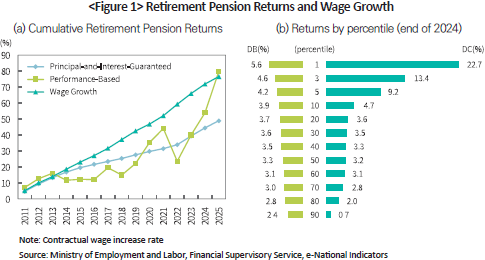
In 2024, returns on performance-based products exceeded the cumulative returns of principal-guaranteed products and also surpassed wage growth in 2025 (see Figure 1(a)). However, there were periods during which their returns fell below those of principal-guaranteed products. Looking at DC plan returns by percentile in 2024, the top 20% of participants achieved returns above the average wage growth rate (3.6%) (see Figure 1(b).4) Overall returns were relatively favorable, but many participants earned returns below wage growth. This disparity indicates substantial variation in returns across individuals within performance-based products. Returns in DB plans also exhibit variation, although to a lesser extent than in DC plans.
The most frequently cited cause of low retirement pension returns is the heavy reliance on principal-guaranteed products. A large portion of domestic retirement pension assets is invested in deposits or insurance products. While this structure provides short-term stability, it may lower expected returns given the long-term nature of retirement savings.
However, simply reducing the share of principal-guaranteed products and increasing exposure to performance-based investments does not fully resolve the issue. Returns on performance-based products have at times been limited, partly due to prolonged stagnation in domestic equity markets. Moreover, these products exhibit relatively high volatility, requiring considerable asset management expertise-something that is difficult to ensure in a system where individuals make investment decisions directly.
Under the current framework, participants often struggle to establish and consistently maintain long-term asset allocation strategies. Differences in financial literacy, information costs, and behavioral biases make it difficult for individuals to adhere to long-term investment principles.
Therefore, addressing the issue of low returns requires not only increasing exposure to risk assets but also improving the structure of investment decision-making itself. From this perspective, TDFs-which provide automatic, life-cycle-based asset allocation-are emerging as an important alternative.
While the introduction of fund-type retirement pension schemes is under consideration, it is expected that considerable time will be required for such systems to stabilize and become widely adopted. Accordingly, continuous improvement of the current asset management framework remains essential. In this regard, TDFs can play a meaningful role even within the existing contract-based pension system.
Status and Performance of the TDF Market
TDFs are investment products that automatically adjust asset allocation over the investor’s life cycle, making them well suited for long-term investment. Typically, they maintain a higher allocation to risk assets such as equities in the early stages and gradually shift toward safer assets such as bonds as retirement approaches. This structure allows for the automatic implementation of long-term asset allocation strategies. Compared to principal-guaranteed products, TDFs offer higher expected returns over the long term and help mitigate behavioral biases among individual investors through automated allocation.
These characteristics are particularly relevant in the domestic retirement pension market, where individuals are often responsible for asset allocation decisions. Not all participants are able to design and consistently manage long-term investment strategies. In such cases, TDFs provide an effective solution by reducing the burden of asset management while enabling disciplined, long-term allocation strategies.
Since their introduction in 2016, the domestic TDF market has grown steadily. As of the end of 2025, total subscriptions reached KRW 16.5 trillion, while net assets amounted to KRW 25.5 trillion. Although net assets declined by KRW 0.4 trillion in 2022 due to stock market downturns, they increased nearly fivefold, from KRW 5.2 trillion at the end of 2020 to KRW 25.5 trillion at the end of 2025.
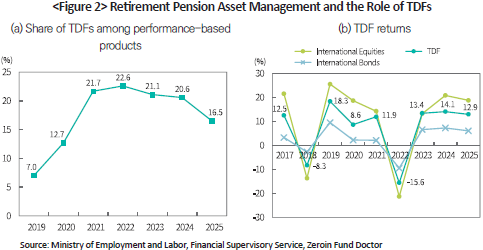
The share of TDFs among performance-based products rose to 22.6% in 2022 but declined to 21.1% in 2023, 20.6% in 2024, and 16.5% in 2025, partly reflecting the expansion of ETFs. Nevertheless, TDFs continue to play a significant role in retirement pension asset management (see Figure 2(a)). As of the end of 2025, KRW 20.3 trillion-equivalent to 16.5% of performance-based pension assets-was invested in TDFs. After a sharp decline in 2022, TDF returns have exceeded 10% since 2023, demonstrating their effectiveness as long-term investment products (see Figure 2(b)).
Recently, more active participants have been increasing their allocation to ETFs, reflecting the growing diversification of retirement pension investment approaches. However, as not all participants are able to independently design and manage asset allocation strategies, TDFs-with their automated structure-continue to serve as an important component of the system.
Policy Tasks for Expanding the Role of TDFs
To enhance the effectiveness of TDFs within the retirement pension system, continuous improvements are needed in the operation of the default option framework, product competitiveness, and the role of employers.
First, the use of TDFs should be expanded through improvements to the default option framework. This framework allows long-term asset allocation strategies to be applied even when participants do not make active investment decisions. TDFs are a representative product that provides life-cycle-based allocation within this framework. Rather than encouraging individuals to select default options themselves, it would be more effective for employers and pension providers to take the lead in selecting them, as participants often lack sufficient information to make appropriate choices.
Second, the competitiveness of TDF products should be strengthened. With the growing popularity of ETFs, cost competitiveness has become increasingly important. Measures to reduce costs-such as expanding directly managed funds or increasing ETF-based TDF offerings-should be considered.
Finally, the role of employers should be reinforced to improve the decision-making environment for participants. While the current system emphasizes individual responsibility, information asymmetry and limited financial literacy make it difficult for participants to make active investment decisions. Strengthening the institutional role of employers and pension providers-rather than placing full responsibility on individuals-would be a more practical and efficient approach. Expanding employer responsibility for default options and standard choices, along with appropriate liability protections and support mechanisms, would enable TDF-centered automated allocation structures to make a more meaningful contribution to improving retirement pension returns.
1) This figure combines KRW 496.8 trillion held by 42 retirement pension providers and KRW 4.5 trillion managed by the Korea Workers’ Compensation and Welfare Service as of the end of 2024 (Financial Supervisory Service Integrated Pension Portal, assets by provider).
2) This figure reflects assets held by 42 retirement pension providers and excludes those managed by the Korea Workers’ Compensation and Welfare Service. Assuming that its assets grew at the same rate as DC plans, its holdings are estimated to have reached KRW 5.5 trillion by the end of 2025 (Financial Supervisory Service Integrated Pension Portal).
3) By plan type, performance-based products accounted for 8.1% of DB assets (KRW 18.6 trillion out of 228.9 trillion), 34.0% of DC assets (KRW 46.5 trillion out of 137.0 trillion), and 44.4% of IRP assets (KRW 58.0 trillion out of 130.9 trillion).
4) Ministry of Employment and Labor and Financial Supervisory Service (2025)
In contrast, under Defined Benefit (DB) plans, retirement benefits are determined based on wage growth, meaning that participants’ benefits are not directly affected by investment performance. However, if investment returns fall below wage growth, employers must make up the shortfall through additional contributions. Consequently, low returns in DB plans increase the financial burden on sponsoring firms and may, over time, constrain their capacity for wage growth. Considering these structural differences, improving retirement pension returns is an important policy issue not only for DC and IRP plans but also for DB plans.
Various measures are being explored to improve returns, including the broader introduction of fund-type retirement pension schemes. TDFs were introduced to ease the challenges participants face in managing their investments and have expanded further following the introduction of the default option framework. Regardless of whether fund-type pensions are introduced in the future, improving and expanding the current use of TDFs can play a significant role in enhancing returns. This paper examines trends and performance in the domestic TDF market and explores directions for sustainable growth.
Current Status of Retirement Pension Returns
As of the end of 2025, retirement pension assets totaled KRW 496.8 trillion, a 16.3% increase from KRW 427.2 trillion at the end of 2024.2) DC plan assets increased by 20.3%, from KRW 113.9 trillion at the end of 2024 to KRW 137.0 trillion at the end of 2025, while IRP assets rose by 33.2%, from KRW 98.2 trillion to KRW 130.9 trillion. In contrast, DB plan assets grew by only 6.7%, from KRW 214.6 trillion to KRW 228.9 trillion. Although most retirement pension assets are still invested in principal-guaranteed products, the share of performance-based products has been rising, particularly in DC and IRP plans. As of the end of 2025, KRW 373.6 trillion (75.2%) of total assets were invested in principal-guaranteed products, while KRW 123.2 trillion (24.8%) were invested in performance-based products.3) The share of performance-based products increased by 7.4 percentage points year-on-year.
In 2024, returns on performance-based products exceeded the cumulative returns of principal-guaranteed products and also surpassed wage growth in 2025 (see Figure 1(a)). However, there were periods during which their returns fell below those of principal-guaranteed products. Looking at DC plan returns by percentile in 2024, the top 20% of participants achieved returns above the average wage growth rate (3.6%) (see Figure 1(b).4) Overall returns were relatively favorable, but many participants earned returns below wage growth. This disparity indicates substantial variation in returns across individuals within performance-based products. Returns in DB plans also exhibit variation, although to a lesser extent than in DC plans.
The most frequently cited cause of low retirement pension returns is the heavy reliance on principal-guaranteed products. A large portion of domestic retirement pension assets is invested in deposits or insurance products. While this structure provides short-term stability, it may lower expected returns given the long-term nature of retirement savings.
However, simply reducing the share of principal-guaranteed products and increasing exposure to performance-based investments does not fully resolve the issue. Returns on performance-based products have at times been limited, partly due to prolonged stagnation in domestic equity markets. Moreover, these products exhibit relatively high volatility, requiring considerable asset management expertise-something that is difficult to ensure in a system where individuals make investment decisions directly.
Under the current framework, participants often struggle to establish and consistently maintain long-term asset allocation strategies. Differences in financial literacy, information costs, and behavioral biases make it difficult for individuals to adhere to long-term investment principles.
Therefore, addressing the issue of low returns requires not only increasing exposure to risk assets but also improving the structure of investment decision-making itself. From this perspective, TDFs-which provide automatic, life-cycle-based asset allocation-are emerging as an important alternative.
While the introduction of fund-type retirement pension schemes is under consideration, it is expected that considerable time will be required for such systems to stabilize and become widely adopted. Accordingly, continuous improvement of the current asset management framework remains essential. In this regard, TDFs can play a meaningful role even within the existing contract-based pension system.
Status and Performance of the TDF Market
TDFs are investment products that automatically adjust asset allocation over the investor’s life cycle, making them well suited for long-term investment. Typically, they maintain a higher allocation to risk assets such as equities in the early stages and gradually shift toward safer assets such as bonds as retirement approaches. This structure allows for the automatic implementation of long-term asset allocation strategies. Compared to principal-guaranteed products, TDFs offer higher expected returns over the long term and help mitigate behavioral biases among individual investors through automated allocation.
These characteristics are particularly relevant in the domestic retirement pension market, where individuals are often responsible for asset allocation decisions. Not all participants are able to design and consistently manage long-term investment strategies. In such cases, TDFs provide an effective solution by reducing the burden of asset management while enabling disciplined, long-term allocation strategies.
Since their introduction in 2016, the domestic TDF market has grown steadily. As of the end of 2025, total subscriptions reached KRW 16.5 trillion, while net assets amounted to KRW 25.5 trillion. Although net assets declined by KRW 0.4 trillion in 2022 due to stock market downturns, they increased nearly fivefold, from KRW 5.2 trillion at the end of 2020 to KRW 25.5 trillion at the end of 2025.
The share of TDFs among performance-based products rose to 22.6% in 2022 but declined to 21.1% in 2023, 20.6% in 2024, and 16.5% in 2025, partly reflecting the expansion of ETFs. Nevertheless, TDFs continue to play a significant role in retirement pension asset management (see Figure 2(a)). As of the end of 2025, KRW 20.3 trillion-equivalent to 16.5% of performance-based pension assets-was invested in TDFs. After a sharp decline in 2022, TDF returns have exceeded 10% since 2023, demonstrating their effectiveness as long-term investment products (see Figure 2(b)).
Recently, more active participants have been increasing their allocation to ETFs, reflecting the growing diversification of retirement pension investment approaches. However, as not all participants are able to independently design and manage asset allocation strategies, TDFs-with their automated structure-continue to serve as an important component of the system.
Policy Tasks for Expanding the Role of TDFs
To enhance the effectiveness of TDFs within the retirement pension system, continuous improvements are needed in the operation of the default option framework, product competitiveness, and the role of employers.
First, the use of TDFs should be expanded through improvements to the default option framework. This framework allows long-term asset allocation strategies to be applied even when participants do not make active investment decisions. TDFs are a representative product that provides life-cycle-based allocation within this framework. Rather than encouraging individuals to select default options themselves, it would be more effective for employers and pension providers to take the lead in selecting them, as participants often lack sufficient information to make appropriate choices.
Second, the competitiveness of TDF products should be strengthened. With the growing popularity of ETFs, cost competitiveness has become increasingly important. Measures to reduce costs-such as expanding directly managed funds or increasing ETF-based TDF offerings-should be considered.
Finally, the role of employers should be reinforced to improve the decision-making environment for participants. While the current system emphasizes individual responsibility, information asymmetry and limited financial literacy make it difficult for participants to make active investment decisions. Strengthening the institutional role of employers and pension providers-rather than placing full responsibility on individuals-would be a more practical and efficient approach. Expanding employer responsibility for default options and standard choices, along with appropriate liability protections and support mechanisms, would enable TDF-centered automated allocation structures to make a more meaningful contribution to improving retirement pension returns.
1) This figure combines KRW 496.8 trillion held by 42 retirement pension providers and KRW 4.5 trillion managed by the Korea Workers’ Compensation and Welfare Service as of the end of 2024 (Financial Supervisory Service Integrated Pension Portal, assets by provider).
2) This figure reflects assets held by 42 retirement pension providers and excludes those managed by the Korea Workers’ Compensation and Welfare Service. Assuming that its assets grew at the same rate as DC plans, its holdings are estimated to have reached KRW 5.5 trillion by the end of 2025 (Financial Supervisory Service Integrated Pension Portal).
3) By plan type, performance-based products accounted for 8.1% of DB assets (KRW 18.6 trillion out of 228.9 trillion), 34.0% of DC assets (KRW 46.5 trillion out of 137.0 trillion), and 44.4% of IRP assets (KRW 58.0 trillion out of 130.9 trillion).
4) Ministry of Employment and Labor and Financial Supervisory Service (2025)