Our bi-weekly Opinion provides you with latest updates and analysis on major capital market and financial investment industry issues.
Publication date Apr. 21, 2026

Given that private credit investment vehicles frequently rely on external funding sources, including bank borrowing, the private credit market exhibits linkages with the broader financial system. However, the leverage of private credit investment vehicles does not appear to be excessively high, and banks’ exposures to the private credit market are generally structured as senior secured loans. These factors suggest that the likelihood of risks in the private credit market transmitting to the financial system as a whole remains limited. Nevertheless, changes in market conditions—such as a prolonged high interest rate environment, persistent redemption pressures, or a slowdown in capital inflows into the private credit market—could amplify risks in the private credit market. Accordingly, continued monitoring of developments in the private credit market remains warranted.
Overview of the Private Credit Market: Structure and Key Characteristics
Private credit refers to loans provided directly to corporations by non-bank financial institutions and operates in a structurally different manner from traditional bank lending, which is a conventional source of corporate financing. In the private credit market, capital raised from investors is pooled into funds that directly provide loans to companies. Investment vehicles such as private credit funds or Business Development Companies1) (BDCs) are generally responsible for originating and managing these loans. Within this framework, investors, fund managers, and borrowing firms are linked through the fund structure. Fund managers use investor capital to provide loans to companies and distribute returns to investors from the interest and principal repayments generated by those loans. This structure differs from traditional bank lending in that credit is provided through a capital market-based investment structure rather than through deposit-based lending.
A defining feature of private credit is the ability to set loan terms flexibly through direct negotiations between borrowers and lenders, allowing financing to be provided more quickly. By contrast, financing through bank loans or public bond issuance typically requires compliance with strict underwriting procedures and regulatory requirements, which often results in a longer funding process. Private credit, however, operates under a less restrictive regulatory framework, enabling loan terms—such as collateral arrangements, maturity structures, and repayment schedules—to be tailored to the borrower’s financial condition and business characteristics. As a result, funding can generally be executed more rapidly. Survey evidence from private credit fund managers indicates that firms using private credit place significant value on flexible lending terms.2) It also suggests that many of these firms face difficulties obtaining financing from banks, often due to a lack of sufficient tangible assets that can be pledged as collateral.
Private credit can be categorized into several strategies—such as direct lending, mezzanine, and distressed debt—depending on the underlying investment approach, with each strategy characterized by distinct risk-return profiles and financing structures. Among these strategies, direct lending accounts for the largest share of the private credit market and typically involves providing senior secured loans to companies with relatively stable cash flows. Mezzanine financing is a form of capital that ranks below senior debt but above equity in the capital structure and generally entails higher risk in return for higher expected returns.3) Distressed debt investing is a strategy that typically seeks to generate returns by acquiring the debt of financially troubled companies at discounted prices or by participating in corporate restructuring processes.
Private credit typically provides financing to middle-market firms.4) In recent years, however, large companies with investment-grade credit ratings have also turned to private credit to support large-scale financing needs, including acquisition financing and major projects such as data center development. The average maturity of private credit loans is approximately five years, and most are structured with floating interest rates.5)
Private credit is generally classified as an illiquid asset, reflecting structural features that make it difficult for an active secondary market to develop. Because private credit consists of customized corporate loans structured through individual negotiations, the terms of each loan can vary significantly, resulting in a low degree of standardization. In addition, borrowers are often companies that are not publicly listed and are therefore not subject to public disclosure requirements, which contributes to a high degree of information asymmetry. These characteristics have led the private credit market to be widely viewed as relatively opaque, with limited price discovery and valuations that often rely on internal models. Given the constraints on secondary market trading, it is common for investment vehicles that originate these loans to hold them until maturity.
This illiquidity creates a need to restrict investor redemptions in the private credit market. As a result, private credit funds and BDCs commonly adopt a closed-end structure that restricts redemptions. Such a structure enables managers to manage loan portfolios in a stable manner while also encouraging investors to take a longer-term investment perspective.
Current Developments in the Private Credit Market
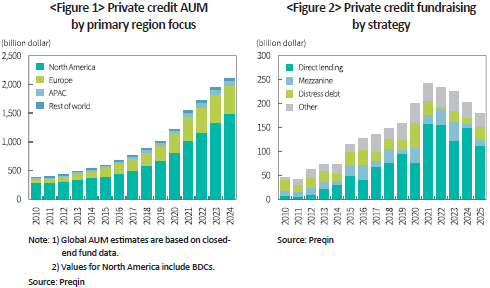
Private credit has emerged as a leading segment of non-bank credit intermediation and has grown rapidly in recent years. Assets under management (AUM) in private credit amounted to approximately $380 billion at the end of 2010 but expanded to about $2.1 trillion by the end of 2024, recording a strong compound annual growth rate of 13.0% (Figure 1). The market, however, remains concentrated in the U.S. and Europe, with relatively limited geographic diversification. In addition, a breakdown of private credit fundraising by strategy shows that direct lending accounts for the largest share, underscoring its role as the core segment of the private credit market (Figure 2).
The rapid expansion of the private credit market is generally attributed to a combination of factors, including the prolonged low interest rate environment, reduced bank lending associated with higher regulatory requirements, and improved funding conditions for non-bank financial institutions.6) Following the global financial crisis, policy rates in major economies such as the U.S. remained at historically low levels for an extended period, leading to increased demand for alternative investment assets offering relatively higher returns. At the same time, higher capital and prudential requirements in the banking sector contributed to constraints on lending, particularly to firms with limited collateral capacity. In this environment, the narrowing gap in funding costs between private credit vehicles and banks supported the rapid growth of the private credit market as an important financing channel for firms facing difficulties in obtaining bank financing.
The investor base of the private credit market has traditionally been centered on institutional investors with long-term investment horizons, such as pension funds, insurance companies, and sovereign wealth funds. This is largely because private credit is typically structured as a closed-end vehicle with limited redemption during the investment period, making it relatively well suited to investors with low liquidity needs and a long-term investment perspective. In addition, private credit is generally considered to offer yields approximately 150 to 300 basis points higher than those of broadly syndicated loans7) due to its inherently illiquid nature. This illiquidity premium has been an important factor driving increased institutional investment in the private credit market.
In recent years, efforts to expand the investor base of the private credit market have led to a growing participation of retail investors. In the past, access to private credit was limited due to high minimum investment requirements and low liquidity. However, the introduction of semi-liquid products that permit redemptions within specified limits has enabled a rapid increase in retail participation.8) The share of retail investors in the private credit market is estimated to have risen from around 1% of assets under management (AUM) in the mid-2010s to approximately 13% in recent years.9) Retail investors primarily participate in the private credit market through BDCs, with most investments made via publicly traded BDCs listed on stock exchanges or non-traded public BDCs operating under semi-liquid structures.10) While these developments have contributed to broadening the investor base of the private credit market, the combination of illiquid underlying assets and semi-liquid investment structures that provide limited liquidity may also give rise to new sources of risk.
Recent Risk Factors in the Private Credit Market
A closer look at the recent rise in concerns surrounding the private credit market suggests that a few default events in the U.S. credit market have served as a trigger for heightened investor concerns about credit risk in private credit. In September 2025, the auto parts manufacturer First Brands and the auto finance company Tricolor each filed for bankruptcy, revealing that substantial levels of debt could accumulate without sufficient oversight by market participants. Notably, these cases uncovered instances of misconduct, including double pledging—where the same asset was pledged as collateral to multiple lenders—highlighting weaknesses in collateral management and information verification frameworks, thereby contributing to increased investor caution.11)
First Brands and Tricolor did not rely primarily on private credit as their main source of financing, and losses were incurred across a range of lenders, including large banks. In light of these circumstances, it would be difficult to generalize these cases as evidence of structural weakness across the private credit market as a whole. Nevertheless, these events are widely viewed as having raised concerns about the effectiveness of credit risk management practices across the private credit ecosystem and as having influenced investor sentiment. Private credit transactions are typically privately negotiated, with loan terms tailored to individual borrowers. As a result, independent external verification and oversight of collateral assets tend to be more limited than in more standardized lending markets, reflecting structural features that may make it more difficult to detect misconduct—such as double pledging—at an early stage. In particular, as the scale of the private credit market has expanded significantly, repeated weaknesses in risk management and oversight frameworks could increase the impact of individual credit events on overall market confidence, drawing heightened attention from policymakers and investors.
Another factor contributing to heightened caution in the private credit market is the growing concern about potential deterioration in loans to software companies amid the rapid advancement of AI. Software firms had emerged as key borrowers in the private credit market, supported by the perception that their recurring revenue models and high customer retention rates enabled them to generate stable cash flows. However, as awareness has grown that advances in AI could erode the business models and revenue bases of existing software companies, a reassessment of credit risk in the sector is now underway.
As of end-2025, the outstanding balance of direct lending to Software-as-a-Service (SaaS) companies in the private credit market exceeded USD 500 billion, accounting for approximately 19% of total direct lending.12) The software sector, in particular, tends to have fewer tangible assets that can be used as collateral compared with other industries, which may result in higher loss rates in the event of borrower distress. Given these characteristics, if advances in AI were to lead to a deterioration in the credit quality of software companies, the resulting impact could be viewed as a potential risk factor affecting the overall stability of the private credit market.
As these concerns have weighed on investor sentiment toward private credit, redemption requests have surged, particularly in semi-liquid investment vehicles that have seen significant growth in retail participation. Reflecting the inherently illiquid nature of private credit, these semi-liquid products typically set a redemption cap of around 5% of net asset value (NAV) per quarter, and redemption gates may be imposed when redemption requests exceed this limit.13) Amid heightened concerns about the private credit market, recent cases have emerged in which redemption requests at some private credit funds and non-traded public BDCs exceeded their redemption limits, leading to the imposition of redemption gates. The concentration of redemption requests in products with a high share of retail investors has highlighted liquidity mismatch risks arising from the gap between the illiquid nature of underlying assets and investors’ demand for liquidity.14) At the same time, these developments suggest that recent changes in the investor base may have an increasingly important influence on overall market stability.
Redemption gates are, in principle, a standard liquidity management measure taken by fund managers within the agreed redemption limits and can be viewed as an effective tool for alleviating short-term liquidity pressures.15) However, if investor concerns spread over the possibility of not being able to withdraw funds at the desired time, this could lead to additional redemption pressure. Furthermore, if fund managers respond to rising redemption pressure by selling higher-quality loan assets first to secure liquidity, this may result in a deterioration in overall portfolio quality as relatively weaker assets come to represent a larger share of the portfolio.
Meanwhile, even publicly traded BDCs listed on stock exchanges have recently been observed trading at significant discounts to their NAV amid heightened concerns about the private credit market.16) This development suggests a deterioration in investor sentiment, as investors have grown less confident in the valuation of private credit assets based on internal valuation models.
Assessment of the Potential for Risk Transmission
As concerns about the stability of the private credit market have intensified, attention has increasingly turned to the possibility that such risks could extend beyond the market itself and affect the broader financial system. In practice, private credit funds and BDCs often rely on external financing, including bank borrowings, while banks serve as key funding providers by extending credit lines to private credit managers. This indicates that the private credit market is connected to the broader financial system to a certain degree, particularly through funding and liquidity channels.
However, the potential for risk transmission to the broader financial system appears limited, given that leverage among private credit investment vehicles is generally not excessive and banks’ exposures to the private credit market are largely structured as senior secured lending. Recent analysis17) based on confidential regulatory data suggests that, while private credit funds do use borrowing, they do not appear to rely heavily on excessive leverage.18) In addition, banks’ exposures to private credit remain relatively contained19), and most lending to private credit vehicles is provided on a senior secured basis, suggesting that losses to the banking sector are unlikely unless economic conditions deteriorate significantly, such as in the event of a severe recession.20) Federal Reserve Chair Jerome Powell has also noted that, although some losses may occur in the private credit market, these developments do not currently appear to pose a broader systemic risk.21)
However, given that related risks could increase depending on future economic conditions, continued monitoring of the private credit market remains warranted. Recently, escalating geopolitical tensions in the Middle East have significantly heightened economic uncertainty, and if rising commodity prices lead to stronger inflationary pressures, high interest rates could persist longer than expected. This could increase debt servicing burdens for private credit borrowers, most of whom operate under floating-rate structures, thereby weakening their repayment capacity and raising the likelihood of defaults. In addition, as the private credit market is a relatively new asset class that has expanded rapidly in recent years, it is also important to recognize that sufficient experience across a full credit cycle has yet to be accumulated.
Looking ahead, as redemption pressures in the private credit market may persist for some time, it is important to remain attentive to the associated risks. A slowdown in capital inflows resulting from weakened investor sentiment toward the private credit market could lead to tighter borrowing conditions for firms that have relied on private credit as a key source of financing. In such circumstances, defaults may increase, particularly among firms facing greater difficulty in securing funding, underscoring the need for continued close monitoring of the private credit market.
1) Although a BDC is legally classified as an investment company, it can be understood as an investment vehicle that functions similarly to a fund from an economic perspective.
2) Block, J., Jang, Y. S., Kaplan, S. N, Schulze A., 2024, A survey of private debt funds, Review of Corporate Finance Studies, 13(2), 335-383.
3) Mezzanine financing is commonly used in merger and acquisition transactions or in raising growth capital, and it is often structured to include equity-linked features such as conversion rights or warrants.
4) In the U.S., firms with annual revenues ranging from approximately $10 million to $1 billion are generally classified as middle-market firms.
5) Cai, F., Haque, S., 2024, Private credit: Characteristics and risks, FEDS Notes.
6) Avalos, F., Doerr, S., Pinter, G., 2025, The global drivers of private credit, BIS Quarterly Review (March).
7) Broadly syndicated loans refer to corporate loans jointly underwritten by multiple financial institutions. Given their relatively standardized contractual structures, these loans tend to be supported by more active secondary markets.
8) Unlike traditional closed-end funds, investment vehicles with semi-liquid structures permit redemptions within defined limits at periodic intervals.
9) Aldasoro, I., Doerr, S., Todorov, K., 2025, Retail investors in private credit, BIS Bulletin No 106.
10) BDCs can be classified into publicly traded BDCs and non-traded BDCs depending on their structure, with non-traded BDCs further divided into non-traded public BDCs and privately offered BDCs.
11) There are also concerns that underwriting standards may have loosened amid intensifying competition and expanding credit supply in the private credit market.
12) For a more detailed discussion of the rapid expansion of private credit lending to Software-as-a-Service (SaaS) companies and the potential credit risks associated with advances in AI technology, see BIS (March 2026), Box B: “Private credit’s software lending meets AI disruption,” Quarterly Review.
13) When a redemption gate is imposed, redemptions are processed on a pro rata basis within the applicable redemption limit.
14) Bloomberg, 2026. 3. 26, Trapped in private credit, investors wait to pull out $5 billion.
15) Redemption restrictions in semi-liquid products are implemented in accordance with contractual terms agreed upon in advance with investors. However, there are also concerns that investors—particularly retail investors—may not have fully understood the nature of semi-liquid structures.
16) Financial Times, 2026. 3. 3, Investors ditch private credit funds on rising worries over bad loans.
17) Berg, T., Lee, J. H., 2026, Measuring Counterparty Exposures to Private Credit, OFR Brief Series 26-02.
18) As of end-2024, a fund-level analysis of private credit funds shows that the leverage ratio (= total assets ÷ net assets) stood at 1.00, 1.04, and 1.36 at the 25th, 50th (median), and 75th percentiles, respectively. However, the leverage ratio at the 95th percentile reached 3.58, indicating the presence of a small group of funds with relatively high leverage.
19) Exposure to private credit among banks subject to Federal Reserve stress testing has been estimated to account for less than 5% of total corporate lending (Berg & Lee, 2026).
20) Fillat, J. L., Landoni, M., Levin, J. D., Wang, J. C., 2025, Could the growth of private credit pose a risk to financial system stability?. Federal Reserve Bank of Boston Current Policy Perspectives Paper 25-8.
21) Reuters, 2026. 3. 31, Fed watching private credit sector for signs of trouble, Powell says.