Our bi-weekly Opinion provides you with latest updates and analysis on major capital market and financial investment industry issues.

Earnings Guidance in Korea: Institutional Constraints, Market Incentives, and Policy Directions
Publication date May. 06, 2026

Summary
Corporate managers voluntarily provide investors with forward-looking information regarding their firm’s future performance through earnings guidance. Earnings guidance enhances the efficiency of capital market by alleviating information asymmetry, improving price discovery, and reducing the cost of capital. In Korea, the introduction of the fair disclosure regime in 2002 established the institutional foundation for such disclosure; however, subsequent regulatory changes under the Capital Markets Act and exchange disclosure rules have weakened firms’ incentives for voluntary disclosure, and the frequency of earnings guidance has decreased significantly. To promote earnings guidance, it is important to enhance the institutional environment by clarifying safe harbor provisions, refining the scope and predictability of sanctions related to corrective disclosures, and diversifying permissible disclosure formats. At the same time, expanding stock price-linked components in executive compensation and strengthening institutional investors’ demand for information can further reinforce firms’ incentives. Taken together, these institutional and market mechanisms can strengthen incentives for voluntary earnings guidance, thereby improving the overall information environment in the capital market. This, in turn, can enhance investors’ access to information and improve the predictability and credibility of the market.
Earnings guidance refers to a voluntary disclosure practice in which a firm proactively provides investors with forward-looking information regarding its anticipated future operating performance. Because information about a firm’s future performance directly affects stock prices and investor decision-making, such disclosures have a significant impact on the informational efficiency and fairness of capital markets. In Korea, the fair disclosure regime established the institutional foundation for earnings guidance in 2002. Fair disclosure was adopted to prevent the selective disclosure of material corporate information to specific groups of investors—such as institutional investors or analysts—and to reduce information asymmetry. Under this framework, material forward-looking information regarding future operating performance should be disclosed to the market as a whole on a simultaneous basis.
Overview of the Earnings Guidance System
Under the current regulatory framework, earnings guidance encompasses forecast information on key financial performance indicators expected within the next three years, including sales revenue, operating income, income from continuing operations before income tax expense, and net income. Because forward-looking information is inherently subject to uncertainty, firms are required to disclose the basis of their estimates, underlying assumptions, and associated risks alongside the projected figures.
Following disclosure, firms are expected to review the likelihood of achieving these forecasts on a quarterly basis. If actual performance deviates from the projections, failure to provide a timely corrective disclosure may result in sanctions imposed by the exchange. These institutional requirements are intended to enhance the reliability of disclosed information and to strengthen investor protection.
Meanwhile, if actual performance deviates significantly from forecasts, management may bear legal responsibility, which is determined by comprehensively assessing the reasonableness of the information available at the time of the guidance disclosure and the adequacy of subsequent actions. Where management provides forward-looking information based on reasonable grounds—i.e., in the absence of willful misrepresentation—legal liability may be limited even if actual results differ from the projections.
For such safe harbor protections to apply, firms should clearly identify the disclosed figures as forward-looking information, disclose the underlying assumptions and bases for judgment, and include cautionary language indicating that the information was prepared in good faith based on reasonable assumptions and that actual results may differ. Nonetheless, satisfying these requirements does not in itself guarantee protection from liability.
Regulators may still conduct an ex post review of the validity of the assumptions and information at the time of disclosure, the nature of subsequent changes in circumstances, and the adequacy of risk disclosure. Furthermore, if the likelihood of achieving the projected figures declines significantly, whether a timely corrective disclosure was made to the market may also affect management’s legal liability.
Administrative sanctions for violations of earnings guidance are imposed through the Korea Exchange’s designation system for unfaithful disclosure corporations. Firms may be subject to sanctions if they disclose guidance inaccurately or omit material information. In this context, management is likely to take potential post-disclosure legal liability into account, which may influence decisions regarding voluntary earnings guidance.
The earnings guidance system in Korea has evolved through a series of institutional changes since the late 2000s. The enforcement of the Financial Investment Services and Capital Markets Act (the Capital Markets Act) in 2009 reorganized and expanded the legal liability framework governing disclosures. These changes may have influenced firms’ perceptions of forward-looking disclosures, which inherently involve uncertainty.
Subsequently, the adoption of International Financial Reporting Standards (IFRS) in 2011 further transformed the framework for financial reporting. Around this period, a decline in the frequency of earnings guidance is observed. The increased practical burden and heightened forecasting uncertainty associated with the transition in accounting standards may have contributed to a reduction in firms’ provision of forward-looking information.
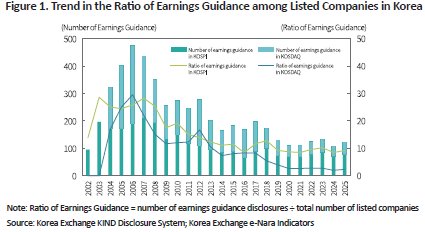
Against this backdrop, the number of firms providing earnings guidance has exhibited a clear downward trend. As of 2025, there were 78 such disclosures in the KOSPI market and 45 in the KOSDAQ market. This represents declines of more than 58% and 84%, respectively, from 189 cases in the KOSPI market and 285 cases in the KOSDAQ market in 2006. Given that the number of listed firms has increased over the past two decades, the decline is even more pronounced on a proportional basis (Figure 1).
The Effects of Earnings Guidance: Benefits and Considerations
Earnings guidance has generated a substantial body of literature as a mechanism for improving the information environment in capital markets. When managers voluntarily provide forecasts of future performance, information asymmetry between insiders and external investors is reduced, leading to improved market liquidity.1) As expectations are formed in advance, the price discovery process is enhanced,2) and both earnings surprises and stock price volatility around earnings announcements are mitigated.3) In addition, reduced uncertainty regarding future performance can lower firms’ cost of capital.4) There is also evidence that management earnings guidance reduces analyst forecast errors, thereby improving the overall quality of market-wide information.5) Collectively, these improvements in the information environment can enhance market perceptions of the transparency and credibility of firms’ disclosure practices.
However, earnings guidance may also give rise to potential adverse effects. As pressure to meet short-term earnings targets intensifies, managers may have stronger incentives to prioritize short-term performance over long-term investment or to engage in earnings management.6) Moreover, the possibility of strategic disclosure behavior—such as issuing overly optimistic forecasts or selectively disclosing favorable information—cannot be ruled out. Accordingly, any initiative to promote earnings guidance should be accompanied by institutional safeguards designed to mitigate the associated risks.
Comparative Analysis with Regulatory Frameworks in the United States and Japan
In the United States, earnings guidance has become a pervasive market practice since the implementation of Regulation Fair Disclosure (Reg FD) in 2000. Based on quantitative forms of guidance, approximately 40% of listed firms provide earnings forecasts on a regular basis,7) while survey evidence indicates that more than 80% of responding firms disclose forward-looking information, including outlooks or performance targets.8) Many U.S. firms also appear to provide forward-looking information proactively—including negative outlooks—through various disclosure channels such as Form 8-K filings, quarterly earnings releases, and earnings calls.
The Safe Harbor provisions of the Private Securities Litigation Reform Act (PSLRA) provide an important institutional backdrop. If a firm meets certain requirements—such as clearly identifying the information as forward-looking and disclosing sufficiently specific, company-level risk factors—the legal liability of managers for such disclosures may be limited, thereby influencing firms’ disclosure incentives.
In the United States, securities class action lawsuits are frequently filed following stock price drops, and forward-looking statements are often central to such litigation. Within this context, the Safe Harbor provisions function as a mechanism that limits managerial liability for forward-looking information when specified conditions are satisfied.
This institutional background shapes how firms perceive the legal and regulatory risks associated with earnings guidance. In the United States, the PSLRA safe harbor provisions limit legal liability for forward-looking information when specified conditions are met, thereby providing firms with an ex ante framework to manage litigation risk.
In Korea, by contrast, securities class actions are relatively limited in scope, and administrative regulation serves as the primary enforcement mechanism. Within this framework, even when firms include cautionary language identifying disclosures as forward-looking, the reasonableness of the disclosed content—such as the basis of the forecast or the appropriateness of estimation methods—may still be subject to ex post review. As a result, such cautionary statements do not function as a uniform exemption from administrative sanctions. These institutional differences help explain how firms perceive and utilize earnings guidance.
Beyond legal and institutional differences, executive compensation structures and corporate governance are also important factors influencing the use of earnings guidance. In the United States, stock price-linked compensation—such as stock options and restricted stock—is relatively prevalent. Accordingly, top management has stronger incentives to proactively manage market expectations and engage more actively in investor communications. In this context, forward-looking disclosures can serve as a tool to reconcile differences with analyst consensus and to shape market expectations.
In Korea, by contrast, performance-based compensation with stock price-linked components is relatively uncommon, and compensation structures comprising fixed salaries and short-term cash incentives continue to represent a substantial share of total remuneration. Moreover, when controlling shareholders and related parties hold substantial ownership stakes, individual executives may be less directly exposed to share price fluctuations, while concerns such as equity dilution and the preservation of managerial control may weigh more heavily on disclosure strategies. Collectively, these factors may reduce firms’ incentives to engage in proactive market communication through forward-looking earnings guidance.
In sum, the use of earnings guidance in Korea is shaped not only by the institutional environment but also by executive compensation structures and corporate governance. More meaningful changes in disclosure practices are likely to require improvements in these complementary factors.
Japan provides a useful reference case for earnings guidance. Unlike the United States, Japan does not have an explicit Safe Harbor provision, and civil and criminal liability for false statements exists under the Financial Instruments and Exchange Act. Nevertheless, earnings guidance is widely used in practice.
The Tokyo Stock Exchange (TSE) requires listed companies to disclose annual forecasts for key financial items, and the majority of firms listed on the Prime Market provide such forecasts. This disclosure practice is driven by a combination of exchange rules and market forces. The exchange’s comply-or-explain approach encourages corporate participation in disclosure, while additional market pressure has emerged following the introduction of the Stewardship Code in 2014 and the Corporate Governance Code in 2015, both of which strengthened institutional investors’ demand for forward-looking information.
In addition, Japanese firms relatively frequently revise their forecasts when actual results are expected to deviate significantly from prior projections, and this practice appears to be supported by market acceptance of such revisions.
Overall, even in the absence of an explicit Safe Harbor provision, earnings guidance is widely used in Japan within an environment shaped by the interaction of exchange rules and market practices. This experience may offer useful implications for promoting earnings guidance in Korea.
Future Challenges and Directions for Improvement
To promote earnings guidance, it is important to establish an environment that reduces the legal uncertainty firms face when deciding whether to provide such disclosures. Under the current framework, firms often find it difficult to assess in advance the extent of potential sanctions if actual results deviate from forecasts, and this uncertainty may discourage voluntary disclosure.
Accordingly, measures to clarify exemption criteria can be considered. Establishing ex ante standards under which managerial liability may be limited—when firms adequately disclose reasonable assumptions and key sources of uncertainty (e.g., firm-specific risks, external variables, and ongoing risk factors)—could enhance the predictability of firms’ disclosure decisions. This effect could be further strengthened by providing detailed guidelines that reflect industry-specific volatility, key exogenous factors, and the broader policy environment.
Refining the criteria for corrective disclosures can also be considered. While the current system appropriately prioritizes investor protection, clearer standards distinguishing between routine earnings shortfalls and fundamental changes in underlying assumptions could help reduce firms’ disclosure-related burdens.
For example, establishing criteria that differentiate forecast errors driven by exogenous factors—such as sharp exchange rate fluctuations, unexpected increases in raw material prices, or changes in the regulatory environment—from those arising from internal performance changes could help alleviate uncertainty in disclosure decisions.
Diversifying disclosure formats is another avenue for improvement. In addition to point estimates under the current system, allowing range-based or scenario-based disclosures would enable firms to communicate forward-looking information more flexibly. For example, presenting forecasts under optimistic, base-case, and pessimistic scenarios, or disclosing sensitivity analyses with respect to key assumptions, can provide investors with more multidimensional information in uncertain environments while reducing the burden on firms of committing to a single point estimate. Such flexible formats may be particularly well suited to industries characterized by high volatility or significant exposure to external conditions.
However, such institutional developments should be accompanied by effective safeguards against false or exaggerated disclosures. It is important to clearly distinguish between errors arising from a diligent forecasting process and intentional misrepresentation or omission of material information, and to ensure that a robust accountability framework operates effectively for the latter. Maintaining the reliability of the disclosure environment is essential; as voluntary disclosures increase, the need to ensure the quality and credibility of information in the market becomes even more important.
Beyond institutional improvements, attention should also be given to executive compensation structures and the role of market participants. When the linkage between compensation and stock price is weak, incentives for voluntary disclosure may be limited; accordingly, strengthening stock price-linked components in compensation can enhance incentives for earnings guidance. This is important in that it provides a structural basis for firms to adopt more market-oriented disclosure practices.
In addition, when institutional investors place greater emphasis on firms’ forward-looking disclosures, firms may respond by increasing the provision of such information, which in turn can be reflected in more favorable market evaluations of those firms.
If these discussions advance, voluntary disclosure of reliable forward-looking information may become more prevalent, strengthening the efficiency and transparency of capital markets. This, in turn, can improve information accessibility for individual investors and minority shareholders, while also strengthening the predictability and credibility of the Korean capital market for global investors.
1) Coller, M., & Yohn, T. L. (1997). Management forecasts and information asymmetry: An examination of bid-ask spreads. Journal of Accounting Research, 35(2), 181-191.
2) Choi, J. H., Myers, L. A., Zang, Y., & Ziebart, D. A. (2011). Do management EPS forecasts allow returns to reflect future earnings? Implications for the continuation of management’s quarterly earnings guidance. Review of Accounting Studies, 16(1), 143-182.
3) Kasznik, R., & Lev, B. (1995). To warn or not to warn: Management disclosures in the face of an earnings surprise. The Accounting Review, 113-134.
4) Baginski, S. P., & Rakow Jr, K. C. (2012). Management earnings forecast disclosure policy and the cost of equity capital. Review of Accounting Studies, 17(2), 279-321.
5) Kross, W. J., Ro, B. T., & Suk, I. (2011). Consistency in meeting or beating earnings expectations and management earnings forecasts. Journal of Accounting and Economics, 51(1-2), 37-57.
6) Graham, J. R., Harvey, C. R., & Rajgopal, S. (2005). The economic implications of corporate financial reporting. Journal of Accounting and Economics, 40(1-3), 3-73.
7) Dechow, P., Ge, W., Loh, W. T., & McVay, S. E. (2025). Beyond Earnings Quality: Evaluating the Quality of Voluntary Corporate Financial Reporting Practices. Working Paper.
8) Call, A. C., Hribar, P., Skinner, D. J., & Volant, D. (2024). Corporate managers’ perspectives on forward-looking guidance: Survey evidence. Journal of Accounting and Economics, 78(2-3), 101731.
Overview of the Earnings Guidance System
Under the current regulatory framework, earnings guidance encompasses forecast information on key financial performance indicators expected within the next three years, including sales revenue, operating income, income from continuing operations before income tax expense, and net income. Because forward-looking information is inherently subject to uncertainty, firms are required to disclose the basis of their estimates, underlying assumptions, and associated risks alongside the projected figures.
Following disclosure, firms are expected to review the likelihood of achieving these forecasts on a quarterly basis. If actual performance deviates from the projections, failure to provide a timely corrective disclosure may result in sanctions imposed by the exchange. These institutional requirements are intended to enhance the reliability of disclosed information and to strengthen investor protection.
Meanwhile, if actual performance deviates significantly from forecasts, management may bear legal responsibility, which is determined by comprehensively assessing the reasonableness of the information available at the time of the guidance disclosure and the adequacy of subsequent actions. Where management provides forward-looking information based on reasonable grounds—i.e., in the absence of willful misrepresentation—legal liability may be limited even if actual results differ from the projections.
For such safe harbor protections to apply, firms should clearly identify the disclosed figures as forward-looking information, disclose the underlying assumptions and bases for judgment, and include cautionary language indicating that the information was prepared in good faith based on reasonable assumptions and that actual results may differ. Nonetheless, satisfying these requirements does not in itself guarantee protection from liability.
Regulators may still conduct an ex post review of the validity of the assumptions and information at the time of disclosure, the nature of subsequent changes in circumstances, and the adequacy of risk disclosure. Furthermore, if the likelihood of achieving the projected figures declines significantly, whether a timely corrective disclosure was made to the market may also affect management’s legal liability.
Administrative sanctions for violations of earnings guidance are imposed through the Korea Exchange’s designation system for unfaithful disclosure corporations. Firms may be subject to sanctions if they disclose guidance inaccurately or omit material information. In this context, management is likely to take potential post-disclosure legal liability into account, which may influence decisions regarding voluntary earnings guidance.
The earnings guidance system in Korea has evolved through a series of institutional changes since the late 2000s. The enforcement of the Financial Investment Services and Capital Markets Act (the Capital Markets Act) in 2009 reorganized and expanded the legal liability framework governing disclosures. These changes may have influenced firms’ perceptions of forward-looking disclosures, which inherently involve uncertainty.
Subsequently, the adoption of International Financial Reporting Standards (IFRS) in 2011 further transformed the framework for financial reporting. Around this period, a decline in the frequency of earnings guidance is observed. The increased practical burden and heightened forecasting uncertainty associated with the transition in accounting standards may have contributed to a reduction in firms’ provision of forward-looking information.
Against this backdrop, the number of firms providing earnings guidance has exhibited a clear downward trend. As of 2025, there were 78 such disclosures in the KOSPI market and 45 in the KOSDAQ market. This represents declines of more than 58% and 84%, respectively, from 189 cases in the KOSPI market and 285 cases in the KOSDAQ market in 2006. Given that the number of listed firms has increased over the past two decades, the decline is even more pronounced on a proportional basis (Figure 1).
The Effects of Earnings Guidance: Benefits and Considerations
Earnings guidance has generated a substantial body of literature as a mechanism for improving the information environment in capital markets. When managers voluntarily provide forecasts of future performance, information asymmetry between insiders and external investors is reduced, leading to improved market liquidity.1) As expectations are formed in advance, the price discovery process is enhanced,2) and both earnings surprises and stock price volatility around earnings announcements are mitigated.3) In addition, reduced uncertainty regarding future performance can lower firms’ cost of capital.4) There is also evidence that management earnings guidance reduces analyst forecast errors, thereby improving the overall quality of market-wide information.5) Collectively, these improvements in the information environment can enhance market perceptions of the transparency and credibility of firms’ disclosure practices.
However, earnings guidance may also give rise to potential adverse effects. As pressure to meet short-term earnings targets intensifies, managers may have stronger incentives to prioritize short-term performance over long-term investment or to engage in earnings management.6) Moreover, the possibility of strategic disclosure behavior—such as issuing overly optimistic forecasts or selectively disclosing favorable information—cannot be ruled out. Accordingly, any initiative to promote earnings guidance should be accompanied by institutional safeguards designed to mitigate the associated risks.
Comparative Analysis with Regulatory Frameworks in the United States and Japan
In the United States, earnings guidance has become a pervasive market practice since the implementation of Regulation Fair Disclosure (Reg FD) in 2000. Based on quantitative forms of guidance, approximately 40% of listed firms provide earnings forecasts on a regular basis,7) while survey evidence indicates that more than 80% of responding firms disclose forward-looking information, including outlooks or performance targets.8) Many U.S. firms also appear to provide forward-looking information proactively—including negative outlooks—through various disclosure channels such as Form 8-K filings, quarterly earnings releases, and earnings calls.
The Safe Harbor provisions of the Private Securities Litigation Reform Act (PSLRA) provide an important institutional backdrop. If a firm meets certain requirements—such as clearly identifying the information as forward-looking and disclosing sufficiently specific, company-level risk factors—the legal liability of managers for such disclosures may be limited, thereby influencing firms’ disclosure incentives.
In the United States, securities class action lawsuits are frequently filed following stock price drops, and forward-looking statements are often central to such litigation. Within this context, the Safe Harbor provisions function as a mechanism that limits managerial liability for forward-looking information when specified conditions are satisfied.
This institutional background shapes how firms perceive the legal and regulatory risks associated with earnings guidance. In the United States, the PSLRA safe harbor provisions limit legal liability for forward-looking information when specified conditions are met, thereby providing firms with an ex ante framework to manage litigation risk.
In Korea, by contrast, securities class actions are relatively limited in scope, and administrative regulation serves as the primary enforcement mechanism. Within this framework, even when firms include cautionary language identifying disclosures as forward-looking, the reasonableness of the disclosed content—such as the basis of the forecast or the appropriateness of estimation methods—may still be subject to ex post review. As a result, such cautionary statements do not function as a uniform exemption from administrative sanctions. These institutional differences help explain how firms perceive and utilize earnings guidance.
Beyond legal and institutional differences, executive compensation structures and corporate governance are also important factors influencing the use of earnings guidance. In the United States, stock price-linked compensation—such as stock options and restricted stock—is relatively prevalent. Accordingly, top management has stronger incentives to proactively manage market expectations and engage more actively in investor communications. In this context, forward-looking disclosures can serve as a tool to reconcile differences with analyst consensus and to shape market expectations.
In Korea, by contrast, performance-based compensation with stock price-linked components is relatively uncommon, and compensation structures comprising fixed salaries and short-term cash incentives continue to represent a substantial share of total remuneration. Moreover, when controlling shareholders and related parties hold substantial ownership stakes, individual executives may be less directly exposed to share price fluctuations, while concerns such as equity dilution and the preservation of managerial control may weigh more heavily on disclosure strategies. Collectively, these factors may reduce firms’ incentives to engage in proactive market communication through forward-looking earnings guidance.
In sum, the use of earnings guidance in Korea is shaped not only by the institutional environment but also by executive compensation structures and corporate governance. More meaningful changes in disclosure practices are likely to require improvements in these complementary factors.
Japan provides a useful reference case for earnings guidance. Unlike the United States, Japan does not have an explicit Safe Harbor provision, and civil and criminal liability for false statements exists under the Financial Instruments and Exchange Act. Nevertheless, earnings guidance is widely used in practice.
The Tokyo Stock Exchange (TSE) requires listed companies to disclose annual forecasts for key financial items, and the majority of firms listed on the Prime Market provide such forecasts. This disclosure practice is driven by a combination of exchange rules and market forces. The exchange’s comply-or-explain approach encourages corporate participation in disclosure, while additional market pressure has emerged following the introduction of the Stewardship Code in 2014 and the Corporate Governance Code in 2015, both of which strengthened institutional investors’ demand for forward-looking information.
In addition, Japanese firms relatively frequently revise their forecasts when actual results are expected to deviate significantly from prior projections, and this practice appears to be supported by market acceptance of such revisions.
Overall, even in the absence of an explicit Safe Harbor provision, earnings guidance is widely used in Japan within an environment shaped by the interaction of exchange rules and market practices. This experience may offer useful implications for promoting earnings guidance in Korea.
Future Challenges and Directions for Improvement
To promote earnings guidance, it is important to establish an environment that reduces the legal uncertainty firms face when deciding whether to provide such disclosures. Under the current framework, firms often find it difficult to assess in advance the extent of potential sanctions if actual results deviate from forecasts, and this uncertainty may discourage voluntary disclosure.
Accordingly, measures to clarify exemption criteria can be considered. Establishing ex ante standards under which managerial liability may be limited—when firms adequately disclose reasonable assumptions and key sources of uncertainty (e.g., firm-specific risks, external variables, and ongoing risk factors)—could enhance the predictability of firms’ disclosure decisions. This effect could be further strengthened by providing detailed guidelines that reflect industry-specific volatility, key exogenous factors, and the broader policy environment.
Refining the criteria for corrective disclosures can also be considered. While the current system appropriately prioritizes investor protection, clearer standards distinguishing between routine earnings shortfalls and fundamental changes in underlying assumptions could help reduce firms’ disclosure-related burdens.
For example, establishing criteria that differentiate forecast errors driven by exogenous factors—such as sharp exchange rate fluctuations, unexpected increases in raw material prices, or changes in the regulatory environment—from those arising from internal performance changes could help alleviate uncertainty in disclosure decisions.
Diversifying disclosure formats is another avenue for improvement. In addition to point estimates under the current system, allowing range-based or scenario-based disclosures would enable firms to communicate forward-looking information more flexibly. For example, presenting forecasts under optimistic, base-case, and pessimistic scenarios, or disclosing sensitivity analyses with respect to key assumptions, can provide investors with more multidimensional information in uncertain environments while reducing the burden on firms of committing to a single point estimate. Such flexible formats may be particularly well suited to industries characterized by high volatility or significant exposure to external conditions.
However, such institutional developments should be accompanied by effective safeguards against false or exaggerated disclosures. It is important to clearly distinguish between errors arising from a diligent forecasting process and intentional misrepresentation or omission of material information, and to ensure that a robust accountability framework operates effectively for the latter. Maintaining the reliability of the disclosure environment is essential; as voluntary disclosures increase, the need to ensure the quality and credibility of information in the market becomes even more important.
Beyond institutional improvements, attention should also be given to executive compensation structures and the role of market participants. When the linkage between compensation and stock price is weak, incentives for voluntary disclosure may be limited; accordingly, strengthening stock price-linked components in compensation can enhance incentives for earnings guidance. This is important in that it provides a structural basis for firms to adopt more market-oriented disclosure practices.
In addition, when institutional investors place greater emphasis on firms’ forward-looking disclosures, firms may respond by increasing the provision of such information, which in turn can be reflected in more favorable market evaluations of those firms.
If these discussions advance, voluntary disclosure of reliable forward-looking information may become more prevalent, strengthening the efficiency and transparency of capital markets. This, in turn, can improve information accessibility for individual investors and minority shareholders, while also strengthening the predictability and credibility of the Korean capital market for global investors.
1) Coller, M., & Yohn, T. L. (1997). Management forecasts and information asymmetry: An examination of bid-ask spreads. Journal of Accounting Research, 35(2), 181-191.
2) Choi, J. H., Myers, L. A., Zang, Y., & Ziebart, D. A. (2011). Do management EPS forecasts allow returns to reflect future earnings? Implications for the continuation of management’s quarterly earnings guidance. Review of Accounting Studies, 16(1), 143-182.
3) Kasznik, R., & Lev, B. (1995). To warn or not to warn: Management disclosures in the face of an earnings surprise. The Accounting Review, 113-134.
4) Baginski, S. P., & Rakow Jr, K. C. (2012). Management earnings forecast disclosure policy and the cost of equity capital. Review of Accounting Studies, 17(2), 279-321.
5) Kross, W. J., Ro, B. T., & Suk, I. (2011). Consistency in meeting or beating earnings expectations and management earnings forecasts. Journal of Accounting and Economics, 51(1-2), 37-57.
6) Graham, J. R., Harvey, C. R., & Rajgopal, S. (2005). The economic implications of corporate financial reporting. Journal of Accounting and Economics, 40(1-3), 3-73.
7) Dechow, P., Ge, W., Loh, W. T., & McVay, S. E. (2025). Beyond Earnings Quality: Evaluating the Quality of Voluntary Corporate Financial Reporting Practices. Working Paper.
8) Call, A. C., Hribar, P., Skinner, D. J., & Volant, D. (2024). Corporate managers’ perspectives on forward-looking guidance: Survey evidence. Journal of Accounting and Economics, 78(2-3), 101731.