Our bi-weekly Opinion provides you with latest updates and analysis on major capital market and financial investment industry issues.
Differentiated Blockchain Strategies in the U.S. Financial Sector and Implications for Korea
Publication date May. 19, 2026

Summary
Blockchain technology in U.S. capital markets has moved well beyond cryptocurrency investment to establish itself as foundational infrastructure across the broader financial system. As the U.S. digital asset regulatory framework takes shape — marked by the enactment of the GENIUS Act in July 2025 and the passage of the CLARITY Act through the House — asset managers, investment banks, and venture capital firms are each pursuing differentiated strategies aligned with their respective business models.
Asset managers are seizing a new growth opportunity through the on-chaining of assets. BlackRock's BUIDL fund, at the forefront of this shift, has established an environment enabling round-the-clock real-time trading — unlike traditional money market funds — setting a milestone for real-world asset tokenization that marries the credibility of traditional finance with the efficiency of blockchain. Investment banks, meanwhile, are channeling their efforts into the on-chaining of infrastructure. JPMorgan's Kinexys and Goldman Sachs's GS DAP reflect a conviction that blockchain will evolve beyond a passing trend to become the core operating system of future finance, as both institutions move strategically to secure dominance over next-generation financial infrastructure. Venture capitalists such as Andreessen Horowitz are betting on the on-chaining of the entire financial ecosystem, deploying capital across the board. Their investment focus has shifted from pure technological experimentation toward commercially viable projects, as they view blockchain as a defining inflection point in the history of digital finance.
Driven by sustained technological innovation, blockchain is emerging as a pivotal pillar of tomorrow's financial infrastructure. Korea's financial sector must likewise pursue flexible on-chain strategies tailored to each segment's strengths — an effort that will require the harmonious alignment of timely regulatory frameworks, the gradual modernization of legacy systems, and a productive finance model that actively supports innovative enterprises.
Background
The U.S. digital asset regulatory landscape reached a significant turning point in 2025. The GENIUS Act, enacted on July 18, 2025, established a federal regulatory framework for stablecoins, while the CLARITY Act — passed by the House on July 17 — introduced a market structure bill allocating supervisory authority over digital assets between the CFTC and the SEC, pending Senate deliberation. This drive toward regulatory clarity and the mainstreaming of digital assets has proceeded in tandem with administrative actions by major financial regulators. The SEC launched its Crypto Task Force in 2025 with the aim of establishing a comprehensive and coherent regulatory framework,1) while the CFTC issued a pilot program and guidance on the use of digital assets as collateral in derivatives markets.2) In the same year, the OCC granted conditional approvals for national trust bank charter applications from major digital asset firms — including Circle, Fidelity Digital Assets, BitGo, Paxos, and Ripple — signaling a broader move to bring industry participants under the federal banking regulatory umbrella.3)
Well before this regulatory push gained momentum, U.S. financial institutions had already been experimenting proactively with blockchain applications, even amid regulatory uncertainty. R&D efforts and direct investments by legacy financial institutions, combined with capital flows into innovative companies through venture capital, served as fertile ground for accumulating technical expertise. Building on this foundation, U.S. financial institutions are now accelerating blockchain strategies optimized for their own business models — and in doing so, positioning themselves to capture the full benefits of the emerging digital financial era once the regulatory framework is firmly in place.
Investment Banks: On-Chaining Payment and Settlement Infrastructure4)
As the core revenue model of traditional investment banks — corporate financial services and capital markets intermediation — faces fundamental disruption from the rise of decentralized finance (DeFi) protocols,5) major institutions such as JPMorgan and Goldman Sachs are actively embracing blockchain as a tool for infrastructure innovation capable of overcoming inefficiencies such as settlement delays. Having first laid the groundwork through private blockchains — which restrict participant access and protect sensitive corporate financial data — these banks are now beginning in earnest to leverage public blockchains6) to broaden their distribution channels and diversify revenue streams through integration with external financial protocols.
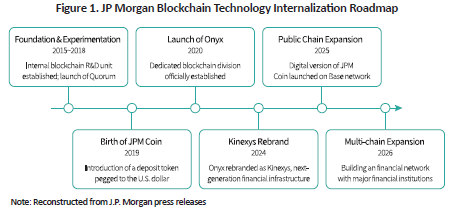
JPMorgan has been evaluating the potential of blockchain in financial environments since 2015, through an internal research unit and its private blockchain, Quorum. Following the 2019 launch of JPM Coin — its proprietary blockchain payment system — and the 2020 establishment of Onyx, a dedicated blockchain project division, the bank developed capabilities enabling corporate clients to automate payment settlement, margin funding, and the automatic capture of arbitrage opportunities arising from exchange rate fluctuations. In 2024, the rebranding of Onyx to Kinexys was accompanied by the announcement that the platform had surpassed $1.5 trillion in cumulative transaction volume. The bank has since deepened its exploration of 24/7 real-time currency clearing and automated settlement, as well as privacy, identity verification, and interoperability with external protocols within the blockchain ecosystem. In 2025, JPMorgan selected Coinbase's public chain “Base” as the pilot chain for an institutional deposit token, experimenting with institutional payment and settlement on a public blockchain, while also pursuing on-chain connectivity with Goldman Sachs, BNY Mellon, and other institutions through the Canton Network7) — accelerating its efforts to build next-generation global financial standard infrastructure.
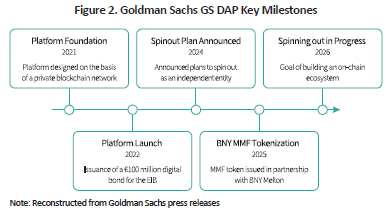
Goldman Sachs, for its part, is advancing the digitization of the full financial asset lifecycle — from issuance and settlement to custody and collateral utilization — centered on its GS DAP (Digital Asset Platform). GS DAP employs private blockchain technology to ensure security and privacy while maintaining compliance with financial regulations and the flexibility to respond to market dynamics. Goldman participated in digital bond issuances by the European Investment Bank (EIB) in 2022 and 2024, and provided blockchain infrastructure for the launch of a tokenized money market fund in collaboration with BNY Mellon — creating an environment in which physical assets can be utilized as immediate collateral even outside business hours. In 2024, Goldman announced plans to spin out GS DAP as an independent entity, with the goal of alleviating the reluctance of other institutions to use a platform owned by a potential competitor, and building a more neutral and broadly accessible platform.
Ultimately, these moves by traditional investment banks reflect more than mere technology adoption — they represent an active embrace of a perspective that seeks to maximize capital efficiency through blockchain technology. JPMorgan's vast payment network and Goldman Sachs's asset lifecycle digitization platform are proving their real-world efficacy through deep integration with existing institutional financial systems. Rather than succumbing to the threat narrative that blockchain will diminish the role of intermediaries, investment banks are positioning themselves as architects of the future digital economy, racing to establish dominance as the standard operating system of tomorrow's financial infrastructure.
Asset Managers: Asset Tokenization and Liquidity Expansion
With management fees as their core revenue source and AUM maximization as their primary objective, asset managers are finding in blockchain-based real-world asset tokenization an unprecedented opportunity for asset commercialization and liquidity generation. Leading firms such as BlackRock are tokenizing safe-haven assets — including U.S. Treasuries and money market funds — to build environments that support 24/7 trading and real-time collateral utilization. In some cases, they have introduced structures allowing investment through existing brokerage accounts and institutional platforms without requiring a separate digital asset wallet, thereby lowering the psychological barriers to entry for investors.
The on-chaining trend among asset managers gained its initial impetus from Franklin Templeton's launch of an on-chain money market fund in 2021. WisdomTree followed with a tokenized MMF in 2023 before expanding its institutional platform and product lineup in 2024. BlackRock's BUIDL fund, launched in March 2024, grew rapidly on the strength of its short-duration high-quality asset investment strategy and on-chain income distribution structure, reaching approximately $2.9 billion in assets under management by mid-2025 and expanding institutional asset distribution across multiple public chains, primarily Ethereum.
Further broadening the picture, BlackRock's BUIDL was adopted as over-the-counter collateral on Binance in November 2025, extending its liquidity use cases. In December, JPMorgan Asset Management launched an Ethereum-based tokenized MMF, and in March 2026, Invesco announced the acquisition of the tokenized Treasury fund operations from Superstate — bringing yet another legacy asset manager into the tokenization market and underscoring the accelerating pace of institutional participation.
The private equity and private credit markets are also seeing forays into tokenized capital markets by major managers including Hamilton Lane, Apollo, and KKR. KKR tokenized a healthcare fund in 2022, and Apollo unveiled a tokenized private credit fund, ACRED, in 2025. Hamilton Lane has been strengthening partnerships — including a strategic investment in Republic, an on-chain global investment platform — as it pursues tokenization, asset distribution, and expanded retail investor access to private markets.
In sum, the global asset management industry is internalizing blockchain capabilities by directly managing tokenized assets while preserving its established fee-based revenue model. Leading U.S. managers are diversifying their fundraising channels through the on-chaining of both public and private market assets — a movement poised to serve as a critical competitive advantage in the race to lead the next generation of digital capital markets.
Venture Capital: Early-Stage Innovation and Ecosystem Building
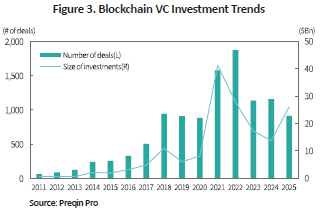
Blockchain-focused VC investment climbed to $6.04 billion in 2017 and $8.15 billion in 2018 before entering a sustained growth trajectory. It peaked at $41.19 billion in 2021, and has since stabilized into a steadier investment cadence through 2024–2025 (see Figure 3). Underpinning this expansion has been the role of aggressive venture investors like a16z (Andreessen Horowitz), which have placed long-term bets on early-stage protocols and infrastructure. Beyond capital provision, these firms have actively supported ecosystem development for nascent projects and engaged in regulatory and policy debates, helping to facilitate the mainstreaming of blockchain. Their "conviction investing" — maintaining exposure to Web3's long-term potential even through prolonged downturns — has played a critical role in sustaining capital supply and confidence signals across the ecosystem, and has ultimately contributed to blockchain's evolution from a passing trend into next-generation financial infrastructure.
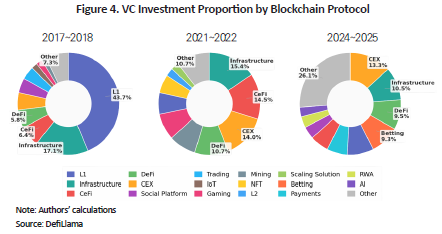
An analysis of VC investment by protocol category reveals that the blockchain investment landscape is transitioning from a phase of "technological genesis" to one of "practical expansion" (see Figure 4). In 2017–2018, nearly half of all investment (43.7%) was concentrated in Layer 1 infrastructure — the foundational highway-building of networks like Ethereum. By 2024–2025, capital has become far more dispersed: CEX (13.3%), infrastructure (10.5%), DeFi (9.5%), and betting (9.3%) each attract meaningful shares. Particularly notable is the emergence of application-layer services — AI, RWA, and betting among them — that address direct user demand, while the "Other" category has surged to 26.1%, reflecting blockchain's expanding reach across diverse industry verticals. In sum, VCs are broadening their focus from foundational technology bets toward services demonstrating tangible business models and monetization potential — a clear indication that the blockchain industry has moved beyond theoretical discourse and onto a commercialization trajectory.
Noteworthy is the fact that traditional financial institutions have made investments in major blockchain startups, including Circle, Digital Asset, Fireblocks, and Securitize.8) These investments are not driven by financial returns alone. By conducting technology due diligence on portfolio companies and selectively integrating their solutions into their own services, these institutions are positioning themselves as strategic investors intent on internalizing blockchain as the "standard operating system of future finance." Legacy financial institutions have likely recognized the technical limitations of decades-old systems that cannot readily accommodate smart contracts or advanced cryptographic security algorithms. Strategic investment thus serves as a mechanism for bridging the technology gap through adoption of validated solutions. The outcome is a deepened technical understanding of the core blockchain value chain and, ultimately, the acquisition of meaningful influence within it — enabling legacy financial institutions to reconstitute themselves on an on-chain basis, powered by the innovative engines of startups, while securing governance authority over next-generation financial infrastructure in the process.
Implications for the Korean Capital Market
The U.S. experience makes clear that blockchain is no longer a peripheral experiment — it has taken hold as the operating system of capital markets writ large. What is especially instructive is that each financial sector has pursued a differentiated strategy aligned with its own business model: asset managers have found new momentum for AUM growth through asset on-chaining; investment banks have moved to secure dominance over future financial networks through the on-chaining of payment and settlement infrastructure; and venture capital has deployed capital across the ecosystem, betting on what may be the largest infrastructure transition since the advent of the internet. Underlying this strategic differentiation is the long-term discipline of U.S. financial institutions, which accumulated know-how through R&D and strategic investment even during periods of regulatory ambiguity.
Korea's financial sector must likewise move away from a one-size-fits-all approach and pursue differentiated on-chain strategies suited to the revenue structures and core competencies of each segment. For such strategies to be effective, however, four conditions must operate in concert. First, the regulatory framework must be updated in a timely manner that keeps pace with market innovation — as exemplified by the legislative processes behind the GENIUS Act and the CLARITY Act. Second, legacy systems must be modernized in a phased and deliberate manner to ensure interoperability with on-chain infrastructure. Third, the spirit of "conviction investing" — exemplified by U.S. VCs such as a16z Crypto and Pantera Capital, which maintained unwavering support for early-stage Web3 protocols even through bear markets — must take root in Korea's domestic VC ecosystem, fostering a culture of bold, patient capital deployment that is not captive to short-term performance. Fourth, as demonstrated by the way U.S. legacy financial institutions acquired both technical capabilities and ecosystem influence through strategic investments in core blockchain value chain companies, financial firms in Korea must also strengthen their role as productive financiers — supporting innovative enterprises within the bounds of current regulation.
At a moment when blockchain is cementing its place as a foundational pillar of tomorrow's financial infrastructure, only a proactive and strategically differentiated response can secure Korea's competitiveness in the next-generation digital capital market.
1) “SEC Crypto 2.0: Acting Chairman Uyeda Announces Formation of New Crypto Task Force” (2025.1.21.) https://www.sec.gov/newsroom/press-releases/2025-30
2) “Acting Chairman Pham Announces Launch of Digital Assets Pilot Program for Tokenized Collateral in Derivatives Markets” (2025.12.8.)
3) “OCC Announces Conditional Approvals for Five National Trust Bank Charter Applications” (2025.12.12.) https://occ.gov/news-issuances/news-releases/2025/nr-occ-2025-125.html
4) On-chaining refers to the process of recording and enabling the verification of transactions, assets, or information on a blockchain.
5) DeFi (Decentralized Finance) protocols are automated financial service frameworks that operate on blockchain networks without reliance on centralized intermediaries such as banks, brokerages, or exchanges.
6) Public chains are open, permissionless blockchains — Bitcoin and Ethereum being the most prominent examples. Private chains, by contrast, are closed networks accessible only to specific institutions or authorized participants.
7) Canton Network is a public Layer 1 blockchain network designed to meet the stringent security requirements of the financial industry, enabling institutions to maintain data sovereignty and confidentiality while facilitating seamless asset transfers and settlements across different ledgers within a hybrid financial ecosystem.
8) BlackRock have invested in Circle; Goldman Sachs, BNY, iCapital, and BNP Paribas have invested in Digital Asset; BNY Mellon in Fireblocks; and BlackRock, Morgan Stanley, and Hamilton Lane in Securitize.
The U.S. digital asset regulatory landscape reached a significant turning point in 2025. The GENIUS Act, enacted on July 18, 2025, established a federal regulatory framework for stablecoins, while the CLARITY Act — passed by the House on July 17 — introduced a market structure bill allocating supervisory authority over digital assets between the CFTC and the SEC, pending Senate deliberation. This drive toward regulatory clarity and the mainstreaming of digital assets has proceeded in tandem with administrative actions by major financial regulators. The SEC launched its Crypto Task Force in 2025 with the aim of establishing a comprehensive and coherent regulatory framework,1) while the CFTC issued a pilot program and guidance on the use of digital assets as collateral in derivatives markets.2) In the same year, the OCC granted conditional approvals for national trust bank charter applications from major digital asset firms — including Circle, Fidelity Digital Assets, BitGo, Paxos, and Ripple — signaling a broader move to bring industry participants under the federal banking regulatory umbrella.3)
Well before this regulatory push gained momentum, U.S. financial institutions had already been experimenting proactively with blockchain applications, even amid regulatory uncertainty. R&D efforts and direct investments by legacy financial institutions, combined with capital flows into innovative companies through venture capital, served as fertile ground for accumulating technical expertise. Building on this foundation, U.S. financial institutions are now accelerating blockchain strategies optimized for their own business models — and in doing so, positioning themselves to capture the full benefits of the emerging digital financial era once the regulatory framework is firmly in place.
Investment Banks: On-Chaining Payment and Settlement Infrastructure4)
As the core revenue model of traditional investment banks — corporate financial services and capital markets intermediation — faces fundamental disruption from the rise of decentralized finance (DeFi) protocols,5) major institutions such as JPMorgan and Goldman Sachs are actively embracing blockchain as a tool for infrastructure innovation capable of overcoming inefficiencies such as settlement delays. Having first laid the groundwork through private blockchains — which restrict participant access and protect sensitive corporate financial data — these banks are now beginning in earnest to leverage public blockchains6) to broaden their distribution channels and diversify revenue streams through integration with external financial protocols.
JPMorgan has been evaluating the potential of blockchain in financial environments since 2015, through an internal research unit and its private blockchain, Quorum. Following the 2019 launch of JPM Coin — its proprietary blockchain payment system — and the 2020 establishment of Onyx, a dedicated blockchain project division, the bank developed capabilities enabling corporate clients to automate payment settlement, margin funding, and the automatic capture of arbitrage opportunities arising from exchange rate fluctuations. In 2024, the rebranding of Onyx to Kinexys was accompanied by the announcement that the platform had surpassed $1.5 trillion in cumulative transaction volume. The bank has since deepened its exploration of 24/7 real-time currency clearing and automated settlement, as well as privacy, identity verification, and interoperability with external protocols within the blockchain ecosystem. In 2025, JPMorgan selected Coinbase's public chain “Base” as the pilot chain for an institutional deposit token, experimenting with institutional payment and settlement on a public blockchain, while also pursuing on-chain connectivity with Goldman Sachs, BNY Mellon, and other institutions through the Canton Network7) — accelerating its efforts to build next-generation global financial standard infrastructure.
Goldman Sachs, for its part, is advancing the digitization of the full financial asset lifecycle — from issuance and settlement to custody and collateral utilization — centered on its GS DAP (Digital Asset Platform). GS DAP employs private blockchain technology to ensure security and privacy while maintaining compliance with financial regulations and the flexibility to respond to market dynamics. Goldman participated in digital bond issuances by the European Investment Bank (EIB) in 2022 and 2024, and provided blockchain infrastructure for the launch of a tokenized money market fund in collaboration with BNY Mellon — creating an environment in which physical assets can be utilized as immediate collateral even outside business hours. In 2024, Goldman announced plans to spin out GS DAP as an independent entity, with the goal of alleviating the reluctance of other institutions to use a platform owned by a potential competitor, and building a more neutral and broadly accessible platform.
Ultimately, these moves by traditional investment banks reflect more than mere technology adoption — they represent an active embrace of a perspective that seeks to maximize capital efficiency through blockchain technology. JPMorgan's vast payment network and Goldman Sachs's asset lifecycle digitization platform are proving their real-world efficacy through deep integration with existing institutional financial systems. Rather than succumbing to the threat narrative that blockchain will diminish the role of intermediaries, investment banks are positioning themselves as architects of the future digital economy, racing to establish dominance as the standard operating system of tomorrow's financial infrastructure.
With management fees as their core revenue source and AUM maximization as their primary objective, asset managers are finding in blockchain-based real-world asset tokenization an unprecedented opportunity for asset commercialization and liquidity generation. Leading firms such as BlackRock are tokenizing safe-haven assets — including U.S. Treasuries and money market funds — to build environments that support 24/7 trading and real-time collateral utilization. In some cases, they have introduced structures allowing investment through existing brokerage accounts and institutional platforms without requiring a separate digital asset wallet, thereby lowering the psychological barriers to entry for investors.
The on-chaining trend among asset managers gained its initial impetus from Franklin Templeton's launch of an on-chain money market fund in 2021. WisdomTree followed with a tokenized MMF in 2023 before expanding its institutional platform and product lineup in 2024. BlackRock's BUIDL fund, launched in March 2024, grew rapidly on the strength of its short-duration high-quality asset investment strategy and on-chain income distribution structure, reaching approximately $2.9 billion in assets under management by mid-2025 and expanding institutional asset distribution across multiple public chains, primarily Ethereum.
Further broadening the picture, BlackRock's BUIDL was adopted as over-the-counter collateral on Binance in November 2025, extending its liquidity use cases. In December, JPMorgan Asset Management launched an Ethereum-based tokenized MMF, and in March 2026, Invesco announced the acquisition of the tokenized Treasury fund operations from Superstate — bringing yet another legacy asset manager into the tokenization market and underscoring the accelerating pace of institutional participation.
The private equity and private credit markets are also seeing forays into tokenized capital markets by major managers including Hamilton Lane, Apollo, and KKR. KKR tokenized a healthcare fund in 2022, and Apollo unveiled a tokenized private credit fund, ACRED, in 2025. Hamilton Lane has been strengthening partnerships — including a strategic investment in Republic, an on-chain global investment platform — as it pursues tokenization, asset distribution, and expanded retail investor access to private markets.
In sum, the global asset management industry is internalizing blockchain capabilities by directly managing tokenized assets while preserving its established fee-based revenue model. Leading U.S. managers are diversifying their fundraising channels through the on-chaining of both public and private market assets — a movement poised to serve as a critical competitive advantage in the race to lead the next generation of digital capital markets.
Venture Capital: Early-Stage Innovation and Ecosystem Building
Blockchain-focused VC investment climbed to $6.04 billion in 2017 and $8.15 billion in 2018 before entering a sustained growth trajectory. It peaked at $41.19 billion in 2021, and has since stabilized into a steadier investment cadence through 2024–2025 (see Figure 3). Underpinning this expansion has been the role of aggressive venture investors like a16z (Andreessen Horowitz), which have placed long-term bets on early-stage protocols and infrastructure. Beyond capital provision, these firms have actively supported ecosystem development for nascent projects and engaged in regulatory and policy debates, helping to facilitate the mainstreaming of blockchain. Their "conviction investing" — maintaining exposure to Web3's long-term potential even through prolonged downturns — has played a critical role in sustaining capital supply and confidence signals across the ecosystem, and has ultimately contributed to blockchain's evolution from a passing trend into next-generation financial infrastructure.
An analysis of VC investment by protocol category reveals that the blockchain investment landscape is transitioning from a phase of "technological genesis" to one of "practical expansion" (see Figure 4). In 2017–2018, nearly half of all investment (43.7%) was concentrated in Layer 1 infrastructure — the foundational highway-building of networks like Ethereum. By 2024–2025, capital has become far more dispersed: CEX (13.3%), infrastructure (10.5%), DeFi (9.5%), and betting (9.3%) each attract meaningful shares. Particularly notable is the emergence of application-layer services — AI, RWA, and betting among them — that address direct user demand, while the "Other" category has surged to 26.1%, reflecting blockchain's expanding reach across diverse industry verticals. In sum, VCs are broadening their focus from foundational technology bets toward services demonstrating tangible business models and monetization potential — a clear indication that the blockchain industry has moved beyond theoretical discourse and onto a commercialization trajectory.
Noteworthy is the fact that traditional financial institutions have made investments in major blockchain startups, including Circle, Digital Asset, Fireblocks, and Securitize.8) These investments are not driven by financial returns alone. By conducting technology due diligence on portfolio companies and selectively integrating their solutions into their own services, these institutions are positioning themselves as strategic investors intent on internalizing blockchain as the "standard operating system of future finance." Legacy financial institutions have likely recognized the technical limitations of decades-old systems that cannot readily accommodate smart contracts or advanced cryptographic security algorithms. Strategic investment thus serves as a mechanism for bridging the technology gap through adoption of validated solutions. The outcome is a deepened technical understanding of the core blockchain value chain and, ultimately, the acquisition of meaningful influence within it — enabling legacy financial institutions to reconstitute themselves on an on-chain basis, powered by the innovative engines of startups, while securing governance authority over next-generation financial infrastructure in the process.
The U.S. experience makes clear that blockchain is no longer a peripheral experiment — it has taken hold as the operating system of capital markets writ large. What is especially instructive is that each financial sector has pursued a differentiated strategy aligned with its own business model: asset managers have found new momentum for AUM growth through asset on-chaining; investment banks have moved to secure dominance over future financial networks through the on-chaining of payment and settlement infrastructure; and venture capital has deployed capital across the ecosystem, betting on what may be the largest infrastructure transition since the advent of the internet. Underlying this strategic differentiation is the long-term discipline of U.S. financial institutions, which accumulated know-how through R&D and strategic investment even during periods of regulatory ambiguity.
Korea's financial sector must likewise move away from a one-size-fits-all approach and pursue differentiated on-chain strategies suited to the revenue structures and core competencies of each segment. For such strategies to be effective, however, four conditions must operate in concert. First, the regulatory framework must be updated in a timely manner that keeps pace with market innovation — as exemplified by the legislative processes behind the GENIUS Act and the CLARITY Act. Second, legacy systems must be modernized in a phased and deliberate manner to ensure interoperability with on-chain infrastructure. Third, the spirit of "conviction investing" — exemplified by U.S. VCs such as a16z Crypto and Pantera Capital, which maintained unwavering support for early-stage Web3 protocols even through bear markets — must take root in Korea's domestic VC ecosystem, fostering a culture of bold, patient capital deployment that is not captive to short-term performance. Fourth, as demonstrated by the way U.S. legacy financial institutions acquired both technical capabilities and ecosystem influence through strategic investments in core blockchain value chain companies, financial firms in Korea must also strengthen their role as productive financiers — supporting innovative enterprises within the bounds of current regulation.
At a moment when blockchain is cementing its place as a foundational pillar of tomorrow's financial infrastructure, only a proactive and strategically differentiated response can secure Korea's competitiveness in the next-generation digital capital market.
1) “SEC Crypto 2.0: Acting Chairman Uyeda Announces Formation of New Crypto Task Force” (2025.1.21.) https://www.sec.gov/newsroom/press-releases/2025-30
2) “Acting Chairman Pham Announces Launch of Digital Assets Pilot Program for Tokenized Collateral in Derivatives Markets” (2025.12.8.)
3) “OCC Announces Conditional Approvals for Five National Trust Bank Charter Applications” (2025.12.12.) https://occ.gov/news-issuances/news-releases/2025/nr-occ-2025-125.html
4) On-chaining refers to the process of recording and enabling the verification of transactions, assets, or information on a blockchain.
5) DeFi (Decentralized Finance) protocols are automated financial service frameworks that operate on blockchain networks without reliance on centralized intermediaries such as banks, brokerages, or exchanges.
6) Public chains are open, permissionless blockchains — Bitcoin and Ethereum being the most prominent examples. Private chains, by contrast, are closed networks accessible only to specific institutions or authorized participants.
7) Canton Network is a public Layer 1 blockchain network designed to meet the stringent security requirements of the financial industry, enabling institutions to maintain data sovereignty and confidentiality while facilitating seamless asset transfers and settlements across different ledgers within a hybrid financial ecosystem.
8) BlackRock have invested in Circle; Goldman Sachs, BNY, iCapital, and BNP Paribas have invested in Digital Asset; BNY Mellon in Fireblocks; and BlackRock, Morgan Stanley, and Hamilton Lane in Securitize.