Our bi-weekly Opinion provides you with latest updates and analysis on major capital market and financial investment industry issues.
Summary
Major economies appear to be adjusting to the impact of the war in Iran, although economic developments continue to differ somewhat across countries depending on their industrial structures and economic fundamentals. Korea recorded strong growth in the first quarter, supported by robust semiconductor exports. As domestic demand, including capital investment and private consumption, continues to recover, the growth rate is projected to reach 2.9% in 2026. Annual consumer price inflation is expected to register 2.8%, driven by higher oil prices and increased consumption.
Although inflationary pressures have increased, the likelihood of a rapid and broad-based acceleration in inflation is assessed to be low, unlike during previous periods of surging oil prices, such as after the global financial crisis and in the immediate aftermath of the pandemic. This is because conditions differ markedly from those periods in terms of global grain supply, the extent of supply-chain disruptions, and the global monetary policy stance, and prices of non-fuel commodities are therefore expected to remain relatively stable. However, given demand-side inflationary pressures arising from stronger-than-expected economic expansion and growth in domestic demand, Bank of Korea is expected to shift its policy stance by raising the policy rate twice in the second half of this year, by a total of 50bps.
Meanwhile, since the outbreak of the war in Iran, the global monetary policy environment has shifted away from expectations of policy easing to concerns over inflation uncertainty. In particular, in the United States, inflation risks have increased the likelihood that the policy rate will remain unchanged through year-end, but uncertainty surrounding the policy rate path remains high. Recently, changes in market interest rates and financial conditions, rather than the policy rate itself, have also emerged as key variables determining the actual degree of tightening. The direction of global monetary policy going forward is likely to be determined by uncertainty over the inflation path, and financial market volatility is therefore expected to remain elevated for a considerable period.
The global economy appears to be adapting to some extent to the supply shock caused by the war in Iran. Although constraints on logistics, including energy supply and demand and maritime shipping, have intensified, the negative impact on the real economies of major countries is assessed to be more limited than at the time of the outbreak of the Russia-Ukraine War.1) However, while economic conditions differ across countries depending on industrial and economic structures, the possibility of renewed conflict between the United States and Iran and inflation risks stemming from rising oil prices remain sources of uncertainty. This paper reviews recent economic developments, presents an outlook for the Korean economy, and discusses key issues: domestic inflation conditions and the direction of monetary policy, as well as changes in global monetary policy.
Recent Domestic and Global Economic Developments
The U.S. economy grew at an annualized rate of 1.6% in the first quarter of 2026, up from the prior quarter (Q4 2025: 0.5%). The U.S. economy is expected to post full-year growth of approximately 2% in 2026, underpinned by increased AI-centered investment and improved export performance, indicating a favorable economic environment. Regarding prices, energy-related goods rose sharply following the outbreak of the Iran war, with the year-on-year consumer price inflation rate expanding to 4.2% in May; the core PCE price index also rose 3.3% year-on-year in April, widening the gap relative to the Federal Reserve's inflation target. While there were expectations at the time of Warsh's appointment as the chair that the Fed would adopt a more accommodative stance2), the renewed pickup in U.S. inflation following the Iran war has created significant divergence in views on the future direction of monetary policy (see Issue 2 for further details).
In the euro area, growth slowed from 0.2% in the fourth quarter of 2025 to 0.1% in the first quarter of 2026, affected by logistics disruptions in the Strait of Hormuz and higher energy prices, including crude oil and natural gas. Although the euro area is highly dependent on natural gas as an energy source, the increase in prices has not been as large as during the 2022 energy crisis3) and is therefore judged not to constitute a shock severe enough to trigger a serious recession. Inflationary pressures in the euro area are also widening, led by energy items, and the ECB is expected to respond with multiple rate hikes in the second half of the year.
Korea recorded a strong quarter-on-quarter growth rate of 1.8% in Q1 2026. Increased exports of semiconductors and other IT products led the growth momentum in the first quarter, and that momentum has continued into April and May, with exports averaging USD 86.8 billion per month (compared to a January~March 2026 average of USD 73.5 billion, on a customs-clearance basis). On the domestic demand side, the growth rate of equipment investment rebounded sharply from -1.6% in Q4 2025 to 6.6% in Q1 2026, while private consumption also expanded from 0.4% to 0.6% over the same period, indicating a recovery. Consumer price inflation (year-on-year) stood at a stable 2.0% in January and February of this year, but climbed to a somewhat elevated level of 3.1% in May, reflecting continued increases in petroleum product prices and service charges including airfares following the Iran war.
Domestic Growth and Inflation Outlook
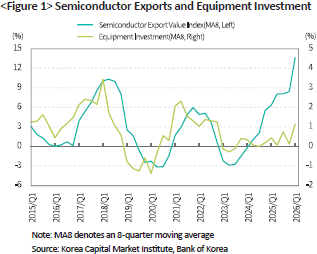
Korea’s GDP is projected to grow by 2.9% in 2026, led by exports, while equipment investment and private consumption are expected to support the expansion of domestic demand. Exports are likely to continue performing strongly, supported by rising global demand for IT products such as semiconductors and storage devices. In addition, as the comovement shown in (Figure 1) suggests, equipment investment is expected to move in tandem with semiconductor export growth, recording a high annual growth rate of 4.9%. Private consumption is expected to grow at approximately 2.5%, exceeding the long-term average (2010–2025 average: 2.2%), supported by improvements in income conditions and consumer sentiment driven by the economic recovery and rising equity prices. Construction investment is unlikely to rebound quickly, but it is anticipated to show some improvement as it emerges from a prolonged period of negative growth.
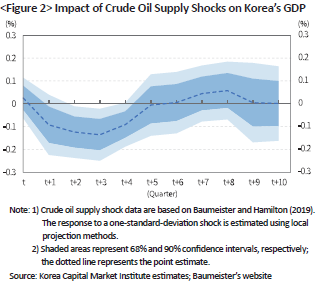
However, despite broadly favorable aggregate indicators, the Iran war is expected to weigh on parts of the Korean economy throughout the year (for the impact of crude oil supply shocks on economic activity, see (Figure 2)). In particular, while profitability in the petrochemical industry has improved, the recovery in capacity utilization has been delayed due to difficulties in securing raw materials, and the construction industry continues to face concerns over rising raw material costs and material supply following the Iran war. Meanwhile, in the automobile sector, exports are declining due to industry-specific factors such as increased offshoring and parts supply-chain issues, as well as a sharp drop in used-car sales caused by transportation disruptions to the Middle East. Logistics problems may be resolved relatively quickly after the end of the war, but normalization of production facilities in oil-producing countries is expected to take some time, meaning elevated oil prices and their repercussions are likely to persist for the time being.
Korea's consumer price inflation is projected to reach 2.8% in 2026. The impact of the oil price shock, combined with improved consumption accompanying the economic recovery, is expected to act as upward pressure on prices. However, while oil prices rose sharply as a result of the supply shock, consumer price inflation is not expected to replicate the rapid surge seen immediately after the pandemic (5.1% in 2022). This is discussed in detail in Issue 1.
Looking ahead, externally, if geopolitical risks are effectively resolved after the peace agreement between the United States and Iran, and if global semiconductor demand continues to grow strongly, growth momentum could strengthen. Domestically, if increases in income and asset prices (stock prices) accelerate consumption growth, this could also act as an additional upside factor for the economy. Conversely, renewed geopolitical risks such as conflict between the United States and Iran4), delays in normalizing production facilities in oil-producing countries, a slowdown in global AI investment, and the resulting contraction in domestic demand are judged to be downside risks to the Korean economy.
Issue 1: Inflation Conditions and Domestic Monetary Policy Outlook
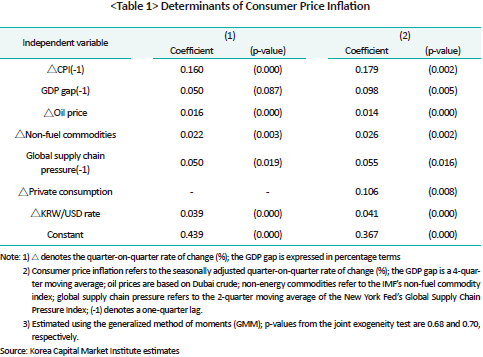
The sharp rise in oil prices caused by the war in the Middle East is acting as a source of instability for the domestic and global macroeconomy. In particular, because Korea experienced a surge in oil prices and high inflation as recently as 2022, concerns have grown that rapid inflation could recur. As shown in Table 1, Korea’s consumer prices are affected by demand pressure, the GDP gap, commodity prices including oil prices, and global supply chains. This section discusses domestic inflation conditions by focusing on these factors and comparing them with past periods of surging oil prices.
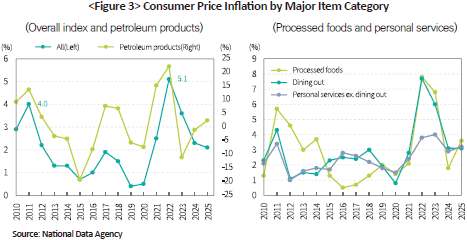
Using the period following the global financial crisis as a reference, there have been three major episodes of sharp oil price surges, including the most recent one. During the 2011 economic recovery following the global financial crisis coinciding with the Middle East and North Africa (MENA) unrest, and in 2022 amid the effects of the pandemic and the outbreak of the Russia-Ukraine War, oil prices (WTI, monthly average) rose to approximately USD 110 per barrel and USD 115 per barrel, respectively. As shown in (Figure 3), domestic consumer price inflation (annual) surged to 4.0% and 5.1%, respectively, during those periods. By item category, broad-based price increases were observed not only in petroleum products but also in processed foods, dining out, and other personal services.
As the high oil price problem triggered by the Middle East crisis is expected to persist for the time being5), increases in non-petroleum components of domestic consumer prices have so far been relatively limited compared with previous episodes. While this is a favorable development, it also implies that non-petroleum items will determine the future course of domestic inflation. Therefore, attention should be paid not only to oil prices but also to other commodity prices, which have a significant impact on non-petroleum item prices.
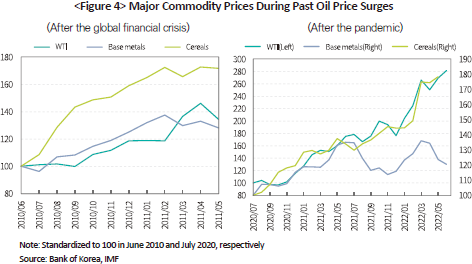
(Figure 4) shows international prices for cereals and base metals during previous oil price surge episodes. In both of the periods shown, sharp increases in the prices of these commodities accompanied the rise in crude oil prices for a substantial period, with cereal prices posting particularly steep increases. These simultaneous jumps triggered price increases in domestic goods such as processed foods and other manufactured products, as well as services such as dining out, thereby contributing to broader price instability. However, it is difficult to attribute these surges in other commodity prices solely to rising oil prices, as complex factors specific to each period also caused the sharp increases in cereal and metal prices. Immediately following the global financial crisis, a ban on grain exports by a major producing country (Russia) due to severe drought, and a rapid expansion of fixed investment in China6), acted as destabilizing factors for commodity prices. Immediately following the pandemic, widespread global supply chain disruptions and the outbreak of the Russia-Ukraine War served as the primary drivers. Furthermore, a common feature of both periods was that central banks across countries maintained ultra-accommodative monetary policies through zero interest rates and quantitative easing, creating a financial environment conducive to simultaneous increases in goods and asset prices.
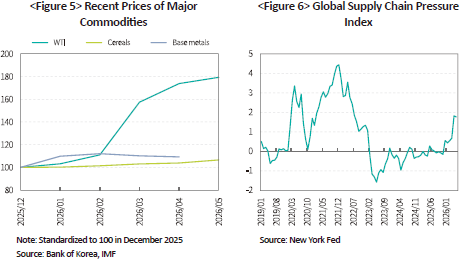
Compared with the previous oil price surge episodes described above, current price conditions can be characterized as relatively favorable. In the case of cereals, there have been no large-scale extreme weather events or natural disasters in major producing regions, and production and inventories are expected to increase.7) Therefore, price pressure is assessed as limited. While base metal prices rose temporarily due to data center investment and related factors, the magnitude of increases in the current year remains contained; and the degree of global supply chain disruption caused by the closure of the Strait of Hormuz is less severe than that seen immediately following the pandemic (see (Figure 5) and (Figure 6)). Furthermore, contrary to initial expectations, the Federal Reserve is expected to refrain from cutting rates, and the ECB is projected to raise its policy rate twice during the year8), which represents a significant departure from the global monetary policy stance during the previous episodes. Taking these conditions into account, unlike the previous oil price surge episodes, prices of other commodities are expected to remain broadly stable following the Iran war. Accordingly, a broad-based spread of inflation through non-fuel commodity prices appears unlikely.
However, economic expansion exceeding expectations at the beginning of the year and an increase in domestic demand, including private consumption, are anticipated to create inflationary pressure, particularly in the personal services sector. From a monetary policy perspective, the domestic economy’s strong growth despite the negative supply shock from the Middle East conflict can be seen as having largely eased the policy dilemma.9) Accordingly, Bank of Korea is expected to shift its monetary policy stance toward rate hikes in order to respond to rising inflationary pressure from the demand side, including consumption and investment.10)
Taking into account the aforementioned macroeconomic conditions, including inflation, the policy rate is projected to be raised twice in the second half of this year, by a total of 50bps. Since inflation driven by demand pressure is a typical situation requiring a monetary policy response, a policy rate hike may appear to be a natural course of action. However, the consumer price inflation rate for 2026 projected by major institutions is in the high-2% range, which is not a drastic rise, and uncertainty remains over the extent to which demand pressure will be transmitted to prices. In light of these factors, Bank of Korea is expected to respond gradually by raising the policy rate twice this year, by 25bps each time. If macroeconomic conditions subsequently unfold broadly in line with Bank of Korea’s forecasts11), one or two additional modest rate hikes are expected next year.
Issue 2: Changes in Global Monetary Policy
Since the outbreak of the Iran war, the global monetary policy environment has shifted from expectations of rate cuts―a dovish pivot―toward a greater emphasis on price stability and inflation risks, or a hawkish pause. Major central banks are maintaining a cautious stance toward immediate further tightening in consideration of downside risks to economic growth; however, as the risk of renewed inflationary pressure driven by rising energy prices has increased, expectations for rate cuts are being recalibrated. In particular, as concerns have emerged regarding the possibility that the energy shock may feed into inflation expectations and wage- and price-setting behavior, some market participants have begun to price in the possibility of additional rate hikes, and the global monetary policy stance is shifting toward placing greater emphasis on price stability. However, the intensity of policy responses is expected to vary by country, depending on differences in energy dependency, growth conditions, exchange rate dynamics, and price structures.
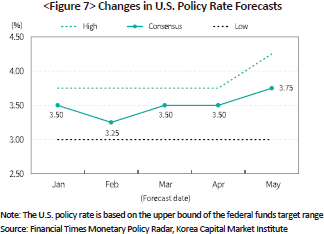
In the United States, a single rate cut (25 basis points) in 2026 was regarded as the baseline scenario at the beginning of the year; however, as rising oil prices and supply-chain uncertainty following the outbreak of the war have pushed up inflation expectations, the timing of rate cuts has been progressively delayed. As shown in (Figure 7), the policy rate path anticipated by the market has been gradually revised upward since the outbreak of war, and consensus that rates will remain on hold through year-end has also strengthened. The median policy rate forecast among major forecasting institutions (based on the upper bound of the federal funds rate target range) stands at approximately 3.75% by end-2026, with the majority of institutions expecting rates to remain on hold through year-end. However, as the U.S. consumer price inflation rate for May, recently released, recorded 4.2% year-on-year—the highest level since 2023—some institutions have withdrawn their prior rate cut forecasts or begun pricing in the possibility of additional rate hikes. Accordingly, the market’s baseline scenario is shifting toward rates remaining on hold for the remainder of the year, and if upward inflationary pressure persists for longer than anticipated, the possibility of additional rate hikes cannot be ruled out.
The April FOMC minutes confirm that the Federal Reserve's assessment is broadly consistent with this view. A majority of participants expressed the view that, given the possibility that elevated inflation could persist for longer than expected and the uncertainty surrounding the economic spillover effects of the Middle East conflict, it would be necessary to maintain the benchmark interest rate at its current level for a longer period than previously anticipated. Concerns were also raised regarding the possibility that persistently high oil and commodity prices could transmit into inflation expectations and the wage- and price-setting process. The recently released consumer price data suggest that these concerns are materializing, lending support to the Federal Reserve's cautious policy stance. Meanwhile, the labor market continues to exhibit resilience, with unemployment rates remaining low, and it therefore appears likely that the Federal Reserve will maintain its current rate level for the time being while monitoring future price developments—prioritizing price stability over concerns about economic slowdown and sustaining a prudent policy posture.
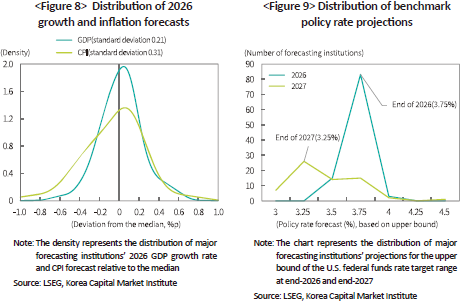
As shown in (Figure 8) below, the dispersion of inflation forecasts among major forecasting institutions is notably higher than that of growth forecasts. This indicates that market participants perceive greater uncertainty regarding the inflation path than the growth path going forward. This perception is also reflected in policy rate projections, and as shown in (Figure 9), the divergence of views among institutions regarding policy rates from 2027 onward is widening. In other words, while market views on the growth path are relatively convergent, uncertainty surrounding the inflation path remains elevated, and this is assessed to be acting as a key factor amplifying uncertainty in projections for the future policy rate path.
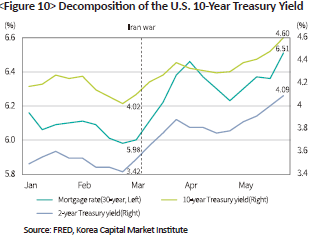
This reassessment of the monetary policy path, together with increased uncertainty, is being reflected across U.S. financial markets. In particular, as financial conditions gradually tighten, led by rising Treasury yields, private-sector funding costs, including mortgage rates and corporate borrowing rates, are also rising in tandem. The U.S. 10-year Treasury yield recently rose to around 4.6%, marking its highest level since early 2025. This is assessed as the result of a combination of factors, including inflation concerns stemming from higher oil prices, a retreat in rate-cut expectations, an increase in the term premium, and concerns over the fiscal deficit and increased Treasury supply. The U.S. 30-year fixed mortgage rate has also remained high at around 6.5% recently, further tightening financial conditions.
A notable point is that financial conditions have been tightening more rapidly than changes in policy rate projections. While the Federal Reserve continues to leave open the possibility of gradual rate cuts going forward, markets are demanding higher rate levels by pricing in long-term risks such as re-accelerating inflation, deteriorating fiscal soundness, and increasing Treasury supply. This suggests that movements in market interest rates, rather than the policy rate itself, are emerging as an increasingly critical variable in determining financial conditions. Indeed, even as the Fed holds the policy rate steady, financial conditions are tightening further through increases in long-term market rates, which can be interpreted as the bond market effectively absorbing a substantial portion of the effects of monetary tightening.
Conclusion
In summary, since the outbreak of the war in Iran, the global monetary policy environment has shifted away from expectations of policy easing toward greater concern over inflation uncertainty and the risk of a renewed acceleration in inflation. In particular, in the case of the United States, a rate freeze for the remainder of the year has become established as the baseline scenario; however, given the re-acceleration of inflation, the possibility of additional rate hikes cannot be ruled out. Furthermore, changes in market interest rates and financial conditions—rather than the policy rate itself—are increasingly emerging as the critical variables determining the actual transmission effects of monetary policy. The future direction of global monetary policy is likely to be determined by the inflation path and whether inflation expectations remain anchored, and accordingly, it is assessed that global financial markets will need to prepare for a "higher for longer" environment in which rate levels remain elevated for an extended period beyond initial expectations.
1) Financial Times, 2026.6.1, Iran war inflation shock set to fall short of 2022 surge.
2) Bloomberg, 2026.2.23, AI is no excuse for the Fed to cut interest rates.
3) European natural gas prices surpassed 300 euros per MWh in 2022, whereas the peak price of natural gas in Europe following the Iran war has been approximately 60 euros per MWh.
4) As in the case of tariff negotiations, the possibility cannot be ruled out that instability could reemerge after the conclusion of negotiations to end the war if the Trump administration presents additional demands to Iran. In addition, a unilateral military operation by Israel after negotiations or the possibility of unexpected actions by Iran are also potential risk factors.
5) In its May 2026 outlook, the U.S. Energy Information Administration projected Brent crude oil prices at USD 99 and USD 89 per barrel for the third and fourth quarters of this year, respectively, compared with USD 64 in the fourth quarter of 2025.
6) According to World Bank data, China’s fixed asset investment-to-GDP ratio rose from 38% in 2007 to 44% in 2013. Korea’s fixed asset investment-to-GDP ratio in 2013 was 29%.
7) Food and Agriculture Organization, May 2026, FAO cereal supply and demand brief.
8) In addition, the Reserve Bank of Australia has raised its policy rate a total of three times including May of this year, and the Bank of Japan is also expected to actively respond to inflation through rate hikes.
9) A negative supply shock simultaneously causes an economic downturn and inflation, creating the risk of a further decline in growth if the policy rate is raised and the risk of a further worsening of inflation if the policy rate is lowered.
10) In addition, financial stability considerations, such as the possibility of instability in housing prices, are also expected to be one factor driving the shift toward a rate-hike stance.
11) In its recent forecast released in May 2026, Bank of Korea projected growth of 2.1% and consumer price inflation of 2.3% for 2027.
Recent Domestic and Global Economic Developments
The U.S. economy grew at an annualized rate of 1.6% in the first quarter of 2026, up from the prior quarter (Q4 2025: 0.5%). The U.S. economy is expected to post full-year growth of approximately 2% in 2026, underpinned by increased AI-centered investment and improved export performance, indicating a favorable economic environment. Regarding prices, energy-related goods rose sharply following the outbreak of the Iran war, with the year-on-year consumer price inflation rate expanding to 4.2% in May; the core PCE price index also rose 3.3% year-on-year in April, widening the gap relative to the Federal Reserve's inflation target. While there were expectations at the time of Warsh's appointment as the chair that the Fed would adopt a more accommodative stance2), the renewed pickup in U.S. inflation following the Iran war has created significant divergence in views on the future direction of monetary policy (see Issue 2 for further details).
In the euro area, growth slowed from 0.2% in the fourth quarter of 2025 to 0.1% in the first quarter of 2026, affected by logistics disruptions in the Strait of Hormuz and higher energy prices, including crude oil and natural gas. Although the euro area is highly dependent on natural gas as an energy source, the increase in prices has not been as large as during the 2022 energy crisis3) and is therefore judged not to constitute a shock severe enough to trigger a serious recession. Inflationary pressures in the euro area are also widening, led by energy items, and the ECB is expected to respond with multiple rate hikes in the second half of the year.
Korea recorded a strong quarter-on-quarter growth rate of 1.8% in Q1 2026. Increased exports of semiconductors and other IT products led the growth momentum in the first quarter, and that momentum has continued into April and May, with exports averaging USD 86.8 billion per month (compared to a January~March 2026 average of USD 73.5 billion, on a customs-clearance basis). On the domestic demand side, the growth rate of equipment investment rebounded sharply from -1.6% in Q4 2025 to 6.6% in Q1 2026, while private consumption also expanded from 0.4% to 0.6% over the same period, indicating a recovery. Consumer price inflation (year-on-year) stood at a stable 2.0% in January and February of this year, but climbed to a somewhat elevated level of 3.1% in May, reflecting continued increases in petroleum product prices and service charges including airfares following the Iran war.
Domestic Growth and Inflation Outlook
Korea’s GDP is projected to grow by 2.9% in 2026, led by exports, while equipment investment and private consumption are expected to support the expansion of domestic demand. Exports are likely to continue performing strongly, supported by rising global demand for IT products such as semiconductors and storage devices. In addition, as the comovement shown in (Figure 1) suggests, equipment investment is expected to move in tandem with semiconductor export growth, recording a high annual growth rate of 4.9%. Private consumption is expected to grow at approximately 2.5%, exceeding the long-term average (2010–2025 average: 2.2%), supported by improvements in income conditions and consumer sentiment driven by the economic recovery and rising equity prices. Construction investment is unlikely to rebound quickly, but it is anticipated to show some improvement as it emerges from a prolonged period of negative growth.
However, despite broadly favorable aggregate indicators, the Iran war is expected to weigh on parts of the Korean economy throughout the year (for the impact of crude oil supply shocks on economic activity, see (Figure 2)). In particular, while profitability in the petrochemical industry has improved, the recovery in capacity utilization has been delayed due to difficulties in securing raw materials, and the construction industry continues to face concerns over rising raw material costs and material supply following the Iran war. Meanwhile, in the automobile sector, exports are declining due to industry-specific factors such as increased offshoring and parts supply-chain issues, as well as a sharp drop in used-car sales caused by transportation disruptions to the Middle East. Logistics problems may be resolved relatively quickly after the end of the war, but normalization of production facilities in oil-producing countries is expected to take some time, meaning elevated oil prices and their repercussions are likely to persist for the time being.
Korea's consumer price inflation is projected to reach 2.8% in 2026. The impact of the oil price shock, combined with improved consumption accompanying the economic recovery, is expected to act as upward pressure on prices. However, while oil prices rose sharply as a result of the supply shock, consumer price inflation is not expected to replicate the rapid surge seen immediately after the pandemic (5.1% in 2022). This is discussed in detail in Issue 1.
Looking ahead, externally, if geopolitical risks are effectively resolved after the peace agreement between the United States and Iran, and if global semiconductor demand continues to grow strongly, growth momentum could strengthen. Domestically, if increases in income and asset prices (stock prices) accelerate consumption growth, this could also act as an additional upside factor for the economy. Conversely, renewed geopolitical risks such as conflict between the United States and Iran4), delays in normalizing production facilities in oil-producing countries, a slowdown in global AI investment, and the resulting contraction in domestic demand are judged to be downside risks to the Korean economy.
Issue 1: Inflation Conditions and Domestic Monetary Policy Outlook
The sharp rise in oil prices caused by the war in the Middle East is acting as a source of instability for the domestic and global macroeconomy. In particular, because Korea experienced a surge in oil prices and high inflation as recently as 2022, concerns have grown that rapid inflation could recur. As shown in Table 1, Korea’s consumer prices are affected by demand pressure, the GDP gap, commodity prices including oil prices, and global supply chains. This section discusses domestic inflation conditions by focusing on these factors and comparing them with past periods of surging oil prices.
Using the period following the global financial crisis as a reference, there have been three major episodes of sharp oil price surges, including the most recent one. During the 2011 economic recovery following the global financial crisis coinciding with the Middle East and North Africa (MENA) unrest, and in 2022 amid the effects of the pandemic and the outbreak of the Russia-Ukraine War, oil prices (WTI, monthly average) rose to approximately USD 110 per barrel and USD 115 per barrel, respectively. As shown in (Figure 3), domestic consumer price inflation (annual) surged to 4.0% and 5.1%, respectively, during those periods. By item category, broad-based price increases were observed not only in petroleum products but also in processed foods, dining out, and other personal services.
As the high oil price problem triggered by the Middle East crisis is expected to persist for the time being5), increases in non-petroleum components of domestic consumer prices have so far been relatively limited compared with previous episodes. While this is a favorable development, it also implies that non-petroleum items will determine the future course of domestic inflation. Therefore, attention should be paid not only to oil prices but also to other commodity prices, which have a significant impact on non-petroleum item prices.
(Figure 4) shows international prices for cereals and base metals during previous oil price surge episodes. In both of the periods shown, sharp increases in the prices of these commodities accompanied the rise in crude oil prices for a substantial period, with cereal prices posting particularly steep increases. These simultaneous jumps triggered price increases in domestic goods such as processed foods and other manufactured products, as well as services such as dining out, thereby contributing to broader price instability. However, it is difficult to attribute these surges in other commodity prices solely to rising oil prices, as complex factors specific to each period also caused the sharp increases in cereal and metal prices. Immediately following the global financial crisis, a ban on grain exports by a major producing country (Russia) due to severe drought, and a rapid expansion of fixed investment in China6), acted as destabilizing factors for commodity prices. Immediately following the pandemic, widespread global supply chain disruptions and the outbreak of the Russia-Ukraine War served as the primary drivers. Furthermore, a common feature of both periods was that central banks across countries maintained ultra-accommodative monetary policies through zero interest rates and quantitative easing, creating a financial environment conducive to simultaneous increases in goods and asset prices.
Compared with the previous oil price surge episodes described above, current price conditions can be characterized as relatively favorable. In the case of cereals, there have been no large-scale extreme weather events or natural disasters in major producing regions, and production and inventories are expected to increase.7) Therefore, price pressure is assessed as limited. While base metal prices rose temporarily due to data center investment and related factors, the magnitude of increases in the current year remains contained; and the degree of global supply chain disruption caused by the closure of the Strait of Hormuz is less severe than that seen immediately following the pandemic (see (Figure 5) and (Figure 6)). Furthermore, contrary to initial expectations, the Federal Reserve is expected to refrain from cutting rates, and the ECB is projected to raise its policy rate twice during the year8), which represents a significant departure from the global monetary policy stance during the previous episodes. Taking these conditions into account, unlike the previous oil price surge episodes, prices of other commodities are expected to remain broadly stable following the Iran war. Accordingly, a broad-based spread of inflation through non-fuel commodity prices appears unlikely.
However, economic expansion exceeding expectations at the beginning of the year and an increase in domestic demand, including private consumption, are anticipated to create inflationary pressure, particularly in the personal services sector. From a monetary policy perspective, the domestic economy’s strong growth despite the negative supply shock from the Middle East conflict can be seen as having largely eased the policy dilemma.9) Accordingly, Bank of Korea is expected to shift its monetary policy stance toward rate hikes in order to respond to rising inflationary pressure from the demand side, including consumption and investment.10)
Taking into account the aforementioned macroeconomic conditions, including inflation, the policy rate is projected to be raised twice in the second half of this year, by a total of 50bps. Since inflation driven by demand pressure is a typical situation requiring a monetary policy response, a policy rate hike may appear to be a natural course of action. However, the consumer price inflation rate for 2026 projected by major institutions is in the high-2% range, which is not a drastic rise, and uncertainty remains over the extent to which demand pressure will be transmitted to prices. In light of these factors, Bank of Korea is expected to respond gradually by raising the policy rate twice this year, by 25bps each time. If macroeconomic conditions subsequently unfold broadly in line with Bank of Korea’s forecasts11), one or two additional modest rate hikes are expected next year.
Issue 2: Changes in Global Monetary Policy
Since the outbreak of the Iran war, the global monetary policy environment has shifted from expectations of rate cuts―a dovish pivot―toward a greater emphasis on price stability and inflation risks, or a hawkish pause. Major central banks are maintaining a cautious stance toward immediate further tightening in consideration of downside risks to economic growth; however, as the risk of renewed inflationary pressure driven by rising energy prices has increased, expectations for rate cuts are being recalibrated. In particular, as concerns have emerged regarding the possibility that the energy shock may feed into inflation expectations and wage- and price-setting behavior, some market participants have begun to price in the possibility of additional rate hikes, and the global monetary policy stance is shifting toward placing greater emphasis on price stability. However, the intensity of policy responses is expected to vary by country, depending on differences in energy dependency, growth conditions, exchange rate dynamics, and price structures.
In the United States, a single rate cut (25 basis points) in 2026 was regarded as the baseline scenario at the beginning of the year; however, as rising oil prices and supply-chain uncertainty following the outbreak of the war have pushed up inflation expectations, the timing of rate cuts has been progressively delayed. As shown in (Figure 7), the policy rate path anticipated by the market has been gradually revised upward since the outbreak of war, and consensus that rates will remain on hold through year-end has also strengthened. The median policy rate forecast among major forecasting institutions (based on the upper bound of the federal funds rate target range) stands at approximately 3.75% by end-2026, with the majority of institutions expecting rates to remain on hold through year-end. However, as the U.S. consumer price inflation rate for May, recently released, recorded 4.2% year-on-year—the highest level since 2023—some institutions have withdrawn their prior rate cut forecasts or begun pricing in the possibility of additional rate hikes. Accordingly, the market’s baseline scenario is shifting toward rates remaining on hold for the remainder of the year, and if upward inflationary pressure persists for longer than anticipated, the possibility of additional rate hikes cannot be ruled out.
The April FOMC minutes confirm that the Federal Reserve's assessment is broadly consistent with this view. A majority of participants expressed the view that, given the possibility that elevated inflation could persist for longer than expected and the uncertainty surrounding the economic spillover effects of the Middle East conflict, it would be necessary to maintain the benchmark interest rate at its current level for a longer period than previously anticipated. Concerns were also raised regarding the possibility that persistently high oil and commodity prices could transmit into inflation expectations and the wage- and price-setting process. The recently released consumer price data suggest that these concerns are materializing, lending support to the Federal Reserve's cautious policy stance. Meanwhile, the labor market continues to exhibit resilience, with unemployment rates remaining low, and it therefore appears likely that the Federal Reserve will maintain its current rate level for the time being while monitoring future price developments—prioritizing price stability over concerns about economic slowdown and sustaining a prudent policy posture.
As shown in (Figure 8) below, the dispersion of inflation forecasts among major forecasting institutions is notably higher than that of growth forecasts. This indicates that market participants perceive greater uncertainty regarding the inflation path than the growth path going forward. This perception is also reflected in policy rate projections, and as shown in (Figure 9), the divergence of views among institutions regarding policy rates from 2027 onward is widening. In other words, while market views on the growth path are relatively convergent, uncertainty surrounding the inflation path remains elevated, and this is assessed to be acting as a key factor amplifying uncertainty in projections for the future policy rate path.
This reassessment of the monetary policy path, together with increased uncertainty, is being reflected across U.S. financial markets. In particular, as financial conditions gradually tighten, led by rising Treasury yields, private-sector funding costs, including mortgage rates and corporate borrowing rates, are also rising in tandem. The U.S. 10-year Treasury yield recently rose to around 4.6%, marking its highest level since early 2025. This is assessed as the result of a combination of factors, including inflation concerns stemming from higher oil prices, a retreat in rate-cut expectations, an increase in the term premium, and concerns over the fiscal deficit and increased Treasury supply. The U.S. 30-year fixed mortgage rate has also remained high at around 6.5% recently, further tightening financial conditions.
A notable point is that financial conditions have been tightening more rapidly than changes in policy rate projections. While the Federal Reserve continues to leave open the possibility of gradual rate cuts going forward, markets are demanding higher rate levels by pricing in long-term risks such as re-accelerating inflation, deteriorating fiscal soundness, and increasing Treasury supply. This suggests that movements in market interest rates, rather than the policy rate itself, are emerging as an increasingly critical variable in determining financial conditions. Indeed, even as the Fed holds the policy rate steady, financial conditions are tightening further through increases in long-term market rates, which can be interpreted as the bond market effectively absorbing a substantial portion of the effects of monetary tightening.
Conclusion
In summary, since the outbreak of the war in Iran, the global monetary policy environment has shifted away from expectations of policy easing toward greater concern over inflation uncertainty and the risk of a renewed acceleration in inflation. In particular, in the case of the United States, a rate freeze for the remainder of the year has become established as the baseline scenario; however, given the re-acceleration of inflation, the possibility of additional rate hikes cannot be ruled out. Furthermore, changes in market interest rates and financial conditions—rather than the policy rate itself—are increasingly emerging as the critical variables determining the actual transmission effects of monetary policy. The future direction of global monetary policy is likely to be determined by the inflation path and whether inflation expectations remain anchored, and accordingly, it is assessed that global financial markets will need to prepare for a "higher for longer" environment in which rate levels remain elevated for an extended period beyond initial expectations.
1) Financial Times, 2026.6.1, Iran war inflation shock set to fall short of 2022 surge.
2) Bloomberg, 2026.2.23, AI is no excuse for the Fed to cut interest rates.
3) European natural gas prices surpassed 300 euros per MWh in 2022, whereas the peak price of natural gas in Europe following the Iran war has been approximately 60 euros per MWh.
4) As in the case of tariff negotiations, the possibility cannot be ruled out that instability could reemerge after the conclusion of negotiations to end the war if the Trump administration presents additional demands to Iran. In addition, a unilateral military operation by Israel after negotiations or the possibility of unexpected actions by Iran are also potential risk factors.
5) In its May 2026 outlook, the U.S. Energy Information Administration projected Brent crude oil prices at USD 99 and USD 89 per barrel for the third and fourth quarters of this year, respectively, compared with USD 64 in the fourth quarter of 2025.
6) According to World Bank data, China’s fixed asset investment-to-GDP ratio rose from 38% in 2007 to 44% in 2013. Korea’s fixed asset investment-to-GDP ratio in 2013 was 29%.
7) Food and Agriculture Organization, May 2026, FAO cereal supply and demand brief.
8) In addition, the Reserve Bank of Australia has raised its policy rate a total of three times including May of this year, and the Bank of Japan is also expected to actively respond to inflation through rate hikes.
9) A negative supply shock simultaneously causes an economic downturn and inflation, creating the risk of a further decline in growth if the policy rate is raised and the risk of a further worsening of inflation if the policy rate is lowered.
10) In addition, financial stability considerations, such as the possibility of instability in housing prices, are also expected to be one factor driving the shift toward a rate-hike stance.
11) In its recent forecast released in May 2026, Bank of Korea projected growth of 2.1% and consumer price inflation of 2.3% for 2027.