Our bi-weekly Opinion provides you with latest updates and analysis on major capital market and financial investment industry issues.
The Expected Benefits and Policy Challenges of Korean Won Internationalization: With a Focus on Expanding Offshore KRW Transactions
Publication date Sep. 08, 2026

Summary
The internationalization of the Korean won is a policy initiative aimed at modernizing the currency’s trading and settlement infrastructure—which has lagged behind the already extensive integration of Korea’s capital markets into the global financial system—and extending the liquidity base of the won to global financial markets. Enabling the won to be traded and settled offshore would allow global demand for KRW transactions, currently concentrated in the non-deliverable forward (NDF) market, to spread to a broader range of instruments, including spot transactions, deliverable forwards, and foreign exchange swaps. Greater participation by global banks and institutional investors could, in turn, broaden the market’s trading base and enhance market depth and price discovery. This would also help establish an FX market infrastructure commensurate with Korea’s already internationalized capital markets and improve market accessibility for global investors. Regulatory liberalization alone, however, will not automatically generate sufficient liquidity. Policies must therefore encourage effective market participation and market-making, while strengthening market surveillance and liquidity management frameworks to address the risk that global financial shocks could be transmitted more rapidly to the domestic market.
In July 2026, the Korean government announced the Roadmap for the Internationalization of the Korean Won, setting out a plan to transform the won from a “restricted currency” into a “freely convertible currency.” Going beyond previous reforms to open the foreign exchange market and extend trading hours, the roadmap focuses on expanding the won’s trading and settlement infrastructure beyond Korea, including through the establishment of offshore KRW settlement arrangements. The initiative is significant in that it seeks to build an infrastructure for KRW transactions commensurate with the already deep integration of the Korean economy and capital markets into the global financial system. This article examines the rationale for KRW internationalization, its expected benefits, and the key policy implications.
Improving Alignment Between the Capital Market and the Foreign Exchange Market
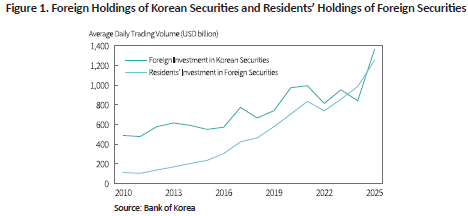
A key rationale for internationalizing the won is to improve alignment between Korea’s highly internationalized capital markets and the foreign exchange infrastructure that supports them. Korea’s capital markets have become closely integrated into global portfolio investment as foreign investment in Korean equities and bonds has expanded and Korean residents’ investment in foreign securities has grown substantially. As shown in Figure 1, both foreign holdings of Korean securities and residents’ holdings of foreign securities have risen sharply. By the end of 2025, the combined stock of cross-border portfolio investment had reached approximately USD 2.618 trillion, more than four times its level at the end of 2010. Nevertheless, KRW trading, hedging, funding, and settlement associated with these cross-border investments continue to depend heavily on Korea’s domestic FX market and domestic financial institutions.
Korea’s potential reclassification as a developed market by MSCI illustrates this mismatch. In its 2026 Market Classification Review, MSCI again identified the limited offshore convertibility of the won as one of the principal impediments to Korea’s reclassification as a developed market. While acknowledging recent reforms—including longer FX trading hours and broader access to the domestic market for foreign financial institutions—MSCI noted that offshore delivery of the won remained restricted and that liquidity during extended trading hours had yet to reach levels comparable with those of developed-market currencies.
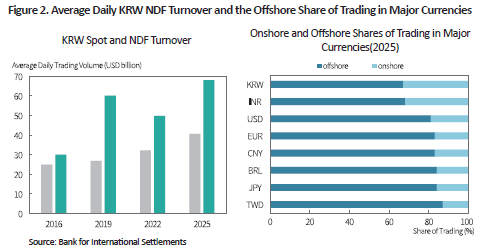
This assessment is also consistent with the structure of KRW trading observed in practice. Lee and Kim (2023) find that the volume of transactions in Korea’s onshore FX market remains relatively small in relation to the size of the real economy, the development of its capital markets, and the scale of cross-border securities investment. By contrast, offshore KRW/USD NDF transactions by non-residents have grown rapidly. This suggests that the issue is not a lack of global demand for KRW transactions. Rather, limitations in the trading and settlement infrastructure of the domestic FX market have led a substantial share of this demand to migrate to the offshore NDF market. As Figure 2 shows, approximately 68% of all KRW FX transactions take place offshore, indicating that the center of gravity of KRW trading has shifted decisively beyond Korea’s borders. This highlights how the internationalization of the infrastructure for KRW trading has lagged behind the internationalization of Korea’s capital markets.
From this perspective, KRW internationalization should be understood not merely as an initiative to expand the FX market itself, but also as a means of improving access to Korea’s capital markets. MSCI’s market accessibility assessment covers not only equity market rules, but also the operational efficiency of the investment process, including foreign exchange transactions, the free flow of capital, account and settlement arrangements, and the repatriation of investment proceeds. KRW internationalization is therefore an essential foundation for building trading and settlement infrastructure commensurate with Korea’s internationalized capital markets and for improving global investors’ access to Korean assets.
Broadening the Global KRW Liquidity Base
The most direct expected benefit of KRW internationalization is the extension of the currency’s liquidity base to global financial markets. Global demand for KRW transactions is already substantial. Offshore transactions, however, are heavily concentrated in NDFs, which settle exchange-rate differences in US dollars without the physical delivery of won. According to Schmittmann and Chua (2020), NDF transactions in the Korean won, Indian rupee, and New Taiwan dollar together accounted for more than half of global NDF turnover in 2019. For these currencies, NDF turnover exceeded turnover in other FX instruments, including spot transactions. This pattern persisted in 2025. As shown in Figure 2, average daily global turnover in KRW/USD NDFs reached approximately USD 68.1 billion, about twice the turnover in the spot market. This indicates that global investors and financial institutions already have substantial demand to trade and manage KRW exposures.
The principal constraint is that this demand is concentrated in the relatively narrow market structure of NDFs. If offshore participants are able to hold, obtain funding in, and settle actual Korean won, some existing NDF demand could migrate to—or generate additional activity in—the spot, deliverable forward, FX swap, and short-term KRW funding markets. KRW internationalization should therefore be viewed less as an attempt to create entirely new demand for the won than as a process of removing institutional constraints so that existing global demand for KRW transactions can translate into actual holdings, funding, and settlement in won and become connected to a broader range of financial instruments and markets.
The importance of this distinction in market structure is also supported by the literature. Caballero et al. (2022) show that FX swaps tend to be the predominant derivative instrument for deliverable currencies, as they are widely used to fund and hedge cross-border investment. Transactions in non-deliverable currencies, by contrast, tend to be concentrated in the NDF market. A broader range of instruments could therefore contribute to greater liquidity across the FX market as a whole. Patel and Xia (2019) find that the expansion of offshore trading in emerging-market currencies can improve FX market liquidity and reduce transaction costs. They also note that the spread of electronic trading, the participation of a diverse range of global financial institutions, and the overlap of trading hours across major financial centers can broaden the trading base and facilitate near-round-the-clock trading.
Against this background, the objective of KRW internationalization need not be defined solely as the creation of a large, stand-alone offshore KRW market. The approach being pursued by the Korean government and the Bank of Korea is to connect a 24-hour domestic FX market with offshore KRW settlement infrastructure and to enable offshore demand to flow into a wider range of instruments, including spot transactions and FX swaps. The ultimate objective is to establish an integrated global KRW liquidity pool spanning both onshore and offshore markets.
Regulatory liberalization alone, however, will not automatically produce such a liquidity base. Meaningful participation by global banks and institutional investors, together with reliable two-way price quotations from market makers, will also be required. The success of the policy should therefore be judged not simply by an increase in offshore transaction volumes or the formal availability of offshore trading, but by whether actual KRW trading and liquidity provision by global market participants develop sufficiently to create a market of adequate scale and depth.
Enhancing Foreign Exchange Market Efficiency
An expanded global KRW liquidity base could do more than increase transaction volumes: it could also deepen the FX market and improve price discovery. A larger number of participants would bring a more diverse range of exchange-rate views and trading motives to the market. This would increase the capacity of the market to absorb one-sided order flows. In Korea’s domestic FX market, transactions associated with trade settlement, exporters’ conversion of foreign-currency receipts, or residents’ foreign securities investment may at times become concentrated in one direction, allowing order flows to exert a relatively large short-term impact on the exchange rate. If global banks, institutional investors, and market makers become more active in KRW trading, the price impact of a given amount of FX demand could be reduced.
The model-based analysis of Lee and Kim (2023) likewise shows that an increase in the number of FX market participants can raise transaction volumes without a significant increase in exchange-rate volatility. In particular, securing a sufficient number of participants during extended trading hours can increase turnover while reducing volatility. This indicates that market opening can mitigate the price impact of idiosyncratic order-flow shocks when higher transaction volumes are accompanied by greater market depth.
Korea’s recent experience with extended FX trading hours provides further support for this possibility. Kang (2026) finds that, following the extension of trading hours in July 2024, volatility in the onshore market during the newly added evening hours was no higher than the volatility previously observed in the NDF market over the corresponding period. The analysis also finds a statistically significant decline in gap volatility that had previously accumulated while the domestic market was closed. These findings suggest that longer trading hours can improve price discovery by allowing information to be incorporated into exchange rates more continuously.
An increase in global KRW trading, however, will not necessarily result in greater exchange-rate stability under all circumstances. Patel and Xia (2019) find that price discovery generally operates in both directions between onshore spot and offshore NDF markets during normal periods. During episodes of heightened global financial stress, however, the offshore NDF market tends to exert a stronger leading influence on onshore prices. Greater internationalization and closer integration with global financial markets may therefore also allow external information and shocks to be transmitted more rapidly to the KRW market. Efforts to broaden and deepen the market should consequently be accompanied by stronger surveillance of onshore and offshore transactions and a robust liquidity management framework for periods of market stress.
Policy Implications
The Korean government’s KRW internationalization initiative can be viewed as an effort to build trading and settlement infrastructure commensurate with Korea’s already internationalized capital markets and to extend the KRW liquidity base from the domestic market to the global financial system. Given that limited offshore convertibility and insufficient FX market liquidity have long been identified as major market-accessibility concerns for Korea’s capital markets, KRW internationalization is not merely an FX market liberalization initiative. It is also a foundational reform aimed at enhancing the global accessibility and competitiveness of Korea’s capital markets.
Accordingly, future policy should focus less on formal liberalization itself and more on whether a KRW market of sufficient scale and depth develops in practice. Policy performance should be assessed primarily in terms of improvements in the breadth and depth of the market—including turnover, bid-ask spreads, the price impact of large orders, liquidity during overnight trading hours, and participation by global financial institutions—rather than movements in the KRW/USD exchange rate. At the same time, Korea should strengthen its surveillance of onshore and offshore transactions and its liquidity provision framework in preparation for the more rapid transmission of changes in global financial conditions to the KRW market.
Deeper KRW liquidity may improve the ease of trading in the won and KRW-denominated assets, increase their attractiveness to investors, and reduce any valuation discount associated with limited liquidity. It may therefore have a positive effect on the value of the won. Empirical evidence of a direct causal relationship between currency internationalization and currency appreciation, however, remains limited. A stronger won should consequently not be treated as the direct objective of the policy, but rather as a possible ancillary benefit arising from the development of a deeper and more efficient FX market.
Ultimately, the central purpose of KRW internationalization is not to “make the won stronger,” but to “make the won a deeper and more liquid currency.” Its success should therefore be judged not by short-term exchange-rate movements, but by whether Korea develops a sufficiently deep pool of KRW liquidity and a robust infrastructure for trading, settlement, and risk management.
Improving Alignment Between the Capital Market and the Foreign Exchange Market
A key rationale for internationalizing the won is to improve alignment between Korea’s highly internationalized capital markets and the foreign exchange infrastructure that supports them. Korea’s capital markets have become closely integrated into global portfolio investment as foreign investment in Korean equities and bonds has expanded and Korean residents’ investment in foreign securities has grown substantially. As shown in Figure 1, both foreign holdings of Korean securities and residents’ holdings of foreign securities have risen sharply. By the end of 2025, the combined stock of cross-border portfolio investment had reached approximately USD 2.618 trillion, more than four times its level at the end of 2010. Nevertheless, KRW trading, hedging, funding, and settlement associated with these cross-border investments continue to depend heavily on Korea’s domestic FX market and domestic financial institutions.
This assessment is also consistent with the structure of KRW trading observed in practice. Lee and Kim (2023) find that the volume of transactions in Korea’s onshore FX market remains relatively small in relation to the size of the real economy, the development of its capital markets, and the scale of cross-border securities investment. By contrast, offshore KRW/USD NDF transactions by non-residents have grown rapidly. This suggests that the issue is not a lack of global demand for KRW transactions. Rather, limitations in the trading and settlement infrastructure of the domestic FX market have led a substantial share of this demand to migrate to the offshore NDF market. As Figure 2 shows, approximately 68% of all KRW FX transactions take place offshore, indicating that the center of gravity of KRW trading has shifted decisively beyond Korea’s borders. This highlights how the internationalization of the infrastructure for KRW trading has lagged behind the internationalization of Korea’s capital markets.
From this perspective, KRW internationalization should be understood not merely as an initiative to expand the FX market itself, but also as a means of improving access to Korea’s capital markets. MSCI’s market accessibility assessment covers not only equity market rules, but also the operational efficiency of the investment process, including foreign exchange transactions, the free flow of capital, account and settlement arrangements, and the repatriation of investment proceeds. KRW internationalization is therefore an essential foundation for building trading and settlement infrastructure commensurate with Korea’s internationalized capital markets and for improving global investors’ access to Korean assets.
Broadening the Global KRW Liquidity Base
The most direct expected benefit of KRW internationalization is the extension of the currency’s liquidity base to global financial markets. Global demand for KRW transactions is already substantial. Offshore transactions, however, are heavily concentrated in NDFs, which settle exchange-rate differences in US dollars without the physical delivery of won. According to Schmittmann and Chua (2020), NDF transactions in the Korean won, Indian rupee, and New Taiwan dollar together accounted for more than half of global NDF turnover in 2019. For these currencies, NDF turnover exceeded turnover in other FX instruments, including spot transactions. This pattern persisted in 2025. As shown in Figure 2, average daily global turnover in KRW/USD NDFs reached approximately USD 68.1 billion, about twice the turnover in the spot market. This indicates that global investors and financial institutions already have substantial demand to trade and manage KRW exposures.
The importance of this distinction in market structure is also supported by the literature. Caballero et al. (2022) show that FX swaps tend to be the predominant derivative instrument for deliverable currencies, as they are widely used to fund and hedge cross-border investment. Transactions in non-deliverable currencies, by contrast, tend to be concentrated in the NDF market. A broader range of instruments could therefore contribute to greater liquidity across the FX market as a whole. Patel and Xia (2019) find that the expansion of offshore trading in emerging-market currencies can improve FX market liquidity and reduce transaction costs. They also note that the spread of electronic trading, the participation of a diverse range of global financial institutions, and the overlap of trading hours across major financial centers can broaden the trading base and facilitate near-round-the-clock trading.
Against this background, the objective of KRW internationalization need not be defined solely as the creation of a large, stand-alone offshore KRW market. The approach being pursued by the Korean government and the Bank of Korea is to connect a 24-hour domestic FX market with offshore KRW settlement infrastructure and to enable offshore demand to flow into a wider range of instruments, including spot transactions and FX swaps. The ultimate objective is to establish an integrated global KRW liquidity pool spanning both onshore and offshore markets.
Regulatory liberalization alone, however, will not automatically produce such a liquidity base. Meaningful participation by global banks and institutional investors, together with reliable two-way price quotations from market makers, will also be required. The success of the policy should therefore be judged not simply by an increase in offshore transaction volumes or the formal availability of offshore trading, but by whether actual KRW trading and liquidity provision by global market participants develop sufficiently to create a market of adequate scale and depth.
Enhancing Foreign Exchange Market Efficiency
An expanded global KRW liquidity base could do more than increase transaction volumes: it could also deepen the FX market and improve price discovery. A larger number of participants would bring a more diverse range of exchange-rate views and trading motives to the market. This would increase the capacity of the market to absorb one-sided order flows. In Korea’s domestic FX market, transactions associated with trade settlement, exporters’ conversion of foreign-currency receipts, or residents’ foreign securities investment may at times become concentrated in one direction, allowing order flows to exert a relatively large short-term impact on the exchange rate. If global banks, institutional investors, and market makers become more active in KRW trading, the price impact of a given amount of FX demand could be reduced.
The model-based analysis of Lee and Kim (2023) likewise shows that an increase in the number of FX market participants can raise transaction volumes without a significant increase in exchange-rate volatility. In particular, securing a sufficient number of participants during extended trading hours can increase turnover while reducing volatility. This indicates that market opening can mitigate the price impact of idiosyncratic order-flow shocks when higher transaction volumes are accompanied by greater market depth.
Korea’s recent experience with extended FX trading hours provides further support for this possibility. Kang (2026) finds that, following the extension of trading hours in July 2024, volatility in the onshore market during the newly added evening hours was no higher than the volatility previously observed in the NDF market over the corresponding period. The analysis also finds a statistically significant decline in gap volatility that had previously accumulated while the domestic market was closed. These findings suggest that longer trading hours can improve price discovery by allowing information to be incorporated into exchange rates more continuously.
An increase in global KRW trading, however, will not necessarily result in greater exchange-rate stability under all circumstances. Patel and Xia (2019) find that price discovery generally operates in both directions between onshore spot and offshore NDF markets during normal periods. During episodes of heightened global financial stress, however, the offshore NDF market tends to exert a stronger leading influence on onshore prices. Greater internationalization and closer integration with global financial markets may therefore also allow external information and shocks to be transmitted more rapidly to the KRW market. Efforts to broaden and deepen the market should consequently be accompanied by stronger surveillance of onshore and offshore transactions and a robust liquidity management framework for periods of market stress.
Policy Implications
The Korean government’s KRW internationalization initiative can be viewed as an effort to build trading and settlement infrastructure commensurate with Korea’s already internationalized capital markets and to extend the KRW liquidity base from the domestic market to the global financial system. Given that limited offshore convertibility and insufficient FX market liquidity have long been identified as major market-accessibility concerns for Korea’s capital markets, KRW internationalization is not merely an FX market liberalization initiative. It is also a foundational reform aimed at enhancing the global accessibility and competitiveness of Korea’s capital markets.
Accordingly, future policy should focus less on formal liberalization itself and more on whether a KRW market of sufficient scale and depth develops in practice. Policy performance should be assessed primarily in terms of improvements in the breadth and depth of the market—including turnover, bid-ask spreads, the price impact of large orders, liquidity during overnight trading hours, and participation by global financial institutions—rather than movements in the KRW/USD exchange rate. At the same time, Korea should strengthen its surveillance of onshore and offshore transactions and its liquidity provision framework in preparation for the more rapid transmission of changes in global financial conditions to the KRW market.
Deeper KRW liquidity may improve the ease of trading in the won and KRW-denominated assets, increase their attractiveness to investors, and reduce any valuation discount associated with limited liquidity. It may therefore have a positive effect on the value of the won. Empirical evidence of a direct causal relationship between currency internationalization and currency appreciation, however, remains limited. A stronger won should consequently not be treated as the direct objective of the policy, but rather as a possible ancillary benefit arising from the development of a deeper and more efficient FX market.
Ultimately, the central purpose of KRW internationalization is not to “make the won stronger,” but to “make the won a deeper and more liquid currency.” Its success should therefore be judged not by short-term exchange-rate movements, but by whether Korea develops a sufficiently deep pool of KRW liquidity and a robust infrastructure for trading, settlement, and risk management.