Our bi-weekly Opinion provides you with latest updates and analysis on major capital market and financial investment industry issues.
Recent Changes in Government Bond Issuance Strategies in Major Economies and Their Implications
Publication date Oct. 06, 2026

Summary
Major economies face changing conditions for government bond issuance as fiscal financing needs remain high, central banks reduce their bond holdings, and investor demand for long-dated bonds weakens. The United States is making greater use of short- and medium-term securities and T-bills, while Japan is reducing the share of super-long-term issuance and preparing to introduce floating-rate government bonds. The United Kingdom is also lowering the shares of long-dated conventional gilts and index-linked gilts in favor of short- and medium-dated gilts, while seeking to expand its T-bill market. These shifts show that debt managers are taking investor demand across maturities into account while seeking to balance borrowing costs and financing stability.
These countries have substantially higher government debt-to-GDP ratios than Korea and different investor bases in their government bond markets, making it difficult to apply their issuance strategies directly to Korea. Nevertheless, their experience suggests that Korea should review demand and borrowing costs by maturity to make its Korea Treasury Bond (KTB) issuance strategy more efficient. In particular, as insurers’ demand for super-long-term bonds, which has supported the expansion of 30-year issuance, moderates, Korea should seek an appropriate share of 30-year bonds in total KTB issuance. It should also identify investor needs that existing KTB maturities and product structures do not adequately serve and broaden the investor base by offering products that meet those needs. As part of this effort, Korea should consider introducing short-term KTBs with maturities of one year or less to tap demand in the money market, including from MMFs.
These countries have substantially higher government debt-to-GDP ratios than Korea and different investor bases in their government bond markets, making it difficult to apply their issuance strategies directly to Korea. Nevertheless, their experience suggests that Korea should review demand and borrowing costs by maturity to make its Korea Treasury Bond (KTB) issuance strategy more efficient. In particular, as insurers’ demand for super-long-term bonds, which has supported the expansion of 30-year issuance, moderates, Korea should seek an appropriate share of 30-year bonds in total KTB issuance. It should also identify investor needs that existing KTB maturities and product structures do not adequately serve and broaden the investor base by offering products that meet those needs. As part of this effort, Korea should consider introducing short-term KTBs with maturities of one year or less to tap demand in the money market, including from MMFs.
In major economies, persistently high fiscal financing needs and declining central bank holdings of government bonds have increased the volume of bonds that private investors must absorb. As a result, issuance strategies that take investor demand into account have become increasingly important. In particular, as demand for long-term bonds has weakened and long-term government bond yields have risen, governments have been adjusting the maturity composition of issuance to reflect shifts in demand. These adjustments show that debt managers are responding to investor demand across maturities while seeking to balance borrowing costs and financing stability. This article examines changes in government bond issuance strategies in major economies and draws implications for Korea's KTB market.
Government Bond Issuance Strategies That Take Investor Demand into Account
A common set of objectives and principles for government bond issuance strategies has been established internationally. The IMF and World Bank's public debt management guidelines identify the central objective of debt management as minimizing borrowing costs over the medium to long term while keeping refinancing and interest-rate risks at prudent levels.1) To this end, they recommend building a broad investor base, maintaining regular communication with investors, and enhancing the transparency and predictability of government bond issuance. These recommendations underscore the importance of taking market demand into account to achieve efficient and stable financing. Issuance volumes and maturity structures should therefore reflect investor demand across maturities.
This approach also has a theoretical basis. According to preferred-habitat theory, government bond markets have distinct investor clienteles across maturities, so bonds of different maturities are not perfect substitutes.2) Pension funds and insurers, for example, prefer long-dated bonds to manage the interest-rate risk of their long-term liabilities, whereas MMFs and banks favor short-dated bonds for liquidity management. A change in demand at a particular maturity can therefore affect yields in that segment, suggesting that debt managers should take demand by maturity into account when adjusting issuance shares.3)
These considerations have become more salient as the investor base for government bonds changes. The OECD notes that, in major government bond markets, relatively price-insensitive investors such as central banks are accounting for a smaller share of holdings, while price-sensitive private investors are playing a greater role. Changes in investor composition may therefore constrain decisions on issuance volumes and the maturity composition of issuance.4) Debt managers should continually assess whether changes in demand by maturity are temporary or structural. Where changes are judged to be structural, they should adjust issuance shares while maintaining transparency and predictability.
Changes in Government Bond Issuance Strategies in Major Economies
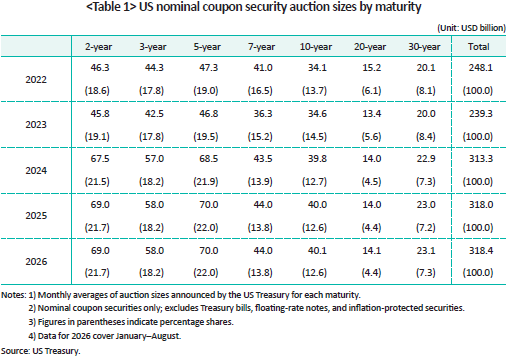
In the United States, the Treasury has expanded issuance mainly in short- and medium-term securities to meet increased fiscal financing needs.5) Trends in auction sizes by maturity (Table 1) show that increases have been concentrated in 2-, 3-, and 5-year notes, while increases in longer-dated securities have been relatively limited. As a result, the combined share of 2-, 3-, and 5-year notes in the total auction size of nominal coupon securities rose from 55.5% in 2022 to 61.9% in January–August 2026. This can be understood as a strategy to tap into the relatively strong demand for short- and medium-term securities while limiting the rise in funding costs associated with a larger supply of long-term bonds. This shift in the maturity composition of issuance is also linked to changes in the investor base for US Treasuries: price-sensitive private investors have become more important as the roles of relatively price-insensitive holders, such as the Federal Reserve and foreign official institutions, have diminished.6)
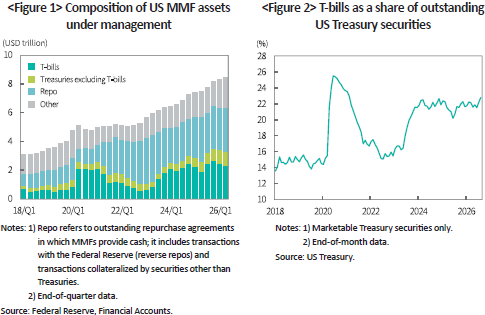
The Treasury has also made active use of T-bills to meet fiscal financing needs. With the Federal Reserve’s policy rate remaining elevated for an extended period, MMF assets under management have grown substantially, creating strong demand in the money market (Figure 1).7) Against this backdrop, the Treasury has expanded T-bill issuance, raising the share of T-bills in outstanding marketable Treasury securities to 22.8% at the end of August 2026 (Figure 2). Meanwhile, the Treasury has increased buybacks in longer-dated segments to support liquidity in long-term securities.8) If the additional funding needed for these larger buybacks is raised mainly through T-bill issuance, reliance on short-term financing could rise further. So far, demand from MMFs and other investors has enabled the smooth absorption of T-bills. However, concerns have been raised that a continued increase in the share of short-term debt could heighten refinancing risk and cause interest costs to rise more quickly when market interest rates increase.9)
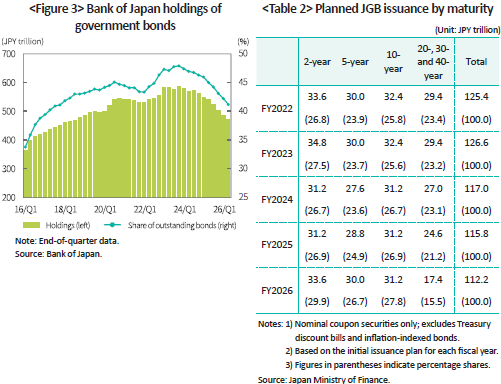
In Japan, government bond market conditions are changing as the Bank of Japan (BOJ) reduces its purchases and demand for super-long-term bonds weakens. The BOJ was a key source of demand during large-scale quantitative easing, but its holdings have steadily declined as it scales back purchases in the course of monetary policy normalization (Figure 3).10) As private investors must absorb a larger volume of government bonds, debt managers face a greater challenge in maintaining the investor base. Life insurers with long-term liabilities have been major investors in the super-long-term segment. Recently, however, life insurers have largely completed efforts to narrow their duration gaps in response to regulatory requirements, while volatility in super-long-term bonds has increased. Their demand for additional super-long-term bonds has consequently moderated.11)
In response, Japan's Ministry of Finance has reduced super-long-term issuance and made its issuance strategy more flexible. In June 2025, it revised the FY2025 issuance plan to reduce the amount offered at each auction of 20-, 30-, and 40-year bonds. It offset those reductions by expanding issuance of 2-year bonds and Treasury discount bills and increasing sales of government bonds to retail investors. In the FY2026 issuance plan announced in December 2025, the ministry further reduced the amount of super-long-term bonds offered per auction while increasing sales to retail investors. These measures can be seen as a response to supply-demand pressures in the super-long-term segment and feedback from market participants (Table 2). In addition, reflecting investor demand, the ministry plans to begin issuing floating-rate government bonds linked to short-term interest rates in January 2027 or later. This can be viewed as an effort to diversify the investor base by offering an instrument with relatively low duration exposure amid heightened interest-rate volatility.
In the United Kingdom, markets for long-dated conventional gilts and index-linked gilts have developed on the back of demand from defined-benefit (DB) pension schemes seeking to hedge long-term liabilities. More recently, however, weaker pension fund demand has been changing the investor base.12) DB pension schemes have traditionally used liability-driven investment (LDI) strategies and have been a key source of demand for long-dated gilts. Since 2022, higher interest rates have improved their funding positions, reducing the need for additional purchases of long-dated gilts. A larger share of long-dated issuance is consequently being absorbed by more price-sensitive investors.13) The UK Treasury has also assessed, based on feedback from market participants, that demand for long-dated conventional gilts is declining over the medium term and that demand for index-linked gilts has weakened recently.14)
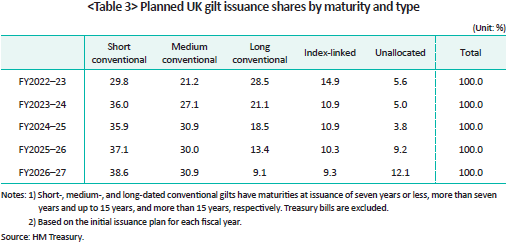
In response, the UK Treasury has adjusted its issuance strategy to make greater use of short- and medium-dated gilts. The gilt issuance plans (Table 3) show that the planned share of long-dated conventional gilts fell sharply from 28.5% in FY2022–23 to 9.1% in FY2026–27, while the shares of short- and medium-dated conventional gilts rose from 29.8% and 21.2% to 38.6% and 30.9%, respectively.15) The share of index-linked gilts has also declined. In particular, the unallocated share—which can be deployed flexibly according to market conditions rather than assigned to a specified maturity or security type—was increased to 12.1% in the FY2026–27 issuance plan, providing more scope to respond to changing demand. The United Kingdom is also seeking to expand its Treasury bill market, including by introducing regular issuance of bills with maturities of around 12 months by the end of FY2026–27. This can be seen as an effort to develop a broader investor base.16)
Implications for the KTB Market
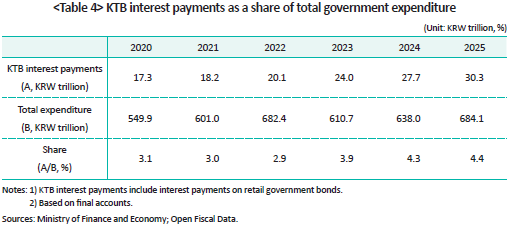
The major economies discussed above have much higher government debt-to-GDP ratios than Korea17) and different investor bases in their government bond markets. Their issuance strategies are therefore difficult to apply directly to Korea. Nevertheless, their adjustments to the maturity mix in response to weaker demand for long-term bonds deserve attention. In Korea, KTB interest payments account for a growing share of total government expenditure (Table 4), and KTB yields have also risen recently, increasing the need for a more efficient issuance strategy. Korea should closely examine investor demand and funding costs across maturities to seek an appropriate maturity structure and balance the government's interest burden against refinancing risk.
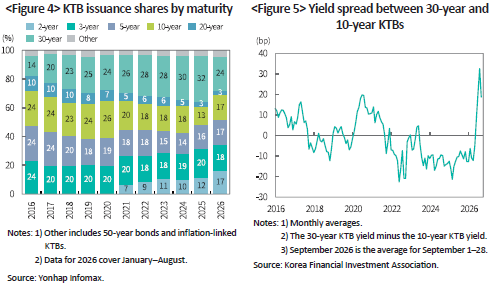
A defining feature of Korea's KTB issuance in recent years has been the growing share of 30-year bonds, supported by demand from insurers. This share reached 31.5% in 2025 (Figure 4). However, insurers have extended the duration of their assets substantially, and recent increases in market interest rates have improved their solvency ratios, moderating their demand for additional super-long-term bonds.18) Alongside this shift in demand, the yield inversion in which 30-year KTB yields were below 10-year yields has recently begun to unwind (Figure 5). The government’s decision to reduce the share of 30-year issuance in 2026 can be seen as consistent with these changed demand conditions. As 30-year bonds still account for a large share of KTB issuance, the government should continue to seek an appropriate share by weighing the benefit of more stable long-term financing against the accompanying borrowing costs.
Efforts to diversify the KTB investor base should also continue. To this end, debt managers should identify investor needs that existing KTB maturities and product structures do not adequately serve and consider introducing new instruments to meet those needs. In particular, Korea does not issue KTBs with maturities of one year or less and thus does not fully tap demand from MMFs and other institutions that manage short-term funds. Given the prospect of continued growth in the KTB market as fiscal financing needs persist, Korea should explore introducing short-term KTBs to draw on the money market as an additional source of demand. Once issuance and secondary trading in short-term KTBs become established, they could also help create the conditions for introducing floating-rate government bonds linked to short-term interest rates. Such product diversification could broaden the investor base and allow a more flexible issuance mix that reflects demand across maturities.
1) IMF & World Bank, 2014, Revised Guidelines for Public Debt Management.
2) Vayanos, D. & Vila, J.-L., 2021, A Preferred-Habitat Model of the Term Structure of Interest Rates, Econometrica 89(1), 77-112.
3) Guibaud, S., Nosbusch, Y. & Vayanos, D., 2013, Bond Market Clienteles, the Yield Curve, and the Optimal Maturity Structure of Government Debt, Review of Financial Studies 26(8), 1914-1961.
4) OECD, 2026, Global Debt Report 2026.
5) The US fiscal balance as a share of GDP deteriorated from an annual average of -3.8% in the pre-pandemic period of FY2016–19 to an annual average of -5.9% in FY2022–25.
6) For changes in the composition of US Treasury investors, see Dilts Stedman, K., 2025, The changing investor composition of U.S. treasuries, Part 1: Foreign treasury sales could raise U.S. yields; and Sengupta, R., Jacobs, J. A., 2025, The changing investor composition of U.S. treasuries, Part 2: Who’s buying U.S. treasuries?, Federal Reserve Bank of Kansas City Economic Bulletin.
7) According to materials from the Treasury Borrowing Advisory Committee for the third quarter of 2026, MMFs are estimated to have historically absorbed about 60% of net T-bill issuance. MMFs also support intermediation in the Treasury market indirectly by supplying funding to dealers in Treasury repo markets, in addition to holding Treasuries directly. More recently, dollar stablecoin issuers have also emerged as a new source of demand for T-bills through the management of their reserve assets.
8) The US Treasury’s liquidity-support buybacks purchase outstanding off-the-run securities to improve secondary market liquidity. Purchases are financed mainly through new Treasury issuance. The Treasury announced that, beginning in September 2026, the maximum purchase amount per operation for securities with remaining maturities of 10–20 years and 20–30 years would increase from USD 2 billion to at least USD 4 billion. For its September 10 buyback operation, the Treasury announced plans to repurchase up to USD 6 billion in securities with remaining maturities of 10 to 20 years. Since Treasury Secretary Scott Bessent described the expansion of long-dated buybacks as a “Treasury twist” in an August 20 CNBC interview, the measure can also be interpreted as intended to ease upward pressure on long-term yields.
9) In its April 2026 Global Financial Stability Report, the IMF noted that greater reliance on short-term issuance in major government bond markets could increase refinancing risk. It noted, in particular, that during periods of rising inflation, refinancing short-term debt at higher rates could increase governments’ interest costs.
10) Following its July 2024 announcement of a plan to reduce JGB purchases, the BOJ has gradually lowered monthly purchases from approximately JPY 5.7 trillion at that time. Under the plan announced in June 2026, monthly purchases are scheduled to be approximately JPY 2.5 trillion in July–September 2026 and to decline to around JPY 2 trillion from April 2027 onward.
11) In its April 2026 Financial System Report, the BOJ assessed that life insurers had largely completed the reduction of duration gaps in response to the introduction of economic value-based solvency regulation (ESR) and were cautious about adding to their holdings of super-long-term government bonds amid greater volatility in that segment. In addition, higher market interest rates, particularly at super-long maturities, had increased unrealized losses on their yen-denominated bond holdings.
12) The Bank of England’s share of outstanding UK government bonds, excluding Treasury bills, also declined sharply, from 33.8% at the end of 2021 to 16.6% at the end of March 2026.
13) Panigrahi, L. & Sidhu, A., 2026, What were the drivers of UK long-term interest rates in 2025?, Bank of England.
14) HM Treasury, 2026, Debt management report 2026-27.
15) HM Treasury classifies conventional gilts by maturity at issuance as short-dated (seven years or less), medium-dated (more than seven years and up to 15 years), and long-dated (more than 15 years). This article uses the same classification.
16) In May 2026, following a consultation on the Treasury bill market, HM Treasury and the UK Debt Management Office (DMO) decided to introduce regular issuance of T-bills with maturities of around 12 months by the end of fiscal 2026–27. To support secondary market activity, they also plan to introduce a standing repo facility through which Treasury bills can be borrowed temporarily and to establish a Treasury bill collateral pool to support it. For details, see HM Treasury & UK DMO, 2026, The UK Treasury Bill Market: Consultation response.
17) According to the IMF’s April 2026 Fiscal Monitor, gross general government debt amounted to 52.3%, 123.9%, 206.5% and 102.3% of GDP in Korea, the United States, Japan and the United Kingdom, respectively, in 2025.
18) Bank of Korea, 2026, Factors behind the recent weakness in foreign investment in Korean bonds, BOK Reports: Collection of financial and economic issue analyses (in Korean).
Government Bond Issuance Strategies That Take Investor Demand into Account
A common set of objectives and principles for government bond issuance strategies has been established internationally. The IMF and World Bank's public debt management guidelines identify the central objective of debt management as minimizing borrowing costs over the medium to long term while keeping refinancing and interest-rate risks at prudent levels.1) To this end, they recommend building a broad investor base, maintaining regular communication with investors, and enhancing the transparency and predictability of government bond issuance. These recommendations underscore the importance of taking market demand into account to achieve efficient and stable financing. Issuance volumes and maturity structures should therefore reflect investor demand across maturities.
This approach also has a theoretical basis. According to preferred-habitat theory, government bond markets have distinct investor clienteles across maturities, so bonds of different maturities are not perfect substitutes.2) Pension funds and insurers, for example, prefer long-dated bonds to manage the interest-rate risk of their long-term liabilities, whereas MMFs and banks favor short-dated bonds for liquidity management. A change in demand at a particular maturity can therefore affect yields in that segment, suggesting that debt managers should take demand by maturity into account when adjusting issuance shares.3)
These considerations have become more salient as the investor base for government bonds changes. The OECD notes that, in major government bond markets, relatively price-insensitive investors such as central banks are accounting for a smaller share of holdings, while price-sensitive private investors are playing a greater role. Changes in investor composition may therefore constrain decisions on issuance volumes and the maturity composition of issuance.4) Debt managers should continually assess whether changes in demand by maturity are temporary or structural. Where changes are judged to be structural, they should adjust issuance shares while maintaining transparency and predictability.
Changes in Government Bond Issuance Strategies in Major Economies
In the United States, the Treasury has expanded issuance mainly in short- and medium-term securities to meet increased fiscal financing needs.5) Trends in auction sizes by maturity (Table 1) show that increases have been concentrated in 2-, 3-, and 5-year notes, while increases in longer-dated securities have been relatively limited. As a result, the combined share of 2-, 3-, and 5-year notes in the total auction size of nominal coupon securities rose from 55.5% in 2022 to 61.9% in January–August 2026. This can be understood as a strategy to tap into the relatively strong demand for short- and medium-term securities while limiting the rise in funding costs associated with a larger supply of long-term bonds. This shift in the maturity composition of issuance is also linked to changes in the investor base for US Treasuries: price-sensitive private investors have become more important as the roles of relatively price-insensitive holders, such as the Federal Reserve and foreign official institutions, have diminished.6)
The Treasury has also made active use of T-bills to meet fiscal financing needs. With the Federal Reserve’s policy rate remaining elevated for an extended period, MMF assets under management have grown substantially, creating strong demand in the money market (Figure 1).7) Against this backdrop, the Treasury has expanded T-bill issuance, raising the share of T-bills in outstanding marketable Treasury securities to 22.8% at the end of August 2026 (Figure 2). Meanwhile, the Treasury has increased buybacks in longer-dated segments to support liquidity in long-term securities.8) If the additional funding needed for these larger buybacks is raised mainly through T-bill issuance, reliance on short-term financing could rise further. So far, demand from MMFs and other investors has enabled the smooth absorption of T-bills. However, concerns have been raised that a continued increase in the share of short-term debt could heighten refinancing risk and cause interest costs to rise more quickly when market interest rates increase.9)
In Japan, government bond market conditions are changing as the Bank of Japan (BOJ) reduces its purchases and demand for super-long-term bonds weakens. The BOJ was a key source of demand during large-scale quantitative easing, but its holdings have steadily declined as it scales back purchases in the course of monetary policy normalization (Figure 3).10) As private investors must absorb a larger volume of government bonds, debt managers face a greater challenge in maintaining the investor base. Life insurers with long-term liabilities have been major investors in the super-long-term segment. Recently, however, life insurers have largely completed efforts to narrow their duration gaps in response to regulatory requirements, while volatility in super-long-term bonds has increased. Their demand for additional super-long-term bonds has consequently moderated.11)
In response, Japan's Ministry of Finance has reduced super-long-term issuance and made its issuance strategy more flexible. In June 2025, it revised the FY2025 issuance plan to reduce the amount offered at each auction of 20-, 30-, and 40-year bonds. It offset those reductions by expanding issuance of 2-year bonds and Treasury discount bills and increasing sales of government bonds to retail investors. In the FY2026 issuance plan announced in December 2025, the ministry further reduced the amount of super-long-term bonds offered per auction while increasing sales to retail investors. These measures can be seen as a response to supply-demand pressures in the super-long-term segment and feedback from market participants (Table 2). In addition, reflecting investor demand, the ministry plans to begin issuing floating-rate government bonds linked to short-term interest rates in January 2027 or later. This can be viewed as an effort to diversify the investor base by offering an instrument with relatively low duration exposure amid heightened interest-rate volatility.
In the United Kingdom, markets for long-dated conventional gilts and index-linked gilts have developed on the back of demand from defined-benefit (DB) pension schemes seeking to hedge long-term liabilities. More recently, however, weaker pension fund demand has been changing the investor base.12) DB pension schemes have traditionally used liability-driven investment (LDI) strategies and have been a key source of demand for long-dated gilts. Since 2022, higher interest rates have improved their funding positions, reducing the need for additional purchases of long-dated gilts. A larger share of long-dated issuance is consequently being absorbed by more price-sensitive investors.13) The UK Treasury has also assessed, based on feedback from market participants, that demand for long-dated conventional gilts is declining over the medium term and that demand for index-linked gilts has weakened recently.14)
In response, the UK Treasury has adjusted its issuance strategy to make greater use of short- and medium-dated gilts. The gilt issuance plans (Table 3) show that the planned share of long-dated conventional gilts fell sharply from 28.5% in FY2022–23 to 9.1% in FY2026–27, while the shares of short- and medium-dated conventional gilts rose from 29.8% and 21.2% to 38.6% and 30.9%, respectively.15) The share of index-linked gilts has also declined. In particular, the unallocated share—which can be deployed flexibly according to market conditions rather than assigned to a specified maturity or security type—was increased to 12.1% in the FY2026–27 issuance plan, providing more scope to respond to changing demand. The United Kingdom is also seeking to expand its Treasury bill market, including by introducing regular issuance of bills with maturities of around 12 months by the end of FY2026–27. This can be seen as an effort to develop a broader investor base.16)
Implications for the KTB Market
The major economies discussed above have much higher government debt-to-GDP ratios than Korea17) and different investor bases in their government bond markets. Their issuance strategies are therefore difficult to apply directly to Korea. Nevertheless, their adjustments to the maturity mix in response to weaker demand for long-term bonds deserve attention. In Korea, KTB interest payments account for a growing share of total government expenditure (Table 4), and KTB yields have also risen recently, increasing the need for a more efficient issuance strategy. Korea should closely examine investor demand and funding costs across maturities to seek an appropriate maturity structure and balance the government's interest burden against refinancing risk.
A defining feature of Korea's KTB issuance in recent years has been the growing share of 30-year bonds, supported by demand from insurers. This share reached 31.5% in 2025 (Figure 4). However, insurers have extended the duration of their assets substantially, and recent increases in market interest rates have improved their solvency ratios, moderating their demand for additional super-long-term bonds.18) Alongside this shift in demand, the yield inversion in which 30-year KTB yields were below 10-year yields has recently begun to unwind (Figure 5). The government’s decision to reduce the share of 30-year issuance in 2026 can be seen as consistent with these changed demand conditions. As 30-year bonds still account for a large share of KTB issuance, the government should continue to seek an appropriate share by weighing the benefit of more stable long-term financing against the accompanying borrowing costs.
Efforts to diversify the KTB investor base should also continue. To this end, debt managers should identify investor needs that existing KTB maturities and product structures do not adequately serve and consider introducing new instruments to meet those needs. In particular, Korea does not issue KTBs with maturities of one year or less and thus does not fully tap demand from MMFs and other institutions that manage short-term funds. Given the prospect of continued growth in the KTB market as fiscal financing needs persist, Korea should explore introducing short-term KTBs to draw on the money market as an additional source of demand. Once issuance and secondary trading in short-term KTBs become established, they could also help create the conditions for introducing floating-rate government bonds linked to short-term interest rates. Such product diversification could broaden the investor base and allow a more flexible issuance mix that reflects demand across maturities.
1) IMF & World Bank, 2014, Revised Guidelines for Public Debt Management.
2) Vayanos, D. & Vila, J.-L., 2021, A Preferred-Habitat Model of the Term Structure of Interest Rates, Econometrica 89(1), 77-112.
3) Guibaud, S., Nosbusch, Y. & Vayanos, D., 2013, Bond Market Clienteles, the Yield Curve, and the Optimal Maturity Structure of Government Debt, Review of Financial Studies 26(8), 1914-1961.
4) OECD, 2026, Global Debt Report 2026.
5) The US fiscal balance as a share of GDP deteriorated from an annual average of -3.8% in the pre-pandemic period of FY2016–19 to an annual average of -5.9% in FY2022–25.
6) For changes in the composition of US Treasury investors, see Dilts Stedman, K., 2025, The changing investor composition of U.S. treasuries, Part 1: Foreign treasury sales could raise U.S. yields; and Sengupta, R., Jacobs, J. A., 2025, The changing investor composition of U.S. treasuries, Part 2: Who’s buying U.S. treasuries?, Federal Reserve Bank of Kansas City Economic Bulletin.
7) According to materials from the Treasury Borrowing Advisory Committee for the third quarter of 2026, MMFs are estimated to have historically absorbed about 60% of net T-bill issuance. MMFs also support intermediation in the Treasury market indirectly by supplying funding to dealers in Treasury repo markets, in addition to holding Treasuries directly. More recently, dollar stablecoin issuers have also emerged as a new source of demand for T-bills through the management of their reserve assets.
8) The US Treasury’s liquidity-support buybacks purchase outstanding off-the-run securities to improve secondary market liquidity. Purchases are financed mainly through new Treasury issuance. The Treasury announced that, beginning in September 2026, the maximum purchase amount per operation for securities with remaining maturities of 10–20 years and 20–30 years would increase from USD 2 billion to at least USD 4 billion. For its September 10 buyback operation, the Treasury announced plans to repurchase up to USD 6 billion in securities with remaining maturities of 10 to 20 years. Since Treasury Secretary Scott Bessent described the expansion of long-dated buybacks as a “Treasury twist” in an August 20 CNBC interview, the measure can also be interpreted as intended to ease upward pressure on long-term yields.
9) In its April 2026 Global Financial Stability Report, the IMF noted that greater reliance on short-term issuance in major government bond markets could increase refinancing risk. It noted, in particular, that during periods of rising inflation, refinancing short-term debt at higher rates could increase governments’ interest costs.
10) Following its July 2024 announcement of a plan to reduce JGB purchases, the BOJ has gradually lowered monthly purchases from approximately JPY 5.7 trillion at that time. Under the plan announced in June 2026, monthly purchases are scheduled to be approximately JPY 2.5 trillion in July–September 2026 and to decline to around JPY 2 trillion from April 2027 onward.
11) In its April 2026 Financial System Report, the BOJ assessed that life insurers had largely completed the reduction of duration gaps in response to the introduction of economic value-based solvency regulation (ESR) and were cautious about adding to their holdings of super-long-term government bonds amid greater volatility in that segment. In addition, higher market interest rates, particularly at super-long maturities, had increased unrealized losses on their yen-denominated bond holdings.
12) The Bank of England’s share of outstanding UK government bonds, excluding Treasury bills, also declined sharply, from 33.8% at the end of 2021 to 16.6% at the end of March 2026.
13) Panigrahi, L. & Sidhu, A., 2026, What were the drivers of UK long-term interest rates in 2025?, Bank of England.
14) HM Treasury, 2026, Debt management report 2026-27.
15) HM Treasury classifies conventional gilts by maturity at issuance as short-dated (seven years or less), medium-dated (more than seven years and up to 15 years), and long-dated (more than 15 years). This article uses the same classification.
16) In May 2026, following a consultation on the Treasury bill market, HM Treasury and the UK Debt Management Office (DMO) decided to introduce regular issuance of T-bills with maturities of around 12 months by the end of fiscal 2026–27. To support secondary market activity, they also plan to introduce a standing repo facility through which Treasury bills can be borrowed temporarily and to establish a Treasury bill collateral pool to support it. For details, see HM Treasury & UK DMO, 2026, The UK Treasury Bill Market: Consultation response.
17) According to the IMF’s April 2026 Fiscal Monitor, gross general government debt amounted to 52.3%, 123.9%, 206.5% and 102.3% of GDP in Korea, the United States, Japan and the United Kingdom, respectively, in 2025.
18) Bank of Korea, 2026, Factors behind the recent weakness in foreign investment in Korean bonds, BOK Reports: Collection of financial and economic issue analyses (in Korean).