Our bi-weekly Opinion provides you with latest updates and analysis on major capital market and financial investment industry issues.
Performance and Market Shares of Retirement Pension Providers
Publication date Oct. 06, 2026

Summary
Korea’s retirement pension market has grown rapidly, with total assets reaching KRW 501.4 trillion at the end of 2025. While the share of defined benefit (DB) plans has declined, defined contribution (DC) plans and individual retirement pension (IRP) accounts have expanded rapidly, along with investment in performance-linked products such as funds, target date funds (TDFs), and exchange-traded funds (ETFs). As a result, product competitiveness and investment performance have become increasingly important in competition among retirement pension providers.
From 2011 to 2025, the Herfindahl-Hirschman Index (HHI) for the retirement pension market changed little, while the combined market share of leading providers increased. At the same time, providers’ market shares have shown considerable persistence, and no clear relationship is observed between long-term investment performance and market-share levels. This suggests that competition among providers has not yet translated sufficiently into market discipline that rewards superior investment performance.
Accordingly, while considering the professional asset-management functions that a fund-based system could offer, Korea also needs to strengthen providers’ authority and responsibility for asset management within the existing contract-based system through measures such as representative investment products, improvements to the default option system, and simplification of investment choices. Competition in the retirement pension market should be judged not merely by the number of providers or the degree of market concentration; it should evolve toward a structure in which superior investment performance leads to participant choice and asset flows.
Retirement pension assets reached KRW 501.4 trillion at the end of 2025, with particularly strong growth in DC plans and individual retirement pension (IRP) accounts. DB plans still account for the largest share, but their share has gradually declined, while the shares of DC plans and IRPs, in which participants make their own investment choices, have continued to rise.
The asset-management structure is also changing. For many years, most retirement pension assets in Korea were invested in principal-protected products such as deposits and insurance products with guaranteed interest rates. More recently, however, growing interest in the equity market has been accompanied by a rapid increase in investment in performance-linked products, including funds, target date funds (TDFs), and exchange-traded funds (ETFs).
These changes are also affecting the competitive structure of the retirement pension market. In the past, competition among retirement pension providers centered mainly on securing corporate clients and offering principal-protected products. More recently, investment performance and product competitiveness have become increasingly important. Competition has expanded not only among retirement pension providers such as securities firms, banks, and insurers, but also among asset-management companies offering funds, TDFs, and ETFs.
The key question is whether the expansion of the market and intensifying competition are actually translating into better outcomes for retirement pension participants. This article examines the competitive structure of Korea’s retirement pension market and the relationship between providers’ investment performance and market shares, and explores ways to promote performance-based competition in which superior investment performance leads to participant choice and asset flows.
Competitive Structure and Investment Performance in the Retirement Pension Market
As of the end of 2025, there were 46 retirement pension providers, of which 43 were active retirement pension administrators. The number of active administrators declined from 51 in 2011 to 43 in 2025.1) Retirement pensions attracted attention as a new business area after their introduction, but as competition among providers intensified, some firms subsequently exited the market.
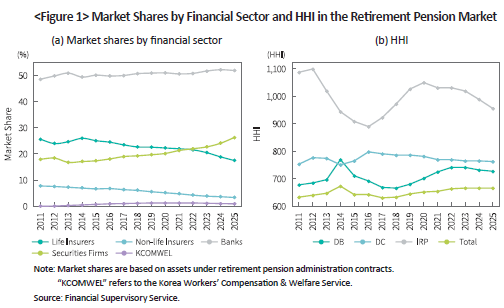
By financial sector, the share of retirement pension assets held by securities firms has increased since 2011, while that of insurers (life and non-life insurers) has declined (see Figure 1(a)). This can be viewed as reflecting the contemporaneous decline in the relative share of DB plans and the expansion of DC plans and IRPs.
Since the introduction of retirement pensions, one of the supervisory authorities’ major concerns has been preventing excessive concentration in a small number of providers while maintaining competition. Market concentration, as measured by the Herfindahl-Hirschman Index (HHI), changed little overall, with the index rising from 632.8 in 2011 to 664.8 in 2025 (see Figure 1(b)). Over the same period, the HHI for DB plans rose modestly from 677.9 to 727.1, while that for DC plans was virtually unchanged, from 751.7 to 761.6. By contrast, the HHI for IRPs declined from 1,087.4 to 955.8, indicating some easing of market concentration.
The three-firm concentration ratio (CR3) declined from 32.7% in 2011 to 31.3% in 2025, while the five-firm ratio (CR5) rose from 46.8% to 48.5% and the ten-firm ratio (CR10) from 68.4% to 74.8%. These results suggest that concentration in a small number of providers has not increased markedly, but at the same time it is difficult to conclude that competition in the market as a whole has clearly intensified. Rather than indicating greater dominance by the top three providers, this pattern appears to reflect an increase in the combined market share of a broader group of leading providers, extending to the top ten.
In financial markets generally, greater competition is expected to lower prices and improve service quality. Applied to the retirement pension market, this logic implies that stronger competition among providers should lower fees, improve investment performance, and induce assets to flow toward better-performing providers. Over the long run, providers with superior performance would be expected to gain market share, while weaker performers would lose it. Thus, for competition in the retirement pension market to improve participant outcomes, it is important not only to have many providers or low market concentration, but also to have market discipline through which provider performance translates into changes in market share.
However, the institutional characteristics of Korea’s retirement pension market can make it difficult for such market discipline to operate effectively. Participants may find it difficult to compare providers’ returns and costs accurately, and the party choosing the provider is often different from the party selecting the actual investment products. In DB plans, the employer selects both the provider and the investment strategy. In DC plans, the provider is generally selected by the employer, while the participant chooses the investment products. IRP holders have relatively greater choice because they can select both the provider and the investment products, but they still face information asymmetries regarding financial institutions and products, as well as search and switching costs associated with changing providers.
These characteristics can also generate substantial persistence in providers’ market shares. Figure 2(a) shows that a large portion of past market share tends to persist over time. This suggests that, in the retirement pension market, provider market shares may be influenced less by short-term investment performance than by factors such as existing client relationships, employers’ selection of providers, and distribution channels.
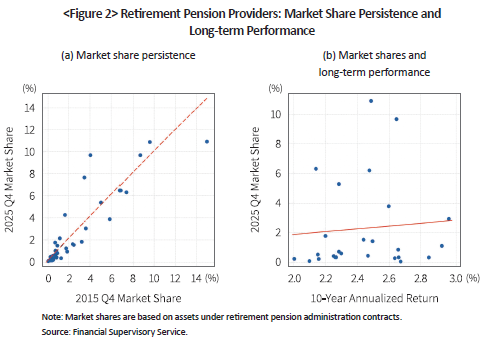
It is therefore useful to examine whether providers with superior long-term performance have higher market shares. Figure 2(b) shows no clear relationship between providers’ long-term investment performance over 2016–2025 and their market-share levels at the end of 2025. This suggests that “performance-based competition,” in which long-term investment performance is sufficiently reflected in providers’ market-share levels, has yet to emerge clearly. However, provider-level returns also reflect participants’ asset allocation and product choices, so they cannot be interpreted solely as reflecting differences in providers’ investment management capabilities.
Policy Measures to Promote Performance-Based Competition
The preceding analysis suggests that even when providers compete, competition alone does not automatically generate performance-based market discipline. One reason is a structural feature of the current retirement pension system: the choice of provider is separated from actual asset-allocation decisions. Accordingly, policy needs to consider not only how to lower market concentration or increase the number of providers, but also how the asset-management structure is designed—who makes asset-allocation decisions for participants and who bears responsibility for the outcomes.
From this perspective, the fund-based retirement pension system currently under discussion could provide one alternative. Under such a system, rather than requiring each participant to select every investment product directly, trustees or professional investment organizations would manage assets collectively. This could facilitate professional asset allocation, economies of scale, long-term investment, and access to a broader range of assets.
A fund-based system, however, does not automatically guarantee higher returns. If fund governance is inadequate or the responsibilities and authority of investment managers are unclear, agency problems may arise. Greater scale may also increase rigidity in asset management. Above all, the performance of a fund-based system depends heavily on who governs the fund, whose interests guide decision-making, and who is accountable for investment performance.
The U.S. experience also offers useful implications. According to the U.S. Department of Labor, the geometric average annual returns of private pension plans with 100 or more participants over 2014–2023 were 5.5% for DB plans, 7.1% for DC plans, and 7.1% for 401(k) plans.2) These figures suggest that professionally managed DB pension funds do not necessarily deliver higher returns than individual-account DC plans.
One reason is that 401(k) plans do not simply leave all asset-management decisions to individuals. The growing use of low-cost index funds and TDFs, together with automatic enrollment and default investment vehicles, has introduced substantial professional and automated asset-management functions within individual accounts. The more important question, therefore, is not a simple dichotomy between fund-based and contract-based systems, but the appropriate degree to which investment decisions should be professionalized and collectivized.
There have long been limits to holding retirement pension providers responsible for low investment returns. Under the current contract-based system, the actual investment products are selected by participants or employers. Providers offer a range of investment products, but final asset-allocation decisions are made by participants or employers, which can weaken the link between the provider’s role and the resulting investment outcomes. Under such a structure, even intense competition among providers does not necessarily translate into competition over superior investment performance.
Regardless of whether a fund-based retirement pension system is introduced, the existing contract-based system also needs improvement. One option is to strengthen both the authority and responsibility of retirement pension providers in asset management. Each provider could establish a representative investment product or portfolio and, when participants select it, manage asset allocation and product composition according to a defined set of principles. This could be viewed as extending to the provider level the professional asset-allocation function currently performed within individual funds such as TDFs. The existing default option system could also be developed in this direction.
Under such a structure, rather than comparing a large number of individual investment products, participants could choose a provider by comparing its representative investment strategy and performance. If participants and assets flow toward providers with superior investment performance, the link between provider performance and market share could strengthen. This could help shift competition among providers away from simply securing customers and toward competition based on investment performance.
Even without directly linking provider choice and investment-product choice, it is worth considering reducing the number of investment products from which participants must choose. One approach would be for each employer or retirement pension provider to select a small number of representative products. More choices do not necessarily lead to more active decision-making. In a complex choice environment, participants may instead postpone decisions or select familiar principal-protected products.
At the same time, participants who do not wish to use the representative investment products offered by providers should retain the option to choose directly from a broader range of products, as under the current system.
In 2025, returns on DC plans and IRPs rose sharply to 8.47% and 9.44%, respectively. Nevertheless, 67.7% of DC and IRP participants earned less than the 6.47% average return for all participants.3) This indicates that the expansion of performance-linked products and rising market returns alone do not improve investment outcomes for all participants. Alongside an approach that leaves investment-product selection entirely to participants, professional and automated asset-management options should be expanded and made easy to select for participants who want them.
Competition in the retirement pension market should therefore be assessed not only by the number of providers or the degree of market concentration, but by whether superior investment performance leads to participant choice, asset flows, and ultimately changes in market share. In this way, competition among retirement pension providers should evolve from competition centered on customer acquisition toward competition focused on delivering better long-term investment outcomes for participants.
1) Based on active retirement pension administrators.
2) U.S. Department of Labor, 2025, Private Pension Plan Bulletin Historical Tables and Graphs 1975–2023, Tables E20, E22.
3) Ministry of Employment and Labor and Financial Supervisory Service, 2026, 2025 Korea Retirement Pension Investment White Paper.
The asset-management structure is also changing. For many years, most retirement pension assets in Korea were invested in principal-protected products such as deposits and insurance products with guaranteed interest rates. More recently, however, growing interest in the equity market has been accompanied by a rapid increase in investment in performance-linked products, including funds, target date funds (TDFs), and exchange-traded funds (ETFs).
These changes are also affecting the competitive structure of the retirement pension market. In the past, competition among retirement pension providers centered mainly on securing corporate clients and offering principal-protected products. More recently, investment performance and product competitiveness have become increasingly important. Competition has expanded not only among retirement pension providers such as securities firms, banks, and insurers, but also among asset-management companies offering funds, TDFs, and ETFs.
The key question is whether the expansion of the market and intensifying competition are actually translating into better outcomes for retirement pension participants. This article examines the competitive structure of Korea’s retirement pension market and the relationship between providers’ investment performance and market shares, and explores ways to promote performance-based competition in which superior investment performance leads to participant choice and asset flows.
Competitive Structure and Investment Performance in the Retirement Pension Market
As of the end of 2025, there were 46 retirement pension providers, of which 43 were active retirement pension administrators. The number of active administrators declined from 51 in 2011 to 43 in 2025.1) Retirement pensions attracted attention as a new business area after their introduction, but as competition among providers intensified, some firms subsequently exited the market.
By financial sector, the share of retirement pension assets held by securities firms has increased since 2011, while that of insurers (life and non-life insurers) has declined (see Figure 1(a)). This can be viewed as reflecting the contemporaneous decline in the relative share of DB plans and the expansion of DC plans and IRPs.
Since the introduction of retirement pensions, one of the supervisory authorities’ major concerns has been preventing excessive concentration in a small number of providers while maintaining competition. Market concentration, as measured by the Herfindahl-Hirschman Index (HHI), changed little overall, with the index rising from 632.8 in 2011 to 664.8 in 2025 (see Figure 1(b)). Over the same period, the HHI for DB plans rose modestly from 677.9 to 727.1, while that for DC plans was virtually unchanged, from 751.7 to 761.6. By contrast, the HHI for IRPs declined from 1,087.4 to 955.8, indicating some easing of market concentration.
The three-firm concentration ratio (CR3) declined from 32.7% in 2011 to 31.3% in 2025, while the five-firm ratio (CR5) rose from 46.8% to 48.5% and the ten-firm ratio (CR10) from 68.4% to 74.8%. These results suggest that concentration in a small number of providers has not increased markedly, but at the same time it is difficult to conclude that competition in the market as a whole has clearly intensified. Rather than indicating greater dominance by the top three providers, this pattern appears to reflect an increase in the combined market share of a broader group of leading providers, extending to the top ten.
In financial markets generally, greater competition is expected to lower prices and improve service quality. Applied to the retirement pension market, this logic implies that stronger competition among providers should lower fees, improve investment performance, and induce assets to flow toward better-performing providers. Over the long run, providers with superior performance would be expected to gain market share, while weaker performers would lose it. Thus, for competition in the retirement pension market to improve participant outcomes, it is important not only to have many providers or low market concentration, but also to have market discipline through which provider performance translates into changes in market share.
However, the institutional characteristics of Korea’s retirement pension market can make it difficult for such market discipline to operate effectively. Participants may find it difficult to compare providers’ returns and costs accurately, and the party choosing the provider is often different from the party selecting the actual investment products. In DB plans, the employer selects both the provider and the investment strategy. In DC plans, the provider is generally selected by the employer, while the participant chooses the investment products. IRP holders have relatively greater choice because they can select both the provider and the investment products, but they still face information asymmetries regarding financial institutions and products, as well as search and switching costs associated with changing providers.
These characteristics can also generate substantial persistence in providers’ market shares. Figure 2(a) shows that a large portion of past market share tends to persist over time. This suggests that, in the retirement pension market, provider market shares may be influenced less by short-term investment performance than by factors such as existing client relationships, employers’ selection of providers, and distribution channels.
It is therefore useful to examine whether providers with superior long-term performance have higher market shares. Figure 2(b) shows no clear relationship between providers’ long-term investment performance over 2016–2025 and their market-share levels at the end of 2025. This suggests that “performance-based competition,” in which long-term investment performance is sufficiently reflected in providers’ market-share levels, has yet to emerge clearly. However, provider-level returns also reflect participants’ asset allocation and product choices, so they cannot be interpreted solely as reflecting differences in providers’ investment management capabilities.
Policy Measures to Promote Performance-Based Competition
The preceding analysis suggests that even when providers compete, competition alone does not automatically generate performance-based market discipline. One reason is a structural feature of the current retirement pension system: the choice of provider is separated from actual asset-allocation decisions. Accordingly, policy needs to consider not only how to lower market concentration or increase the number of providers, but also how the asset-management structure is designed—who makes asset-allocation decisions for participants and who bears responsibility for the outcomes.
From this perspective, the fund-based retirement pension system currently under discussion could provide one alternative. Under such a system, rather than requiring each participant to select every investment product directly, trustees or professional investment organizations would manage assets collectively. This could facilitate professional asset allocation, economies of scale, long-term investment, and access to a broader range of assets.
A fund-based system, however, does not automatically guarantee higher returns. If fund governance is inadequate or the responsibilities and authority of investment managers are unclear, agency problems may arise. Greater scale may also increase rigidity in asset management. Above all, the performance of a fund-based system depends heavily on who governs the fund, whose interests guide decision-making, and who is accountable for investment performance.
The U.S. experience also offers useful implications. According to the U.S. Department of Labor, the geometric average annual returns of private pension plans with 100 or more participants over 2014–2023 were 5.5% for DB plans, 7.1% for DC plans, and 7.1% for 401(k) plans.2) These figures suggest that professionally managed DB pension funds do not necessarily deliver higher returns than individual-account DC plans.
One reason is that 401(k) plans do not simply leave all asset-management decisions to individuals. The growing use of low-cost index funds and TDFs, together with automatic enrollment and default investment vehicles, has introduced substantial professional and automated asset-management functions within individual accounts. The more important question, therefore, is not a simple dichotomy between fund-based and contract-based systems, but the appropriate degree to which investment decisions should be professionalized and collectivized.
There have long been limits to holding retirement pension providers responsible for low investment returns. Under the current contract-based system, the actual investment products are selected by participants or employers. Providers offer a range of investment products, but final asset-allocation decisions are made by participants or employers, which can weaken the link between the provider’s role and the resulting investment outcomes. Under such a structure, even intense competition among providers does not necessarily translate into competition over superior investment performance.
Regardless of whether a fund-based retirement pension system is introduced, the existing contract-based system also needs improvement. One option is to strengthen both the authority and responsibility of retirement pension providers in asset management. Each provider could establish a representative investment product or portfolio and, when participants select it, manage asset allocation and product composition according to a defined set of principles. This could be viewed as extending to the provider level the professional asset-allocation function currently performed within individual funds such as TDFs. The existing default option system could also be developed in this direction.
Under such a structure, rather than comparing a large number of individual investment products, participants could choose a provider by comparing its representative investment strategy and performance. If participants and assets flow toward providers with superior investment performance, the link between provider performance and market share could strengthen. This could help shift competition among providers away from simply securing customers and toward competition based on investment performance.
Even without directly linking provider choice and investment-product choice, it is worth considering reducing the number of investment products from which participants must choose. One approach would be for each employer or retirement pension provider to select a small number of representative products. More choices do not necessarily lead to more active decision-making. In a complex choice environment, participants may instead postpone decisions or select familiar principal-protected products.
At the same time, participants who do not wish to use the representative investment products offered by providers should retain the option to choose directly from a broader range of products, as under the current system.
In 2025, returns on DC plans and IRPs rose sharply to 8.47% and 9.44%, respectively. Nevertheless, 67.7% of DC and IRP participants earned less than the 6.47% average return for all participants.3) This indicates that the expansion of performance-linked products and rising market returns alone do not improve investment outcomes for all participants. Alongside an approach that leaves investment-product selection entirely to participants, professional and automated asset-management options should be expanded and made easy to select for participants who want them.
Competition in the retirement pension market should therefore be assessed not only by the number of providers or the degree of market concentration, but by whether superior investment performance leads to participant choice, asset flows, and ultimately changes in market share. In this way, competition among retirement pension providers should evolve from competition centered on customer acquisition toward competition focused on delivering better long-term investment outcomes for participants.
1) Based on active retirement pension administrators.
2) U.S. Department of Labor, 2025, Private Pension Plan Bulletin Historical Tables and Graphs 1975–2023, Tables E20, E22.
3) Ministry of Employment and Labor and Financial Supervisory Service, 2026, 2025 Korea Retirement Pension Investment White Paper.